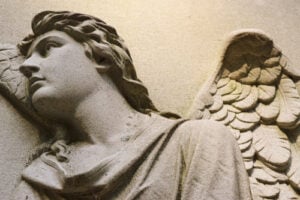
A carved stone angel on a grave at historic Mount Hope Cemetery in Rochester, New York. Photo: A.A. Gluckman / Shutterstock.com.
The names on cemetery stones can tell us things that do not always appear in history books. A president who spent his final years in the Capital Region, a writer who found inspiration in the Finger Lakes, a woman who escaped slavery and returned to fight for the freedom of others, and an inventor whose work changed aviation are all part of New York’s history. Their graves are scattered across cities, villages, and hillsides throughout Upstate New York. Some are visited regularly, while others remain largely unknown beyond the communities that maintain them.
Many of New York’s most remarkable cemeteries were established during the 19th-century rural cemetery movement. As growing cities ran out of room in churchyards and older burying grounds, civic leaders began setting aside larger tracts of land for burial. Rather than arranging every grave in a tightly packed grid, they created winding drives, wooded hillsides, ponds, and carefully placed monuments. These new cemeteries offered places to walk and reflect at a time when large public parks were still uncommon. Rochester, Buffalo, Albany, Syracuse, Troy, and smaller Upstate communities all participated in this change.
Not every burial ground on this list belongs to that movement. Kingston’s Old Dutch Churchyard reaches back to the colonial period, while the churchyard in Cooperstown provides a much more intimate setting for the grave of one of America’s earliest celebrated novelists. Other sites tell stories of the Erie Canal, the Civil War, the women’s rights movement, the beginnings of modern electrical power, and New York’s role in national politics.
The distinction between a famous person who lived in a town and one who is actually buried there is particularly important. This list identifies documented graves rather than merely associating well-known figures with nearby cemeteries. The burial places also give us an opportunity to look beyond famous names and appreciate the countless other people whose lives shaped these communities.
1. Mount Hope Cemetery, Rochester
Established in 1838, Mount Hope Cemetery is recognized as the country’s first municipally owned Victorian cemetery. The city chose a landscape of ridges, valleys, and glacial formations south of downtown Rochester, creating a burial ground that was also intended to be a peaceful public setting. The cemetery eventually expanded to approximately 196 acres. Its monuments, mausoleums, and tree-lined roads preserve nearly two centuries of Rochester history, including the lives of ordinary families who helped turn a canal town into an important industrial city.
Two graves receive particular attention. Frederick Douglass, the formerly enslaved abolitionist, orator, and newspaper publisher who made Rochester a center of his work, is buried here. So is Susan B. Anthony, a central figure in the campaign for women’s voting rights. Visitors have made a tradition of placing voting-related tributes near Anthony’s grave, especially during elections. Their presence in the same cemetery makes Mount Hope an exceptionally important site for understanding the struggles over freedom and citizenship in the United States.
2. Forest Lawn Cemetery, Buffalo
Forest Lawn opened in 1849, when Buffalo was becoming one of the most important commercial cities in the nation. Its landscaped grounds reflect the rural cemetery ideal, despite their location within the city. Buffalo’s canal commerce, industry, political life, and cultural history are all represented in the graves and monuments. The cemetery remains an active burial ground as well as a destination for historical research and guided tours.
The list of notable burials illustrates Buffalo’s remarkable range. Millard Fillmore, the 13th president of the United States, rests here, as does Shirley Chisholm, the pioneering congresswoman and presidential candidate who was born in Brooklyn and represented a New York City district. Chisholm is entombed in the Birchwood Mausoleum. Music fans can also visit the grave of Buffalo-born R&B and funk performer Rick James. Forest Lawn’s history extends well beyond any one figure, but these three individuals represent very different chapters of American life.
3. Albany Rural Cemetery, Menands
Albany Rural Cemetery was incorporated in 1841 and opened in 1844 on elevated land north of Albany. Its 467 acres of wooded slopes, curving roads, and elaborate family monuments exemplify the rural cemetery movement on an ambitious scale. Albany was the state capital and a major political center, and the cemetery eventually became the burial place of governors, cabinet officers, legislators, artists, and generations of Capital Region residents.
Its best-known grave belongs to Chester A. Arthur, the 21st president of the United States, who succeeded James A. Garfield after Garfield’s assassination in 1881. Arthur’s monument includes a bronze figure of an angel beside a dark stone sarcophagus. The cemetery also contains the graves of Kate Stoneman, the first woman admitted to practice law in New York State, and numerous Civil War soldiers. Albany Rural’s own maps and burial records make it possible to explore a much broader historical story than the presidential memorial alone.
4. Oakwood Cemetery, Troy
Oakwood Cemetery opened in the 19th century as Troy grew into a center of ironworking, manufacturing, and Hudson River commerce. Its wooded heights, monuments, and dramatic setting above the river reflect the prosperity of a city that once produced everything from industrial machinery to the detachable shirt collars for which it became famous. The cemetery also offers insight into the families whose businesses and institutions helped shape Troy and nearby communities.
The grave most closely connected with national folklore belongs to Samuel Wilson, the Troy meatpacker traditionally associated with the figure of Uncle Sam. During the War of 1812, Wilson supplied meat to the United States Army, and the story of his name becoming associated with government provisions contributed to the familiar patriotic character. The historical development of Uncle Sam is more complicated than a single origin story, but Wilson’s connection has been officially commemorated for generations. Oakwood continues to host remembrance ceremonies at his grave.
5. Oakwood Cemetery, Syracuse
Syracuse’s Oakwood Cemetery was established in 1859, when the city was growing rapidly because of the Erie Canal, railroads, and manufacturing. Its broad landscaped grounds now stand beside Syracuse University, making an unusual contrast between an active university neighborhood and a 19th-century burial landscape. The cemetery holds memorials to soldiers, civic leaders, architects, professors, and families whose names appear throughout Central New York history.
Among those buried here is Major General Edwin Vose Sumner, a career Army officer who served in the Mexican-American War and became one of the Union Army’s senior commanders during the Civil War. Sumner led the II Corps of the Army of the Potomac and participated in campaigns that included Antietam and Fredericksburg. He died in Syracuse in 1863 and was buried in Oakwood. The cemetery also contains the grave of Archimedes Russell, an architect closely associated with the buildings and streetscapes of Syracuse.
6. Fort Hill Cemetery, Auburn
Fort Hill Cemetery occupies a historically important rise above Auburn. The grounds are associated with an earlier Cayuga Nation fortified settlement, a reminder that the story of the land long predates the cemetery’s creation. The cemetery association was incorporated in 1851, and the grounds were dedicated in 1852. The site remains an active burial place, with historic monuments and a chapel that have made it one of the Finger Lakes region’s most significant places of remembrance.
Two extraordinary figures are buried here. Harriet Tubman escaped slavery, returned repeatedly to assist others seeking freedom, served the Union cause during the Civil War, and made her later home in Auburn. William H. Seward, the former governor of New York and Abraham Lincoln’s secretary of state, is also buried at Fort Hill. Seward played a leading role in opposing the expansion of slavery and later negotiated the purchase of Alaska. Their graves make Auburn an essential stop for anyone studying abolition, the Civil War, and the political history of New York.
7. Woodlawn Cemetery, Elmira
Elmira’s Woodlawn Cemetery reflects the history of a Southern Tier city that became closely connected with railroads, industry, and the Civil War. Its best-known literary connection comes from Samuel Langhorne Clemens, better known as Mark Twain. Clemens married Olivia Langdon, whose family lived in Elmira, and spent many summers in the area. He wrote portions of some of his most famous works during those visits, including time spent in the writing study at Quarry Farm.
Twain was buried in the Langdon family plot after his death in 1910. Woodlawn is also the resting place of Ernie Davis, the Elmira-raised football star who became the first Black recipient of the Heisman Trophy in 1961 while playing for Syracuse University. Davis died of leukemia in 1963 before appearing in a regular-season National Football League game. Their graves connect Elmira with two very different national stories: American literature and the breaking of racial barriers in major college athletics.
8. Lake View Cemetery, Jamestown
Lake View Cemetery in Jamestown began in the 19th century, as the growing Chautauqua County community needed additional burial space. Its monuments and family plots reflect Jamestown’s development as a manufacturing city and the home of generations of Western New Yorkers. The cemetery’s best-known visitor destination today is associated with one of the greatest performers in the history of television.
Lucille Ball, born in Jamestown in 1911, died in California in 1989. Her cremated remains were originally placed in California, but her family arranged for them to be moved to Lake View Cemetery in 2002. She now rests with members of the Ball family. That detail is important: Lake View is her final resting place, although she was not first interred there following her death. The grave draws fans who also visit Jamestown’s Lucille Ball Desi Arnaz Museum and National Comedy Center, institutions that preserve her influence on television and comedy.
9. Brookside Cemetery, Watertown
Brookside Cemetery provides a valuable North Country connection to New York’s early history. Burials on the grounds date to the opening years of the 19th century, when Watertown and Jefferson County were developing as settlements near Lake Ontario and the Black River. A historical marker documents the graves of at least 15 Revolutionary War veterans, an especially interesting fact for a cemetery in a region that became more extensively settled after the Revolution.
One of Brookside’s most prominent graves belongs to Roswell P. Flower, governor of New York from 1892 to 1894. Flower was a businessman and politician whose career took him from northern New York into state and national politics. The cemetery also includes several former members of Congress. Brookside shows that an important historical cemetery need not be located in one of the state’s largest cities to hold people who influenced New York’s development.
10. Lake View Cemetery, Ithaca
On the hills above Cayuga Lake, Ithaca’s Lake View Cemetery reflects the history of a college town whose identity became closely bound to education, research, and scientific inquiry. Its setting provides views over the Finger Lakes landscape and contains memorials to residents who helped build Ithaca’s civic and academic institutions. One burial in particular gives the cemetery a place in the history of modern science communication.
Carl Sagan, the astronomer, Cornell University professor, writer, and host of the television series Cosmos, is buried at Lake View Cemetery. Sagan helped explain astronomy and planetary science to audiences far beyond universities and research institutions. His work on space exploration, public understanding of science, and the search for life elsewhere in the universe gave him an international following. His grave in Ithaca connects that worldwide influence to the community where he spent much of his professional life.
11. Forest Hill Cemetery, Utica
Forest Hill Cemetery was incorporated in 1850 and occupies landscaped grounds above Utica, a city whose 19th-century fortunes were shaped by the Erie Canal, textiles, railroads, and manufacturing. Its cemetery association remains active, preserving a large burial landscape that includes the graves of civic leaders, military veterans, and figures from the Mohawk Valley’s political life.
Its most nationally prominent burial is James Schoolcraft Sherman, who served as vice president under William Howard Taft from 1909 until his death in 1912. Sherman had represented New York in the U.S. House of Representatives and maintained strong ties to his native Utica. He died while still in office, after having been nominated for another term. The cemetery also holds Horatio Seymour, a former governor of New York who was the Democratic presidential nominee in 1868. Few cemeteries so clearly reflect Utica’s former importance in national politics.
12. Vale Cemetery, Schenectady
Vale Cemetery was established in the 19th century and preserves the changing history of Schenectady, from earlier community burial grounds to the city’s later growth as a center of electrical manufacturing. The cemetery also has an important African American burial history. Its grounds offer an opportunity to consider not just famous industrial figures but the lives of people whose contributions to the city were not always adequately recorded or recognized.
One of Vale’s best-known graves is that of Charles Proteus Steinmetz, the mathematician and electrical engineer whose work at General Electric helped advance the understanding and practical use of alternating-current electrical systems. Steinmetz became one of Schenectady’s most recognizable scientific figures and also taught at Union College. He died in 1923 and was buried at Vale. His grave links the city’s industrial identity to the scientific principles that transformed electrical power in homes, workplaces, and transportation.
13. Old Dutch Churchyard, Kingston
Kingston’s Old Dutch Churchyard belongs to a much earlier period than the great Victorian rural cemeteries. Located in the historic Stockade District, the burial ground reflects the city’s Dutch colonial heritage and its role in the American Revolution. Many gravestones predate the 19th century, and the churchyard’s compact setting gives visitors an unusually direct view of early Hudson Valley history.
One of the most important graves is that of George Clinton, New York’s first elected governor and later vice president under both Thomas Jefferson and James Madison. Clinton died in Washington in 1812 and was initially buried in the capital. His remains were brought to Kingston in 1908 and reinterred in the Old Dutch Churchyard, along with the monument that had marked his Washington grave. The church’s own historical chronology documents the transfer, an important detail because Clinton was not originally buried in Kingston.
14. Oswego Rural Cemetery, Town of Oswego
Oswego Rural Cemetery should not be confused with Riverside Cemetery, another historic burial ground in the Oswego area. Rural Cemetery lies on Cemetery Road in the Town of Oswego, with burials documented as early as 1820. Its history extends into the years before the Erie Canal transformed regional commerce and before Oswego became a major port on Lake Ontario. A historical marker records the graves of two Medal of Honor recipients on the grounds.
The most famous is Dr. Mary Edwards Walker, the Civil War surgeon, women’s rights advocate, and reformer who remains the only woman awarded the Medal of Honor. Walker served in difficult and dangerous circumstances during the war and was held prisoner by Confederate forces. She later fought for voting rights and dress reform, refusing to accept many of the conventions imposed on women of her time. She died in 1919 and was buried in her home region at Oswego Rural Cemetery. Her burial location is documented by the National Park Service and local historical organizations.
15. Cortland Rural Cemetery, Cortland
Cortland Rural Cemetery was established in 1853 and preserves an important portion of the city’s 19th- and 20th-century history. Located along Tompkins Street, it contains the graves of veterans, teachers, business owners, political figures, and local families. The cemetery also has distinguished funerary architecture, including the Gibson Memorial Chapel, and maintains historical material about the people buried there.
One of its best-known burials is Nathan L. Miller, governor of New York from 1921 to 1922. Born in Cortland County, Miller worked as a teacher and lawyer before rising through the state’s judiciary and entering politics. He defeated Al Smith in the 1920 gubernatorial election, although Smith returned to win the office two years later. Miller’s burial at Cortland Rural Cemetery is documented by the cemetery itself. The 1904 Democratic presidential nominee Alton B. Parker, sometimes incorrectly associated with this cemetery, is buried in Wiltwyck Cemetery in Kingston.
16. Spring Forest Cemetery, Binghamton
Spring Forest Cemetery was established in 1849 as Binghamton was expanding into an important Southern Tier commercial and manufacturing center. Its wooded grounds and historic monuments record the city’s 19th-century rise. Among those buried there are politicians, military officers, architects, and members of families connected with the region’s industrial growth. Its distinctive entrance gates were designed by architect Isaac G. Perry, who is himself buried in the cemetery.
Perry became one of the state’s notable 19th-century architects, associated with major public buildings and the monumental work on the New York State Capitol. Another significant burial is Daniel S. Dickinson, the former lieutenant governor of New York and United States senator whose career extended into the Civil War era. Spring Forest also contains the grave of Union general and Medal of Honor recipient John C. Robinson. Aviation pioneer Edwin Link is strongly associated with the Binghamton region, but his burial is at Vestal Hills Memorial Park rather than Spring Forest.
17. Hamilton College Cemetery, Clinton
In the village of Clinton, the cemetery associated with Hamilton College preserves the graves of faculty members, family members, and others connected to one of New York’s oldest institutions of higher education. It should be distinguished from the nearby Sunset Hill Cemetery on Franklin Avenue. The college burial ground has a particularly important connection to American diplomacy through a member of the Root family.
Elihu Root, born in Clinton in 1845, served as U.S. secretary of war, secretary of state, and senator from New York. His diplomatic and international-law work earned him the Nobel Peace Prize in 1912. Root died in 1937 and was buried in Hamilton College Cemetery, where other members of his family also rest. His grave offers a reminder that this small Oneida County community contributed a figure of international importance to American public life.
18. Woodlawn Cemetery, Canandaigua
Woodlawn Cemetery in Canandaigua preserves the history of Ontario County and the early Finger Lakes community that developed around the courthouse, lake, and surrounding farms. Its plots include families whose members helped shape politics and commerce in the years after American independence. The Granger family is especially important to that history.
Gideon Granger served as U.S. postmaster general under Presidents Thomas Jefferson and James Madison, making him a key administrator during the rapid growth of the early republic’s postal system. After his federal service he settled in Canandaigua and entered New York politics. He died in 1822, before Woodlawn Cemetery was established; later burial records document his reinterment there. His son Francis Granger, who also served as postmaster general, is buried in the cemetery. The family plot connects the history of Canandaigua with the development of national communications and government.
19. Greenridge Cemetery, Saratoga Springs
Greenridge Cemetery opened in 1844 and grew as Saratoga Springs developed into a destination known for mineral springs, hotels, racing, and summer visitors. The burial ground contains early village families as well as writers, judges, reformers, and people associated with the city’s racing culture. Its old section includes memorials that document a period when Saratoga was becoming nationally prominent.
One of the people buried here is Charles F. Dowd, the educator who became an early and influential advocate for standardized time in North American railroad operations. At a time when communities used local solar time, the growth of rail travel created practical problems for timetables and connections. Dowd’s proposals helped advance the idea of uniform time zones, although the system’s eventual adoption involved many contributors. Greenridge also contains the graves of members of the racing and civic communities, making it a record of more than Saratoga’s fashionable public image.
20. Historic St. Agnes Cemetery, Menands
St. Agnes Cemetery in Menands is an important Catholic burial ground in the Albany area, reflecting the religious and immigrant history of the Capital Region. Its monuments and mausoleums commemorate families, clergy, veterans, and public officials. The cemetery is distinct from nearby Albany Rural Cemetery, despite the fact that both are associated with many well-known figures in state politics.
Among the most notable people buried at St. Agnes is Martin H. Glynn, governor of New York from 1913 to 1914. Glynn had served as lieutenant governor and succeeded William Sulzer after Sulzer’s removal from office through impeachment proceedings. He was also a journalist and a prominent figure in New York Democratic politics. St. Agnes contains the graves of other civic leaders, but Glynn’s story is particularly revealing because it connects the cemetery to one of the state’s most turbulent political transitions.
21. Cold Springs Cemetery, Lockport
Cold Springs Cemetery in Lockport traces its burial history to the early 19th century and was incorporated in 1841. The cemetery’s monuments reflect the growth of Niagara County and the extraordinary changes brought by the Erie Canal. Lockport itself became an engineering landmark because of the locks that helped vessels climb the Niagara Escarpment, and the cemetery preserves the memory of people involved in that era.
Among those buried here is Jesse Hawley, whose newspaper essays were an early and important argument for building a canal across New York State. Writing under the name Hercules in the early 1800s, Hawley offered ideas about a canal linking the Hudson River with Lake Erie. He was not the only advocate or designer of the Erie Canal, but his proposals became part of its intellectual history. The cemetery also contains the graves of jurist Cuthbert W. Pound and World War II Medal of Honor recipient William F. Leonard. Former governor Washington Hunt is buried at a different Lockport cemetery, Glenwood.
22. Glenwood Cemetery, Homer
Glenwood Cemetery in the village of Homer is one of Cortland County’s important 19th-century burial grounds. Its wooded setting and monumental stones reflect the lives of families who contributed to the region’s agricultural, educational, and cultural development. The cemetery is listed on the National Register of Historic Places, with its significance extending beyond individual memorials to the history of the community itself.
The grave of Francis Bicknell Carpenter gives Glenwood a notable connection to the presidency of Abraham Lincoln. Born in Homer in 1830, Carpenter was the painter of First Reading of the Emancipation Proclamation of President Lincoln, which depicts Lincoln presenting the proclamation to members of his Cabinet. Carpenter spent time in the White House while developing the painting and later wrote about that experience. He died in New York City in 1900 and was buried in Glenwood Cemetery. The National Register documentation identifies his grave in Section 14.
23. Mount Albion Cemetery, Albion
Mount Albion Cemetery was developed in the 1840s on elevated land near the Orleans County village of Albion. Its entrance, monuments, and prominent Civil War memorial make it an important example of the rural cemetery tradition in Western New York. The cemetery was added to the National Register of Historic Places in 1976, recognizing its landscape and historical significance.
One of its most unexpected graves belongs to Rufus B. Bullock, who served as governor of Georgia during Reconstruction after the Civil War. Bullock was a Republican whose administration was associated with the deeply contested efforts to rebuild Georgia’s political system and extend legal rights to formerly enslaved people. He later lived in Albion and was buried at Mount Albion following his death in 1907. A guide produced by Georgia’s historic preservation authorities documents his resting place, underscoring how a cemetery in a small New York village can be connected with major events far beyond the state.
24. Christ Churchyard, Cooperstown
Christ Churchyard in Cooperstown is smaller and older in character than the expansive rural cemeteries found in many Upstate cities. Located in the village closely associated with Otsego Lake and the Cooper family, the churchyard preserves an unusually direct link between local history and early American literature. Its most famous burial is that of the novelist whose work made the surrounding region known to generations of readers.
James Fenimore Cooper died in Cooperstown in 1851 and was buried in the family plot at Christ Church. His novels, including The Last of the Mohicans and The Pioneers, helped establish American frontier fiction and drew on places and events associated with New York’s early history. Cooper’s portrayals of Native Americans and the frontier have also been criticized and reassessed by later historians and literary scholars. The Library of Congress preserves an early book devoted specifically to his grave and the churchyard, demonstrating how the site became a destination for literary visitors long ago.
25. Poughkeepsie Rural Cemetery, Poughkeepsie
Poughkeepsie Rural Cemetery opened in 1853 as the Hudson Valley city sought an alternative to crowded older burial grounds. The cemetery became a landscaped setting of winding roads, hills, and historic monuments. One of the men who helped organize it was Matthew Vassar, a successful brewer and businessman who later founded Vassar College. The cemetery’s own historical records explain his role in the early planning of the site.
Vassar is buried here with members of his family. His founding of Vassar College helped expand opportunities for women’s higher education in the 19th century, giving his grave an importance that reaches well beyond Poughkeepsie’s business history. The cemetery also holds Smith Thompson, a former U.S. Supreme Court justice and secretary of the navy, and members of the family behind Smith Brothers cough drops. Few places provide such a concise view of the people who contributed to the Hudson Valley’s commercial, legal, and educational history.
Why These Historic Cemeteries Matter
These burial grounds preserve far more than a list of notable names. Their monuments tell stories of changing religious traditions, immigration, wealth, war, epidemics, industrial growth, political conflict, and social reform. Some of the most significant graves belong to people who challenged the conventions of their time, while others commemorate figures whose contributions remain controversial or whose influence has been reassessed over the years.
Anyone visiting should remember that these are active places of burial, not simply historical attractions. Many are maintained by cemetery associations, local governments, churches, and volunteers. Visiting respectfully, checking access rules, and taking the time to read the surrounding monuments can reveal more about a community than stopping at its best-known grave alone.
For more on the history of the people and communities represented in these cemeteries, explore our articles on 25 famous people from Upstate New York, famous writers from Upstate New York, and famous women from Upstate New York.