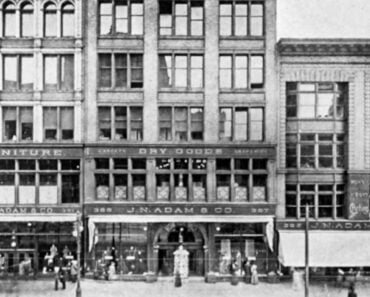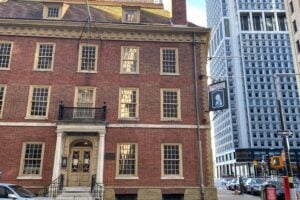
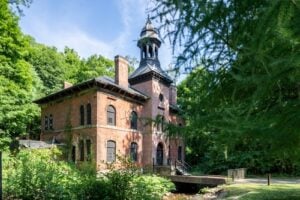
The surviving historic office building at West Point Foundry Preserve in Cold Spring, New York. The foundry was once a major center of American iron manufacturing. Photo: TW Farlow Media / Shutterstock.com.
Stand beside the Hudson River today and it is easy to think of mountains, bridges, riverfront parks, and the towns spread along its banks. Two centuries ago, the view would have been very different. Large icehouses stood near the shoreline. Brickyards covered acres of riverfront land. Barges carried cargo past factories and foundries, and river landings were crowded with workers moving stone, lumber, coal, and goods bound for New York City. The Hudson was not simply a scenic river. For many communities, it was their working waterfront and their connection to a national economy.
Some of the industries that once depended on the Hudson seem almost unimaginable now. Before household refrigerators became common, workers cut ice from the river each winter and stored it for sale during the summer. The city of Hudson sent ships to hunt whales in the Atlantic. Troy made enormous quantities of detachable shirt collars, bells, and iron horseshoes. Near Kingston, boats loaded Pennsylvania coal and left the Delaware and Hudson Canal. These were substantial businesses that employed people, shaped neighborhoods, and sometimes permanently changed the landscape.
Their decline did not happen all at once, and no single factor explained it. Mechanical refrigeration undercut natural ice harvesting. Railroads and trucks displaced older forms of freight transportation. New materials and changing fashions reduced demand for products that had once supported entire factory districts. Pollution and depleted fish populations led to the closing of historic Hudson fisheries. In several places, the industry’s environmental costs became impossible to ignore.
The title makes an important distinction. The 25 entries below describe particular historical industries or ways of working that have vanished from the Hudson River corridor, not necessarily products or activities that have disappeared everywhere. People still quarry stone in New York, and boats still carry passengers on the Hudson. What ended was the large-scale industrial system that once made these activities defining features of the river’s economy. Some surviving buildings and museum sites help us understand what was lost.
1. Natural Ice Harvesting
Historic center: Mid-Hudson River, including Staatsburg and communities north of Poughkeepsie.
Before electric refrigerators and modern cold storage, natural ice was a commercial necessity. When the Hudson’s freshwater reached deep enough to freeze, workers scored the surface, cut large blocks, and moved them along channels or wooden conveyors into insulated riverside icehouses. Teams of horses helped haul the heavy ice before machinery took over some of the work. The cutting season was short, but they could store an entire year’s inventory beneath insulating material and dispatch it to markets when the weather warmed.
New York State Parks documents substantial Hudson River harvesting from roughly 1840 to 1920, particularly north of Poughkeepsie. People transported ice to New York City, where households, restaurants, and food businesses needed it. The trade provided seasonal employment for people who worked in farming or brickmaking during warmer months. Manufactured ice and mechanical refrigeration eventually ended the river’s role as a major ice supply. Icehouses and winter fleets of workers disappeared, though photographs preserve the business’s extraordinary scale.
2. Hudson River Brickmaking
Historic center: Haverstraw, Kingston, and other riverfront brickyard communities.
The clay deposited along the Hudson helped create one of the river’s best-known industries. Workers dug the deposits, molded or pressed bricks, dried them, fired them in kilns, and loaded the finished product onto barges. Haverstraw became especially associated with the trade, while Kingston and other ports supplied enormous quantities of building material. Demand increased as New York City expanded and builders sought masonry construction after devastating urban fires.
The brickyards also left a costly legacy. In Haverstraw, years of excavation contributed to the catastrophic ground collapse of January 1906, which killed residents and exposed the dangers of mining beneath a growing community. The industry later declined as building methods, manufacturing economics, and transportation changed. The shoreline once crowded with brick pits, sheds, kilns, and barges no longer supports that historic network. Riverfront ruins and museum collections preserve evidence of the trade.
3. Ocean Whaling from Hudson River Ports
Historic center: Hudson, Newburgh, and Poughkeepsie.
A person standing in Hudson today might not guess that the Columbia County city once financed ocean whaling voyages. Merchants with New England maritime connections established a whaling business there in the late 18th century. In the 1830s, investors in Poughkeepsie and Newburgh also outfitted ships that traveled down the Hudson and out into the Atlantic. Their destination was not the Hudson River itself: the towns served as home ports for voyages across the open ocean.
Whale oil was valuable for lighting and industrial uses, and whalebone had a variety of commercial applications. But voyages demanded large investments and could take long periods to return a profit. The Hudson River Maritime Museum documents the brief burst of Newburgh and Poughkeepsie whaling enterprises in the 1830s and their vulnerability to falling oil prices. This river-based branch of the Atlantic whaling business eventually ended, leaving an unexpected chapter in Hudson Valley maritime history.
4. Commercial Shad Fishing
Historic center: Tidal Hudson River, from its lower reaches toward Albany.
Each spring, American shad returned from the Atlantic to spawn in the Hudson. Fishing families built seasonal routines around that migration, setting nets, tending boats, cleaning fish, and selling fresh shad and shad roe. Commercial camps and riverside markets helped turn a seasonal natural event into a recognized trade. Shad fishing was also part of a much older food history, long predating the establishment of industrial fisheries.
The Hudson stock declined under pressures that included commercial harvest, habitat changes, and other environmental stresses. New York’s Department of Environmental Conservation closed both commercial and recreational American shad fishing in the Hudson in 2010. The closure remains in place, and the agency continues to monitor the population. Shad still exist in the river; it is the once-familiar commercial fishery that has disappeared. The distinction matters because the goal of protection is recovery, not the disappearance of the species.
5. Commercial Sturgeon Fishing and Caviar Production
Historic center: Hudson River, especially its middle and upper tidal reaches.
Atlantic sturgeon were once caught in the Hudson for meat and eggs, with the meat famously known as “Albany beef.” These fish can live for decades and take many years to reach reproductive maturity. That biology made them particularly vulnerable to heavy harvesting. Riverside fishing camps once handled large sturgeon, and both their flesh and caviar had commercial value.
The fishery’s decline was prolonged and damaging. New York and other Atlantic coastal jurisdictions imposed protections as concern grew over depleted populations; a coastwide commercial-fishing moratorium began in 1998. New York’s current rules prohibit recreational and commercial harvest of Atlantic and shortnose sturgeon in the Hudson River. Sturgeon continue to use the river, and conservation work remains important. What vanished was the legal commercial business that once supplied meat and caviar to markets.
6. Original Rosendale Natural Cement Manufacturing
Historic center: Rosendale and Rondout Creek, Ulster County.
The limestone formations around Rosendale supported a distinctive natural cement industry beginning in the 1820s. Workers quarried cement rock, burned it in kilns, ground the product, and packed it for transport. Rondout Creek and the Delaware and Hudson Canal gave the manufacturers access to larger markets. Rosendale natural cement became associated with major 19th-century construction projects, including public works that demanded material capable of hardening reliably under difficult conditions.
The original industry declined as Portland cement became the dominant general-purpose building material. According to the historical chronology maintained by a present-day natural-cement producer, the last of the original Rosendale mining operations closed in 1970. There is an essential qualification: production of authentic natural cement was revived in 2004 for specialized restoration work. The enormous original mining and manufacturing industry is gone, but the material itself has not become extinct.
7. Commercial Freight Carried by Hudson River Sloops
Historic center: Albany-to-New York City trade and river towns along the route.
For generations before steamboats were common, the Hudson’s distinctive single-masted sloops hauled passengers and freight between river communities and New York City. The vessels followed a design adapted to local conditions, using the wind and tide rather than engines. A favorable passage could be relatively quick, but a trip could also be delayed for days. Sloops carried farm produce, livestock, hay, stone, timber, and other cargo that helped supply the growing city.
Steamboats attracted passengers and time-sensitive goods first, while sail remained economical for heavy freight. The Hudson River Maritime Museum documents sailing vessels still carrying bulky stone into the late 19th century. Eventually steam towing, railroads, and later motor freight replaced the old commercial system. Historic sailing vessels survive for education and recreation, but the everyday business of moving regional cargo under sail no longer defines the river.
8. Hemlock Bark Tanning
Historic center: Catskill foothills and tributary valleys, especially Greene and Ulster counties.
The forests west of the Hudson once provided one of the essential ingredients in leather production: tannin from hemlock bark. Bark peelers and teamsters worked among the Catskill trees, moving loads to tanneries where the material was processed and used to treat animal hides. The resulting leather went into shoes, harnesses, belts, and other goods. Access to stream water, timber, and transport routes helped establish sizable tanning operations in mountain communities.
The industry transformed the landscape. Trees were felled or stripped, streams received tannery waste, and settlements grew around the mills. Scenic Hudson documents the first commercial tannery in Greene County in 1817 and the subsequent spread of the trade. As accessible hemlock stands were exhausted and new chemical methods became economical, the old bark-based system receded. The trade’s decline is part of both the industrial and environmental history of the Catskills.
9. Cannon and Heavy-Iron Production at West Point Foundry
Historic center: Cold Spring, Putnam County.
Cold Spring developed around a manufacturing enterprise whose products reached well beyond the Hudson Valley. Established in the late 1810s, the West Point Foundry made heavy iron equipment and military ordnance. The nearby river made it possible to ship large, heavy castings, while a local stream provided power. During the Civil War, the factory became especially associated with Parrott rifled cannon, which were used by Union forces.
The foundry also manufactured locomotives, engines, and other industrial products. It operated for much of the 19th century before financial decline culminated in bankruptcy in 1911. The site is now protected as West Point Foundry Preserve, where industrial foundations, remnants, and interpretation help visitors understand the huge operation that once occupied the valley. Ironworking continues elsewhere, but the particular Cold Spring industrial complex disappeared.
10. Wooden Steamboat and Barge Construction
Historic center: Newburgh, Rondout Creek, Kingston, and neighboring ports.
The river’s busy transportation business required boats of every kind. Shipyards built or repaired wooden steamboats, towboats, canal boats, and cargo barges along accessible waterfronts. Newburgh and Rondout were important centers, providing work for carpenters, shipwrights, caulkers, machinists, and laborers. The Hudson also became an early proving ground for commercial steam navigation after Robert Fulton’s North River Steamboat made its famous 1807 voyage to Albany.
The original Fulton boat should not be confused with the later name “Clermont,” which became a popular shorthand. Locally, shipbuilding families and yards sustained a distinct industry across much of the 19th and early 20th centuries. The Hudson River Maritime Museum documents the Marvel family’s Newburgh shipbuilding work from the 1830s into the 1940s and the varied yards of Rondout Creek. Steel construction, changing vessel designs, and reduced local demand ended the older wooden-boat manufacturing landscape.
11. Detachable Shirt Collars and Cuffs
Historic center: Troy, Rensselaer County.
Troy earned the name “Collar City” because it became a national center for detachable shirt collars and cuffs. These articles allowed a wearer to replace or launder the parts of a shirt most likely to become dirty without washing the entire garment. As production expanded in the 19th century, collar factories and laundries occupied major sections of Troy’s commercial and industrial districts.
Women performed much of the sewing, washing, starching, and ironing, frequently under difficult working conditions. That labor history is inseparable from the success of the industry. Hudson Mohawk Industrial Gateway reports that Troy’s textile factories accounted for more than 90 percent of American collar and cuff production in the late 19th century. Changes in men’s clothing and the adoption of attached collars eventually made the old product obsolete. Many factory buildings were reused, but the trade that gave Troy its nickname disappeared.
12. Commercial Church-Bell Casting
Historic center: Troy and Watervliet, opposite banks of the upper Hudson.
Bellfounders once shipped bronze bells from the upper Hudson to churches, schools, civic buildings, and institutions across the country. The best-known name was Meneely, but there were separate Meneely foundries in Watervliet and Troy. Andrew Meneely began his bell business in what became Watervliet in 1826; another branch of the family established a competing firm across the river in Troy decades later.
Making large bells required skilled patternmaking, metal casting, tuning, and substantial equipment. The finished objects could outlive their manufacturers by many generations. New York State Library archival records document the Troy company’s business, and local industrial historians trace the region’s bellmaking into the mid-20th century. The great foundries eventually closed, leaving bells still heard in distant communities and some surviving industrial records in the Capital Region.
13. Destructive Quarrying of the Palisades
Historic center: Lower Hudson River cliffs in New York and New Jersey.
The Palisades are now so closely associated with protected river scenery that it is difficult to imagine explosives tearing into the cliffs. During the 19th century, quarry operators extracted hard trap rock for construction and railroad use. Barges offered convenient access to the metropolitan market, while blasted rock faces permanently altered sections of the dramatic Hudson River escarpment.
The quarrying controversy helped mobilize a conservation movement. Civic groups and lawmakers in New York and New Jersey cooperated to protect the cliffs, and the Palisades Interstate Park Commission was established in 1900. The commission and later donors helped end the worst quarrying threats. Stone extraction certainly continues elsewhere, but the earlier commercial destruction of the protected Palisades cliffs was stopped through organized preservation.
14. Large-Scale Felt Hat Manufacturing
Historic center: Beacon, formerly Fishkill Landing and Matteawan, Dutchess County.
Beacon’s modern reputation as a place of art galleries and shops conceals an earlier identity as an industrial hat-making center. Beginning in the 1860s, factories in the communities that later formed Beacon manufactured large quantities of felt hats. Fishkill Creek furnished water and power, while rail connections carried the finished products to regional and national markets. The trade employed hundreds of people in individual plants and became an important part of local working life.
Scenic Hudson and the Beacon Historical Society document the growth of nearly 50 hat factories at the industry’s height. Some of the processing methods exposed workers to dangerous chemicals, including mercury compounds used in felting. Shifts in fashion, production, and industrial organization gradually undermined the business. The old Tioronda Hat Works and other former factory sites preserve traces of a trade that once shaped Beacon far more visibly than its modern cultural identity does.
15. Commercial Oyster Harvesting in the Lower Estuary
Historic center: Upper New York Bay and tidal waters at the Hudson’s mouth.
Long before New York was an international metropolis, oysters were abundant in parts of its harbor and tidal estuary. Indigenous communities harvested shellfish, and later commercial watermen supplied a growing city with oysters from nearby beds. Ellis and Liberty islands were historically grouped among the “Oyster Islands,” a name that speaks to the scale of the natural resource in these waters.
The old commercial beds near the densely settled waterfront suffered from contamination, overharvesting, filling, and other changes to the estuary. The National Park Service preserves the history of the Oyster Islands and their shellfish habitat. Modern oyster-reef restoration projects are about recovering ecological benefits, not automatically reopening a commercial food harvest in polluted waters. This entry concerns the old local oyster-dredging business at the mouth of the Hudson, not every oyster operation elsewhere in New York.
16. Water-Powered Cotton Textile Mills
Historic center: Cohoes at the Mohawk-Hudson confluence and other tributary mill towns.
The Hudson’s tributaries helped turn water power into industrial labor. At Cohoes, the power of the Mohawk River drove an enormous cotton-textile manufacturing complex whose buildings dominated the city. Harmony Mills became one of the country’s most important cotton factories in the decades after the Civil War, employing thousands of workers and placing a great deal of the city’s economic life under the control of one industrial enterprise.
The National Park Service identifies Harmony Mill No. 3, completed in 1872, as one of the world’s largest individual cotton factories of its day. The industry’s growth also produced difficult labor conditions and struggles over wages and employer control. Cotton manufacturing eventually receded from Cohoes as the economics of textile production shifted. Historic mill structures survive, but the old water-powered factory economy no longer runs the city.
17. Cement-Barrel Cooperage and Wooden Hoop Making
Historic center: Rosendale, Rondout Creek, Kingston, and supply villages.
When Rosendale cement traveled to market in the 19th century, it was commonly packed in wooden barrels. Those barrels did not appear by themselves. Cooperages employed workers who assembled staves, fashioned heads, and fitted hoops that held the container together. The business linked timber supplies, small wood-product shops, and the enormous cement plants that shipped through Rondout Creek.
An account preserved by the Hudson River Maritime Museum describes a Rosendale-area cement company whose cooperage was equipped to turn out about 1,000 barrels a day. The barrel trade helps explain the less glamorous supporting businesses behind major industrial production. Changes in packaging and transportation, together with the decline of the original cement industry, ended this large-scale specialized cooperage. Wooden barrels are still made for other uses; the lost business was the Hudson Valley’s industrial cement-barrel supply system.
18. Cast-Iron Stove Manufacturing
Historic center: Troy and the upper Hudson industrial district.
Long before central heating transformed American homes, cast-iron stoves were household essentials. Troy had an unusually large concentration of stove foundries, which produced heating and cooking equipment for markets far beyond New York. Foundries required skilled molders, patterns, iron supplies, furnaces, and a reliable way to distribute heavy finished goods. The Hudson and regional railroads helped manufacturers send stoves to distant customers.
A history of Troy published in 1891 documented the rise of the city’s stove works from the 1820s and the scale of their output later in the century. A federal historic-preservation summary also identifies stove manufacturing as a major part of Troy’s industrial identity. Those individual foundries and the citywide stove-making concentration disappeared as production and heating technology changed. The story is distinct from Troy’s collar trade and its manufacture of horseshoes.
19. Delaware and Hudson Canal Coal-Boat Operations
Historic center: Rondout Creek, Kingston, and the canal corridor toward Pennsylvania.
The Delaware and Hudson Canal connected Pennsylvania coal districts with the Hudson River at Rondout Creek. Beginning in 1828, canal boats moved coal and other freight toward the river, where cargo could be transferred for shipment to New York and other markets. The business required lock tenders, boat crews, towpath laborers, dockworkers, and vessels adapted to the narrow canal.
Rondout grew into a busy commercial port because of this traffic. The Hudson River Maritime Museum documents the canal’s main period of operation through 1898, with limited later traffic continuing on a section that served cement interests until 1917. Rail transportation displaced much of the canal’s freight business, and the old coal-boat traffic ended. Sections of the route can still be traced, but its economic role cannot be recreated by looking at the surviving waterway alone.
20. Machine-Made Horseshoe Manufacturing
Historic center: South Troy, Rensselaer County.
Henry Burden transformed the horseshoe from a labor-intensive blacksmith product into one manufactured by machinery on an enormous scale. His works along the Wynantskill and Hudson rivers used specialized machines, furnaces, and an immense waterwheel to produce goods for expanding transportation and military markets. The Civil War created extraordinary demand for the horseshoes needed by Army animals, and Troy became a major supplier.
Hudson Mohawk Industrial Gateway documents Burden’s mechanical advances and a complex that eventually employed nearly 2,000 people. The company continued into the 20th century, but changes in metal production, transportation, and the demand for horse-powered work undermined the business. The iron operation passed through new ownership and eventually ceased. Burden’s surviving office building houses a museum; the industrial horseshoe works surrounding it are gone.
21. Charcoal Production for Iron Furnaces
Historic center: Hudson Highlands and forested areas feeding valley ironworks.
The earliest iron furnaces needed enormous quantities of fuel, and charcoal made from wood was a practical solution where forests were abundant. Charcoal burners, often called colliers, stacked wood in carefully managed piles or kilns and restricted the air reaching the burning material. The resulting charcoal was lighter than the original wood and useful in smelting and forging iron, but the process consumed large quantities of timber and demanded close attention.
The Hudson Highlands and other wooded parts of the valley supplied charcoal to ironworks before coal and coke became more economical in many industrial settings. Hudson Mohawk Industrial Gateway documents charcoal’s place among the fuels of the early Troy iron industry. The old furnace-supply system eventually disappeared as technology and fuel sources changed. This does not mean charcoal itself is no longer produced; it means the once-important woodland trade supplying the region’s historic iron furnaces ended.
22. Shawangunk Millstone Quarrying
Historic center: Shawangunk Ridge and Delaware and Hudson Canal connections.
The hard, quartz-rich rock of the Shawangunk Ridge was suited to an industry very different from ordinary building stone. Workers cut and shaped millstones that were used to grind grain, relying on rock that could withstand sustained abrasion. Quarrying was physically difficult, and the finished stones had to be moved from hillsides to transport routes before they could be sold to mill operators.
The New York State Museum identifies Shawangunk millstone quarrying as a significant 19th-century industry and notes that stones were shipped by the Delaware and Hudson Canal. Quarry pits can still be found on the ridge. As milling technology changed and manufactured alternatives became common, the market for hand-quarried millstones disappeared. The scars in the rock are reminders of a trade that made the ridge an industrial resource as well as a dramatic natural landmark.
23. Gunpowder Milling Along Hudson Tributaries
Historic center: Schaghticoke, Tomhannock Creek, and the Hoosic River valley.
Gunpowder mills required water power, specialized machinery, and distance from dense settlements because an accident could be devastating. In the upper Hudson watershed, the Masters family established a powder works in the Schaghticoke area during the War of 1812. The business supported other local trades, including keg making, and drew workers to sites near the Tomhannock and later the Hoosic River.
Research by the Schaghticoke town historian traces the local powder business through changes of ownership and location, while the town’s own historical account confirms the importance of water-powered powder mills. The trade experienced repeated explosions, and the historic Schaghticoke operation closed in the 20th century. Its story is an especially clear example of why a lost industry may have disappeared for reasons involving danger, changing industrial control, and new technologies rather than simply a shortage of customers.
24. Hudson River Day Line Passenger Steamboats
Historic center: New York City, West Point, Poughkeepsie, Kingston, and Albany routes.
The Hudson River Day Line offered a form of travel that was part transportation and part excursion. Large passenger steamboats carried travelers past the Highlands, historic houses, towns, and mountains that had attracted tourists for generations. Passengers could spend hours on deck taking in the river scenery while going to a scheduled destination. The line became a well-known institution in the age before private automobiles reshaped recreational travel.
Improved roads, cars, and changing vacation habits weakened the market for large scheduled river steamers. The Hudson River Maritime Museum dates the end of the Day Line’s Hudson service to 1971, when Circle Line purchased the business. Other passenger boats and modern cruises continued, but the celebrated fleet and its regular day-trip system did not. This entry is about a particular vanished form of Hudson River passenger service, not the disappearance of boating for tourists.
25. Traditional Water-Powered Gristmills and Riverborne Flour Trade
Historic center: Hudson tributary towns and historic grain-shipping landings.
The small gristmill once stood at the center of many Hudson Valley farming communities. Grain growers brought wheat, corn, or other crops to mills on streams where waterwheels turned the stones that ground grain into flour or meal. The mills let families turn harvests into usable food or goods they could sell. For towns connected with the river, barrels of flour and other agricultural products could then move toward regional markets.
The Hudson River Maritime Museum’s account of early cargoes shows how important agricultural products were, carried south by the river’s sailing vessels. Later, larger industrial mills, rail transport, shifting agricultural patterns, and modern milling equipment reduced the small water-powered gristmill’s role and its direct river trade. Some historic mills survive as museums or preserved machinery, and milling itself certainly continues elsewhere. What vanished was the old valleywide system of local waterwheel mills feeding a busy river freight economy.
Why the Hudson River’s Industrial Landscape Changed
What united these businesses was access to water. Sometimes the river carried heavy cargo more cheaply than a road could. Sometimes tributary streams powered machinery. Sometimes the river or its surrounding land supplied the raw material itself. The same advantages could become liabilities as technology changed, markets moved, workers faced dangerous conditions, or pollution damaged the resource on which a trade depended.
It would be a mistake to say that the Hudson is no longer a working river. Modern transportation, industry, and restoration efforts are all part of its present life. But the old icehouses, waterfront brickyards, whaling investors, machine-made horseshoe plants, and scheduled passenger steamboat lines belonged to a particular industrial world that is no longer here. Understanding that world helps explain the buildings, ruins, changed shorelines, and communities that remain.