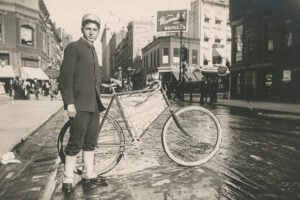
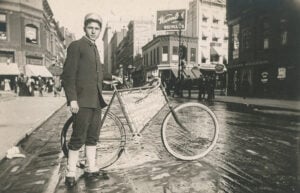
A young messenger boy stands beside his bicycle on a New York City street in 1896, when telegram delivery was an important part of urban communication. Photograph by Alice Austen. From The New York Public Library.
If you have been to New York City lately, especially in Manhattan, you will notice that the streets are filled with bike lanes. These lanes, originally built to help people cycle through the city, have also become crowded with food-delivery workers. In fact, it’s mostly food-delivery workers. And let me tell you something: I am more fearful of being hit by these bicycle delivery riders than by a car or a bus. A lot of them don’t even pay attention to the lights. Sometimes I feel like I’m in Amsterdam, and if you’ve been there, you know what I’m saying. Nonetheless, many, many years ago, the streets were also filled with cyclists, but they weren’t delivering food. They were delivering telegrams.
Before the telephone became a fixture in American homes, and long before anyone could send a text message, a telegram could bring important news across the country in hours, sometimes much faster. The message traveled over wires, but someone still had to deliver the printed words to the recipient. In New York City, a young messenger working for Western Union or a competing telegraph company often made that final part of the journey. Some rode bicycles; others covered their assigned neighborhoods on foot.
The messenger boys became a familiar sight in the streets of old New York. Their uniforms and caps identified them as employees of a communications business that connected offices, merchants, families, and distant cities. They carried everything from ordinary business instructions and congratulations to news that families dreaded receiving. What they delivered could be important, but the boys themselves were usually among the youngest and lowest-paid workers in the system.
How the Western Union Messenger System Worked
Western Union grew out of the rapid expansion of electric telegraphy during the nineteenth century. Telegraph operators turned messages into electrical signals that traveled over long distances through wires. At the receiving office, the message was written down or printed and prepared for delivery. The telegraph could move information between cities almost instantly by the standards of the time. Delivering that information to someone’s home or business was another matter.
In a crowded city like New York, Western Union maintained offices near the commercial districts that generated considerable message traffic. Once a telegram was ready, a messenger was assigned to carry it to the correct address. A boy might be sent to a Wall Street office, a hotel, a shop, or a tenement apartment. His responsibility was not to interpret the message. It was to get it to the recipient and, where required, obtain acknowledgment that it had been delivered.
There was no single method of delivery throughout the company’s history. A bicycle was useful for covering a larger area, while a messenger assigned to a compact part of Manhattan might reach several nearby addresses faster on foot. Motorcycles and other forms of transportation were also used in later periods. The familiar image of the boy pedaling through traffic is authentic, but it represents one part of a much larger delivery operation.
The Uniform That Made the Messengers Recognizable
Western Union understood the value of having its messengers readily identifiable. Uniform caps, jackets, and badges helped distinguish company employees from other boys on the street. The precise design and colors changed over time. The Smithsonian’s National Museum of American History, for example, preserves a green Western Union messenger cap dating to about 1960, with a yellow company shield and black visor.
Earlier photographs show young messengers wearing the kind of caps and jackets associated with telegraph service in the early twentieth century. The uniform gave a teenager an air of official responsibility, even though he might be only fourteen or fifteen years old. For the recipient, the appearance of a messenger at the door announced that a communication had arrived from somewhere beyond the immediate neighborhood.
The delivery bag was another practical part of the job. Telegrams had to be carried through rain, snow, and city dirt without losing or damaging them. A bicycle offered mobility, but the messenger still had to find the right building, climb the stairs or locate the office, and put the message into the right hands. New York’s large office buildings and dense residential neighborhoods created very different challenges for the same young workers.
Were the Telegram Boys Really Riding Bicycles Through New York?
Yes, although not all of them rode bicycles. Bicycle delivery was part of telegraph service by the late nineteenth century. Western Union and other companies employed bicycle messengers during the great bicycle boom of the 1890s, when cycling was becoming increasingly common in American cities. By the twentieth century, messenger work could also involve walking, and much depended on the distance and neighborhood being served.
A revealing article published in The New Yorker in December 1975 described the city’s newer generation of bicycle couriers as successors to an older tradition. The writer specifically noted that Western Union had once delivered telegrams by bicycle and still did so in exceptional cases. By that point, telephone delivery of messages and newer messenger businesses had changed the occupation considerably.
For the earlier generation, the street was a difficult place to work. Around the turn of the twentieth century, riders and pedestrians had to contend with horse-drawn wagons, streetcars, and, increasingly, automobiles. There were no modern protected bicycle lanes. Busy intersections and delivery traffic created hazards, particularly for young workers who were expected to complete assignments promptly.
We should be careful, however, not to imagine every Western Union boy riding an identical heavy bicycle with the same tires, basket, and equipment. The surviving historical record documents bicycle messengers, but it does not establish one universal model of bicycle or a single set of maintenance rules for all New York messengers over the decades.
Lewis Hine Photographed New York’s Messenger Boys
Some of the strongest surviving evidence of this vanished occupation comes from photographer Lewis Wickes Hine. Working for the National Child Labor Committee, Hine documented young people employed across the United States. In New York, he photographed messengers in parks, on Broadway, and outside telegraph offices. His images show that the boys were not merely picturesque figures in uniform. They were children and teenagers working in a demanding business.
One particularly striking photograph was made on April 11, 1908, at midnight. Hine identified messenger boys from a Western Union office at 172 Fifth Avenue, in the district then commonly called the Tenderloin. His original caption identifies one boy by his badge number and records that he said he was fifteen years old. The time of the photograph matters as much as the clothing. These were young workers still out on the streets when many other children their age would have been at home.
In July 1910, Hine photographed messenger boys in City Hall Park and individual messengers on Broadway. Those photographs place them in the actual geography of Manhattan. They are valuable historical records because they help us see the men and boys who performed the last physical stage of what was otherwise a technological communication system.
Hine’s work also reminds us that the messenger system had a cost that nostalgia can obscure. Long hours, exposure to bad weather, and the possibility of dangerous nighttime assignments were not romantic adventures for the young people who had to earn a living doing them. The National Child Labor Committee used photographs and investigations to press for changes in the employment of children.
The Messages Inside the Envelope
The telegram could carry almost any kind of message brief enough to send economically. Businesses used the service for orders, instructions, financial decisions, appointments, and transactions that could not wait for an ordinary letter. An important message might arrive in an office well before a mailed letter could cross the same distance. That speed made the telegraph valuable to an expanding national economy.
For families, a telegram could announce a birth, an arrival, a wedding, a serious illness, or a death. It was not always a tragic communication, and it was not used exclusively for emergencies. Western Union even made entertainment out of personal messages with the singing telegram, introduced in the 1930s. A birthday greeting could be delivered in song rather than simply handed over on paper.
Yet the sight of a telegram messenger at the door could cause real apprehension, particularly during wartime. During World War II, American families received official notices about military casualties through telegrams sent on behalf of the War Department. The messenger was not responsible for the news, but he could become the person a family remembered from one of the hardest days of its life.
The boy delivering the envelope generally had no role in composing the message. He was the final link in a system that separated the transmission of news from its personal consequences. That is what makes the surviving accounts of telegram delivery so affecting. A few words that had traveled over wires could change the atmosphere of a home as soon as the envelope was opened.
Long Hours and the Problem of Child Labor
Messenger work offered employment to young people who needed wages, including boys from working-class and immigrant families. It also raised serious questions about child labor. Telegraph offices needed staff at hours when other businesses were closed, and messengers could be sent into neighborhoods or situations that adults themselves might have considered unsafe.
Hine’s 1908 photograph of boys outside the Fifth Avenue office at midnight is direct evidence of the hours some young New York messengers worked. Other photographs he made around the country describe boys on late-night shifts, reinforcing concerns about the conditions in which young workers delivered messages.
National campaigns against child labor gained momentum in the early twentieth century. Congress passed the Keating-Owen Child Labor Act in 1916, although the Supreme Court later struck it down. State laws, later federal protections, schooling requirements, and changing employment practices gradually altered the place of children in the workforce. It would be misleading to suggest that one law suddenly brought an end to telegram messenger boys. The change took place over many years.
And while some former messengers may have recalled the independence and excitement of the job, we should not assume that every boy experienced it that way. The freedom of moving through the streets came with responsibility, exposure to weather, and the pressure of earning a wage at a young age.
The Messengers Were Part of New York’s Street Life
Western Union messenger boys worked in a city full of other occupations that depended on fast movement through the streets. Newspaper boys sold the latest editions. Delivery workers carried merchandise from stores to apartments. Drivers moved food, coal, furniture, and parcels in horse-drawn wagons. A telegram messenger belonged to the same working city, but his cargo was information.
The distinction made the job unusual. The telegraph operator might work at a desk or machine, while the boy who delivered the message had to know the streets, the buildings, and the ways to reach an address quickly. In an era before electronic maps and smartphones, practical knowledge of the city was an important part of messenger work.
Downtown Manhattan, with its offices, exchanges, newspaper buildings, and busy streets, was a natural place for large numbers of business messages. The residential neighborhoods of Manhattan, Brooklyn, and the other boroughs offered a different kind of work. In either setting, the messenger stood at the meeting point between modern technology and the ordinary life of the street.
Women and the Changing Messenger Workforce
The name messenger boys reflects how closely the occupation was associated with young males, particularly in its earlier decades. But Western Union’s workforce was never confined to one type of worker, and women’s participation in telegraph operations became increasingly visible in the twentieth century.
During World War II, labor needs changed dramatically as men entered military service. Women took on a wider range of jobs in communications offices. Photographer Esther Bubley documented women working for Western Union in Washington, D.C., in June 1943, including employees handling telephoning, message routing, switching, and messenger duties. The photographs show wartime changes in the occupation, though they should not be mistaken for proof of the number of women working as New York bicycle messengers.
As the industry changed, the image of a small boy in a uniform cap no longer adequately described everyone working in message delivery. The familiar term survived in popular memory longer than the workforce it originally described.
How Telephone Service Changed Telegram Delivery
The decline of traditional telegram delivery was gradual. The telephone had been available for decades, but not every household could afford one, and not every long-distance communication was easy to arrange. The telegraph therefore remained useful long after the telephone was invented. Businesses and individuals continued to rely on telegrams well into the twentieth century.
By the 1950s, however, Western Union increasingly delivered telegram text by telephone when possible. A person could receive the message without a uniformed messenger bringing a paper copy to the door. The practice reduced the need for the kind of street delivery that had once made the messenger boys so visible. In 1975, The New Yorker looked back on bicycle delivery as an earlier way of doing the job, while acknowledging that Western Union still used it in exceptional cases.
Other changes followed. Long-distance calling became more accessible, and fax machines and electronic communications eventually made written messages easier to send without a messenger. Later, email and mobile messaging transformed the speed and cost of exchanging information. The end of bicycle telegram delivery did not occur on one precise day. It faded as people found other ways to communicate.
When Did Western Union Stop Sending Telegrams?
Western Union finally discontinued its United States telegram and commercial messaging services on January 27, 2006. By then, the business had long since shifted toward other financial and communications services, particularly money transfers. The announcement marked the end of the company’s traditional telegram service, not the end of Western Union itself.
It was a quiet conclusion to a form of communication that had once been revolutionary. For much of the nineteenth and twentieth centuries, the telegram offered a way to send news across enormous distances without waiting for the mail. But by 2006, people could communicate by telephone, email, and other electronic means almost immediately. There was little reason for most customers to pay for a message that had to be handled by a separate telegram company.
Remembering the Telegram Boys of New York City
What remains fascinating to me is that the city has come almost full circle. Today, we see cyclists weaving through Manhattan to deliver food. More than a century ago, cyclists and pedestrians working for telegraph companies were moving through some of those same streets to deliver information. The traffic, the technology, and the people receiving the deliveries have all changed, but the need to move something quickly from one address to another is familiar.
The Western Union boys were not simply colorful characters in old photographs. They were part of the labor force that made the telegraph work. Without the people who carried messages from the office to the recipient, the remarkable speed of electrical communication could stop a few blocks short of its destination.
Their story also gives us a fuller picture of old New York. The telegraph system showed ingenuity and pride in a recognizable uniform, but it also meant long hours and dangerous streets for young workers. Lewis Hine’s photographs capture both the distinctive appearance of the messenger boys and the realities of their work. They remind us that long before a message appeared instantly on a screen, somebody often had to walk or pedal through the city to put it into another person’s hands.
For more stories about the changing streets and working life of New York, read our articles on George Waring and New York City’s White Wings sanitation workers, 10 Lost Sounds of Old New York City, and 10 Lost NYC Transit Lines, Terminals & Ferries.