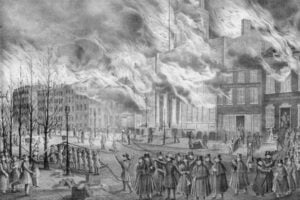
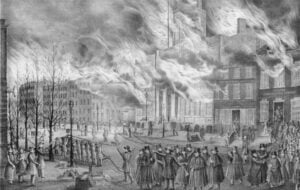
The Great Fire of New York City on December 16, 1835, showing the burning Merchants’ Exchange. Historic lithograph drawn by Hoffy, published by Robinson in 1836. Library of Congress / Wikimedia Commons. Public domain.
When Americans think of catastrophic nineteenth-century urban blazes, the Great Chicago Fire of 1871 usually comes to mind first. Yet thirty-six years earlier, on a bitterly cold December night, a conflagration devastated the commercial heart of New York City. The Great Fire of 1835 reduced much of Lower Manhattan’s thriving financial and dry-goods district to ruins, destroying nearly 700 buildings and helping reshape the future of the metropolis.
The disaster struck as the Erie Canal was strengthening New York’s position as a great American trading center. It exposed the dangerous fragility of a booming city that had outgrown its water infrastructure. In the years that followed, New York rebuilt its business district and completed an ambitious new water system that transformed everyday life and firefighting.
A Booming City Waiting for a Spark
During the decade following the opening of the Erie Canal in 1825, the volume of trade passing through New York City rose dramatically. Ships brought imported fabrics, coffee, and other goods into the harbor, while warehouses and countinghouses clustered along the narrow streets near the East River. The growth brought wealth, jobs, and increasing congestion to Lower Manhattan.
Many warehouses contained highly combustible merchandise, including textiles, whale oil, and turpentine. Brick walls offered some protection, but tightly packed buildings, wooden interior structures, and goods stored from floor to ceiling created a dangerous environment if a fire escaped its point of origin.
The city’s basic services struggled to keep pace. New York relied on volunteer firefighters using hand-pumped engines, neighborhood wells, cisterns, and limited reservoirs. A dependable municipal system capable of delivering large quantities of water through the streets did not yet exist. In the days before the Great Fire, firefighters had also been called upon to battle other serious blazes, leaving men and equipment strained when the next emergency began.
The Night the Rivers Froze and Burned
On the evening of December 16, 1835, fire was discovered at the dry-goods establishment of Comstock & Andrews at 25 Merchant Street, near Hanover Square. Investigators later attributed the blaze to gas escaping from a damaged pipe and igniting near a coal stove. What began inside one building soon became a disaster that the city’s firefighting resources could not contain.
Severe cold and powerful winds made the conditions extraordinary. Water froze in hoses and engine equipment, while ice along the waterfront complicated efforts to draw water from the rivers. Firefighters chopped through ice to reach supplies, but the water they obtained was difficult to deliver effectively through the bitterly cold streets.
Wind carried flames from building to building as the fire fed on the combustible cargo stored in the district. Contemporary descriptions tell of metal fixtures damaged by the intense heat and burning materials spreading toward the waterfront. Oil and other flammable substances added to the danger, and flames reflected across the East River, presenting a terrifying sight to observers on the Brooklyn side.
Gunpowder, Ruin, and the Destruction of the Merchants’ Exchange
As ordinary firefighting methods failed, city leaders turned to a desperate solution: destroying buildings ahead of the flames to create a firebreak. Gunpowder brought from the Brooklyn Navy Yard was used to demolish structures in the fire’s path. The explosions sacrificed buildings in the hope of preventing an even greater portion of Manhattan from burning.
By the morning of December 17, the fire had been brought under control. The damage extended across approximately 17 blocks in the commercial district, and nearly 700 buildings had been destroyed. The blaze consumed warehouses, shops, businesses, and important institutions. Among the most prominent losses was the Merchants’ Exchange on Wall Street, a major symbol of New York’s growing financial power that also housed postal facilities.
The destruction reached streets including Pearl, Water, Hanover, and Wall. The Tontine Coffee House, a longstanding gathering place for merchants, was also lost. The financial consequences were staggering: contemporary estimates placed the property losses at roughly $20 million, an enormous amount in 1835. Beyond the buildings themselves, merchants lost merchandise, records, and the means to continue trading.
The Insurance Crisis After the Great Fire
The consequences spread beyond the burned district. Insurance companies faced claims on a scale that many had never anticipated. Of the 26 fire insurance companies based in New York, 23 became insolvent following the catastrophe. For business owners who believed their policies would protect them, the failure of an insurer could turn a devastating property loss into a financial calamity.
Insurers based in Hartford, Connecticut, emerged with a stronger reputation. The Hartford Fire Insurance Company, among others, honored obligations arising from the fire, helping establish confidence in Hartford as an insurance center. The Great Fire exposed how vulnerable an entire local insurance industry could become when too much of its risk was concentrated in one tightly packed business district.
How the Great Fire Changed New York City
Rebuilding began quickly. Merchants needed new premises, and the city could not afford to leave the heart of its commercial economy in ruins. Brick and stone buildings replaced many of the structures that had burned. Reconstruction also created opportunities for improvements to streets and building practices, although no single rebuilding measure could eliminate the danger of future fires.
The fire’s most important long-term connection was to the struggle for a dependable municipal water supply. New York had debated obtaining water from the Croton River in Westchester County for years. Crucially, voters had already approved the Croton Aqueduct project in April 1835, eight months before the disaster. The Great Fire did not originate the idea or secure the initial approval. Instead, it made the need for a reliable supply painfully unmistakable and strengthened the argument for completing the undertaking.
Construction of the Old Croton Aqueduct began in 1837. In 1842, fresh water from the Croton watershed reached Manhattan through the new system, which included a long masonry aqueduct and reservoirs for receiving and distributing water. Its arrival transformed public health, household life, and the ability to fight fires. The project became one of the great infrastructure achievements of nineteenth-century New York.
The Lasting Legacy of the Great Fire of 1835
The Great Fire of 1835 remains one of the defining disasters in New York City history. It devastated the financial district, ruined hundreds of properties, overwhelmed the city’s volunteer firefighters, and shook the insurance industry. Yet the catastrophe also revealed, with terrible clarity, the cost of allowing urban growth to outpace public infrastructure.
Today, the streets around Wall Street and Hanover Square look very different from the crowded merchant district of 1835. The disaster itself is easy to overlook amid modern skyscrapers, but its influence survives in the story of how New York confronted the problems of fire protection and water supply. The city’s recovery became part of the longer transformation of a busy Atlantic port into a modern metropolis.
For more stories about the forces that shaped New York, explore our history of the Erie Canal and our history of New York City Hall.