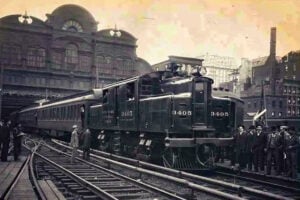
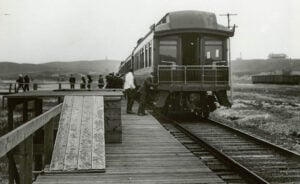
Passengers board the first westbound run of the Long Island Rail Road’s Cannonball at Montauk in 1899. Photo: Hal B. Fullerton, public domain, via Wikimedia Commons.
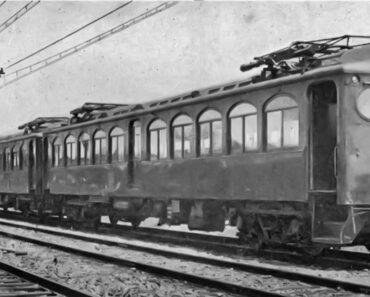
The Long Island Rail Road we know today is only part of the railroad network that once stretched across Long Island, Queens, and Brooklyn. Over nearly two centuries, vanished branches carried summer vacationers to beach resorts, soldiers to military camps, factory workers and freight to industrial plants, and commuters to communities that eventually outgrew or abandoned their rail connections.
Some of these routes disappeared as automobiles and highways changed how Long Islanders traveled. Others became redundant after competing railroads were consolidated, lost their industrial customers, or were replaced by newer transit routes. In several cases, the rails are gone but the old right-of-way is still surprisingly easy to find. This installment in our Lost Railways of New York series looks at 12 lost Long Island Rail Road branches and predecessor lines, why they disappeared, and what remains of them today.
1. The Wading River Branch
Route: Extended the Port Jefferson Branch east through Miller Place, Rocky Point, and Shoreham to Wading River.
Years of Operation: 1895-1938 for passenger service; formal abandonment followed in 1939.
Original Builder: Long Island Rail Road.
Why It Vanished: The LIRR extended service east from Port Jefferson to Wading River in 1895, with hopes that the route might someday continue toward Riverhead or Calverton. That extension never happened. By the 1930s, ridership on the lightly populated North Shore route had fallen sharply, and the railroad reduced service before discontinuing passenger operations in 1938. The remaining line was formally abandoned in 1939.
What Remains Today: Much of the former right-of-way survives as a utility corridor. In June 2022, a major portion opened as the paved North Shore Rail Trail, running about 10.4 miles from the Mount Sinai-Port Jefferson Station area to Wading River.
2. The Sag Harbor Branch
Route: From Bridgehampton north through the South Fork to Sag Harbor, with connections serving the village and its waterfront.
Years of Operation: 1870-1939.
Original Builder: Long Island Rail Road.
Why It Vanished: Sag Harbor was originally an important eastern destination for the railroad because of its busy harbor, maritime trade, industry, and connections to steamships. When the LIRR extended the Montauk line east from Bridgehampton in 1895, Sag Harbor changed from an important terminal to a short branch. By the 1930s, automobiles and improved roads had further reduced passenger traffic, and the branch was abandoned on May 3, 1939.
What Remains Today: Portions of the former railroad grade survive as trails through the Long Pond Greenbelt. Historic railroad structures also survive in Sag Harbor, preserving a physical reminder of the years when trains ran directly into the village.
3. The Lost Central Extension Across the Hempstead Plains
Route: The former Central Railroad of Long Island route ran east from the Garden City area across the Hempstead Plains toward Bethpage Junction, with associated lines connecting west toward Queens and southeast toward Babylon.
Years of Operation: The original Central Railroad opened in the 1870s. Regular passenger service on the Garden City-Bethpage portion ended in 1939, although sections continued to be used or temporarily rebuilt afterward.
Original Builder: Alexander Turney Stewart’s Central Railroad of Long Island.
Why It Vanished: Stewart built the railroad to serve his newly planned community of Garden City, carry material from his Bethpage brick works, and create a competing route across Long Island. After the LIRR absorbed the competing system, portions of the Central route remained useful while others became redundant. The Garden City-to-Bethpage section, later known as the Central Extension, lost regular passenger service in 1939. During World War II, part of the eastern track was removed. In 1946, rails were temporarily relaid eastward to help deliver construction materials for Levittown, but the old through route was never restored.
What Remains Today: This is not a case in which the entire railroad disappeared. Portions of Stewart’s system survive in today’s Hempstead Branch and Central Branch, while the western end of the former Central Extension survived as the Garden City-Mitchel Field Secondary. Much of the abandoned right-of-way farther east can still be traced across central Nassau County.
4. The Whitestone Branch
Route: From the Flushing area north through College Point and Malba to Whitestone Landing.
Years of Operation: 1869-1932.
Original Builder: Flushing and North Side Railroad.
Why It Vanished: The Whitestone Branch served northern Queens communities that were still relatively isolated when the line was built. It was electrified in 1912, but ridership weakened during the 1920s as automobiles and competing transit expanded. Proposals were discussed for New York City to acquire the branch and incorporate it into a rapid-transit system, but no agreement was completed. Passenger service ended on February 15, 1932.
What Remains Today: The railroad itself is gone. Much of its old route was absorbed into later streets, parks, industrial property, and transportation development in northern Queens, although the former alignment can still be reconstructed from historical maps.
5. The Manhattan Beach Branch
Route: From the Manhattan Beach Junction area south through Sheepshead Bay to the oceanfront resort district at Manhattan Beach in Brooklyn.
Years of Operation: Passenger service began in 1877 and ended in 1924; freight activity survived into the 1930s.
Original Builder: New York and Manhattan Beach Railway.
Why It Vanished: The railroad was closely tied to the Gilded Age resort empire developed at Manhattan Beach. As the great beachfront hotels declined and faster streetcar and rapid-transit routes offered cheaper access to the Coney Island area, the railroad lost the traffic that had justified it. Passenger service ended in 1924. The LIRR later sought permission to abandon the remaining southern trackage, which was removed during the late 1930s and early 1940s.
What Remains Today: The oceanfront branch is gone, but portions of the broader Manhattan Beach railway system survive in the modern Bay Ridge freight corridor. In residential sections of southern Brooklyn, unusual property lines and alleys still reveal portions of the former railroad alignment.
6. The Manorville Branch
Route: Connected the LIRR Main Line at Manorville with the Montauk Branch at Eastport.
Years of Operation: The route dated to the 19th century and was formally abandoned in 1949.
Original Builder: Long Island Rail Road.
Why It Vanished: The Manorville-Eastport connection had once been part of the railroad’s route to Sag Harbor and later provided a useful link between the Main Line and the South Shore. As traffic patterns changed, the connection saw less use. Scheduled passenger use had largely disappeared before the railroad formally took the branch out of service on December 27, 1949.
What Remains Today: Portions of the old roadbed remain visible through the Pine Barrens and around Manorville and Eastport. Suffolk County once considered using the corridor for a proposed highway, but that plan was eventually abandoned, leaving sections of the former railroad route as wooded open space and trail.
7. The Creedmoor Branch
Route: From Floral Park northwest toward the former Creedmoor Rifle Range and later Creedmoor State Hospital in eastern Queens.
Years of Operation: The route originated in 1873 as part of the Central Railroad of Long Island. Through passenger service ended in the 19th century, while freight service survived until 1966.
Original Builder: Central Railroad of Long Island.
Why It Vanished: The original railroad carried passengers to the famous Creedmoor Rifle Range, which hosted major shooting competitions during the late 19th century. The range closed in 1907, and the property later became the site of the Farm Colony of Brooklyn State Hospital, which opened in 1912 and evolved into Creedmoor Psychiatric Center. The branch remained useful for freight, particularly coal deliveries to the institution, long after passenger service disappeared. It was finally taken out of service on December 27, 1966.
What Remains Today: The tracks were removed during the 1970s. Portions of the old right-of-way were absorbed into adjoining properties and later development, although the alignment can still be followed in sections along the Queens-Nassau border.
8. The Cedarhurst Cut-Off
Route: A historic railroad connection through southeastern Queens toward Cedarhurst and the Rockaways.
Years of Operation: The original route opened in 1871. Portions were abandoned, rebuilt, and reused at different times before the cut-off was permanently removed in 1934.
Original Railroad: New York and Rockaway Railroad, later controlled by the Long Island Rail Road system.
Why It Vanished: The route emerged from the intense 19th-century competition to reach the Rockaways. After competing Long Island railroads came under common control, the line became redundant. Parts of the route were later rebuilt for railroad purposes, and track was relaid again in the late 1920s as residential development spread across southeastern Queens. The LIRR ultimately determined that existing Rockaway service made the cut-off unnecessary, and the line was permanently removed in 1934.
What Remains Today: The former right-of-way influenced the later street pattern in parts of southeastern Queens. Remnants of the old corridor also survive around the marshland near the Queens-Nassau border and North Woodmere Park.
9. The Bethpage Branch
Route: A short branch running north from Bethpage Junction to the Bethpage brick works in what is now Old Bethpage.
Years of Operation: 1873-1942.
Original Builder: Central Railroad of Long Island.
Why It Vanished: Alexander Turney Stewart built the approximately 1.75-mile branch primarily to serve his Bethpage Brickworks. The bricks were used in the development of Garden City, making the line an important industrial piece of Stewart’s larger railroad project. Passenger use was always secondary to the branch’s freight purpose. After the brick works and other local freight traffic declined, the line was downgraded and finally abandoned on November 10, 1942.
What Remains Today: No operating track survives. The historic route can still be reconstructed through old railroad maps and the landscape around Old Bethpage and Bethpage State Park.
10. The Camp Upton Branch
Route: A military spur from the LIRR Main Line near Yaphank into Camp Upton in central Suffolk County.
Years of Operation: Built in 1917 for World War I; service to the camp ended in 1922. The military spur was rebuilt during World War II.
Original Builder: Long Island Rail Road in support of the U.S. Army’s Camp Upton.
Why It Vanished: Camp Upton was created in 1917 as a major Army training center, and the railroad became essential for moving recruits, supplies, and equipment into the enormous temporary camp. The site was deactivated after World War I, and LIRR service to the camp ended in 1922. Camp Upton returned to military use during World War II, and the rail connection was rebuilt to support the installation. After the war, the Army declared the site surplus, and in 1947 it became Brookhaven National Laboratory, ending the need for a military railroad branch.
What Remains Today: The Camp Upton landscape is now largely part of Brookhaven National Laboratory. Historical maps and archival photographs preserve the route of the military spur, but it is not a public rail trail and only limited traces of the old camp railroad remain.
11. The Old Northport Branch
Route: From the Port Jefferson Branch near present-day Northport Station north into Northport Village.
Years of Operation: Passenger service began in 1868 and ended in 1899; freight service continued until 1978.
Original Builder: Long Island Rail Road and its North Shore expansion interests.
Why It Vanished: The original railroad reached Northport Village in 1868, but the route into the harbor community was poorly positioned for an eastward extension. When the railroad pushed on toward Port Jefferson in 1873, it built a new station south of the village and turned the older route into a branch. Passenger service to the village ended in 1899, although freight customers kept the spur alive for decades. The remaining freight branch was abandoned in 1978 and dismantled during the 1980s.
What Remains Today: A portion of the old right-of-way is preserved as the Northport Rail Trail, a short wooded public trail between Laurel Hill Road and the Elwood Road area.
12. The Evergreen Branch
Route: At its greatest extent, the line linked Greenpoint and Bushwick in Brooklyn with Ridgewood and a connection to the Bay Ridge railroad network near Cooper Avenue.
Years of Operation: Passenger operations began in 1878 and were gradually reduced during the 1880s and 1890s. A surviving freight portion remained in use much longer and was not fully abandoned until 1984.
Original Railroads: Glendale and East River Railroad and Brooklyn and Rockaway Beach Railroad interests; later operated within the Long Island Rail Road and Manhattan Beach system.
Why It Vanished: The Evergreen route once helped connect Greenpoint and northern Brooklyn with trains bound for Manhattan Beach. Passenger service disappeared as the railroad reorganized its terminal operations and rapid transit expanded through Brooklyn and Queens. Parts of the line were abandoned during the 1890s, but a shorter industrial freight branch survived for decades. A section was removed in 1939, yet the remaining freight route continued through later railroad ownership until Conrail received permission to abandon it in 1984.
What Remains Today: Much of the corridor has been built over, but unusual lot lines, parking areas, industrial property boundaries, and occasional physical traces still reveal portions of the old Evergreen alignment.
For more Long Island transportation history, read our St. James Train Station, 19th Century Building Still Stands, History of Levittown and the American Dream, and Life on the Long Island Expressway.
Sources
Stony Brook University Libraries — Vincent F. Seyfried Collection
Stony Brook University Libraries — Robert M. Emery Long Island Rail Road Collection
Vincent F. Seyfried — The Long Island Rail Road: A Comprehensive History, Part Two
Vincent F. Seyfried — The Long Island Rail Road: A Comprehensive History, Part Four
Metropolitan Transportation Authority — Central Branch Historical Discussion
Suffolk County — North Shore Rail Trail
Southampton Trails Preservation Society — Long Pond Greenbelt and Old Railroad Spur
Town of Huntington — Northport Rail Trail
New York State Office of Mental Health — Creedmoor Historical Timeline
Brookhaven National Laboratory — History of Camp Upton
Long Island Rail Road Historical Archive — Wading River Extension
Long Island Rail Road Historical Data — Former Branches and Abandonments
Long Island Rail Road Historical Archive — Camp Upton Branch
12 Lost Long Island Rail Road Branches & Rail Lines article published on ClassicNewYorkHistory.com © 2026