
Photo: Gryffindor, CC BY-SA 3.0 <https://creativecommons.org/licenses/by-sa/3.0>, via Wikimedia Commons
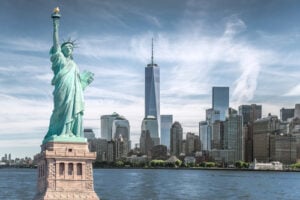
If you have ever just wanted to take a break from the busy New York City streets in lower Manhattan, then a visit to Battery Park may just be the choice you need to make. All it takes is a moment to find an empty park bench or just squat down on the grass and just stare out across the water for a magnificent view of the Statue Of Liberty and Ellis Island. Even for New Yorkers who have lived in the city their entire lives, that view never gets old.
Located on the southernmost tip of Manhattan, the history of Battery Park goes back all the way to 1623 when the Dutch settled the area that would become known as New Amsterdam. The Dutch named the area Capske Hook. The first fort at Battery Park that was built by the Dutch was called Fort Amsterdam. To defend the fort, protective batteries were built on the shoreline. It’s where the name of Battery Park originates. The Dutch weren’t there for too long as we all know the British eventually took over in 1684. Fort Amsterdam was renamed Fort James under British Control. It would later be changed to Fort George. Kings like everything to be put under their name. Some things never change……
At he end of the American Revolution, Fort George was torn down and many celebrations took place in Battery Park commemorating the victory, American Independence, and the departure of the British from the area.
In 1815, the area was named Castle Clinton, almost 10 years later it was renamed Castle Garden. The area we know now as Battery Park had become an entertainment complex in the early eighteen hundreds. At first it was used as a beer garden but then it was turned into one of the most popular theaters in all of New York City. Eventually the building housed for entertainment would become an important immigration facility from 1855 to 1890. The building was no longer used for immigration after Ellis Island opened up in 1890. An Aquarium was built by Stanford White called the New York Aquarium from 1896 to 1941.
In the present day Castle Clinton, stands as a National Monument. New Yorkers and tourists are also able to use a ticket booth at Castle Clinton to buy tickets for the ferry that takes people to the Statue Of Liberty and Ellis Island.
During World War II and the Korean War the New York City Parks Department closed down the park in order to build the Battery Tunnel below it. Since the park was closed during the War years many memorials would be built during that time period. The East Coast Memorial was built to honor the servicemen who fought in World War II. The East Coast Memorial is inscribed with the names of servicemen who died in the Atlantic Ocean during the “Battle Of The Atlantic.” Many of those memorials still stand today at Battery Park.
A Fritz Koenig’s Sculpture that had been standing at the World Trade Center for thirty years in celebration of hope and world peace was moved to Battery Park after the September 11th attacks. The Korean War Memorial was built in 1991 at Battery Park. There is the Immigrants Memorial that was built in 1983. Battery Park has many memorials that go back to the start of the twentieth century. The John Ericsson Statue was built n 1903. A statue of Giovanni da Verazzano was designed and placed in Battery Park in 1909. The Wireless Operators Memorial was placed in Battery Park in 1915. In 1924 Henry Bacon designed the Wallon Settlers Memorial as a tribute to Jesse de Forest who had fled Europe leading the way for a group of Europeans called the Wallon Huguenots to the new world due to religious persecution in Europe.
For those New Yonkers who lived in the city during the 1970s, memories of Battery Park are often filled with remembrances of an area that was often too dangerous to hang around in. New York City was a very different place in the 1970s. I remember it well. Crime ran rampart in the city in the 1970s. Battery Park was not the type of place you went to especially at night. Throughout the decade the park continued to deteriorate on all levels. At the same time Battery Park City was being constructed. With the success of the newly developed Battery Park City, money would soon be spent on renovating Battery Park by the State of New York. Battery Park was redesigned. Gardens were added and the riverfront was redesigned to offer breathtaking views of New York Harbor along with the Statue of Liberty, Ellis Island and the beauty of New York City.
In the 1990s the Battery Conservatory nonprofit organization poured even money into the park to help improve its condition. Battery Park was still an old park land. After all, this was an area that been used for hundreds of years going back o the Dutch.
In the 2010s, still additional money was spent on Battery Park with addition of a sea themed carousel The carousel called the SeaGlass Carousel is beautiful carousel housed inside glass. Throughout the 21st century the Battery Conservancy has spent close to a hundred million dollars of privately raised funs in restoring Battery Park . A brand new playground is set top open in 2021 as one the latest of the restoration efforts led by the Battery Conservancy.
Battery Park has now become a destination for all New Yonkers looking for a break from the rest of the city and tourists on the way to see the Statue of Liberty. There are bike paths that run through the park that are connected to rest of New York City’s new found love for bicyclists. And of course there is a public transportation hub we like to call the subway that stops at the South Ferry Station, that is also constantly being redesigned. That’s New York City!
History Of New York’s Battery Park article published on Classic RockHistory.com© 2021
ClassicNewYorkHistory.com claims ownership of all its original content and Intellectual property under United States Copyright laws and those of all other foreign countries. No one person, business or any organizations is allowed to republish any of our original content anywhere on the web or in print without our permission.