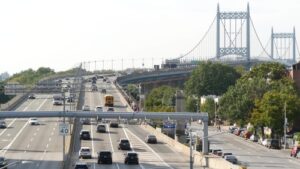
Officially, it is the Robert F. Kennedy Bridge. To generations of New Yorkers, it is still the Triborough, the enormous three-bridge complex linking Manhattan, Queens, and the Bronx through Randall’s Island. Its history is also the story of a stalled Depression-era public works project, Robert Moses’s rise to power, and the toll authority that helped reshape modern New York.
Most New York bridges connect two places. The bridge now officially known as the Robert F. Kennedy Bridge connects three: Manhattan, Queens, and the Bronx, all meeting at a sprawling interchange on Randall’s Island, where the East River, the Harlem River, and the Bronx Kill come together. It is less a bridge than a small kingdom of bridges, three separate spans stitched together through one of the most ambitious highway interchanges built anywhere in America at the time.
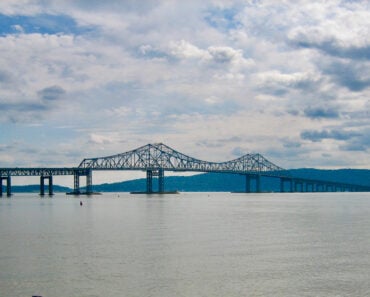
Depending on whom you ask, most native New Yorkers still do not call it the RFK at all. I have been traveling over that bridge for the past 65 years, and I still cross it regularly. I still call it the Triborough, just as I still call the Governor Mario M. Cuomo Bridge the Tappan Zee. It is hard to make the change. Like me, most New Yorkers will probably always call it the Triborough, a name so sturdy that even an act of the state legislature could not fully retire it.
A Three-Borough Crossing Conceived in 1916
The idea for a three-borough crossing predates the bridge itself by two full decades. In 1916, Edward A. Byrne, the chief engineer for the city’s Department of Plant and Structures, proposed a connected crossing linking Manhattan, Queens, and the Bronx. The original plan was extraordinarily ambitious. It was intended to carry vehicles and pedestrians while also providing space for a double-track surface railway.
The proposal stalled for years because of limited funding and political will. In 1927, the Board of Estimate finally appropriated money for surveys and borings. The Manhattan terminus was placed at 125th Street because city officials considered it the first practical river-to-river route north of Central Park.
In June 1929, the Board of Estimate allocated $3 million to begin the project. Ground was finally broken in Astoria Park on October 25, 1929, one day after Black Thursday shook Wall Street. New York’s timing could hardly have been worse. As the stock market collapse deepened into the Great Depression, municipal financing became increasingly difficult, and the work soon stalled. Steel, foundations, and unfinished structures stood over the waterways while the city struggled to find a way forward.
Robert Moses Revives the Triborough Bridge
The project’s rescue began in 1933, when the New York State Legislature created the Triborough Bridge Authority to oversee construction. After Fiorello LaGuardia became mayor in January 1934, Robert Moses joined the three-member authority and became its executive director. This was the moment when the Triborough Bridge became central to Moses’s rise as New York’s most powerful builder.
The authority secured $44 million in federal grants and loans from the Public Works Administration, including a $9 million grant and a $35 million loan. The federal support put thousands of people to work and restarted a project that New York City could not finish on its own.
Moses brought Othmar Ammann into the project as chief engineer. Ammann was already celebrated for designing the George Washington Bridge, which had opened in 1931. Working from the earlier plans, Ammann simplified the costly East River suspension bridge. The proposed double-deck structure was reduced to a single roadway deck, and the redesigned span required two main cables instead of four. The changes saved millions of dollars without sacrificing the scale of the crossing.
The Triborough project also became part of a bitter political struggle involving Moses, Public Works Administration administrator Harold Ickes, President Franklin D. Roosevelt, and Mayor LaGuardia. Ickes attempted to prevent federal funds from flowing to agencies led by officials who simultaneously held other municipal posts, a rule widely viewed as aimed directly at Moses. Moses refused to surrender his positions, and LaGuardia and Roosevelt eventually found a way to keep the funding in place. The bridge continued toward completion, but the hostility between Moses and Ickes never disappeared.
Three Bridges Joined on Randall’s Island
What rose from the water was not one bridge but a complex of three major bridges, elevated viaducts, ramps, and approach roads. The three branches meet on Randall’s Island, where an interchange directs traffic among Manhattan, Queens, and the Bronx.
The most dramatic section is the East River suspension bridge over Hell Gate, connecting Astoria, Queens, with Wards Island. Its suspended structure is 2,724 feet long, with a 1,380-foot central span between the towers. The roadway stands high enough above the water to accommodate major shipping traffic.
The Manhattan branch required a completely different design. A 705-foot vertical-lift bridge crosses the Harlem River between East 125th Street and Randall’s Island. Its movable roadway can rise vertically to allow tall vessels to pass beneath it.
The Bronx branch crosses the Bronx Kill on a 1,530-foot truss structure. Along with the three primary spans, the system includes more than 11,700 feet of viaducts and approaches, nearly 11,000 feet of ramps, and approximately 14 miles of connecting approach roads.
Architect Aymar Embury II gave the project a visual identity that went beyond its engineering requirements. Its administration buildings, towers, pylons, and decorative details reflected the Art Deco style of the period, adding a sense of ceremony to what could easily have become a purely industrial highway complex.
The Triborough Bridge Opens in 1936
After years of stops, starts, redesigns, and political warfare, the Triborough Bridge opened on July 11, 1936. Approximately 3,000 people attended the ceremony, which took place during one of the hottest days of the year. President Franklin D. Roosevelt joined Harold Ickes, Mayor LaGuardia, Robert Moses, and other officials for the opening.
Moses presided over the event and introduced the speakers. Referring to the political battles surrounding the project, he said that work as important as the Triborough was “too big for personal enmities.”
LaGuardia described the bridge as a symbol of a nation attempting to build its way out of the Depression. Roosevelt praised the laborers at the site and the workers in factories and mills across the country who supplied the steel, concrete, machinery, and other materials needed to finish the project.
The final cost was approximately $60.3 million. At different stages, the project involved hundreds of contractors and manufacturing plants across dozens of states. During the final construction push, thousands of people worked around the clock to finish the bridge and its enormous interchange.
The Bridge That Financed Robert Moses’s New York
The Triborough Bridge did far more than connect three boroughs. It created the financial base that allowed Robert Moses to expand his power across New York.
The Triborough Bridge Authority could collect tolls, issue bonds, and use future revenue to finance additional projects. What had originally been presented as a self-liquidating undertaking became a permanent and highly profitable public authority. Its income helped support the construction and operation of later crossings, including the Bronx-Whitestone Bridge, the Throgs Neck Bridge, the Verrazano-Narrows Bridge, and the Brooklyn-Battery Tunnel.
In 1946, the agency was renamed the Triborough Bridge and Tunnel Authority. It eventually became part of the Metropolitan Transportation Authority and now operates publicly as MTA Bridges and Tunnels. The agency runs seven bridges and two tunnels, and its toll revenue also supports the region’s public transportation system.
That financial structure became one of Moses’s greatest sources of institutional power. In a very real sense, the Triborough Bridge supplied the seed money for his decades-long transformation of New York City and its surrounding region. Admirers saw unprecedented construction and mobility. Critics saw neighborhoods divided, communities displaced, and public policy built around the automobile. Both views begin with the same bridge.
Why the Triborough Became the RFK Bridge
For 72 years, the bridge carried traffic under the Triborough name. That officially changed on November 19, 2008, when it was renamed in honor of Robert F. Kennedy, the former United States senator from New York who was assassinated in 1968 while seeking the Democratic presidential nomination.
The state legislature approved the renaming, and Governor David Paterson signed it into law. The dedication recognized Kennedy’s connection to New York and his work on civil rights, poverty, and social justice.
Not every New Yorker welcomed the change. The Triborough name had described the structure perfectly for more than seven decades, and it had become part of the city’s language. There were also complaints about the cost of changing signs and official materials throughout the highway system.
Still the Triborough to Generations of New Yorkers
The bridge now carries its official name, but its older identity has never disappeared. On maps and MTA documents, it is the Robert F. Kennedy Bridge. In everyday conversation, traffic reports, and directions exchanged among New Yorkers, it remains the Triborough or simply the Triboro.
The complex carries eight lanes of Interstate 278 across its Queens and Bronx branches and six lanes across the Manhattan branch. Tens of millions of vehicles use the crossing each year, moving among three boroughs through an interchange first imagined before the United States entered World War I.
Structurally and symbolically, the Triborough remains one of the truest monuments to Robert Moses’s particular genius. It is an engineering triumph assembled from three very different kinds of bridges, a connection among three boroughs, and the financial machine that helped determine how New York chose to build itself for generations.
Readers interested in the larger history of New York’s bridges and Robert Moses can continue with our features on the history of the Verrazano-Narrows Bridge, the history of the Brooklyn Bridge, and how Robert Moses shaped the Long Island he misunderstood.