Photo by Brian Kachejian, taken August 5, 2026
I still remember the drills.
Back in the 1960s, when I was a kid at St. Brendan’s in the Bronx, every so often a bell would ring and we would all climb under our desks. We would crouch there with our heads down, waiting for the all clear, just in case the Soviets decided to drop a bomb on our building.
Looking back, the whole thing seems absurd. The idea that a wooden school desk was going to save us from a nuclear blast is almost funny now. But that was life during the Cold War, and this is exactly what schools all over New York had us do.
The drills themselves were not new. During World War II, schools across the country ran air raid drills, and coastal cities such as ours took them seriously. What made the 1960s version different was the enemy. Now it was the Soviet Union and the atomic bomb, and that fear worked its way into everything.
The other thing I remember is the signs. Back then, the government designated basements in schools and public buildings as nuclear fallout shelters and bolted those black-and-yellow “Fallout Shelter” placards onto the walls. Most of them have come down over the years. Every once in a while, though, you still turn a corner in an old building and there one is.
Whenever I spot one, it takes me right back to St. Brendan’s and those ridiculous drills. I have to be honest with you. Fear of the nun standing at the front of that classroom was a lot more real to me than any bomb the Russians might drop.
Those fallout shelter signs are a perfect example of what this article is really about. They are markers left behind by a world that no longer exists, still hanging on our walls long after their purpose disappeared. New York City is full of signs like that.
The most beautiful ones are the ghost signs, the faded advertisements and old business names that still cling to brick walls and storefronts across Manhattan and Brooklyn. Some are true hand-painted wall advertisements. Others are preserved metal signs or architectural lettering that have outlived the businesses they identified. All of them hold on to a piece of the city that would otherwise be forgotten.
So, if you love this kind of thing the way I do, here are thirteen famous New York City ghost signs, their stories, and where their legacy can still be found.
What Is a Walldog? The Forgotten Artists Behind Ghost Signs
Before digital billboards, vinyl banners, and electronic displays transformed New York’s streets, advertising was a physical and sometimes dangerous craft. Businesses hired specialized sign painters known as walldogs to paint enormous messages directly onto brick walls while working from ladders or suspended platforms high above the pavement.
Many painters mixed oil-based colors with ingredients that included lead pigments and linseed oil. The paint bonded deeply with porous masonry, which helps explain why fragments of some advertisements remain visible many decades later. When a new business wanted the wall, another advertisement was often painted directly over the old one. As the upper layers faded, earlier lettering could reappear, producing the layered effect known as a palimpsest.
1. Carl Fischer Music Building
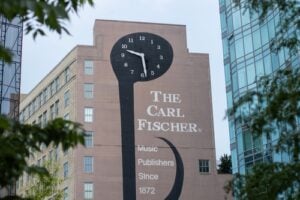
Location: 62 Cooper Square, best viewed from Astor Place
What it advertised: Carl Fischer Music
Status: Preserved on the building
Rising above Cooper Square, the former Carl Fischer headquarters remains one of downtown Manhattan’s most recognizable pieces of commercial history. Its north wall carries the company’s name along with the enormous musical-note clock that generations of New Yorkers associated with Astor Place.
German immigrant Carl Fischer founded his New York music business in 1872. The company became an important publisher of band, orchestral, and classical music, with a catalog connected to composers including John Philip Sousa, Sergei Rachmaninoff, Fritz Kreisler, and Ernest Bloch.
Architect W. K. Benedict designed the Cooper Square building, which was constructed in 1922 and 1923 to house the company’s store, offices, and printing operations. Fischer died in 1923, the same year his company moved into the new headquarters. His family continued running the business there for decades.
Carl Fischer Music left the building in 1999, and the property was converted into condominiums. The sign and musical-note clock survived, and the clock later underwent restoration. The building’s place within the NoHo Historic District gives this piece of New York music history an additional layer of protection.
2. A.S. Beck Shoes
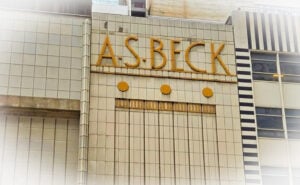
Location: 128 West 34th Street, between Sixth and Seventh Avenues
What it advertised: A.S. Beck Shoes
Status: Preserved architectural lettering
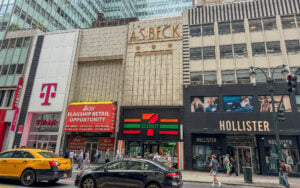
Directly across from Macy’s Herald Square, large gold letters spelling out A.S. BECK still crown a nearly windowless facade. This is not a faded wall advertisement in the strictest sense. It is surviving architectural signage, but it performs the same function as a ghost sign by keeping the name of a vanished business alive over the street.
Alexander Samuel Beck was a Hungarian immigrant who arrived in the United States in 1888 and initially worked as a butcher. He entered the shoe business with his brother Samuel in 1909. After that partnership ended, Alexander opened a store on Manhattan Avenue in Greenpoint and began expanding the chain.
By 1920, Beck operated thirteen stores. He sold the company to the Diamond Shoe Corporation for $1 million, reportedly on the condition that the A.S. Beck name would remain. At its mid-twentieth-century peak, the chain operated about 147 stores.
The West 34th Street location was the last A.S. Beck store in Manhattan. It closed in 1982, but the bold lettering still looks down on one of the busiest shopping blocks in New York.
3. Louis Zuflacht “Smart Clothes”
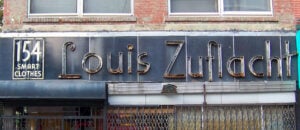
Original location: 154 Stanton Street, at Suffolk Street
Where to find it now: New York Sign Museum, 2465 Atlantic Avenue, Brooklyn
What it advertised: Louis Zuflacht’s tailor shop and haberdashery
Status: Removed from Stanton Street and preserved in a museum
For decades, the Louis Zuflacht sign turned a Lower East Side corner into a time capsule. Its weathered lettering advertised “Smart Clothes” above a storefront that once served working-class shoppers looking for suits and other men’s clothing.
Zuflacht was born in Austria in 1881 and came to New York in 1900. After an earlier clothing business on Stanton Street ran into financial trouble, he established himself at 154 Stanton Street in the early 1940s. He later ran the shop with his sons, Jack and Joe. Zuflacht died in 1986, but later tenants left his old signs in place.
That changed in April 2025, when the sign was carefully removed before the building’s redevelopment. Instead of being thrown away, it was rescued by the New York Sign Museum in Brooklyn. Pieces of the sign are now on view there during ticketed museum tours.
This means you can no longer find the Louis Zuflacht sign hanging over Stanton Street. Its survival is still a victory, however, because one of the Lower East Side’s most beloved pieces of storefront history has been saved rather than destroyed.
4. Coca-Cola Wall in SoHo
Location: West wall of 60 Grand Street, near West Broadway
What it advertised: Coca-Cola
Status: Partly visible; visibility changes
High on the exposed brick wall at 60 Grand Street are remnants of a painted Coca-Cola advertisement. The familiar flowing script offers a glimpse of the era when beverage companies covered city walls with enormous hand-painted messages.
Coca-Cola made painted wall advertising a major part of its national identity, and examples once appeared in cities and small towns throughout the country. The SoHo sign survived because the exposed side wall remained visible after the neighboring building disappeared.
There is one important warning for anyone planning a special trip. The wall remains valuable advertising space and has sometimes been covered or partly obscured by newer hand-painted campaigns. How much of the old Coca-Cola lettering can be seen depends on what is currently occupying the wall.
5. Meier & Oelhaf Marine Repair
Location: 177 Christopher Street, at Weehawken Street
What it advertised: Marine repair and plumbing supplies
Status: Preserved metal sign
Long before Hudson River Park turned the West Village waterfront into a place for walking, running, and sunbathing, this was a working maritime district filled with piers, tugboats, barges, warehouses, and businesses that served the ships along the Hudson.
Meier & Oelhaf was one of those businesses. The company became associated with the Christopher Street property in the early twentieth century and was listed there for decades as a marine repair and plumbing-supply operation.
The lettering that remains below the fire escape is actually a painted metal sign rather than an advertisement painted directly onto the brick. Subsequent owners preserved it, and it remains one of the clearest reminders that this polished West Village neighborhood once depended on the working waterfront.
6. Fresh, Salt, and Smoked Fish
Location: 146 Beekman Street, between South and Front Streets
What it advertised: Fresh, salt, and smoked fish
Status: Sign and building remain
Few surviving signs fit their neighborhood more perfectly than the old “Fresh, Salt, Smoked Fish” lettering on Beekman Street. The words belong to the era when the South Street Seaport was not primarily a historic attraction or dining destination. It was a working market district built around ships, wholesalers, warehouses, and the Fulton Fish Market.
The sign does not need an elaborate logo or clever slogan. Its blunt list of products tells you exactly what kind of business once belonged on these streets. That directness is part of its beauty.
The building and sign remain standing at 146 Beekman Street. It is an authentic survivor and replaces the often-cited Parodi Cigars sign on East 6th Street, which looks old but was actually created as scenery for The Godfather Part II.
7. Griffon Shears and Cutlery
Location: 151 West 19th Street, between Sixth and Seventh Avenues
What it advertised: Shears, scissors, and cutlery products
Status: Still visible
The Griffon sign is a direct link to the era when New York was a manufacturing center for the American fashion industry. The company sold shears, scissors, nail files, tweezers, nippers, manicure tools, and other cutting instruments used by professionals and consumers.
Griffon Cutlery Works occupied the West 19th Street building from about 1920 into the 1960s. Its large wall advertisement, complete with a graphic of scissors, has remained surprisingly legible.
Today, the sign functions as a quiet monument to Chelsea’s industrial past and to the garment trades that once dominated nearby blocks.
8. “Drink Milk, Eat Milk”
Location: Side wall of 149-151 Elizabeth Street, viewed from Kenmare Street
What it advertised: Milk and dairy consumption
Status: Faded but documented as surviving
Not every ghost sign promoted shoes, tobacco, or a neighborhood business. This unusual wall sign urges New Yorkers to “Drink Milk, Eat Milk,” a wonderfully strange phrase that has survived above Elizabeth Street.
The exact date and sponsor are difficult to establish with confidence. The message has often been described as part of an old dairy-promotion or public-nutrition campaign, but the surviving documentation does not firmly identify the organization behind it.
That uncertainty makes the sign even more intriguing. We know what it wanted New Yorkers to do. The identity of the person or agency that paid the walldogs to paint it has faded along with the lettering.
9. Sweet’N Low and Cumberland Packing
Location: Cumberland Street and Flushing Avenue, Brooklyn
What it advertised: Cumberland Packing Corporation and Sweet’N Low
Status: Signage remains at the company’s historic Brooklyn home
Across from the Brooklyn Navy Yard, the Sweet’N Low name became part of the surrounding brick landscape, and the story behind it is pure Brooklyn.
Benjamin and Betty Eisenstadt operated the Cumberland Cafeteria at the corner, serving shipbuilders and service members connected to the Navy Yard during World War II. When the war ended and the crowds disappeared, the couple needed a new business.
Betty disliked the unsanitary shared sugar bowls used in restaurants. Remembering Ben’s earlier work with tea-bag machinery, she suggested packaging sugar in individual bags. Ben adapted the equipment, and Cumberland Packing Corporation produced the first granulated sugar packets in 1945. Sweet’N Low followed in 1957 as a single-serving sugar substitute in the now-famous pink packet.
The company ended large-scale manufacturing and packing operations at the Brooklyn plant after announcing the change in 2016, but Cumberland Packing remains headquartered at the same historic location where the business began. The surviving name and logo continue to mark one of Brooklyn’s great stories of reinvention.
10. The “Neglected Children” Sign at 381 Lafayette Street
Location: 381 Lafayette Street, viewed from Great Jones Street
What it advertised: The Mission of the Immaculate Virgin’s work with homeless and orphaned children
Status: Historic wall lettering; visibility can depend on neighboring obstructions
The south wall at 381 Lafayette Street carries traces of lettering associated with the Mission of the Immaculate Virgin, including the haunting words “Neglected Children.” This is not a commercial advertisement at all. It is an institutional ghost sign tied to one of the building’s earlier lives.
The Mission of the Immaculate Virgin was founded in 1870 as a home for orphaned newsboys. It acquired the Lafayette Street property in the late 1880s and transformed the building into a convent and chapel in 1890 and 1891. The mission also operated the neighboring St. Joseph’s Home, a dormitory and school that was demolished in 1929.
The mission retained 381 Lafayette Street until 1965, when artist Robert Rauschenberg bought the building and converted it into his residence and studio. The Robert Rauschenberg Foundation now uses the property.
The original draft described this wall as a commercial palimpsest containing advertisements for multiple businesses. The better-documented story is more compelling. The surviving words belonged to a charitable institution that served homeless and orphaned children, making the sign a reminder of both New York’s social history and its constantly changing buildings.
11. Wolf Paper & Twine Co.
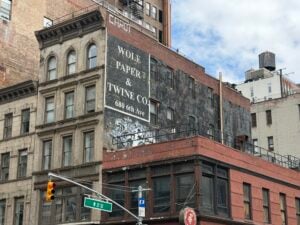
Photo by Brian Kachejian
Location: South wall of 678-680 Sixth Avenue, between West 21st and West 22nd Streets
What it advertised: Wolf Paper & Twine Co.
Status: Faded but still visible
The Wolf Paper & Twine sign is one of Chelsea’s great surviving business advertisements. The company occupied the adjoining buildings at 678 and 680 Sixth Avenue from the 1940s until early 2003, selling the paper, twine, wrapping, and packing materials that generations of New York businesses depended upon.
Wolf Lubitz, a Russian immigrant, founded the company in 1916. Over the years, Wolf Paper & Twine operated from several Manhattan addresses before settling on Sixth Avenue. The business later moved around the corner to West 22nd Street and closed in 2004 after merging with another company.
The address attached to the sign has shifted in surviving photographs. An earlier painted version used 678 Sixth Avenue, while an awning later identified the business as 680. The two neighboring buildings functioned together, so the most accurate location is 678-680 Sixth Avenue. The lettering is best viewed from West 21st Street.
12. Layered Fashion District Signs Across from FIT
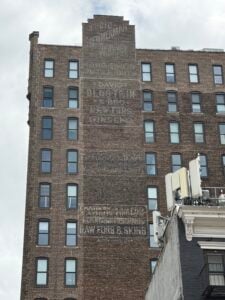
Photo by Brian Kachejian
Location: Seventh Avenue at West 27th Street, visible above 297 Seventh Avenue and across from the Fashion Institute of Technology
What they advertised: Several overlapping fashion and garment advertisements
Status: Multiple faded layers remain visible
This wall is a textbook New York palimpsest. At least three generations of painted advertising overlap one another on the exposed brick, with portions of older messages appearing through the paint that once covered them.
The most legible upper layer begins with the word “NEW” and appears to include the name “SILKSKIN,” followed by additional wording that may refer to fashion colors. Other large blocks of lettering survive beneath it, but too much has disappeared to identify every advertiser with confidence.
That uncertainty is part of the wall’s appeal. Located directly across from the Fashion Institute of Technology, the signs belong to the history of a neighborhood once crowded with clothing manufacturers, showrooms, suppliers, and businesses serving New York’s garment trades. Rather than assigning names that cannot be proven, it is more accurate to present the wall as a surviving collection of layered Fashion District advertisements.
13. Printers, Engravers, and Stationers
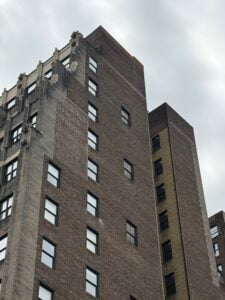
Photo by Brian Kachejian
Location: 254 West 31st Street, between Seventh and Eighth Avenues
What it advertised: Printing, engraving, stationery, office furniture, and business supplies
Status: Faded wall lettering remains visible
The surviving words “Printers,” “Engravers,” and “Stationers” recall the period when the blocks around Penn Station were filled with commercial printers, art-supply dealers, engravers, publishers, and companies furnishing New York offices.
The fifteen-story building at 254 West 31st Street was completed in 1926. Businesses connected with printing and art supplies later operated at the address, including Sam Flax and Copy X Press. The remaining lettering, however, is too faded to tie every visible line conclusively to one company.
This is another sign whose generic wording tells an important story even when the original advertiser cannot yet be established beyond doubt. It preserves the identity of an entire trade that once had a much stronger physical presence in Midtown.
How to Spot Ghost Signs in the Wild
Look beside empty lots and shorter buildings. Many wall advertisements became visible only when an adjoining structure was demolished. Others survived because a neighboring building shielded the paint from years of direct sun, wind, and rain.
Look up after a light rain. Wet brick darkens, and faint lettering can temporarily become easier to distinguish as the contrast between the masonry and old paint increases.
Walk through historic districts. SoHo, NoHo, the Lower East Side, the South Street Seaport, Chelsea, and the old waterfront neighborhoods still contain concentrations of older buildings. Landmark protections do not guarantee that every sign will survive, but they can slow the redevelopment that destroys them.
Do not assume every old-looking sign is authentic. New York has been used as a film set for generations. The faded Parodi Cigars advertisement at 620 East 6th Street is a perfect example. It was painted for The Godfather Part II, not left behind by an early twentieth-century cigar business at that address.
Once you start looking up, you will see remnants of the old city everywhere. Like the fallout shelter signs from my childhood, each one is a small, stubborn survivor from a New York that no longer exists.
13 Famous NYC Ghost Signs at a Glance
| Number | Sign | Location | Current status |
|---|---|---|---|
| 1 | Carl Fischer Music | 62 Cooper Square | Preserved on the building |
| 2 | A.S. Beck Shoes | 128 West 34th Street | Architectural lettering remains |
| 3 | Louis Zuflacht “Smart Clothes” | New York Sign Museum, 2465 Atlantic Avenue | Removed from Stanton Street and preserved in Brooklyn |
| 4 | Coca-Cola | 60 Grand Street | Partly visible; can be obscured by newer advertising |
| 5 | Meier & Oelhaf Marine Repair | 177 Christopher Street | Preserved metal sign |
| 6 | Fresh, Salt, and Smoked Fish | 146 Beekman Street | Sign and building remain |
| 7 | Griffon Shears and Cutlery | 151 West 19th Street | Still visible |
| 8 | “Drink Milk, Eat Milk” | 149-151 Elizabeth Street | Faded but surviving |
| 9 | Sweet’N Low | Cumberland Street and Flushing Avenue | Signage remains at company headquarters |
| 10 | “Neglected Children” | 381 Lafayette Street | Historic wall lettering; visibility can vary |
| 11 | Wolf Paper & Twine Co. | 678-680 Sixth Avenue | Faded but still visible |
| 12 | Layered Fashion District signs | Seventh Avenue at West 27th Street | Several overlapping advertisements remain |
| 13 | Printers, Engravers, and Stationers | 254 West 31st Street | Faded wall lettering remains |
More New York City History
Readers interested in the streets and businesses connected to these signs can also explore our history of Macy’s Department Store in Herald Square, our guide to the oldest subway stations in New York City, our look at the most famous department stores in New York City history, and our history of the Brooklyn Bridge.
Updated August 6, 2026.
Famous Ghost Signs in NYC article published on ClassicNewYorkHistory.com © 2026