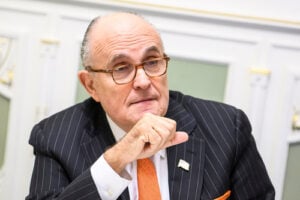
Rudolph “Rudy” Giuliani served as New York City’s 107th mayor from January 1, 1994, through December 31, 2001. During those eight years, New York experienced one of the steepest crime declines in its modern history, major changes in policing, a dramatic redevelopment of Times Square, falling welfare rolls, strong private-sector job growth, and an increasingly tourism-driven economy. His administration also became deeply controversial over police tactics, race relations, civil liberties, and the social costs of redevelopment.
No serious history of the period can credit or blame one mayor for everything that happened. Crime had already begun falling during David Dinkins’s final years, Times Square redevelopment was underway before Giuliani took office, and the national economy and federal welfare policies also shaped New York’s trajectory. Giuliani nevertheless put a distinctive stamp on the city through aggressive management, data-driven policing, quality-of-life enforcement, fiscal policies, and a combative political style. His final months in office were then transformed by the September 11, 2001 terrorist attacks.
How Did New York City Change Under Rudy Giuliani?
The most visible change was public safety. Major crime fell sharply, homicides dropped to levels New Yorkers had not seen in decades, and the NYPD adopted CompStat, a management system that used current crime information, mapping, rapid deployment, and regular meetings to hold precinct commanders accountable.
At the same time, the administration aggressively enforced quality-of-life offenses, pushed welfare offices toward employment-focused Job Centers, encouraged private development, and promoted a cleaner and more tourist-friendly image of the city. Times Square became the most visible symbol of that transformation. These changes won Giuliani devoted supporters, but they also produced fierce opposition from New Yorkers who believed the city’s policing and redevelopment strategies were too punitive or displaced communities and businesses that had long been part of New York.
The 1993 Election and the City Giuliani Inherited
Giuliani’s victory in 1993 was a rematch of the 1989 mayoral election, when Democrat David Dinkins had defeated him. Four years later, Giuliani narrowly defeated Dinkins and took office on January 1, 1994.
The city he inherited had been battered by recession, job losses, the crack-cocaine epidemic, and extraordinary levels of violent crime. New York recorded 2,245 homicides in 1990, the highest annual total in the modern city record. By 1993, the number had fallen to 1,946, meaning the crime decline was already underway before Giuliani became mayor.
Dinkins had raised taxes to fund the Safe Streets, Safe City program, which added thousands of police officers and expanded the city’s public-safety effort. His administration also supported the creation of an independent Civilian Complaint Review Board and began redevelopment initiatives that would continue into the Giuliani years.
The Crime Drop Did Not Begin in 1994
The enormous decline in crime became the central achievement associated with the Giuliani administration, but the chronology matters. Major crime had already begun declining during the final years of the Dinkins administration. Giuliani and his police commissioners then continued and dramatically intensified the city’s crime-control effort.
By September 2001, New York City reported that major crime was down more than 62 percent from 1993. The homicide numbers tell the same story. The city recorded 1,946 murders in 1993, 1,561 in 1994, 1,177 in 1995, 983 in 1996, 770 in 1997, 633 in 1998, and 649 in 2001.
Those figures changed the daily experience of New York. Neighborhoods that had lived with extremely high levels of robbery, automobile theft, shootings, and homicide became significantly safer. The decline also changed how the rest of the country viewed New York City.
William Bratton, CompStat, and a New Style of Policing
Giuliani appointed William J. Bratton as police commissioner in 1994. Under Bratton and senior NYPD officials including Jack Maple, the department developed CompStat, one of the most influential police-management systems of the era.
CompStat brought timely crime statistics, computerized mapping, rapid deployment of resources, and regular accountability meetings into the center of NYPD management. Precinct commanders were expected to know where crime was occurring, explain emerging patterns, develop strategies, and return to later meetings prepared to show whether those strategies had worked.
The system spread well beyond New York. Police departments across the United States adopted CompStat-style management during the years that followed, making the program one of the Giuliani era’s most lasting institutional legacies.
Broken Windows and Quality-of-Life Policing
CompStat was only one part of the policing strategy. The Giuliani administration also embraced aggressive quality-of-life enforcement influenced by the “broken windows” theory associated with James Q. Wilson and George L. Kelling.
The basic argument was that visible disorder, such as aggressive panhandling, fare evasion, public drinking, graffiti, and other low-level offenses, could undermine public confidence and create conditions in which more serious crime flourished. The NYPD devoted greater attention to those offenses and to people with outstanding warrants or illegal weapons encountered during enforcement.
Supporters argued that the approach restored order and contributed substantially to the crime decline. Critics argued that the same strategy led to unnecessary arrests, aggressive street encounters, racial disparities, and a growing number of complaints about police conduct.
Why Crime Fell Remains Debated
The scale of New York’s crime decline is not in dispute. The cause remains one of the most debated questions in modern urban history.
Giuliani, Bratton, and supporters of the NYPD strategy credited better police management, CompStat, rapid deployment, quality-of-life enforcement, and the department’s focus on guns and repeat offenders. Researchers and critics have pointed out that crime was also falling nationally and that changes in the economy, demographics, incarceration, drug markets, policing strategies, and other social conditions likely contributed.
New York’s decline was unusually steep, but it did not occur in isolation. That makes the most defensible conclusion a complicated one: policing changes were part of the story, but the transformation cannot be explained by a single policy or mayor.
Times Square Was Already Changing Before Giuliani
Few places became more closely identified with the Giuliani-era transformation than Times Square. Adult theaters, peep shows, crime, vacant storefronts, and aggressive street activity had long shaped the area’s reputation. By the end of the 1990s, Times Square had become a brightly lit center of tourism, Broadway theater, corporate media, chain retail, and large-scale commercial development.
Giuliani’s administration strongly promoted and accelerated that transformation, but the redevelopment did not begin with him. City and state redevelopment efforts dated back years, and the Dinkins administration had already helped broker a deal with the Walt Disney Company connected to the restoration of the New Amsterdam Theatre.
Under Giuliani, the city continued enforcing zoning restrictions on adult businesses, emphasized public safety and street order, encouraged corporate investment, and promoted Times Square as a symbol of New York’s comeback. Disney’s restored New Amsterdam Theatre reopened in 1997, while new theaters, restaurants, retail stores, media companies, and office towers remade the district.
Jobs, Tourism, and the Economic Boom
The Giuliani years also coincided with a powerful national economic expansion. New York recovered the hundreds of thousands of private-sector jobs lost during the early 1990s recession and then moved beyond its previous employment levels.
By early 2001, city officials reported that New York had added more than 450,000 private-sector jobs since January 1994. The city’s unemployment rate averaged 5.7 percent in 2000, down from 10.2 percent in December 1993. Tourism also expanded dramatically, with an estimated 38.4 million visitors coming to the city in 2000.
Giuliani’s administration credited tax reductions, lower crime, fiscal discipline, and business development policies for helping create the expansion. The larger national boom, Wall Street growth, falling interest rates, and strong consumer spending were also major parts of the economic environment in which New York prospered.
Welfare Reform and the Growth of Job Centers
Another major change involved public assistance. New York City’s welfare rolls peaked at 1,160,593 people in March 1995. By June 2001, the city reported 497,113 recipients, a decline of 57.2 percent.
The administration converted traditional welfare offices into Job Centers that placed greater emphasis on employment, work requirements, and moving recipients off cash assistance. Giuliani presented the decline as proof that the city was replacing long-term dependency with work and self-sufficiency.
Critics argued that falling caseloads did not automatically mean every former recipient had escaped poverty or secured stable employment. The change also unfolded during a national economic boom and after federal welfare reform fundamentally altered assistance programs across the United States.
Police Controversies and Race Relations
The same policing policies praised for helping make New York safer became the most divisive part of Giuliani’s mayoralty. Relations between City Hall, the NYPD, civil-rights organizations, and many Black and Latino communities were repeatedly strained by allegations of excessive force and aggressive policing.
In 1997, Abner Louima, a Haitian immigrant, was brutally assaulted and sexually tortured by police officers after his arrest and while in custody at Brooklyn’s 70th Precinct. Federal prosecutors later brought civil-rights charges against officers involved in the attack.
In February 1999, four officers from the NYPD Street Crime Unit confronted Amadou Diallo, an unarmed immigrant from Guinea, outside his Bronx building. The officers fired 41 shots; 19 bullets struck Diallo, killing him. The shooting produced enormous protests and intensified the national debate over race, policing, and the use of force in New York City.
In March 2000, Patrick Dorismond, an unarmed security guard, was fatally shot during an encounter with undercover police officers in Manhattan. The case further damaged relations between the Giuliani administration and civil-rights leaders.
These incidents became inseparable from the historical debate over the era. The city was becoming dramatically safer at the same time that many New Yorkers believed the methods used to enforce order carried an unacceptable human and constitutional cost.
September 11, 2001
Giuliani entered 2001 as a term-limited mayor approaching the end of a contentious eight years in office. The terrorist attacks of September 11 transformed the final months of his mayoralty and permanently changed his public image.
The attacks on the World Trade Center killed 2,753 people in New York City. Giuliani went downtown shortly after the attacks began, was nearly trapped when the towers collapsed, and then became one of the most visible public officials guiding the city through the immediate crisis.
His frequent press briefings, appearances with emergency workers, attendance at funerals and memorials, and insistence that New York reopen and continue functioning brought him extraordinary national and international acclaim. Time magazine named Giuliani its Person of the Year for 2001.
The events of September 11 did not erase the conflicts of the previous seven years, but they changed the way millions of people viewed Giuliani. A mayor whose political style had often divided New Yorkers became, during the city’s darkest days, a symbol of New York’s determination to survive.
How Should the Giuliani Mayoral Era Be Remembered?
There is no single version of the Giuliani years that captures the entire period. Supporters point to the collapse in crime, a stronger economy, lower welfare rolls, cleaner public spaces, data-driven government, and a renewed confidence in New York City. They also point to his leadership after September 11 as one of the defining moments of his mayoralty.
Critics point to confrontational policing, racial tension, civil-rights controversies, the treatment of poor and homeless New Yorkers, and a redevelopment model that often favored large corporations and rising real-estate values over the older character of neighborhoods and commercial districts.
Both perspectives belong in the history. Giuliani did not single-handedly create the safer and wealthier New York that emerged during the 1990s, just as every controversy of the era cannot be attributed to one person. He inherited important programs from the Dinkins administration, benefited from a powerful national economy, made aggressive changes of his own, and governed with a style that made him one of the most consequential and polarizing mayors in New York City history.
More New York City Political and 1990s History
To place the Giuliani years in the broader history of City Hall, continue with our profiles of David Dinkins and Michael Bloomberg. Readers interested in the city’s physical transformation can also explore our History of Times Square in New York City, the History of the New Amsterdam Theatre on Broadway, and our history of the Oculus Transportation Hub at the World Trade Center.
Rudy Giuliani’s Mayoral Era at a Glance
| Year | Event or Milestone |
|---|---|
| 1993 | Giuliani defeats incumbent Mayor David Dinkins in a close rematch of the 1989 election. |
| 1994 | Giuliani takes office as New York City’s 107th mayor; William Bratton becomes police commissioner and CompStat develops within the NYPD. |
| 1995 | New York City’s public-assistance caseload reaches a peak of 1,160,593 before beginning a major decline. |
| 1997 | The restored New Amsterdam Theatre reopens as the redevelopment of Times Square accelerates; the Abner Louima police-brutality case shocks the city. |
| 1999 | Four NYPD officers fire 41 shots at Amadou Diallo, killing him and triggering major protests. |
| 2000 | Patrick Dorismond is fatally shot during an encounter with undercover police; New York records strong private-sector job growth during the national economic boom. |
| 2001 | Welfare rolls fall below 500,000; the September 11 attacks destroy the World Trade Center and redefine the final months of Giuliani’s mayoralty. |
| December 31, 2001 | Giuliani’s second term ends and Michael Bloomberg succeeds him as mayor. |
Published August 9, 2026.
Rudy Giuliani as NYC Mayor: How New York Changed From 1994 to 2001 article published on ClassicNewYorkHistory.com © 2026