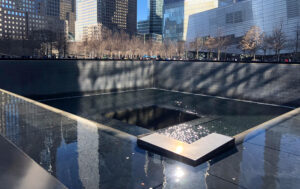
9/11 Memorial Photo by Brian Kachejian
The National September 11 Memorial & Museum is located at 180 Greenwich Street in Lower Manhattan at the rebuilt World Trade Center site. The outdoor Memorial occupies eight acres of the 16-acre World Trade Center complex and honors the 2,977 people killed in the terrorist attacks of September 11, 2001, along with the six people killed in the February 26, 1993 World Trade Center bombing. The outdoor Memorial is free to visit and is open daily.
This was not an easy article to write, as I used to work in the World Trade Center. My workday was not in the traditional sense, as most people were working in an office, one of the stores, or as part of the maintenance or security staff. I was an entertainer; I performed at a lot of weddings way up on the 107th floor. I will never forget performing there, playing piano, and looking out the windows at the other building right opposite ours. When I was taking breaks, I would lean up against the glass and look out, not just across the city, but as if I could see the entire East Coast.
What I clearly remember was how little security there was. We used to pull up in a van underneath the building and unload equipment and big giant cases, roll them onto an elevator, and take them all the way up. No one would stop us; no one asked what was in the cases, and no one would ask who we were. That’s the way the city was for the most part back then. It was a different time in the 1980s when I worked there.
I go back often and visit the Memorial. I always think about the people working in the kitchen at that catering hall, the waiters, the maitre d’s, the party planners, and the maintenance people that I worked with over the years, and I wonder how many of them were there when the plane hit. And, of course, everyone else who worked in the building who had woken up that morning to go to work as usual and then found themselves trapped with no escape. If you go there, be respectful, and never forget.
Where Is the 9/11 Memorial Located?
The official address is:
National September 11 Memorial & Museum
180 Greenwich Street
New York, NY 10007
The Memorial Plaza is south of Fulton Street, north of Liberty Street, west of Greenwich Street, and east of West Street. The two reflecting pools sit in the footprints of the original North and South Towers. One World Trade Center stands just north of the Memorial, while the Oculus Transportation Hub is immediately to the east.
How to Get to the 9/11 Memorial by Subway and PATH
Public transportation is the easiest way to reach the World Trade Center site. Several subway stations are either directly connected to the campus or only a short walk away.
- 1 train: WTC Cortlandt.
- E train: World Trade Center.
- R and W trains: Cortlandt Street.
- 2, 3, 4, 5, A, C, J, and Z trains: Fulton Street.
- A, C, 1, 2, and 3 trains: Chambers Street.
- 2 and 3 trains: Park Place.
Travelers coming from New Jersey can take PATH service directly to the World Trade Center station inside the Oculus. From there, signs and escalators lead toward street level and the Memorial Plaza.
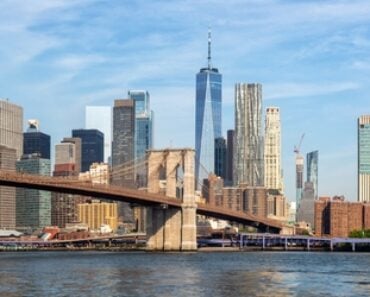
If you are already in Lower Manhattan, the Memorial is within walking distance of the Brooklyn Bridge, Battery Park, Wall Street, the New York Stock Exchange, St. Paul’s Chapel, and Trinity Church.
How the 9/11 Memorial Was Designed
In April 2003, the Lower Manhattan Development Corporation launched an international competition for a permanent memorial at the World Trade Center site. The competition received 5,201 submissions from 63 countries.
The winning design, Reflecting Absence, was created by architect Michael Arad and landscape architect Peter Walker. The design placed two enormous reflecting pools inside the footprints of the original Twin Towers and surrounded them with bronze parapets carrying the names of the victims.
The Memorial was dedicated on September 11, 2011, the tenth anniversary of the attacks, and opened to the public the following day. The 9/11 Memorial Museum was dedicated on May 15, 2014, and opened to the public on May 21, 2014.
The Twin Reflecting Pools
The two reflecting pools are the focal point of the Memorial. Each is nearly an acre in size and sits within the footprint of one of the original Twin Towers.
Water descends approximately 30 feet into the square basins before dropping again into smaller central voids. The waterfalls are the largest man-made waterfalls in North America. Their scale is overwhelming when you stand beside them, but the sound of the water also separates the pools from the noise and movement of Lower Manhattan.
The 2,983 Names Around the Memorial Pools
The bronze parapets surrounding the pools contain 2,983 names: the 2,977 people killed in the September 11, 2001 attacks and the six people killed in the February 26, 1993 bombing of the World Trade Center.
The names are not arranged alphabetically. Instead, the Memorial uses a system known as “meaningful adjacencies.” Victims are grouped according to where they were on September 11, including the towers, the Pentagon, the four hijacked flights, and first responder agencies. Families were also able to request that relatives, friends, and colleagues be placed next to one another.
One of the Memorial’s most moving traditions is easy to miss if you do not know what it means. Each morning, a staff member places a single white rose at the name of every victim whose birthday falls on that day.
The Survivor Tree
Among the hundreds of swamp white oak trees on the plaza stands one Callery pear tree known as the Survivor Tree. Recovery workers discovered the badly damaged tree at Ground Zero in October 2001. Its roots were broken and its branches were burned, but the New York City Department of Parks and Recreation removed it from the site and nursed it back to health.
The Survivor Tree returned to the World Trade Center site in 2010. It now stands as one of the Memorial’s most recognizable symbols of survival, recovery, and resilience.
The 9/11 Memorial Glade
The southwestern section of the plaza contains the 9/11 Memorial Glade, which honors rescue, recovery, and relief workers, survivors, lower Manhattan residents and workers, and others who became sick or died after exposure to toxins in the aftermath of the attacks.
The Glade includes a pathway bordered by six large stone monoliths weighing between 13 and 18 tons. World Trade Center steel is incorporated into the stones. The Memorial Glade was dedicated on May 30, 2019, the seventeenth anniversary of the formal end of the recovery effort at Ground Zero.
Is the 9/11 Memorial Free?
Yes. The outdoor 9/11 Memorial Plaza is free and does not require a ticket. It is currently open daily from 8:00 a.m. to 8:00 p.m.
The 9/11 Memorial Museum is different. The Museum requires a paid timed ticket and is currently open Wednesday through Monday from 9:00 a.m. to 7:00 p.m., with last admission at 5:30 p.m. The Museum also opens on selected Tuesdays and holidays during parts of the year, so visitors should check the current schedule before making the trip.
What Is the Difference Between the 9/11 Memorial and the Museum?
The outdoor Memorial is the public plaza containing the reflecting pools, names of the victims, Survivor Tree, and Memorial Glade. It is a place primarily intended for remembrance and reflection.
The underground Museum tells the broader history of the September 11 attacks and the 1993 World Trade Center bombing. Its collections include artifacts, photographs, recordings, personal objects, structural remains, the Last Column, portions of the original slurry wall, and extensive exhibitions documenting the attacks and their aftermath.
The Museum experience is much more intensive than walking the outdoor plaza. Visitors pass through security screening and should allow enough time to experience the exhibitions at their own pace.
Visitor Etiquette at the 9/11 Memorial
The most important thing to remember is that this is not simply another New York tourist attraction. It is a memorial and a place of mourning. Thousands of families come here because the names on those bronze panels belong to people they loved.
Keep your voice down around the pools. Do not sit on the bronze name parapets. Photography is allowed in many outdoor areas, but treat the people around you with respect. Tribute items may be left in designated ways, and the white roses placed in victims’ names should never be disturbed.
If you are trying to locate a particular name, the 9/11 Memorial & Museum provides a “Find a Name” system that identifies the person’s pool and panel location.
Visiting the 9/11 Memorial Today
There is no single correct amount of time to spend at the Memorial. Some people walk around both pools and leave quietly. Others remain for much longer, reading names, looking at the Survivor Tree, visiting the Glade, or simply standing beside the water.
If you are coming primarily for quiet reflection, arriving near opening time can make the experience less crowded. The pools are also striking after dark when the Memorial is illuminated.
St. Paul’s Chapel stands only a short walk away and became one of the most important places of refuge and support for rescue and recovery workers after September 11. The Oculus, One World Trade Center, and the rebuilt Lower Manhattan streets surrounding the Memorial show another side of the story: what New York built after the attacks without erasing the footprints of what was lost.
More Lower Manhattan History
Continue exploring the history surrounding the World Trade Center with our History of New York’s Oculus Transportation Hub at the WTC, History of the Brooklyn Bridge, History of New York’s Battery Park, History of New York’s Trinity Church, and History of the New York Stock Exchange.
9/11 Memorial and Museum at a Glance
| Feature | 9/11 Memorial Plaza | 9/11 Memorial Museum |
|---|---|---|
| Location | Outdoor World Trade Center plaza | Below and within the Memorial site at 180 Greenwich Street |
| Admission | Free | Paid timed ticket required |
| Current Hours | Daily, 8:00 a.m. to 8:00 p.m. | Wednesday through Monday, 9:00 a.m. to 7:00 p.m., plus selected Tuesdays and holiday hours |
| Main Features | Reflecting pools, names, Survivor Tree, Memorial Glade | Historic artifacts, exhibitions, Last Column, slurry wall, personal stories |
| Opened | Dedicated September 11, 2011; public opening September 12, 2011 | Opened to the public May 21, 2014 |
Published August 10, 2026.
Where Is the 9/11 Memorial in NYC? Location, History & Visitor Guide article published on ClassicNewYorkHistory.com © 2026