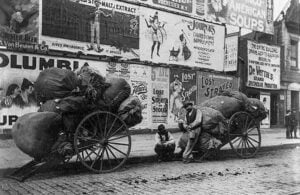
Ragmen and their carts on a New York City street, circa 1896. Photograph by Alice Austen. Library of Congress. No known restrictions on publication.
Long before delivery apps, electric streetlights, chain repair shops, and modern sanitation systems reshaped everyday life, New York City’s streets were workplaces. As a kid growing up in the 1960s in the Bronx, I remember an old man pushing a cart down the block sharpening people’s knives. He was a bit of a scary gentleman, and none of the kids on the block ever messed with him.
Residents could identify many trades simply by sound: a vendor’s cry, the bell of a grinder’s cart, the clatter of a milk wagon, or the music of a hand-cranked organ moving slowly down the block.
Some of these jobs disappeared completely. Others still exist in specialized forms but no longer function as roaming neighborhood trades. Together, they reveal a New York in which household repair, food delivery, entertainment, recycling, transportation, and even basic maintenance often came directly to the curb.
Staten Island photographer Alice Austen created one of the best visual records of this world. Her 1896 portfolio, Street Types of New York, documented working New Yorkers, including ragmen, newsboys, bootblacks, an organ grinder, a shoelace peddler, and other street occupations at the end of the nineteenth century.
1. The Scissors and Knife Grinder
The traveling knife and scissors grinder was once a familiar neighborhood figure. Instead of throwing away a dull kitchen knife, tailor’s shears, or barber’s scissors, New Yorkers could have the blade sharpened by a worker who brought the grinding equipment directly into the street.
Grinders used portable wheels mounted on carts, frames, or later bicycles and small vehicles. A bell, whistle, or shouted call announced that the sharpener had arrived. Customers brought down household knives, scissors, razors, and work tools for sharpening.
The trade was especially useful in a city filled with butchers, restaurants, garment workers, barbers, and households that expected tools to be repaired rather than replaced. Traveling sharpeners survived well into the twentieth century, but inexpensive manufactured cutlery and stationary sharpening businesses gradually made the roaming street grinder far less common.
2. The Umbrella Mender
An umbrella was once a repairable possession rather than something many people discarded when a rib bent or the fabric tore. Itinerant umbrella menders moved through New York neighborhoods offering to repair damaged frames, handles, ribs, springs, and coverings.
This was not a later nostalgic invention. An 1870 account in The Atlantic describing the street cries of New York specifically mentioned the familiar call of the man asking for “umbrellas to mend.” The same article described other traveling repairmen and peddlers whose voices were part of ordinary neighborhood life.
The umbrella mender belonged to a larger repair economy in which craftsmen brought their skills to the customer. Mass production, inexpensive imports, and the rise of permanent repair shops gradually pushed this kind of curbside service out of everyday New York life.
3. The Ragman and Rag-and-Bone Collector
Long before blue recycling bins appeared on New York sidewalks, ragmen earned money by collecting materials other people no longer wanted.
Rags were particularly valuable because old cotton and linen could be sold for papermaking and other industrial uses. Ragmen also dealt in metal, bottles, old clothing, and other salvageable household materials. Some worked on foot with sacks, while others used handcarts or horse-drawn wagons.
A period account published in 1870 described the harsh cry of “Rags! Rags!” moving through New York streets and explained that collected textiles were sold by weight, sorted, baled, and sent away for conversion into paper.
Alice Austen documented the trade directly in 1896. Her Street Types of New York portfolio included a photograph of ragmen and their cart on a Manhattan street. The Library of Congress also preserves the image and classifies it among New York street occupations and vendors.
The ragman was not performing municipal recycling in the modern sense, but he was part of a large reuse economy in which discarded materials still had monetary value. Modern sanitation collection, organized recycling, changing manufacturing methods, and motorized scrap businesses eventually transformed the trade.
4. The Street Lamplighter
Before electric streetlights, thousands of lamps had to be lit, monitored, and maintained by people.
Manufactured gas service arrived in Manhattan in the 1820s and later spread through Brooklyn and other growing parts of the city. Lamplighters made regular rounds, opening the gas supply and lighting street lamps as darkness approached. Maintenance could include cleaning glass, checking burners or mantles, and dealing with damaged fixtures.
The work began disappearing as electric street lighting spread. New York’s first public electric-lighting systems appeared along Broadway around 1880 and 1881, years before Thomas Edison’s Pearl Street Station began supplying customers in Lower Manhattan in 1882.
As electric lights became more reliable and widespread, the nightly occupation of physically lighting individual street lamps faded from New York life.
5. The Organ Grinder
Few vanished street occupations are more closely associated with old New York than the organ grinder.
Street musicians carried or wheeled mechanical organs through residential and commercial neighborhoods, turning a crank that operated the instrument while pedestrians, children, and residents listened from the sidewalk and windows. Some performers worked with trained monkeys that collected coins from the crowd.
Alice Austen photographed an organ grinder and his wife at 48th Street and Broadway in 1896, preserving the trade as part of her Street Types of New York series.
By the 1930s, Mayor Fiorello La Guardia’s administration moved aggressively against street musicians and organ grinders. Municipal archive records contain correspondence and files on organ grinders from 1935 through 1937, while contemporary accounts describe the mayor’s refusal to continue the licensing system that had allowed them to perform legally.
Radio, recorded music, changing attitudes toward street noise, and new licensing policies all helped end the organ grinder’s long reign as one of New York’s most recognizable street entertainers.
6. The Neighborhood Milkman
Milk delivery once arrived before much of the city was awake. This is another job that survived into the 60s and even 70s. I remember the milkman leaving the glass bottles of milk in a small silver box outside my apartment door. As soon as my father would hear him in the morning, he would rush to bring the milk in before anyone stole it.
An 1870 description of New York street life reported milk trains reaching city depots after midnight, followed by horse-drawn milk wagons heading into neighborhoods before dawn. The milkman’s call was described as one of the first street cries heard in the morning.
Before widespread household refrigeration and supermarkets, frequent milk delivery was a practical necessity. Milkmen served regular routes, bringing fresh milk directly to homes and apartment buildings.
The glass bottle left at the doorstep became one of the enduring images of early twentieth-century domestic life. Refrigerators, supermarkets, longer-lasting packaging, automobiles, and changing shopping habits eventually reduced traditional home milk delivery to a specialty service rather than a normal part of every New York neighborhood.
7. The Itinerant Chimney Sweep
In a city heated for generations by coal and other solid fuels, chimneys demanded constant attention.
New York’s nineteenth-century chimney sweeps traveled with brushes, scrapers, rods, and other equipment used to remove soot and accumulated residue. An 1870 account of New York street cries described chimney sweeps traveling in pairs with the implements of their trade strapped to their bodies.
The work was dirty but important. A blocked or soot-filled chimney reduced draft and increased the danger of smoke and fire inside crowded buildings.
Professional chimney cleaning still exists, but the old itinerant sweep calling for business on dense Manhattan streets largely disappeared as central heating, gas, oil, electricity, building codes, and specialized service companies changed how New Yorkers heated and maintained buildings.
8. The Bootblack
The bootblack, or shoeshine boy, was once a familiar figure around City Hall, railroad stations, hotels, ferry terminals, and other places with heavy pedestrian traffic.
Bootblacks carried boxes containing brushes, cloths, polish, and footrests or worked from established sidewalk stands. In a city of muddy streets, horse traffic, coal soot, and formal leather footwear, keeping shoes presentable required frequent attention.
Children and teenagers were especially visible in the trade. Alice Austen photographed bootblacks in City Hall Park in April 1896, and her photographs remain an unusually direct record of young street workers at the end of the nineteenth century.
Shoeshine businesses never disappeared completely, but the roaming bootblack became far less common as footwear changed, paved streets became cleaner, and shoe care shifted toward indoor stands and shops.
9. The Newsboy
Before radio, television, smartphones, and instant news alerts, the newspaper boy could turn a street corner into a breaking-news outlet.
Newsboys sold individual papers where crowds gathered: railroad depots, ferry terminals, business districts, theaters, and major intersections. They shouted headlines to attract buyers and competed for the busiest locations.
Many were children working long hours in a precarious street economy. Alice Austen’s 1896 New York street series included newsboys, and the Library of Congress preserves one of the photographs under the subject of child labor and newsboys.
The occupation changed as home newspaper delivery became more organized and later collapsed as print circulation declined. The familiar child shouting an extra edition to pedestrians is now part of New York’s past.
10. The Shoelace Peddler
Not every street trade involved a large cart or specialized machinery. Some New Yorkers survived by selling a small inventory that could be carried by hand.
Alice Austen photographed a shoelace peddler beside the railing of Trinity Church in Lower Manhattan on April 13, 1896. The image is striking precisely because of how modest the business was: one person, a small collection of goods, and a busy public location where passing pedestrians might become customers.
Peddlers sold countless inexpensive necessities in this way. Shoelaces, suspenders, buttons, household tools, brushes, notions, and other small goods could all be offered directly on city sidewalks.
Street vending certainly did not disappear from New York. What changed was the specific economy represented by Austen’s shoelace peddler, in which a worker could build an entire day’s livelihood around walking the streets and selling one inexpensive household necessity.
Why These Old New York Street Jobs Disappeared
No single invention eliminated these occupations. Instead, the city changed around them.
Electricity eliminated the need for lamplighters. Refrigeration and supermarkets transformed milk delivery. Recorded music and licensing restrictions pushed organ grinders from the streets. Municipal sanitation and industrial recycling changed the ragman’s business. Cheap mass-produced household goods made it less economical to repair umbrellas and sharpen some everyday tools. Newspapers shifted toward organized delivery before digital media undermined the print business itself.
The streets changed physically as well. Horses gave way to automobiles, paved roads became cleaner, apartment buildings gained modern utilities, and retail stores made an ever-wider range of inexpensive goods immediately available.
What disappeared was not simply a list of jobs. It was an entire form of neighborhood commerce in which New Yorkers often waited for the person providing a service to come walking, shouting, ringing, pushing, or riding down their block.
Alice Austen Preserved New York’s Street Workers
Many of these jobs would be much harder to imagine today without the work of photographer Alice Austen.
In 1896, Austen published a portfolio titled Street Types of New York. The surviving images include a street sweeper, street cleaner, mounted messenger boy, newsboy, bootblacks, organ grinder and wife, shoelace peddler, pretzel vendor, ragmen and cart, and other working New Yorkers.
The photographs matter because they show these people not as fictional characters or nostalgic illustrations but as actual workers occupying real New York streets.
More New York City Working-Class History
These street trades belonged to the immigrant and industrial city explored in our Why Is New York City So Important? How Gotham Built America’s Economy. Many of the people who built their lives through small trades arrived through the immigration system documented in our History of Ellis Island. For the mayor whose administration helped bring the organ grinder era to an end, continue with our Fiorello La Guardia, History of New York City Mayors.
Sources
The Atlantic, “The Street-Cries of New York,” February 1870
The Gotham Center for New York City History, Alice Austen: Amateur or Professional?
Historic Richmond Town, The Staten Island Historical Society’s Alice Austen Collection
National Gallery of Art, Alice Austen’s Street Types of New York
Library of Congress, Street Types of New York City: Newsboys
Library of Congress, Street Types of New York City: Rag Carts
Library of Congress, Street Types of New York City: Emigrant and Pretzel Vendor
New York City Landmarks Preservation Commission, Consolidated Edison Building Designation Report
New York City Municipal Archives, Mayor Fiorello H. La Guardia Records: Organ Grinders
Old-Fashioned New York Street Jobs at a Glance
| Street Job | What the Worker Did | What Changed the Trade |
|---|---|---|
| Knife and scissors grinder | Sharpened household and commercial blades using portable grinding equipment | Mass-produced cutlery, electric sharpeners, and stationary repair businesses |
| Umbrella mender | Repaired umbrella frames, ribs, coverings, and handles | Low-cost mass production and disposable consumer goods |
| Ragman | Collected textiles, metal, bottles, and salvageable household material | Municipal sanitation, formal recycling systems, and motorized scrap businesses |
| Lamplighter | Lit and maintained gas street lamps | Electric street lighting |
| Organ grinder | Played mechanical street organs for coins | Recorded music, radio, noise regulation, and licensing changes |
| Milkman | Delivered fresh milk directly to neighborhood customers | Refrigeration, supermarkets, packaging, and automobiles |
| Itinerant chimney sweep | Removed soot and residue from chimneys | Modern heating systems and specialized building-service companies |
| Bootblack | Cleaned and polished pedestrians’ shoes and boots | Changing footwear, cleaner streets, and indoor shoeshine stands |
| Newsboy | Sold individual newspapers and shouted headlines in busy public places | Organized home delivery, broadcast media, and digital news |
| Shoelace peddler | Sold small household necessities directly to pedestrians | Department stores, chain retail, and mass-produced consumer goods |
Published August 16, 2026.
10 Old-Fashioned Street Jobs That Once Defined New York City article published on ClassicNewYorkHistory.com © 2026