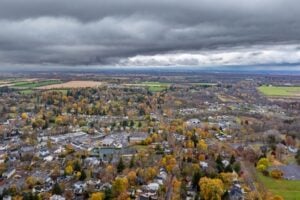
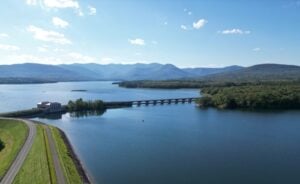
Ashokan Reservoir in the Catskill Mountains, one of the principal reservoirs supplying water to New York City. Feature Photo: yuriyt licensed from Shutterstock
According to the New York City Department of Environmental Protection, New York City’s municipal drinking water meets federal and state drinking-water standards and is safe to drink. The water that reaches New York comes from one of the largest municipal water systems in the world, a network of 19 reservoirs and three controlled lakes spread across nearly 2,000 square miles of watershed as far as 125 miles north of the city.
That safety statement refers to the municipal water supply. Water quality at a specific faucet can be affected by a building’s private service line, plumbing, fixtures, maintenance, and other local conditions, particularly in older properties where lead-containing plumbing may be present. Neighborhoods can also receive water from the Catskill, Delaware, and Croton systems, or a blend of those sources, and the mix can change as the Department of Environmental Protection manages reservoirs, aqueducts, maintenance, weather, and demand.
The history behind the water is just as remarkable as the water itself. The Catskill Aqueduct, completed during the early twentieth century, carries water 92 miles from Ashokan Reservoir to Hillview Reservoir largely by gravity. It was the centerpiece of a project that allowed New York City to keep growing after the older Croton system could no longer meet the demands of a five-borough metropolis.
Health and Safety Note: This article is provided for general historical and informational purposes and is not medical, health, or individualized water-quality advice. Statements about the safety of New York City tap water refer to the municipal water supply and current information published by the New York City Department of Environmental Protection and other public agencies. Water quality at a specific faucet can be affected by a building’s service line, plumbing, fixtures, maintenance, and other local conditions. Anyone concerned about lead or the water quality in a particular home or building should consult current NYC DEP guidance and consider having the water tested.
Is New York City Tap Water Safe to Drink?
According to the New York City Department of Environmental Protection, yes. DEP states that New York City’s drinking water meets federal and state standards and is safe to drink. DEP scientists monitor water throughout the reservoir system, aqueducts, treatment facilities, and approximately 1,000 street-side sampling stations in the five boroughs.
In Fiscal Year 2025, DEP collected more than 27,700 samples from the city’s distribution system and performed approximately 323,700 analyses. The department also performed approximately 329,400 analyses on about 13,000 samples from the upstate watershed and made more than 2.6 million robotic monitoring measurements.
That level of monitoring applies to the municipal water system and should not be interpreted as a guarantee about the condition of the plumbing inside every individual building.
What About Lead in NYC Tap Water?
New York City water is virtually lead-free when it arrives from the upstate reservoir system, and the city’s aqueducts and water mains do not contain lead. The potential problem is older privately owned service lines, solder, fixtures, and interior plumbing.
Water can absorb lead after it enters a building if it passes through lead-containing plumbing. DEP reduces that risk by adjusting the water’s pH and adding orthophosphate, which forms a protective coating inside plumbing and helps reduce the release of metals.
Residents who are concerned about lead can request a free lead test kit from DEP through 311. Owners of older houses, particularly one- to four-family homes, can also check the city’s service-line map to see what material is recorded for the pipe connecting the property to the water main.
Where Does New York City Tap Water Come From?
New York City’s drinking water comes from three major systems: the Catskill, Delaware, and Croton water supply systems.
Together they include 19 reservoirs and three controlled lakes across a watershed of almost 2,000 square miles. The Catskill and Delaware systems normally provide the great majority of the city’s water, while the Croton system provides a smaller share and can be used more heavily when operating conditions require it.
The Catskill watershed lies roughly 100 miles north of New York City. The Delaware watershed extends even farther west and north. The Croton watershed is closer to the city in Westchester, Putnam, and Dutchess counties.
The system is designed so that approximately 97 percent of the water reaches homes and businesses by gravity. Pumps are needed mainly for locations where elevation or pressure conditions require additional help.
Before the Aqueducts, New York Had a Drinking Water Crisis
For much of New York’s early history, Manhattan depended on local wells, springs, cisterns, and ponds. The most important early source was Collect Pond, a roughly 48-acre spring-fed body of water near today’s Foley Square.
As the city grew, those sources became increasingly inadequate and contaminated. Human waste, garbage, industrial activity, and saltwater intrusion damaged wells and local waterways. New Yorkers sometimes had to bring fresh water from Brooklyn because Manhattan could not reliably supply enough clean drinking water for its population.
The consequences went far beyond bad taste. In 1832, contaminated water contributed to a cholera epidemic that killed approximately 3,500 people in New York City.
The Old Croton Aqueduct Brings Upstate Water to Manhattan
By the late 1820s, city leaders had concluded that New York needed a large source of water outside Manhattan. They eventually chose the Croton River in what is now Westchester County.
Construction of the Old Croton system began in 1837. The project included a dam on the Croton River and a 41-mile aqueduct carrying water south toward New York City.
Croton water reached the city in 1842, largely by gravity. It first entered a receiving reservoir located on land that later became the Great Lawn in Central Park, then continued to the Murray Hill Distributing Reservoir at Fifth Avenue and 42nd Street.
That distributing reservoir stood on the site now occupied by the New York Public Library. The old reservoir and the modern library belong to two very different chapters of New York history, but they occupy the same strategically important Midtown location.
Why the Croton System Was No Longer Enough
The Croton system transformed New York, but its success encouraged the very growth that eventually overwhelmed it. Indoor plumbing, sewers, household faucets, firefighting, industry, and population growth all increased water demand.
New York expanded the Croton system during the late nineteenth century, including construction of the New Croton Aqueduct beginning in 1885. Even that enlargement could not solve the long-term problem.
The consolidation of Manhattan, Brooklyn, Queens, Staten Island, and the Bronx into modern New York City in 1898 added millions of residents and greatly expanded the territory that required a dependable municipal supply.
By the beginning of the twentieth century, city engineers were looking far beyond Westchester County for the next source of water.
The 1905 McClellan Act Opens the Catskills to New York City
In 1905, the New York State Legislature passed the McClellan Act, creating the New York City Board of Water Supply and giving the city authority to acquire land and develop reservoirs in the Catskills.
The project was placed under the engineering leadership of J. Waldo Smith, chief engineer of the Board of Water Supply and one of the central figures in the creation of the Catskill system.
Construction began in 1907. The undertaking required dams, reservoirs, aqueducts, pressure tunnels, shafts, bridges, roads, rail facilities, and enormous amounts of excavation through rock and earth.
It also required land. Farms, homes, cemeteries, and entire communities in the Catskills were removed or relocated as New York City acquired watershed property and flooded valleys for reservoirs. The engineering triumph therefore came with a very real human cost for the people who lived in the watershed.
Ashokan Reservoir Becomes the Heart of the Catskill System
Ashokan Reservoir in Ulster County became the great storage basin for the new Catskill supply. At full capacity it holds approximately 128 billion gallons of water.
The reservoir collects rain and snowmelt from a watershed of roughly 255 square miles. It is divided into eastern and western basins and stretches across a landscape that was extensively reshaped to create New York City’s new water source.
Ashokan began supplying water to the Catskill Aqueduct in 1915. More than a century later, it remains one of the most important reservoirs in the New York City system.
How Long Is the Catskill Aqueduct?
The Catskill Aqueduct is approximately 92 miles long, carrying water from Ashokan Reservoir to Hillview Reservoir in Yonkers, immediately north of the Bronx.
About 55 miles of the original aqueduct were constructed using cut-and-cover methods. Workers excavated trenches, built the aqueduct structure, and then covered it again. Other sections required tunnels through rock, pressure tunnels beneath valleys and rivers, and large siphons capable of carrying water through dramatic changes in elevation.
The aqueduct can currently deliver hundreds of millions of gallons each day and historically gave New York access to a volume of water that the Croton system alone could never have supplied.
The Hudson River Crossing Was an Extraordinary Engineering Challenge
One of the most difficult sections of the Catskill Aqueduct was the crossing beneath the Hudson River between the Storm King and Breakneck Ridge areas.
Rather than pump the water over the river, engineers constructed a deep pressure tunnel through rock beneath the Hudson. The Catskill Aqueduct reaches a maximum depth of approximately 1,114 feet in its pressure-tunnel system.
The crossing allowed Catskill water to continue moving east toward Westchester County while preserving the gravity-driven design of the overall system.
What Do Kensico and Hillview Reservoirs Do?
After crossing the Hudson and continuing through the aqueduct system, Catskill water reaches Kensico Reservoir in Westchester County. Kensico is an important connecting reservoir where water from the Catskill and Delaware systems can be stored, blended, and managed before continuing toward the city.
Water then moves south toward Hillview Reservoir in Yonkers. Hillview serves as the final major balancing reservoir before Catskill and Delaware water enters New York City’s distribution tunnels.
From there, the water continues through the city’s great underground tunnel and water-main network to the five boroughs.
When Did Catskill Water Reach New York City?
The first Catskill water from Ashokan Reservoir reached New York City on December 27, 1915, initially supplying the Bronx.
By 1917, Catskill water was reaching all five boroughs. New York celebrated the completion of the system with three days of parades, concerts, and civic events.
The new supply effectively doubled the city’s access to clean drinking water and gave New York the capacity required for another era of population and economic growth.
Why Does New York City Tap Water Taste So Good?
Taste is subjective, but there are several measurable characteristics that help explain New York water’s reputation.
The Catskill and Delaware supplies are considered soft or slightly hard water, meaning they contain relatively low concentrations of dissolved calcium and magnesium. DEP currently reports a citywide average hardness of about 1.8 grains per gallon as calcium carbonate, although areas receiving Croton water or a blend can be moderately harder.
The source water also comes from extensively protected watersheds dominated by forests, streams, wetlands, farms, and reservoir lands rather than dense urban development. New York has spent billions of dollars acquiring sensitive watershed property, upgrading wastewater systems, working with farmers, repairing septic systems, restoring streams, and protecting forests to keep contaminants out of the source water.
That source protection is one of the defining features of the New York water system. The city spends enormous sums protecting the water before it enters an aqueduct rather than relying entirely on treatment after the fact.
Does NYC Water Really Make Bagels and Pizza Better?
The idea that New York water is the secret behind the city’s bagels and pizza has become part of local culinary folklore.
There is some science behind the broader idea. Water chemistry, including mineral content and hardness, can affect dough hydration, gluten development, fermentation, and the behavior of yeast. New York’s Catskill and Delaware water is relatively soft, so it does behave differently from the much harder water found in some other parts of the country.
But water alone does not explain New York pizza or bagels. Flour, yeast, fermentation time, mixing, baking temperature, ovens, technique, and recipes all matter. The strongest claim we can responsibly make is that New York’s water chemistry is one ingredient in the city’s baking tradition, not a magical formula that automatically reproduces a New York bagel or slice.
Is NYC Tap Water Really Unfiltered?
Much of it is, but the answer needs qualification.
The Catskill and Delaware systems normally provide about 90 percent of New York City’s drinking water and are allowed to operate without conventional filtration under a regulatory waiver called the Filtration Avoidance Determination, or FAD.
The waiver does not mean the water is untreated. It means New York has demonstrated that intensive watershed protection, disinfection, monitoring, and other safeguards can meet the requirements for avoiding a conventional filtration plant for those supplies.
The Croton system is different. Croton water has been treated at the Croton Water Filtration Plant since 2015.
The current Catskill/Delaware FAD was issued in 2017 and revised in 2022. In 2026, DEP began formal discussions with New York State regulators about renewing the filtration waiver for another ten-year period.
How Is Catskill and Delaware Water Treated?
Before entering the city’s distribution system, Catskill and Delaware water receives several carefully controlled forms of treatment.
Chlorine is used for disinfection and to maintain protection against microbial growth as water travels through the distribution network.
Ultraviolet light provides another layer of disinfection. The Catskill/Delaware UV Disinfection Facility in Westchester County can treat more than two billion gallons per day and was completed as the world’s largest ultraviolet drinking-water treatment facility. UV treatment is especially important for organisms such as Cryptosporidium and Giardia.
Sodium hydroxide is used to adjust pH and reduce the corrosiveness of the water.
Orthophosphate is used for corrosion control by helping form a protective coating inside service lines and household plumbing, reducing the potential release of metals such as lead.
Fluoride is also added to New York City’s drinking water for dental protection.
Why Watershed Protection Matters So Much
New York’s ability to avoid conventional filtration for the Catskill and Delaware supply depends on protecting the water long before it reaches the city.
The city’s watershed programs include land acquisition and conservation easements, agricultural partnerships, wastewater-treatment upgrades, septic-system repairs, stream restoration, forest management, development regulations, and extensive water-quality monitoring.
Nearly 40 percent of the Catskill and Delaware watershed has been preserved by the city, New York State, and other entities for water-quality protection. Forests cover much of the larger watershed and help reduce erosion while absorbing nutrients and rainfall.
This is the modern counterpart to the aqueduct itself. The engineering system moves the water, but watershed protection helps preserve the quality that makes the system work.
Why Gravity Is One of the System’s Greatest Advantages
Approximately 97 percent of New York City’s drinking water reaches customers through gravity rather than final mechanical pumping.
That does not make the water taste fresher or preserve some special “mountain aeration,” as is sometimes claimed. Its real advantage is engineering efficiency and reliability. The elevation difference between upstate reservoirs and New York City allows enormous quantities of water to move through reservoirs, aqueducts, tunnels, and mains with comparatively limited pumping.
That principle has been part of the system since the Old Croton Aqueduct and remains one of the most impressive features of New York’s modern water infrastructure.
More New York City Infrastructure History
The original Croton system once stored water in a receiving reservoir on land that later became the Great Lawn, connecting this story directly to our History of New York’s Central Park. Croton water then traveled to the Murray Hill Distributing Reservoir at Fifth Avenue and 42nd Street, the site now occupied by the New York Public Library.
Sources
New York City Department of Environmental Protection, 2025 Drinking Water Supply and Quality Report
New York City Department of Environmental Protection, Drinking Water Frequently Asked Questions
New York City Department of Environmental Protection, History of New York City’s Drinking Water
New York City Department of Environmental Protection, Lead and Drinking Water
New York City Department of Environmental Protection, 2026 Review of Filtration Avoidance
New York City Department of Environmental Protection, Catskill Aqueduct History and Rehabilitation
New York City Tap Water at a Glance
| Fact | Current Detail |
|---|---|
| Is NYC tap water safe? | According to NYC DEP, the municipal supply meets federal and New York State drinking-water standards and is safe to drink. Conditions at an individual faucet can still be affected by private plumbing. |
| Main water systems | Catskill, Delaware, and Croton |
| Reservoirs and controlled lakes | 19 reservoirs and 3 controlled lakes |
| Watershed area | Nearly 2,000 square miles |
| Distance from city | Some water sources are more than 125 miles north of New York City |
| Gravity delivery | Approximately 97 percent reaches customers through gravity |
| Catskill/Delaware filtration | Conventional filtration avoided under the Filtration Avoidance Determination; water is still disinfected and treated |
| Croton filtration | Filtered at the Croton Water Filtration Plant |
| Catskill/Delaware hardness | Generally soft or slightly hard |
| Lead | Water leaves the municipal system virtually lead-free; older private service lines, fixtures, solder, or interior plumbing can introduce lead. |
Catskill Aqueduct History at a Glance
| Year | Milestone |
|---|---|
| 1832 | A major cholera epidemic kills approximately 3,500 New Yorkers as the city’s inadequate and contaminated water supply becomes a public-health crisis. |
| 1837 | Construction begins on the Old Croton water supply system. |
| 1842 | Croton water reaches New York City through the Old Croton Aqueduct. |
| 1885 | Construction begins on the New Croton Aqueduct as the city expands its original upstate supply. |
| 1898 | Consolidation creates modern five-borough New York City and greatly increases future water demand. |
| 1905 | The McClellan Act creates the Board of Water Supply and authorizes development of Catskill reservoirs. |
| 1907 | Construction begins on the Catskill Water Supply System. |
| 1915 | Ashokan Reservoir begins service; the first Catskill water reaches the Bronx on December 27. |
| 1917 | Catskill water reaches all five boroughs and New York celebrates completion of the system. |
| 2012 | The Catskill/Delaware UV Disinfection Facility begins treating water. |
| 2015 | The Croton Water Filtration Plant enters service, making Croton the city’s filtered surface-water supply. |
| 2026 | New York begins discussions to renew the Catskill/Delaware filtration-avoidance waiver for another ten-year period. |
Published August 17, 2026.
Is NYC Tap Water Safe? Why It Tastes So Good & the History of the Catskill Aqueduct article published on ClassicNewYorkHistory.com © 2026