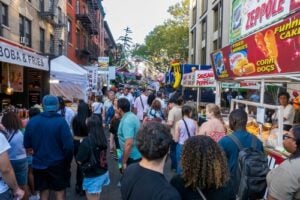
Crowds fill the streets of Little Italy during the annual Feast of San Gennaro in New York City. Feature Photo: Brian Logan Photography / Shutterstock.com
Few sights signal the arrival of warmer weather in New York City quite like wooden street barricades rolling into place on a weekend morning. Within hours, traffic lanes can become pedestrian bazaars filled with sizzling sausage and pepper skillets, zeppole fryers, vintage stalls, handmade goods, live music, and neighborhood crowds.
New York City’s street fairs are not one single tradition. They grew from several different strands of city life: immigrant religious feasts, the open-air pushcart economy, neighborhood merchant associations, flea markets, block parties, and, more recently, city programs that temporarily return streets to pedestrians.
Some of these events have been part of New York for more than a century. Others are much newer. Together they show how often New Yorkers have turned ordinary streets into places to shop, eat, celebrate, worship, perform, and simply spend time together.
From Pushcarts to Street Fairs: The Roots of New York’s Outdoor Markets
The Lower East Side of the late nineteenth and early twentieth centuries was one of the great open-air shopping districts in American history. Immigrants crowded into tenements while pushcart peddlers worked the surrounding streets, selling vegetables, fish, pickles, clothing, household goods, and countless other necessities.
Orchard, Hester, Grand, Rivington, Stanton, and East Houston Streets became closely associated with the pushcart trade. For newly arrived families, selling from a cart could provide an entry into New York’s economy without the expense of opening a permanent storefront.
The streets could also become extraordinarily congested. Pushcarts competed for space with pedestrians, horses, automobiles, delivery vehicles, and established merchants. Sanitation and licensing became recurring political issues as city officials searched for ways to regulate the sprawling outdoor economy.
Fiorello La Guardia Moves the Pushcarts Indoors
During the administration of Mayor Fiorello La Guardia, New York made a major effort to move pushcart vendors into permanent public markets.
The Park Avenue Retail Market opened in East Harlem in 1936 and later became known as La Marqueta. The city built the Essex Street Market buildings in 1939, and the market opened in 1940 with space for hundreds of vendors who had previously worked in Lower East Side open-air markets.
La Guardia’s market program changed the physical character of street commerce, but it did not end New Yorkers’ appetite for shopping and gathering outdoors. Religious feasts continued, neighborhood festivals grew, merchant groups organized avenue events, and block associations made temporary street closures a familiar part of city life.
How Street Fairs Work in New York Today
Modern New York distinguishes among several types of street events. The city’s Street Activity Permit Office issues permits for street festivals, block parties, farmers markets, single-block festivals, and other activities on streets, sidewalks, and pedestrian plazas.
A traditional block party is different from a commercial street fair. Under current city rules, a block party is a community-sponsored event limited to one block and one day, with no sale of goods or services. Larger festivals with vendors fall into different permit categories.
The street-fair tradition has also expanded through New York City’s Open Streets program. In 2026, the Department of Transportation supported more than 150 initial Open Streets across the five boroughs, creating temporary pedestrian spaces for community programming, outdoor dining, recreation, and neighborhood events.
Where Are the Best Street Fairs and Markets in NYC?
New York has far too many neighborhood festivals to reduce the entire city to a single definitive ranking. However, several events stand out because of their history, scale, food, cultural importance, or distinctly New York character.
Street-fair dates can shift from year to year, so the listings below include both the time of year each event is usually held and the confirmed 2026 dates where available.
1. Feast of San Gennaro, Little Italy
Location: Mulberry Street and surrounding streets in Little Italy, Manhattan
Tradition Began: 1926
Usually Held: Eleven days in mid-to-late September
2026 Dates: September 17–27, 2026
The Feast of San Gennaro is probably New York City’s most famous Italian street feast. Neapolitan immigrants living around Mulberry Street organized the first celebration in 1926 as a one-day block party honoring San Gennaro, the patron saint of Naples. As much as I love this feast, it is by far the most challenging to walk through as it gets incredibly packed with people. You can barely move. There isn’t much room because the streets of Little Italy are very narrow.
The celebration eventually grew into an eleven-day festival stretching through the heart of Little Italy. Food is one of the great attractions. Sausage and peppers, zeppole, cannoli, torrone, pizza, pasta, seafood, and other Italian-American specialties compete with carnival games, music, processions, and religious observances for visitors’ attention.
San Gennaro is not New York’s oldest Italian feast, but its Mulberry Street setting and enormous popularity have made it one of the city’s defining annual street celebrations.
2. Ninth Avenue International Food Festival, Hell’s Kitchen
Location: Ninth Avenue from West 42nd Street to West 57th Street, Manhattan
Tradition Began: 1973
Usually Held: One weekend in mid-May
2026 Dates: May 16–17, 2026
The Ninth Avenue International Food Festival began in 1973 and grew alongside the changing restaurant culture of Hell’s Kitchen. The Ninth Avenue Association describes it as New York City’s oldest and largest continuing food festival.
For one weekend each May, fifteen blocks of Ninth Avenue become a showcase for neighborhood restaurants and visiting food vendors. Greek, Mexican, Caribbean, Italian, Brazilian, Thai, Middle Eastern, and other cuisines reflect the extraordinary culinary diversity that has long defined the avenue.
The attraction is not simply the number of food stands. The festival works best as a giant neighborhood tasting event, where long-established Hell’s Kitchen businesses share the avenue with performers, community organizations, and temporary vendors.
3. Atlantic Antic, Brooklyn
Location: Atlantic Avenue from Fourth Avenue to Hicks Street, Brooklyn
Tradition Began: 1974
Usually Held: One Sunday in late September or early fall
2026 Date: September 27, 2026
The Atlantic Antic has been held on Atlantic Avenue since 1974 and is described by its organizer, the Atlantic Avenue Local Development Corporation, as the oldest and largest street festival in Brooklyn.
The fair stretches for more than a mile through the neighborhoods surrounding Atlantic Avenue. Hundreds of vendors join local restaurants, shops, craftspeople, artists, musicians, and community organizations for an event that feels much more closely tied to its avenue than many generic street fairs.
That neighborhood connection is one of the reasons the Atlantic Antic has lasted. Atlantic Avenue’s restaurants and independent businesses remain part of the attraction rather than simply serving as a backdrop for the festival.
4. Our Lady of Mount Carmel Feast and the Dancing of the Giglio, Williamsburg
Location: Streets surrounding Our Lady of Mount Carmel, 275 North 8th Street, Williamsburg, Brooklyn
Tradition Began: 1887; the first Brooklyn Giglio Feast was organized in 1903
Usually Held: Twelve days in July surrounding the July 16 Feast of Our Lady of Mount Carmel
2026 Dates: July 8–19, 2026
Williamsburg’s Our Lady of Mount Carmel Feast reaches farther back than the Feast of San Gennaro. Italian Americans have celebrated the parish feast since 1887, while immigrants from Nola organized the first Brooklyn Giglio Feast in 1903.
The centerpiece is the Dancing of the Giglio, a towering structure standing more than seventy feet high and carried through Williamsburg by more than one hundred lifters. Music accompanies the enormous structure as the men raise, turn, and “dance” it through the streets.
The religious and cultural tradition honors San Paolino, or Saint Paulinus, and developed from customs brought to Brooklyn from Nola in southern Italy. Today, the feast runs for twelve days in July and combines religious observances with food vendors, rides, games, entertainment, and one of the most extraordinary street spectacles in New York City.
5. Grand Bazaar NYC, Upper West Side
Location: 100 West 77th Street at Columbus Avenue, Manhattan
Tradition Began: Around 1979; reincorporated in 1985
Usually Held: Every Sunday, year-round
2026 Schedule: Sundays from 10:00 a.m. to 5:00 p.m., indoors and outdoors
Grand Bazaar NYC traces its roots to a yard sale organized by public-school parents around 1979 to raise money for their children’s schools. The market later became known as GreenFlea and was reincorporated in 1985 before taking the Grand Bazaar NYC name decades later.
It remains an indoor-and-outdoor Sunday market featuring vintage dealers, artists, independent designers, collectors, jewelry makers, and food vendors. Unlike a once-a-year street festival, Grand Bazaar is part of the weekly rhythm of the Upper West Side.
The market also retains its original educational mission. Its net profits support four neighborhood public schools and more than 2,000 children, tying the market’s commercial activity directly back to the community that created it.
6. Queens Night Market, Flushing Meadows-Corona Park
Location: New York Hall of Science area, Flushing Meadows-Corona Park, Queens
Tradition Began: 2015
Usually Held: Saturday evenings from spring through fall, with a late-summer break during the U.S. Open
2026 Dates: Saturdays, April 18–August 22 and September 19–October 31, 2026, from 4:00 p.m. to midnight
The Queens Night Market is much younger than New York’s historic religious feasts, but it may represent the clearest modern continuation of the city’s open-air market tradition. Founded in 2015, it was designed around the extraordinary cultural diversity of Queens and the idea that visitors should be able to sample food from many countries without spending restaurant prices on every dish.
The market takes place beside the New York Hall of Science and brings together more than one hundred independent food, art, and merchandise vendors over the course of its season. Small cultural performances add to an atmosphere that feels closer to an international night bazaar than a conventional Manhattan avenue fair.
The Queens Night Market also serves as an incubator for small food businesses. Vendors representing cuisines from around the world have used the market as a place to introduce dishes to New Yorkers, test concepts, and build followings before moving into other forms of food service.
Where to Find NYC Street Fairs Throughout the Season
There is no single street-fair season that covers every New York event, but the calendar becomes especially active from spring through early fall. Traditional avenue fairs appear across Manhattan and the outer boroughs, while Italian religious feasts are concentrated in summer and September.
Open Streets add another layer to the calendar. Unlike a one-day street fair, many Open Streets operate on recurring days for weeks or months and may feature outdoor dining, children’s activities, performances, markets, or simply car-free public space.
Schedules change from year to year. The city’s Street Activity Permit Office, NYC DOT Open Streets listings, community boards, business improvement districts, and individual festival organizers are the best places to confirm dates and street closures before making a trip.
Why New York Keeps Taking Commerce Back to the Street
The modern street fair is very different from a Lower East Side pushcart market in 1900, and a curated Upper West Side flea market is different from a Catholic feast in Williamsburg. Yet all of them depend on the same basic New York idea: a city street can temporarily become something more than a place for traffic.
For a few hours, an avenue can become a restaurant, a market, a concert stage, a neighborhood reunion, a religious procession, or a place where thousands of strangers walk together without watching for the next light to change.
That may be the strongest connection between the old pushcart streets and today’s festivals. New York has repeatedly found new reasons to turn commerce and community inside out and put them directly onto the pavement.
Sources
City of New York, History of La Marqueta and the Park Avenue Retail Market
NYC Street Activity Permit Office, Permit Types
NYC Department of Transportation, Open Streets
Feast of San Gennaro, Official History
Ninth Avenue International Food Festival
Baruch College, Ninth Avenue International Food Festival History
Atlantic Avenue Local Development Corporation, Atlantic Antic
Our Lady of Mount Carmel Feast, Official History
Grand Bazaar NYC, Mission and History
NYC Street Fairs and Markets at a Glance
| Street Fair or Market | Neighborhood | Tradition Began | Usual Timing / 2026 Dates | Best Known For |
|---|---|---|---|---|
| Feast of San Gennaro | Little Italy, Manhattan | 1926 | Mid-to-late September; Sept. 17–27, 2026 | Italian-American food, religious tradition, and Mulberry Street atmosphere |
| Ninth Avenue International Food Festival | Hell’s Kitchen, Manhattan | 1973 | Mid-May weekend; May 16–17, 2026 | International food and neighborhood restaurants |
| Atlantic Antic | Atlantic Avenue, Brooklyn | 1974 | Late September/early fall; Sept. 27, 2026 | Brooklyn businesses, food, crafts, and live entertainment |
| Our Lady of Mount Carmel Feast and Giglio | Williamsburg, Brooklyn | 1887; Giglio tradition 1903 | 12 days in July around July 16; July 8–19, 2026 | The Dancing of the Giglio and Italian-American religious tradition |
| Grand Bazaar NYC | Upper West Side, Manhattan | Around 1979 | Every Sunday year-round; 10 a.m.–5 p.m. in 2026 | Vintage goods, independent makers, and support for local public schools |
| Queens Night Market | Flushing Meadows-Corona Park, Queens | 2015 | Saturdays; Apr. 18–Aug. 22 and Sept. 19–Oct. 31, 2026 | Affordable international street food and independent vendors |
Published August 18, 2026.
Where Are the Best Street Fairs in NYC? The History of New York Street Markets article published on ClassicNewYorkHistory.com © 2026