Feature Photo: star5112, CC BY-SA 2.0 <https://creativecommons.org/licenses/by-sa/2.0>, via Wikimedia Commons
Long before New York City became a global showcase for celebrity chefs and social-media dining trends, much of the city’s culinary identity was built in automats, German beer halls, Broadway restaurants, society dining rooms, Jewish delicatessens, and neighborhood institutions whose names became part of everyday New York conversation.
These establishments are all gone from New York’s dining scene today. Together, they tell the story of a city where the room, the regulars, and the ritual of going out to eat could matter just as much as what was on the plate.
1. Horn & Hardart Automat
New York Era: 1912–1991
Notable Locations: Times Square, Sixth Avenue, and dozens of Manhattan locations
We open with one I truly miss, where I spent many Sunday mornings eating breakfast with my father and uncle. Horn & Hardart transformed inexpensive urban dining into something that felt both futuristic and completely democratic. The company opened its first New York Automat in 1912, introducing generations of New Yorkers to walls of small glass-fronted compartments where a few coins could buy sandwiches, macaroni and cheese, vegetables, pie, and other prepared foods.
The gleaming chrome, marble, mirrors, and coin-operated doors made the Automat feel like a machine, but an enormous workforce stood behind those compartments keeping the food fresh and the system moving. Wall Street workers, Broadway performers, office clerks, tourists, students, and people with very little money could all sit at the same tables. The Automat became so deeply woven into New York life that its disappearance still evokes powerful memories.
What Happened: Changing work patterns, suburbanization, rising operating costs, and competition from newer fast-food chains gradually weakened the Automat model. Horn & Hardart converted many locations to Burger King restaurants during the 1970s. The last New York Automat closed in 1991.
For the full story, read our History of Horn & Hardart Automats.
2. Lutèce
Active Years: 1961–2004
Location: 249 East 50th Street, Midtown Manhattan
Lutèce opened in 1961 and became one of the most celebrated French restaurants in the United States. Founder André Surmain brought the young Alsatian chef André Soltner to New York to run the kitchen, and Soltner eventually became the restaurant’s defining figure.
Lutèce was elegant without becoming theatrical. Its reputation rested on meticulous French cooking, exceptional ingredients, deeply personal service, and the consistency Soltner maintained for decades. At its height, reservations could require months of planning, and the restaurant drew political leaders, international visitors, actors, writers, and generations of New Yorkers celebrating important occasions.
During the 1980s, Zagat ranked Lutèce as the best restaurant in America for six consecutive years. Soltner sold the restaurant in 1994, and later owners attempted to modernize it, but the changes never recreated the extraordinary relationship the original restaurant had with its regulars.
What Happened: Lutèce served its final dinner on February 14, 2004, closing after nearly 43 years. Its disappearance marked the end of one of the great eras of formal French dining in New York.
3. Lüchow’s
Original Union Square Era: 1882–1982
Location: 110–112 East 14th Street
German immigrant August Lüchow took over the small café where he had worked as a waiter and bartender in 1882 and gradually transformed it into one of New York’s best-known German restaurants. Lüchow’s expanded through adjoining buildings until it became a sprawling institution filled with dark wood, mirrors, paintings, music, enormous meals, and imported beer.
Its location near Union Square placed it in the middle of New York’s theater, music, publishing, and literary worlds. Victor Herbert was closely associated with the restaurant, and musicians, writers, actors, politicians, and visiting celebrities made Lüchow’s one of the city’s great gathering places.
What Happened: Lüchow’s left its East 14th Street home in 1982 and attempted to continue in Midtown for another two years. The original building later suffered a major fire in 1992 and was demolished in 1995. An NYU residence hall eventually rose on the site.
4. The Stork Club
Active Years: 1929–1965
Final Location: 3 East 53rd Street
Sherman Billingsley’s Stork Club became one of the great symbols of New York café society. After operating at earlier addresses, the club moved to 3 East 53rd Street in 1934 and remained there until it closed in 1965.
The club’s most famous inner sanctum was the Cub Room, where admission itself became a sign of social status. Newspaper and radio columnist Walter Winchell held court at Table 50, surrounded by celebrities, politicians, socialites, athletes, and other people who understood that being seen at the Stork Club could be almost as important as what happened there.
What Happened: Labor disputes, changing nightlife tastes, and the decline of the old café-society culture contributed to the Stork Club’s closing in October 1965. Its building was demolished, and Paley Park opened on the site in 1967.
5. Toots Shor’s Restaurant
Classic Era: 1940–1971
Historic Locations: 51 West 51st Street and later 33 West 52nd Street
Bernard “Toots” Shor created a restaurant whose biggest attraction was not necessarily the food. It was the crowd. Athletes, sportswriters, entertainers, judges, politicians, and Broadway personalities gathered around Shor’s enormous circular bar, where the proprietor’s insults could function as a sign of affection.
Joe DiMaggio was one of Shor’s closest celebrity regulars. Jackie Gleason, Frank Sinatra, Yogi Berra, and many other familiar names were part of the restaurant’s mythology. PBS described Toots Shor’s as the place to be in New York during its prime, a setting where famous people came to be around other famous people.
What Happened: Shor sold the lease on the original West 51st Street restaurant in 1958 and left the building in 1959 as the property was assembled for redevelopment. He opened a new Toots Shor’s at 33 West 52nd Street in 1960. Financial troubles eventually caught up with the operation, and authorities padlocked the restaurant in 1971 for unpaid taxes. Shor attempted another comeback, but the great era of his restaurant had ended.
6. Sherry’s
Fifth Avenue and 44th Street Era: 1898–1919
Location: Fifth Avenue and 44th Street
Louis Sherry built one of the defining restaurants of Gilded Age New York. By the time Sherry’s occupied its grand Fifth Avenue and 44th Street building, it had become one of Delmonico’s most formidable rivals for society dinners, private parties, formal balls, and extravagant celebrations.
Nothing demonstrated that extravagance better than C.K.G. Billings’s famous horseback dinner on March 28, 1903. Thirty-six guests ate a 14-course dinner while seated on horses inside Sherry’s ballroom. The floor was covered with sod, the room was transformed into a country setting, and specially designed trays allowed the riders to dine without dismounting.
What Happened: Sherry’s left the Fifth Avenue and 44th Street building in 1919, but the business did not simply vanish with that move. The Sherry name continued through catering, confections, and later restaurant operations. What disappeared was the great Fifth Avenue dining palace that had epitomized New York’s Gilded Age society scene.
7. Mamma Leone’s
Active Years: 1906–1994
Famous Location: 239 West 48th Street
Mamma Leone’s began in 1906 with Luisa Leone serving Italian food in a small family setting and grew into one of the most famous Italian-American restaurants in the country. Enrico Caruso became closely associated with the restaurant’s early history, and over the decades Leone’s developed into an enormous Theater District destination.
At 239 West 48th Street, Mamma Leone’s spread through multiple rooms and adjoining spaces. It was theatrical, excessive, warm, crowded, and unmistakably old New York. Politicians, athletes, actors, tourists, theatergoers, and generations of families ate beneath its elaborate decorations while huge portions of Italian-American food arrived at the table.
What Happened: The famous West 48th Street location closed in 1988 as redevelopment changed the block. Mamma Leone’s continued at another Theater District location, including space associated with the Milford Plaza, before closing for good in 1994.
The restaurant belonged to the same changing Theater District explored in our History of Times Square in New York City.
8. Stage Deli
Active Years: 1937–2012
Location: 834 Seventh Avenue
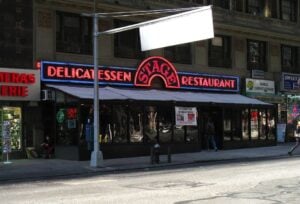
Max Asnas opened the Stage Deli in 1937, helping turn a stretch of Midtown into one of New York’s great Jewish delicatessen districts. The Stage became famous for oversized sandwiches, Broadway clientele, celebrity photographs, and the kind of quick New York banter that could be as memorable as the pastrami.
The menu reflected the world around it, with sandwiches and dishes named after entertainers and other celebrities. Its rivalry with the nearby Carnegie Deli became part of the mythology of Seventh Avenue.
What Happened: Stage Deli closed on November 29, 2012, after 75 years. Its owners cited difficult business conditions, scaffolding that had hurt traffic, and repeated rent increases, with another increase expected when the lease expired.
For another surviving piece of New York deli culture, read why Katz’s Delicatessen remains one of the city’s great pastrami institutions.
9. Elaine’s
Active Years: 1963–2011
Location: 1703 Second Avenue, Upper East Side
Elaine Kaufman opened Elaine’s in 1963 on Second Avenue and turned an ordinary Upper East Side restaurant into one of the most famous literary and celebrity gathering places in New York. Writers, journalists, actors, directors, comedians, politicians, and other New York personalities treated the restaurant less like a formal dining room than an extension of their own living rooms.
The list of regulars became part of Elaine’s legend: Gay Talese, Norman Mailer, George Plimpton, Woody Allen, Michael Caine, Nora Ephron, and many others gathered there over the decades. The restaurant’s appeal was inseparable from Kaufman herself, who decided who sat where, greeted longtime customers as family, and created a social world that could not easily be reproduced anywhere else.
What Happened: Elaine Kaufman died in December 2010. Her longtime manager Diane Becker inherited the restaurant and initially tried to keep it going, but concluded that the business could not survive without its founder. Elaine’s served its final meal on May 26, 2011.
Its closing ended nearly half a century of one of New York’s most distinctive restaurant scenes, where conversation, personalities, and the people in the room often mattered more than the menu.
10. The Four Seasons Restaurant
Original Seagram Building Era: 1959–2016
Final Revival: 2018–2019
Historic Location: 99 East 52nd Street in the Seagram Building
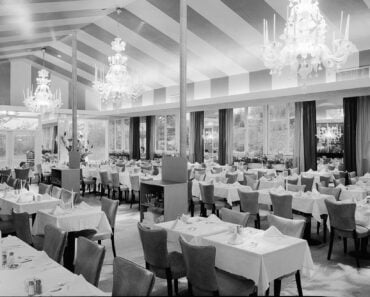
The Four Seasons opened in 1959 inside the Seagram Building and became one of the most influential restaurants in New York City history. Designed by Philip Johnson, its celebrated Pool Room and Grill Room created a modern dining environment unlike almost anything that had come before it. The restaurant was so important architecturally that its interiors were designated a New York City Interior Landmark in 1989.
For decades, The Four Seasons became synonymous with the New York power lunch. Corporate executives, publishers, politicians, celebrities, cultural figures, and dealmakers filled its tables, while the restaurant’s seasonal approach to menus helped popularize an idea that later became commonplace in American fine dining.
The restaurant’s physical setting was inseparable from its reputation. The marble pool, soaring ceilings, metal curtains, modernist furniture, and dramatic rooms made dining there feel like entering one of the great public interiors of postwar Manhattan.
What Happened: The Four Seasons served its final meal in the Seagram Building in July 2016 after 57 years. Owners later revived the restaurant nearby at 42 East 49th Street in 2018, but the new version lasted less than a year. It closed in June 2019 after investors concluded that the business was not generating enough revenue.
The Four Seasons name is now gone from New York dining, while its original landmarked Seagram Building rooms continue under different restaurant operators. What disappeared was one of the defining social institutions of postwar Manhattan.
More New York Food History
New York’s restaurant history stretches far beyond these 10 dining rooms. For more old-school New York food stories, read our History of Horn & Hardart Automats, History of New York Cheesecake, our look at Katz’s Delicatessen and its famous pastrami, and Dreams of Fame Begin and End at the Stardust Diner.
Sources
Smithsonian Magazine: Meet Me at the Automat
Los Angeles Times: Lutèce Closes After Nearly 43 Years
Village Preservation: Lüchow’s and Kleindeutschland
Paley Park: History of the Former Stork Club Site
PBS American Experience: Bernard “Toots” Shor
Museum of the City of New York: A Dinner on Horseback at Sherry’s
Saveur: Mamma Leone’s and Italian-American Dining
Eater New York: Stage Deli Closes After 75 Years
Vanity Fair: Remembering Elaine’s
Eater New York: The Four Seasons Restaurant Closes After Its Midtown Revival
Updated August 20, 2026.