Feature Photo: William Graham, CC BY-SA 4.0 <https://creativecommons.org/licenses/by-sa/4.0>, via Wikimedia Commons
Travel north on Interstate 87 through the Adirondacks and eventually the food vocabulary changes. Around Plattsburgh and the Champlain Valley, one regional specialty appears again and again on diner menus and roadside signs: the Michigan.
To an out-of-town visitor, the name can be baffling. Why would a North Country hot dog be named after a Midwestern state? The answer is buried in nearly a century of Plattsburgh food history, family recipes, roadside stands, and local lore. The Michigan is a hot dog topped with a specially seasoned meat sauce, usually joined by mustard and chopped onions, and Plattsburgh has embraced it so completely that the Town of Plattsburgh officially celebrates July as Michigan Month.
1. What Exactly Is a Plattsburgh Michigan?
There is no single recipe shared by every stand, and that is part of the point. The Town of Plattsburgh describes the traditional Michigan as a natural-casing hot dog served in a split-top bun and covered with seasoned meat sauce, with mustard and onions optional. The onions can be placed on top or ordered “buried” beneath the sauce.
Beyond that basic framework, the details become intensely local. Some people prefer the bright red natural-casing Glazier franks made in Malone, while other stands use different dogs. The sauce may be sweeter, more tomato-forward, darker, pepperier, or more heavily spiced depending on where you order it. Recipes are famously guarded, and North Country Public Radio found that competing stands often treat the exact spice blend as a family or business secret.
- The Bun: Traditionally a split-top roll, usually steamed so it stays soft while holding the dog and meat sauce.
- The Hot Dog: Natural-casing franks are strongly associated with the regional style, and red-skinned Glazier dogs from Malone have long been a North Country favorite.
- The Michigan Sauce: A seasoned ground-meat sauce. The exact ingredients and texture vary from stand to stand, which is why locals can immediately argue about whose version is best.
- The Toppings: Yellow mustard and finely chopped onions are the classic additions. Onions can be served on top or “buried” beneath the sauce.
That variation is important. A Michigan is not defined by one universal secret recipe. It is defined by the Plattsburgh tradition of the hot dog, meat sauce, split-top bun, and the local customs that have grown around ordering and eating it.
2. Why Is It Called a Michigan?
The honest answer is that nobody can prove the complete origin story. A historic marker installed through the William G. Pomeroy Foundation notes that the Plattsburgh specialty was advertised as early as 1927 and states that the origin of the name is “buried in local lore.”
The earliest known newspaper advertisement announced a Michigan Hot Dog Shop associated with Garth C. Otis in Plattsburgh in 1927. One long-repeated explanation is that Garth and Eula Otis had connections to Michigan and that Eula either developed or learned the meat-sauce recipe there before bringing it to Plattsburgh. North Country accounts have also connected the style to the Coney-dog traditions that developed around Detroit and other Midwestern cities.
But even local historians have stopped short of calling that story proven fact. Retired Plattsburgh broadcaster and writer Gordie Little, who researched the Michigan for decades, told North Country Public Radio that the reason for the name remains uncertain. What can be established is that by the late 1920s, Michigans were being advertised in Plattsburgh, and over the following decades the food became deeply embedded in Champlain Valley culture.
3. The Ordering Language: With, Without, and Buried
Part of the fun of ordering a Michigan is the local shorthand. The vocabulary is simple once you know it, but it has become one of the traditions surrounding the food.
- “With”: Your Michigan comes with chopped onions.
- “Without”: No onions.
- “Buried”: The onions are placed beneath the Michigan sauce rather than scattered across the top. At some stands they may sit directly around or beneath the hot dog.
- “On top”: The chopped onions remain visible above the meat sauce.
The terminology is not merely tourist folklore. During Plattsburgh’s Michigan Fest, Town Supervisor Michael Cashman explained the same “with,” “without,” and “buried” vocabulary while discussing the food’s place in local culture. The advantage of buried onions is also practical: they stay inside the bun instead of falling off while you eat.
4. Five Plattsburgh-Area Michigan Stops to Know
The Town of Plattsburgh currently recognizes five local Michigan restaurants in its annual Michigan Passport program: Clare & Carl’s, Ronnie’s Michigan Stand, Gus’ Red Hots, McSweeney’s Red Hots, and Michigans Plus. They share the same regional tradition, but each has its own history and its own version of the sauce.
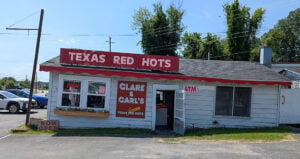
Clare & Carl’s – 4729 U.S. Route 9, Plattsburgh
Clare & Carl’s is one of the essential surviving roadside stands in the Michigan story. Local histories date the business to 1942, and generations of customers have pulled off Route 9 for dogs served from the small old-school stand. The experience remains part of the attraction: carhop service, counter seating, steamed buns, and the house Michigan sauce give the place the feeling of an earlier roadside era.
Clare & Carl’s is also one of the places most closely associated with the “with, without, or buried” ordering ritual. The recipe has long been treated as proprietary, reinforcing the larger Plattsburgh tradition in which every stand insists its sauce has a personality of its own.
Ronnie’s Michigan Stand – 1265 State Route 3, Morrisonville
Ronnie’s Michigan Stand was founded in 1959 by Veronica “Ronnie” Jette and remains one of the best-known Michigan stops west of Plattsburgh. The stand celebrated its 65th anniversary in 2024, and its seasonal reopening remains a familiar sign of spring for many local residents.
Ronnie’s is especially known for a sauce that has historically been described as sweeter and more tomato-forward than some competing versions. Like the other classic stands, it has built its identity around repeat local customers, carhop-style service, and a recipe whose precise spice mixture is kept private.
Gus’ Red Hots – 5 Commodore Thomas MacDonough Highway, Plattsburgh
Gus’ Red Hots opened in 1951 as a small sandwich shop operated by Gus Niforos and his brother-in-law Peter Larios. The restaurant grew over the decades into a full diner, but the Michigan remained one of its defining foods. Gus’ own history says its hot dog with meat sauce, mustard, and chopped onions quickly became a local favorite.
Today the restaurant still sells its “Famous Red Hot Michigan Dog,” along with a much larger diner menu. Unlike some seasonal stands, Gus’ operates as a year-round restaurant, making it one of the easiest places for travelers to try a Michigan outside the traditional summer drive-in season.
McSweeney’s Red Hots – Plattsburgh
McSweeney’s is younger than the oldest Michigan stands but has become firmly established in the local tradition. The company opened its first restaurant in 1991 at 7067 Route 9 under brothers Michael and Stephen Farrell and later expanded to additional Plattsburgh-area locations.
McSweeney’s version is often described as having a little more pepper and heat than some competitors. Its restaurants combine the Michigan tradition with burgers, fries, shakes, and roadside-style service, helping carry the regional specialty into a more modern fast-casual setting without abandoning the basic formula.
Michigans Plus – 313 Cornelia Street, Plattsburgh
Michigans Plus rounds out the five restaurants included in the Town of Plattsburgh’s Michigan Passport program. It operates more like a traditional family diner than a roadside hot dog stand, with a broad breakfast and lunch menu alongside the regional specialty.
That makes it useful evidence of how deeply the Michigan has moved beyond the original drive-in stands. In Plattsburgh, the dish is not confined to one nostalgic roadside format. It can turn up at a counter-service stand, a carhop, or a full diner and still be immediately understood as part of the same North Country food tradition.
5. From Roadside Food to Regional Identity
The Michigan has become important enough to Plattsburgh that local government now treats it as part of the region’s cultural identity. In 2022, the Town Board declared July “Michigan Month,” noting that the Plattsburgh area has one of the highest concentrations of Michigan restaurants and that the food had been a local favorite for more than ninety years.
The town’s Michigan Passport encourages people to visit participating restaurants during July, while Michigan Fest has added a larger public celebration built around the same food tradition. North Country Public Radio reported that thousands attended the inaugural festival in 2025.
That may be the best explanation for why locals bristle when an outsider casually dismisses the Michigan as just another chili dog. It is not simply the meat sauce. It is the roadside stands, the secret recipes, the ordering language, the family arguments over which version is best, and nearly a century of people in and around Plattsburgh knowing exactly what someone means when they say they are going out for “two buried.”
Quick Guide to Ordering a Plattsburgh Michigan
| Order Term | What It Means |
|---|---|
| With | Michigan served with chopped onions. |
| Without | Michigan served without onions. |
| Buried | Onions placed beneath the Michigan sauce instead of on top. |
| On Top | Chopped onions placed over the meat sauce. |
For more on Upstate New York food traditions, see 20 Foods That Were Invented in Upstate New York. Readers spending time in Plattsburgh may also enjoy our review of The Pepper in downtown Plattsburgh and our guide to Plattsburgh’s most popular hotels.