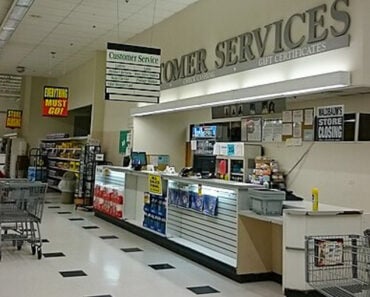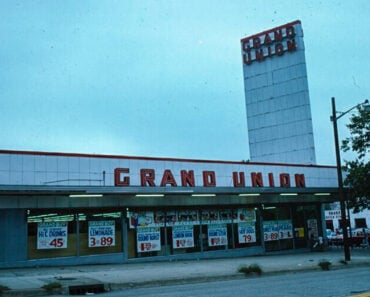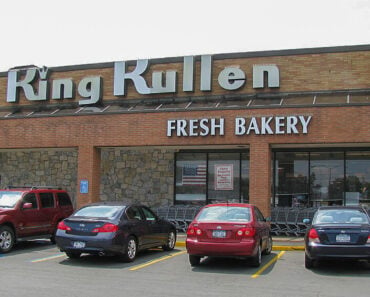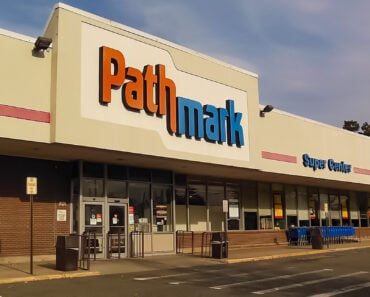
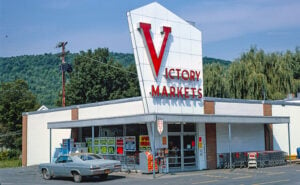
Victory Market on Main Street in Margaretville, New York, in 1976. Photo: John Margolies / Library of Congress.
In the early 80s, I worked at an A&P supermarket in New York for three years. I was young at the time, but because I worked very hard, every department wanted me for themselves. While it often created arguments between department managers, the benefit for myself was I learned a lot about food. Lessons that I would utilize for the rest of my life. I also came to appreciate the people who work in supermarkets, people who do it for their entire lives. I have a fondness for it all. That’s why I write so many articles about supermarkets on this site. I think anyone who is grown up in New York connects to supermarkets. It’s the one store that we go to more than any others. So I hope if you’re following my work here, you are enjoying the supermarket articles.
For much of the twentieth century, the supermarket a family shopped at was a clue to where it lived in Upstate New York. In Syracuse, it might have been P&C or Victory Markets. In Buffalo, Bells and Super Duper competed for customers long before the arrival of some of today’s biggest chains. Rochester shoppers remember Hart’s and Star, while Albany residents knew the extraordinary stores built by Albany Public Markets. Many of these names disappeared from the signs outside shopping plazas, but they remain part of the history of those communities.
The changes began long before the era of supercenters and online grocery delivery. Neighborhood grocery chains gave way to self-service supermarkets with bigger meat counters, parking lots, and entire departments devoted to frozen foods. New shopping centers followed families into the suburbs. Later came corporate mergers, discount competition, rising expenses, and bankruptcies. One grocery building might carry three or four different names in a single generation, leaving customers with the odd experience of shopping at the same address while watching the store they knew disappear.
This list looks at 25 historic supermarket and grocery-store banners that no longer represent the operations Upstate shoppers once knew. Some were sizable supermarket chains; others were older neighborhood grocers or short-lived regional formats. A few parent companies or successor businesses are still operating, which is not the same as saying the original chain survived unchanged. That distinction matters, especially for names such as P&C and Acme. What follows is a look at the businesses, the towns they served, and the changes that took their familiar signs off the landscape.
1. P&C Food Markets (Central and Northern New York)
P&C’s story began in 1944 as a producers-and-consumers cooperative in Ithaca, designed to connect regional farm products with shoppers. The business grew into one of Central New York’s most recognizable grocery names. In Syracuse, Ithaca, Cortland, and communities stretching toward the North Country, the P&C sign identified the supermarket where families bought everything from holiday groceries to the week’s ordinary necessities. The company also became a wholesaler that supplied independent stores, including many operating under the Big M name.
P&C later became part of Penn Traffic, whose financial troubles brought the old regional network to an end. Following the company’s 2009 bankruptcy, Tops acquired the chain’s stores in 2010, and many were converted to the Tops name. The P&C name has not vanished completely, however. A separate locally owned operator retained the name as P&C Fresh at stores in Ithaca and Cortland. What disappeared was the extensive P&C Food Markets chain shoppers remember across Upstate New York.
2. Bells Markets (Buffalo and Rochester)
Bells was a familiar competitor in the crowded Western New York grocery business, with stores in Buffalo-area neighborhoods, suburbs, and eventually parts of Rochester. Long before one or two enormous supermarkets could dominate a shopping district, customers could compare a Bells advertisement with a Tops, Super Duper, or A&P circular and choose where to spend the family grocery budget. Its everyday reputation grew from that intensely local competition rather than from a nationwide advertising campaign.
Old city directories tell the story of change at individual addresses. Stores that carried the Loblaws or Park Edge names in one decade appeared as Bells in another. In the 1990s the Bells presence shrank as locations changed operators or disappeared. The company’s sign was gradually replaced, but it remains associated with a Western New York period when a short drive could take shoppers past several substantial hometown grocery competitors.
3. Victory Markets (Central New York and the Mohawk Valley)
Victory Markets belonged to a Central New York grocery tradition that extended far beyond downtown Syracuse. A predecessor known as Victory Chain bought the Johnson’s stores in 1955, helping the business gain a wider foothold in the area. Its locations served communities such as Solvay, Baldwinsville, and other towns that were growing along with the suburbs. For many customers, Victory was a practical neighborhood alternative to the largest national supermarket chains.
The later history was less successful. Victory Holdings expanded beyond New York, acquiring the troubled Almacs supermarket operation in New England in 1994. In 1995, financial pressures and debt problems pushed Victory Markets and New Almacs into Chapter 11 bankruptcy protection. The disappearance of Victory’s original local grocery identity was part of a larger wave of restructuring that changed the retail landscape from the Mohawk Valley westward.
4. Star Super Markets (Rochester)
Rochester’s Star Super Markets came out of the much older Hart’s grocery business. Hart’s began opening supermarkets under the Star name in 1940, adapting to the demand for bigger stores that could combine produce, meat, packaged food, and household supplies under one roof. Star locations spread through Rochester and its developing suburbs, giving an old neighborhood grocery organization a place in the new supermarket age.
The shift was dramatic. By the 1970s, Star still appeared at numerous Rochester addresses, including South Avenue, Penfield Road, and West Henrietta Road. During the early 1980s, many former Star locations acquired other names, including Bells and Apple’s. Star therefore represents more than a vanished sign. It marks the moment when a chain built to replace small neighborhood shops found itself facing another round of consolidation and more powerful supermarket competitors.
5. Quality Markets (Western New York and the Southern Tier)
Quality Markets had especially deep roots in the Southern Tier. Its history began in Jamestown in 1913, and the company became an important grocery operator in Chautauqua County and neighboring communities. Customers knew it in an era when supermarkets competed fiercely over fresh meat, weekly specials, and prices on essential household goods. Quality later moved into additional Western New York communities and became a meaningful competitor around Buffalo.
By the late twentieth century, Quality was part of Penn Traffic. Its corporate history even entered the federal courts in a dispute involving supermarket competition in the Jamestown area. The chain’s last major transition came with Tops’ acquisition of Penn Traffic’s operations in 2010. Quality stores were rebranded, ending a name that had been part of Western New York shopping for generations, even though many of the underlying grocery locations continued serving customers.
6. Super Duper (Buffalo and Western New York)
Super Duper was one of the unforgettable names in Western New York supermarket history. In the years when families clipped coupons from the newspaper and planned trips around advertised specials, the chain appeared in Buffalo neighborhoods and communities such as Hamburg, Orchard Park, and Tonawanda. Its stores were an important part of a local marketplace that also included Bells, Tops, A&P, and later Wegmans.
The changes can be traced through former store addresses. A location listed as Super Duper in the 1980s might appear as Jubilee Foods in the 1990s, while other buildings were closed or taken over by different operators. The regional Super Duper network was eventually lost to changing ownership and competition. For longtime Western New Yorkers, the words still evoke a period when supermarket names felt inseparable from particular plazas and neighborhoods.
7. Loblaws (Western and Central New York)
Loblaws may sound to today’s shoppers like a Canadian supermarket name, but for decades it was also part of everyday life south of the border. Stores operated in Buffalo, Rochester, Syracuse, Watertown, and other Upstate communities. Their presence went back to an earlier period when grocery chains expanded through dense networks of neighborhood locations and later tried to keep up with the movement toward larger self-service stores.
By the 1970s, the American Upstate operation was retreating. Historical Syracuse store records indicate that Loblaws left that market and much of Upstate New York around 1977. In many communities, its former locations became other supermarkets, sometimes with little change to the building itself. The Canadian company survived, but the Loblaws that New York families remember from their own neighborhood shopping trips is long gone.
8. Albany Public Markets (Capital Region)
Albany Public Markets grew from the work of the Nigro family into one of the Capital Region’s most ambitious supermarket businesses. Its history was connected to the development of shopping centers and the movement away from small neighborhood stores. The company made a particular impression with large, heavily promoted food markets on Central Avenue and at Westgate Plaza, where grocery shopping became part of a modern suburban-style retail experience.
The family was skilled at attracting public attention, but Albany Public Markets was more than a publicity success. It helped establish the large supermarket as a dominant local business model. Weis Markets purchased the chain in 1967 and continued operating it under the familiar name for years. In 1986, Weis closed its Albany Public Markets operation and leased its stores to Grand Union. Another once-prominent Capital Region sign disappeared.
9. Hart’s Groceries (Rochester)
Before Rochester had widespread supermarket shopping, Hart’s filled streets across the city with small grocery stores. Started by Moses Hart and expanded by his son Alfred, it became closely connected to the city’s neighborhoods. By the late 1920s there were more than one hundred Hart’s locations. Such stores belonged to an era when shoppers could walk to the grocer and buy smaller quantities of food more frequently than many families do today.
The business gradually replaced that model with its Star supermarkets. Hart’s and Star operated alongside one another for years, but the older stores slowly closed as the larger supermarkets drew more business. The Hart’s name has since been borrowed by an unrelated Rochester grocery venture, but the original neighborhood chain did not return. Its importance lies in showing how an entire retail system could disappear without the company immediately abandoning the grocery business.
10. Park Edge Supermarkets (Western New York)
Park Edge had a distinct place in the Western New York grocery market during the 1960s and 1970s. Stores under that name appeared in Buffalo and Rochester-area shopping districts, competing with the larger regional chains as supermarkets expanded toward suburban roads and new plazas. It was part of a period when familiar local and regional operators could be found only a few miles apart, each trying to hold onto regular customers.
Historical store directories show how quickly the Park Edge identity faded. A Rochester location on West Henrietta Road, for instance, appeared as Park Edge in the 1970s and as Bells by the mid-1980s. Buffalo-area sites experienced similar changes. Rather than pretending every Park Edge store closed on one date, its story is better understood as a gradual disappearance through sales, conversions, and a changing regional grocery market.
11. Schaffer Stores (Schenectady and Eastern New York)
Schaffer Stores began in Schenectady in 1907 under Henry Schaffer. What began as a neighborhood grocery enterprise expanded across eastern New York, becoming one of the region’s notable examples of early chain-store retailing. Like Hart’s in Rochester, it belonged to the period before large supermarkets displaced the smaller shops where many customers made their regular food purchases.
The Schaffer business helped usher in that change rather than simply resisting it. By 1933, it was operating a supermarket under the Empire name, and the newer format steadily became central to the company’s operation. Grand Union bought the Schaffer business in 1958. Its original store name had already been giving way to Empire, so Schaffer survives in retail history as the predecessor of a later supermarket chain, not as a brand that remained unchanged until the takeover.
12. Acme Markets (Former Upstate New York Stores)
Acme is still a grocery name in other parts of the Northeast, but its former Upstate New York stores belong to an earlier chapter. Acme appeared in Syracuse-area locations and other New York communities during the middle of the twentieth century. The chain was associated with the American Stores organization and entered local markets where customers were already familiar with operators such as Market Basket, Loblaws, Victory, and P&C.
Acme acquired Syracuse’s Market Basket chain in 1955. The transition was not simply a matter of changing every sign overnight; records show some acquired stores changing operators or eventually closing. By the middle of the 1970s, Acme itself had withdrawn from Syracuse. The larger Acme company still operates outside this region, but the Upstate stores that once carried its name are no longer part of the local landscape.
13. Mohican Markets (Buffalo, Rochester, and Syracuse)
Mohican was a recognizable grocery name before many of Upstate New York’s best-remembered postwar supermarkets appeared. Historical directories place Mohican stores in Buffalo and Rochester in the 1930s, while Syracuse records show the name in use during the 1950s. These were not all giant supermarkets of the type now found beside highways. Many reflected a retail world still organized around compact city business districts.
The old Mohican locations were eventually displaced by newer formats and competing names. Rochester’s historical counts, for example, show the number of Mohican stores declining sharply as larger supermarkets spread into the suburbs. Mohican is a useful reminder that the lost supermarket story does not begin with the chains that failed in the 1990s. Earlier generations had already watched familiar grocers disappear as the industry adopted self-service, parking lots, and larger food departments.
14. B-Kwik Food Stores (Buffalo Area)
B-Kwik occupied a particular niche in the Buffalo grocery business. The stores were smaller than the full-service supermarkets taking over suburban shopping centers, yet they were more substantial grocery outlets than many corner convenience stores. Buffalo retail historian Steve Cichon has documented B-Kwik as part of the development of the Tops-related grocery business, along with Tops supermarkets and Wilson Farms stores.
Its history helps explain why customers sometimes remember a vanished grocery brand even when its parent company prospered. Different store formats served different purposes: a large supermarket for the week’s shopping and a smaller B-Kwik for a more convenient stop. Addresses on Hertel Avenue and Niagara Falls Boulevard carried the B-Kwik name into the 1980s and, in some cases, 1990. As the formats changed, the sign disappeared from Western New York streets.
15. Star Discount Foods (Buffalo Area)
Star Discount Foods was a Western New York discount grocery banner, separate from Rochester’s Star Super Markets. The similarity of the names can easily cause confusion, but the store histories are different. Buffalo-area directories record Star Discount Foods locations in the 1960s, including sites on Elmwood Avenue, West Ferry Street, and Bailey Avenue. Those records place the banner in the period when discounted groceries were becoming a powerful way to compete for the family food dollar.
Many stores did not keep the Star Discount name for long. At some addresses, later directory entries show Loblaws or other operators. Star Discount illustrates how a grocery banner could be visible for only a relatively short period while still forming part of neighborhood memory. Its disappearance was a matter of changing local operations, not evidence that Rochester’s unrelated Star chain had suddenly changed its name.
16. Super Saver (Rochester)
Super Saver appeared in the Rochester area during the 1970s as the supermarket business experimented with discount formats. The name suited a time when customers were increasingly willing to trade elaborate presentation for lower prices. Historical listings place Super Saver at locations such as East Henrietta Road and Browncroft Boulevard, where it competed with more familiar Rochester names such as Wegmans and Star.
The local Super Saver banner did not become a permanent part of Rochester retailing. By the mid-1980s, some of its former locations were identified with other operators, including Super Duper. Different grocery companies have used the words ‘Super Saver,’ so the Rochester stores should not automatically be confused with stores bearing the same name elsewhere. The Rochester-area discount supermarket presence eventually disappeared.
17. Par-Super Market (Syracuse)
Par-Super Market reaches back to an earlier Syracuse grocery landscape. Historic city directories record a location on West Fayette Street by 1940 and use of the Par-Super name alongside Community Stores at a North Franklin Street address in the 1950s. The business belonged to the city’s network of smaller neighborhood food retailers.
Par-Super belonged to a period when small chains and individual neighborhood grocers remained important even as supermarkets gained ground. Par-Super was a smaller Syracuse grocery operation, not a giant statewide chain. Stores like it competed on city streets before suburban shopping centers reshaped where people bought food.
18. One Way Stores (Watertown)
Watertown’s One Way Stores represent the oldest style of grocery retailer on this list. Local directory research identifies One Way shops at several city addresses during the 1920s and early 1930s, including Arsenal, Court, Clay, and State streets. This was before the full-size supermarket became the standard way many American families purchased groceries, and customers were still accustomed to shopping at smaller neighborhood outlets.
By the middle of the 1930s, a number of those addresses had acquired other grocery names. One Way operated as a chain of small neighborhood groceries rather than the modern supermarkets with long aisles and enormous parking lots that would come later. Its history shows that the North Country had its own competitive grocery market well before the automobile-centered retail era.
19. Larkin Economy Stores (Buffalo)
Buffalo’s famous Larkin Company is remembered for soap, mail-order sales, and its remarkable industrial buildings, but the company also operated neighborhood food stores. The Larkin Economy Stores appeared at numerous Buffalo addresses, including locations on Bailey Avenue, Hertel Avenue, and Elmwood Avenue. They were an effort to turn an already prominent consumer-products business into a more direct food retailer.
The experiment was not as successful as the company’s earlier enterprises. Research into the Larkin retail system documents repeated operating losses, particularly during the Depression, and the sale of its food stores in 1937. Many Buffalo locations passed to Danahy-Faxon, another regional grocery operator. Those storefronts are long gone, but they form an important and often overlooked part of the city’s retail history, long before today’s supermarket mergers.
20. Market Basket (Syracuse and Central New York)
Market Basket was an established Syracuse-area grocery name before its acquisition by Acme in 1955. Historic listings place Market Basket stores on East Fayette Street and Milton Avenue, as well as in nearby Liverpool and other local communities. It was a part of the era when chain grocers could build a citywide presence through several modestly sized stores rather than a handful of very large supermarkets.
The 1955 Acme purchase changed that network. Not every former Market Basket address became a lasting Acme supermarket, and some locations eventually carried still other names. That uncertainty is itself characteristic of food-retail history: a corporate acquisition might produce new signs, closed stores, or sales to independent operators. The Syracuse Market Basket was unrelated to the well-known New England supermarket company using the same name today.
21. Empire Super Markets (Capital Region and Hudson Valley)
Empire Super Markets emerged from Schaffer Stores, whose owner, Henry Schaffer, had been expanding grocery operations in and around Schenectady for years. The first Empire supermarket opened in 1933, helping move the business away from the small-shop model. Empire stores reached communities in the Capital Region and Hudson Valley, including the Poughkeepsie area, where the banner appeared in mid-century listings.
In 1958 Grand Union acquired the Schaffer organization, including 41 grocery stores that were operating largely under the Empire name. Federal Trade Commission records preserve details of the acquisition and its effect on supermarket competition. The familiar Empire signs eventually disappeared as the stores entered Grand Union’s system. Though Schaffer and Empire shared a corporate history, the names represent two different stages of Upstate New York grocery shopping.
22. Food Fair and Pantry Pride (Hudson Valley)
Food Fair was an East Coast supermarket chain that reached parts of the Hudson Valley. A historical survey of Poughkeepsie grocery locations records a Food Fair store on South Road in the 1960s and 1970s, followed by the Pantry Pride name in the mid-1970s. That transition reflected the broader company’s growing interest in a discount-oriented grocery format.
The Food Fair and Pantry Pride business ultimately went through serious financial difficulties, and its New York locations passed out of the familiar system. For Hudson Valley shoppers, the old names are attached to a particular period of Route 9 retail development, when new shopping centers collected supermarket, department-store, and other errands in one place. Food Fair was never unique to Upstate New York, but its former Hudson Valley stores are part of the region’s lost supermarket landscape.
23. A&P (Across Upstate New York)
The Great Atlantic & Pacific Tea Company, better known as A&P, was once so widespread that its stores were part of ordinary life in cities and villages across New York State. Historical directories record A&P at many addresses in Buffalo, Rochester, Syracuse, Watertown, and the Hudson Valley. Its early stores served a different shopping world from the large modern supermarket, often occupying relatively small neighborhood storefronts.
A&P later expanded into full-size supermarkets but struggled as regional competitors adapted more quickly to changing consumer habits. Decades of restructuring and acquisitions culminated in bankruptcies in 2010 and 2015. The final liquidation removed the A&P chain from grocery shopping in New York. Unlike some of the other entries here, its disappearance was the end of a famous national supermarket institution, not simply the loss of one local banner.
24. Apple’s Supermarkets (Rochester)
Apple’s is one of the shorter-lived names in Rochester supermarket history, and that is precisely why longtime shoppers sometimes recall it when comparing vanished stores. Historical store directories show Apple’s operating at former Star supermarket locations during the mid-1980s, including sites on South Clinton Avenue and North Clinton Avenue. The name belongs to a time of rapid changes in Rochester’s grocery business.
By the end of the decade, the city’s grocery market was being dominated by familiar companies such as Wegmans, Tops, and Bells, while a variety of smaller operations disappeared from the listings. Apple’s did not have the historical reach of Hart’s or the later corporate scale of Wegmans. Its significance is more local: it captures one of those brief periods when a shopping plaza carried a new supermarket name that did not survive for another generation.
25. Danahy-Faxon Stores (Buffalo)
Danahy-Faxon was part of Buffalo’s early neighborhood grocery network, appearing at many addresses during the 1930s and 1940s. The operation grew out of earlier regional grocery businesses associated with the Danahy and Faxon names. Its stores occupied commercial streets where customers could shop close to home, a practice that changed dramatically as suburban supermarkets became more common after World War II.
The name also connects to the decline of Larkin’s food-store experiment. When Larkin sold its grocery operation in 1937, Danahy-Faxon was among the buyers of those Buffalo outlets. Old directories place Danahy-Faxon locations on streets including East Delavan Avenue, Hertel Avenue, and South Park Avenue. Like other neighborhood chains, it faded as the city’s grocery market moved toward different store sizes and retail operators.
For a wider look at stores that shaped New York shopping habits, visit the ultimate list of New York supermarkets past and present, our history of A&P supermarkets, and the history of Pathmark supermarkets. Those articles trace the rise and fall of additional grocery names across New York City, Long Island, and the rest of the state.