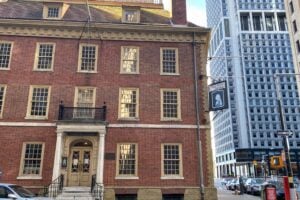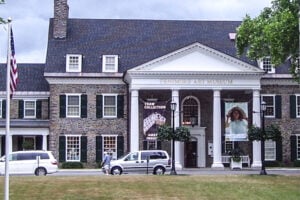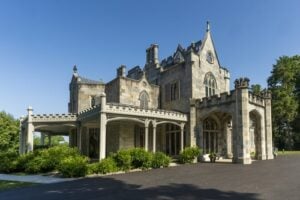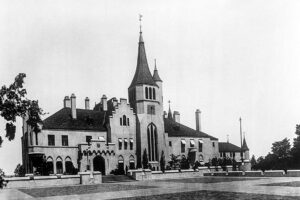
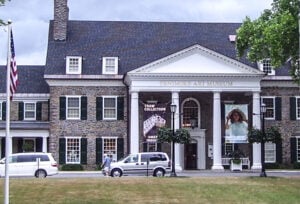
The Fenimore Art Museum in Cooperstown, New York, houses an important collection of American art. Photo: Beyond My Ken / Wikimedia Commons, CC BY-SA 4.0.
When people think about famous American artists and the history of American art, New York City usually comes to mind first. Manhattan’s museums, galleries, and art schools have played an enormous role in shaping the country’s artistic traditions. However, some of the nation’s most important painters, sculptors, and illustrators were born far beyond the five boroughs, in the cities, villages, and small towns of Upstate New York.
From the Hudson Valley and the Adirondacks to Buffalo, Syracuse, Albany, and the Finger Lakes, Upstate New York has produced artists whose work has influenced generations of Americans. Some became internationally recognized painters whose works now hang in the world’s greatest museums. Others created famous illustrations, comic strips, and sculptures that became part of American popular culture.
What’s particularly interesting about this group is how different their careers became. Frederic Remington helped shape the popular image of the American West. Grandma Moses became famous for painting scenes of rural life. Eric Carle introduced generations of children to the colorful world of The Very Hungry Caterpillar. And artists such as Arthur Dove, Ad Reinhardt, and Ellsworth Kelly helped transform the direction of modern American painting.
The following 25 artists were all born in Upstate New York. Some spent their childhoods in the communities where they were born, while others moved away at an early age. Their artistic achievements eventually reached far beyond New York State.
1. Frederic Remington
Born in Canton, St. Lawrence County, in 1861, Frederic Remington became one of America’s most celebrated painters, illustrators, and sculptors of the American West. His childhood was spent in northern New York, including Ogdensburg, where his family moved in the early 1870s. Although his artistic reputation would eventually become inseparable from the American frontier, his personal history began in the North Country.
Remington developed a fascination with horses, soldiers, and outdoor life, interests that became central to his artistic career. After traveling west, he began producing illustrations for magazines such as Harper’s Weekly. His paintings and bronze sculptures depicted cavalrymen, cowboys, and Native Americans during a period when the frontier was rapidly changing. His famous bronze sculpture The Bronco Buster became one of the most recognizable examples of American Western art. Today, the Remington Museum of Art in Ogdensburg preserves an extensive collection of his work and maintains his important connection to Upstate New York.
2. Grandma Moses
Anna Mary Robertson Moses, better known as Grandma Moses, was born in Greenwich, Washington County, in 1860. Her childhood was spent in a rural farming community, and much of her early life involved the everyday responsibilities of agricultural work. Long before she became famous, she was familiar with the chores, seasonal activities, and traditions that eventually appeared in her paintings.
What makes Grandma Moses’s story so remarkable is that she did not begin painting seriously until she was in her seventies. Working without formal artistic training, she created colorful scenes of rural American life, including farms, country roads, winter celebrations, and village gatherings. Her paintings attracted national attention in the late 1930s, and she eventually became one of America’s best-known folk artists. She lived to be 101 years old, leaving behind an extraordinary collection of paintings that continue to provide a nostalgic look at American country life.
3. Arthur Dove
Arthur Garfield Dove was born in Canandaigua, Ontario County, in 1880 and grew up in nearby Geneva. The Finger Lakes landscape became an important part of his early experiences, introducing him to the colors, rhythms, and changing appearances of the natural world. After graduating from Cornell University in 1903, Dove moved to New York City and began working as a commercial illustrator.
Dove eventually abandoned conventional representation and became one of the pioneering figures of American abstract painting. His early abstract works, produced during the 1910s, explored relationships between shapes, colors, sounds, and natural forms. He developed an especially close professional relationship with photographer and gallery owner Alfred Stieglitz, who championed his work. Dove’s paintings helped establish abstraction as an important direction in American modern art. His career also brought him back to New York State, where he spent his final years on Long Island.
4. Ad Reinhardt
Ad Reinhardt was born in Buffalo, Erie County, in 1913. Although his family later moved to New York City, his birthplace connects one of the twentieth century’s most influential abstract painters to Western New York. Reinhardt studied at Columbia University and became involved with the American Abstract Artists organization during the 1930s.
Reinhardt was known for his strict artistic philosophy and his belief that painting should exist independently of storytelling or personal symbolism. His work gradually became more restrained, eventually leading to the famous black paintings of his later career. These canvases initially appear almost completely black, but closer examination reveals subtle differences in tone and carefully arranged geometric forms. Reinhardt’s approach influenced later generations of minimalist and conceptual artists, making him an important figure in the transition from Abstract Expressionism toward newer forms of abstraction.
5. Susan Rothenberg
Contemporary painter Susan Rothenberg was born in Buffalo in 1945. Growing up in Western New York, she developed an interest in art and visited the Albright-Knox Art Gallery, one of the region’s most important cultural institutions. She later attended Cornell University, where she studied painting before eventually establishing herself in New York City’s art world.
Rothenberg attracted widespread attention during the 1970s for her paintings of horses. At a time when minimalist and conceptual approaches dominated much of the contemporary art scene, her decision to return to recognizable imagery was particularly significant. Her horses were not simply realistic animal portraits. They were often reduced to powerful outlines, fragmented shapes, and expressive forms that combined elements of abstraction with recognizable subjects. As her career progressed, Rothenberg explored human figures, animals, and personal experiences, earning a reputation as one of the most distinctive American painters of her generation.
6. J. Alden Weir
Julian Alden Weir was born at West Point in Orange County in 1852. His father, Robert Walter Weir, was an established painter who taught drawing at the United States Military Academy. Growing up in a family surrounded by art gave the younger Weir an early introduction to painting and the techniques of professional artists.
Weir later studied at the National Academy of Design in New York City and continued his education in Paris. He became a leading figure in American Impressionism, developing a style that emphasized natural light, color, and the changing appearance of outdoor landscapes. Much of his best-known work was created at his farm in Connecticut, which became a gathering place for artists and is now preserved as Weir Farm National Historical Park. Although his artistic career took him far beyond West Point, his early years in the Hudson Valley helped establish the foundations of his professional life.
7. Robert De Niro Sr.
Robert De Niro Sr. was born in Syracuse, Onondaga County, in 1922. While his name is often associated with his famous son, actor Robert De Niro, he was an accomplished painter whose career deserves recognition on its own. His artistic abilities appeared during childhood, and he studied at the Syracuse Museum before pursuing additional training with influential modern artists.
As a young man, De Niro studied with Josef Albers and Hans Hofmann, two important figures in twentieth-century modern art. His paintings developed a distinctive expressive style, frequently combining recognizable subjects with bold colors and energetic brushwork. Portraits, still lifes, and landscapes became recurring subjects throughout his career. Although his work received considerable recognition during his lifetime, his reputation later received renewed attention through exhibitions and efforts to preserve his artistic legacy. His connection to Syracuse remains an important part of his biography.
8. Eric Carle
Eric Carle, the author and illustrator of The Very Hungry Caterpillar, was born in Syracuse in 1929. His parents were German immigrants, and his early childhood was spent in Central New York. Carle later recalled happy memories of Syracuse, including spending time outdoors with his father. When he was six years old, his family returned to Germany, where he spent the remainder of his childhood and received his formal artistic education.
Carle returned to the United States in 1952 and began working in commercial design. He eventually became a children’s book illustrator and developed the colorful collage technique that made his artwork instantly recognizable. By painting tissue paper and arranging the pieces into illustrations, he created an imaginative visual style that appealed to young readers. Published in 1969, The Very Hungry Caterpillar became one of the most successful children’s books ever produced. Carle’s influence extended well beyond publishing, helping establish children’s book illustration as an important artistic field.
9. Arthur B. Davies
Arthur Bowen Davies was born in Utica, Oneida County, in 1862. He became an important American painter whose career bridged the late nineteenth-century artistic establishment and the modernist movements that transformed art during the early twentieth century. His paintings frequently featured dreamlike landscapes, mysterious figures, and subjects inspired by mythology and imagination.
Davies is particularly remembered for helping organize the 1913 Armory Show in New York City. This exhibition introduced many American viewers to European modernist movements, including Cubism and other experimental approaches that challenged traditional ideas about painting and sculpture. The Armory Show became a turning point in American art history, and Davies played a central role in bringing it together. Although his own paintings differed from some of the more radical works included in the exhibition, his willingness to promote new artistic ideas helped change the American art world.
10. Erastus Dow Palmer
Erastus Dow Palmer was born in Pompey, Onondaga County, in 1817. Unlike many prominent nineteenth-century sculptors who received extensive formal training in European academies, Palmer was largely self-taught. He began his working life as a carpenter and demonstrated unusual skill in carving detailed objects from wood and other materials.
Palmer eventually developed a reputation for his cameo portraits before turning to marble sculpture. He established his career in Albany, where his studio became an important center for artistic activity. His sculptures combined classical techniques with subjects that reflected American society and personal emotion. Among his well-known works is The White Captive, completed during the nineteenth century. Palmer’s accomplishments helped establish Albany as a home for serious American sculpture, and his influence extended to younger artists who studied with him.
11. Walter Launt Palmer
Walter Launt Palmer was born in Albany in 1854 and grew up in an artistic household. His father was the celebrated sculptor Erastus Dow Palmer, whose studio introduced him to professional artists and their working methods. As a young painter, Walter received instruction from Frederic Edwin Church, one of the leading figures of the Hudson River School.
Palmer developed a successful career painting landscapes, interiors, and scenes of Venice, but he became especially celebrated for his winter landscapes. His paintings of snow-covered forests, frozen streams, and quiet woodland settings demonstrated an extraordinary sensitivity to color. Rather than treating snow as simply white, Palmer used subtle blues, violets, and other tones to capture its changing appearance in natural light. The Albany Institute of History & Art maintains an important collection of his work and has organized exhibitions devoted to his paintings.
12. Johnny Hart
Johnny Hart was born in Endicott, Broome County, in 1931. Although he worked in cartooning rather than traditional painting or sculpture, his illustrations became familiar to millions of newspaper readers. Hart grew up in the Southern Tier and began developing his drawing skills at an early age before pursuing a career as a professional cartoonist.
Hart achieved his greatest success with the comic strip B.C., which followed a group of prehistoric characters through humorous situations that frequently reflected modern society. The strip became widely syndicated and established Hart as one of America’s most recognizable newspaper cartoonists. He also collaborated with cartoonist Brant Parker to create The Wizard of Id, another long-running comic strip. His ability to combine simple drawings with clever dialogue gave his work a distinctive character and earned him a lasting place in American popular illustration.
13. Francis Bicknell Carpenter
Francis Bicknell Carpenter was born in Homer, Cortland County, in 1830. He became a successful portrait painter during the nineteenth century, producing likenesses of prominent Americans, including presidents and political leaders. His interest in public figures eventually led him to create one of the most historically significant paintings associated with Abraham Lincoln and the Civil War.
Carpenter is best remembered for his 1864 painting First Reading of the Emancipation Proclamation by President Lincoln. To complete the work, he spent several months at the White House, where he had opportunities to observe Lincoln and members of his administration. The painting depicts the president presenting the Emancipation Proclamation to his Cabinet. Today, the large canvas is displayed in the United States Capitol. Carpenter also published Six Months at the White House with Abraham Lincoln, providing a valuable account of his experiences with the president. His achievements make him one of the most historically important artists born in Central New York.
14. Ellsworth Kelly
Ellsworth Kelly was born in Newburgh, Orange County, in 1923. Although he spent much of his childhood in New Jersey, his birthplace places him among the important artists who originated in the Hudson Valley. Kelly eventually became one of America’s most influential abstract painters and sculptors, recognized for his striking use of color and simplified geometric forms.
After studying art and serving in the United States Army during World War II, Kelly spent several years in France, where he encountered European modernism and developed his artistic approach. His paintings frequently feature sharply defined shapes and bold areas of color, often without recognizable subjects. He also produced large sculptures that explored the relationships between form, space, and architecture. Kelly’s work helped shape the development of hard-edge painting and Minimalism, although his artistic interests extended beyond any single movement.
15. Sanford Robinson Gifford
Sanford Robinson Gifford was born in Greenfield, Saratoga County, in 1823 and grew up in Hudson, Columbia County. He became one of the leading landscape painters associated with the Hudson River School, the nineteenth-century movement that celebrated the natural scenery of New York State and the American countryside.
Gifford developed an artistic style distinguished by atmospheric light and subtle changes in color. His paintings frequently depict mountains, lakes, and valleys illuminated by warm sunlight or softened by distant haze. He traveled throughout the United States and Europe, but the landscapes of New York remained important subjects throughout his career. His visits to the Catskills, Adirondacks, and Shawangunk Mountains contributed to paintings that helped establish the Hudson Valley as one of the central subjects of American landscape art. His work is also closely associated with the painting style known as Luminism.
16. Homer Dodge Martin
Homer Dodge Martin was born in Albany in 1836. He developed an early interest in landscape painting and became largely self-taught, although he received some instruction from other artists. His early paintings reflected the detailed landscape traditions associated with the Hudson River School, which had already become an important influence on American art.
As Martin’s career developed, he began moving away from highly detailed representations of nature toward a more atmospheric and emotionally expressive style. He was particularly influenced by the Barbizon painters of France, who emphasized mood and natural conditions rather than idealized scenery. His landscapes often feature subdued colors, unusual lighting, and quiet settings that suggest a contemplative view of nature. Martin’s artistic development illustrates how American landscape painting changed during the second half of the nineteenth century.
17. Jervis McEntee
Jervis McEntee was born in Rondout, now part of Kingston in Ulster County, in 1828. Growing up near the Hudson River gave him direct experience with the scenery that would later dominate his artistic career. He studied with Frederic Edwin Church and became associated with the Hudson River School during a period when landscape painting occupied an important place in American culture.
McEntee became especially known for his paintings of autumn landscapes. His work frequently portrayed wooded hillsides, quiet streams, and fading seasonal colors. Unlike painters who favored dramatic mountain panoramas, McEntee often explored the quieter and more reflective qualities of the natural world. He also kept extensive diaries that documented his experiences and relationships within the nineteenth-century American art community. These writings, preserved by the Smithsonian’s Archives of American Art, remain valuable historical resources for understanding the artistic culture of his era.
18. John Vanderlyn
John Vanderlyn was born in Kingston, Ulster County, in 1775, shortly before the American Revolution. He became one of the earliest American artists to receive significant training in European academic painting. His artistic abilities attracted the attention of influential supporters, including Aaron Burr, who helped him pursue studies abroad.
Vanderlyn spent considerable time in France, where he studied classical painting techniques and developed a reputation for portraits and large historical compositions. One of his best-known works is Landing of Columbus, a monumental painting commissioned for the United States Capitol Rotunda. The painting depicts Christopher Columbus’s arrival in the Americas, reflecting the historical interpretations and artistic conventions of the nineteenth century. Vanderlyn’s career demonstrated the growing ambition of American artists to participate in the international fine arts community during the republic’s early decades.
19. George Inness
George Inness was born in Newburgh, Orange County, in 1825. Although his family moved away while he was young, his birthplace connects him to the Hudson Valley, a region closely associated with the development of American landscape painting. Inness became one of the most important American painters of the nineteenth century, admired for his emotional and atmospheric interpretations of nature.
His early work reflected elements of the Hudson River School, but he gradually developed a more personal artistic style influenced by European landscape painting and the French Barbizon School. His later paintings often featured soft edges, subtle light, and rural settings that emphasized atmosphere rather than precise detail. Inness was also influenced by the spiritual writings of Emanuel Swedenborg, which contributed to his belief that paintings could communicate deeper meanings through nature. His mature works helped expand the possibilities of American landscape painting beyond straightforward representations of scenery.
20. Charles Loring Elliott
Charles Loring Elliott was born in Scipio, Cayuga County, in 1812. He became one of the leading American portrait painters of the middle nineteenth century, earning recognition for his ability to capture the appearance and personality of his subjects. His father worked as an architect, and Elliott initially considered entering the same profession before deciding to pursue painting.
Elliott moved to New York City as a young man and developed a career painting portraits of prominent Americans. His sitters included political figures, writers, businessmen, and members of socially influential families. He became particularly admired for his careful attention to facial expressions and the psychological qualities of his subjects. According to a Smithsonian Libraries account, Elliott was credited with painting hundreds of portraits during his lifetime. His career reflected the importance of portraiture in nineteenth-century America, when painted likenesses remained a primary means of preserving the images of public figures.
21. Milton Avery
Milton Avery was born in Sand Bank, a small community in Oswego County now known as Altmar, in 1885. His family later moved to Connecticut, where Avery spent much of his youth and began developing his artistic interests. Despite his modest beginnings and limited financial resources, he eventually became one of the most influential American colorists of the twentieth century.
Avery developed a distinctive style built around simplified forms, flat areas of color, and carefully balanced compositions. His subjects often included people, animals, landscapes, and scenes from everyday life. Unlike artists who pursued complete abstraction, Avery frequently retained recognizable imagery while reducing details to their essential shapes. His approach influenced younger painters who were exploring the expressive possibilities of color. Artists including Mark Rothko and Adolph Gottlieb admired his work, and his paintings helped establish an important connection between American modernism and later abstract painting.
22. Bradley Walker Tomlin
Bradley Walker Tomlin was born in Syracuse in 1899. He developed an interest in painting while growing up in Central New York and studied at Syracuse University before continuing his artistic education in Europe. His early work explored several modern painting approaches, but he eventually became associated with the New York School of Abstract Expressionism.
Tomlin’s mature paintings are recognized for their carefully balanced arrangements of abstract shapes, lines, and calligraphic marks. Although Abstract Expressionism is often associated with spontaneous gestures and emotional intensity, Tomlin’s work frequently displays a more restrained sense of structure and organization. He participated in the influential Ninth Street Show of 1951, which helped bring greater attention to the emerging Abstract Expressionist movement. His paintings are represented in major museum collections, including the Metropolitan Museum of Art.
23. Edmonia Lewis
Edmonia Lewis was born in Greenbush, now Rensselaer, in Rensselaer County, in 1844. She became one of the most historically significant American sculptors of the nineteenth century and the first sculptor of African American and Native American descent to achieve international recognition. Her early life involved considerable hardship, including the loss of her parents and the racial discrimination she experienced while pursuing an education.
Lewis attended Oberlin College in Ohio before moving to Boston, where she began developing her sculptural career. She later established herself in Rome, joining an international community of artists who worked in marble and explored classical subjects. Her sculptures frequently addressed themes of freedom, identity, history, and human dignity. Among her best-known works is The Death of Cleopatra, a monumental marble sculpture displayed at the 1876 Centennial Exhibition in Philadelphia. Lewis’s accomplishments are especially significant because she established an international artistic reputation during an era when opportunities for Black and Native American women were severely restricted.
24. Robert Mangold
Robert Mangold was born in North Tonawanda, Niagara County, in 1937. He grew up in Western New York before leaving the region to pursue his artistic education. Mangold studied at the Cleveland Institute of Art and later at Yale University, eventually becoming associated with the minimalist art movement that emerged during the 1960s.
Mangold’s paintings are distinguished by their geometric shapes, carefully controlled colors, and precise lines. Many of his works explore the relationship between the physical shape of a canvas and the forms painted upon it. Rather than presenting complicated scenes or recognizable subjects, Mangold concentrates on the interaction of line, color, and surface. His work has appeared in major museum exhibitions and helped establish him as an important figure in American minimalist painting. His career illustrates the continuing contribution of artists born in Upstate New York to modern and contemporary art.
25. Bolton Brown
Bolton Coit Brown was born in Dresden, Yates County, in 1864. He grew up in the Finger Lakes region and developed interests in both art and the outdoors. Brown studied at Syracuse University and eventually became an accomplished painter, lithographer, teacher, and writer. His career also included work in art education, including teaching positions at Cornell University and Stanford University.
Brown became an important figure in the development of the Woodstock art community in the Catskills. Working with Ralph Radcliffe Whitehead and other artists, he helped establish the Byrdcliffe Arts Colony during the early twentieth century. The colony attracted painters, craftspeople, writers, and other creative individuals who were interested in developing an artistic community outside the major cities. Brown also became highly skilled in lithography, producing prints and writing about the techniques of the medium. His contributions helped establish Woodstock as an important American arts center long before the town became internationally associated with popular music.
These 25 artists represent a remarkable range of creative achievements. Some became famous for painting the landscapes of New York State, while others developed artistic styles that influenced movements across the world. Their work includes everything from children’s book illustrations and newspaper cartoons to marble sculptures and experimental abstract paintings.
Perhaps the most interesting part of their collective history is that so many different regions of Upstate New York are represented. The small communities of the Finger Lakes, the cities of Western New York, the villages of the Hudson Valley, and the towns of the North Country all contributed to American art history. Their stories demonstrate that artistic achievement has never been limited to the major cultural centers of New York City.
For more stories about the people and places that shaped New York State, explore our articles on 25 Famous People You Didn’t Know Were From Upstate New York, Famous People From the Adirondacks and North Country, Famous People Who Chose a Quieter Life in Upstate New York, and Historic Small Towns in Upstate New York Worth Visiting.