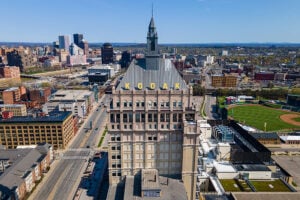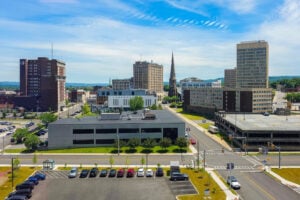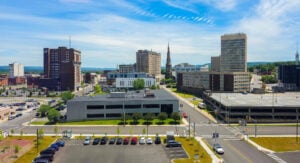
A panoramic view of downtown Utica in Oneida County, New York. Photo: Mahmoud Suhail / Shutterstock.com
Oneida County sits at one of New York State’s most important crossroads. From the Mohawk Valley around Utica and Rome to the villages of Clinton and New Hartford and the wooded country north toward Remsen and Taberg, its communities have been shaped by transportation, manufacturing, farming, education, and generations of families who built their lives in Central New York. The county’s place in American history stretches far beyond any one city’s boundaries.
Long before European settlers arrived, this landscape was part of the homeland of the Oneida Nation, one of the original members of the Haudenosaunee Confederacy. Colonial conflict, the American Revolution, and growing settlement dramatically changed the region. Rome developed at a strategically important waterway crossing, while Utica grew into a major commercial and manufacturing center. The completion of the Erie Canal in 1825 helped connect the Mohawk Valley to markets extending from the Great Lakes to the Atlantic coast.
The county’s industrial story is remarkable in its own right. Textile mills, machine shops, railroads, transportation businesses, and the copper industry provided work to successive generations. Hamilton College in Clinton developed a different kind of influence, educating people whose careers extended into law, politics, literature, and public life. Meanwhile, the villages and smaller communities outside the county’s cities nurtured athletes, musicians, writers, and inventors whose names would eventually become familiar far from New York.
Some of the people featured here were born in Oneida County and left when they were young. Others grew up in its schools, neighborhoods, or sports programs before finding success elsewhere. A few came from different birthplaces but developed a sustained and important professional life here. These are different kinds of hometown connections, and each deserves to be described accurately rather than reduced to a misleading birthplace claim.
The range of achievements is striking. The county has produced a basketball coaching legend, a pioneer of the Pledge of Allegiance, a Nobel Peace Prize recipient, NASCAR champions, prominent public officials, musicians, actors, scientists, and writers. Their stories offer another way of understanding Oneida County: not simply as a place travelers pass through on their way across New York, but as a community whose influence has repeatedly reached the national stage.
1. Pat Riley
Oneida County connection: Rome
Pat Riley was born in Rome, New York, on March 20, 1945. His family later moved to Schenectady, where he attended Linton High School and became an outstanding basketball and football player. Although most basketball fans associate him with Los Angeles, New York City, or Miami, his life began in Oneida County. That distinction is particularly interesting given how closely his later career would become tied to the most visible franchises in professional basketball.
Riley played college basketball at the University of Kentucky under Adolph Rupp before beginning an NBA playing career that included a championship with the Los Angeles Lakers in 1972. His greatest influence came from the bench. As coach of the Lakers, he helped define the fast-paced Showtime era and guided the team to four NBA championships during the 1980s. The tailored suits and slicked-back hair became part of his public image, but the foundation of his success was a demanding approach to preparation, teamwork, and defense.
New Yorkers remember a different side of Riley from his years coaching the Knicks, when intense defense and fiercely contested playoff games became central to the team’s identity. He later won another championship as Miami Heat head coach in 2006 and became one of basketball’s most influential executives. Inducted into the Naismith Memorial Basketball Hall of Fame in 2008, Riley remains one of the most widely recognized sports figures whose story began in Rome.
2. Francis Bellamy
Oneida County connection: Rome
Francis Bellamy was born in Mount Morris, New York, in 1855, but his childhood and school years were spent in Rome. His father, the Rev. David Bellamy, moved the family there in 1859 to serve as pastor of the First Baptist Church. Francis grew up in the community, attended Rome Free Academy, and developed the interests in religion, public service, and writing that would guide his adult life.
After graduating from the University of Rochester, Bellamy became a Baptist minister and writer. His best-known work emerged in 1892, when he composed the original Pledge of Allegiance for a national school celebration associated with the 400th anniversary of Christopher Columbus’s arrival in the Americas. The wording he wrote was not identical to the pledge familiar today; it changed over subsequent decades as Americans debated how the national ritual should be expressed.
Although Bellamy worked in several other communities, Rome remained an important part of his personal history. Following his death in 1931, he was buried in Rome Cemetery, where his association with the pledge is memorialized. The connection between the author of one of America’s most familiar civic recitations and a Central New York childhood is an enduring part of Oneida County’s story.
3. Elihu Root
Oneida County connection: Clinton
Elihu Root was born in Clinton, New York, in 1845, in a family closely associated with Hamilton College. His father, Oren Root, taught mathematics there, and Elihu grew up surrounded by the academic life of College Hill. He graduated from Hamilton in 1864, beginning a legal career that eventually took him into the highest levels of American government.
Root became an influential lawyer in New York City before serving as secretary of war under Presidents William McKinley and Theodore Roosevelt and then as secretary of state under Roosevelt. His work touched the administration of America’s newly acquired overseas territories, the organization of the armed forces, and the development of international diplomacy. His record was complex, reflecting both the ambitions and controversies of American power at the turn of the twentieth century.
In 1912, Root was awarded the Nobel Peace Prize for his advocacy of international arbitration and cooperation. He also maintained close ties with Hamilton College and kept a country home in Clinton. That continuing connection matters: Oneida County was not simply the location of his birth, but a place he returned to throughout a long career in national and international public affairs.
4. Roscoe Conkling
Oneida County connection: Utica
Roscoe Conkling was born in Albany in 1829 and grew up in Auburn, but Utica became the central base of his early career and political rise. He moved to the city as a teenager to study law and was admitted to the bar in 1850. Utica, a busy commercial center along the Erie Canal, offered an ambitious young lawyer the clients, public connections, and political opportunities that would carry him into national office.
Conkling served as mayor of Utica in 1858 before entering the U.S. House of Representatives and later the Senate. By the 1870s, he had become one of the most powerful members of the Republican Party and a principal leader of the Stalwart faction. His influence rested in part on his command of political appointments, particularly the federal patronage system that reformers increasingly attacked.
His confrontation with President James A. Garfield over appointments at the New York Custom House ended with Conkling’s resignation from the Senate in 1881. He failed to win reelection, bringing an abrupt end to his Washington career. Conkling later practiced law in New York City, but he was buried in Utica’s Forest Hill Cemetery. His story captures a period when a Oneida County political figure could exercise extraordinary influence over national politics.
5. Joe Bonamassa
Oneida County connection: New Hartford
Blues-rock guitarist Joe Bonamassa was born in New Hartford in 1977 and grew up in the Utica area in a family where music was part of everyday life. His father owned a guitar shop, giving the young musician early exposure to instruments that would later become a major part of his professional identity. Bonamassa has spoken directly about growing up in New Hartford and how the community, his family, and local musical influences shaped his interests.
He began playing guitar at an unusually young age and was already attracting attention as a child performer. By the time he was twelve, he had appeared on stage with B.B. King, a remarkable introduction to professional blues performance. He later played in the band Bloodline before building his own touring and recording career, drawing on electric blues, hard rock, and the tradition of guitar-driven live performance.
Bonamassa went on to become an internationally known concert attraction, regularly performing in major venues and releasing a large catalog of albums and concert recordings. He also became a passionate collector and advocate for vintage guitars and amplifiers. For Oneida County music fans, his career is a particularly appealing example of a hometown interest becoming a lifelong artistic pursuit without losing its connection to Central New York.
6. Erin Hamlin
Oneida County connection: Remsen
Erin Hamlin grew up in Remsen, a small Oneida County community that seems an unlikely starting point for an Olympic career in luge. She attended Remsen Junior/Senior High School and competed in school sports before becoming one of the leading American athletes in a discipline that requires remarkable precision, speed, and composure. Her hometown remained an important part of the story as she developed from a young athlete into a four-time Olympian.
Hamlin represented the United States at the Winter Olympics in 2006, 2010, 2014, and 2018. Her breakthrough came at the 2014 Sochi Games, when she won a bronze medal in women’s singles luge, the first Olympic medal earned by an American woman in that event. She was also a world champion in 2009 and again in the sprint discipline in 2017, demonstrating that her Olympic success was part of a sustained career at the highest international level.
In 2018 she was selected as the United States’ opening-ceremony flag bearer at the Pyeongchang Winter Games, an honor recognizing her standing among American winter-sport competitors. Her achievements brought national attention to Remsen, showing how a small Upstate community could become closely associated with a major Olympic milestone.
7. Rob Manfred
Oneida County connection: Rome
Rob Manfred was born and raised in Rome, a city whose industrial economy left an impression on him long before he became commissioner of Major League Baseball. His mother was a schoolteacher and union member, while his father worked as an executive for Revere Copper and Brass. The competing perspectives on management and organized labor that he encountered at home became surprisingly relevant to his later professional life.
After attending Le Moyne College and graduating from Cornell University’s School of Industrial and Labor Relations, Manfred earned a law degree from Harvard. He developed a specialty in labor relations and became deeply involved in baseball’s collective-bargaining negotiations. That experience helped make him a central executive in the commissioner’s office as professional baseball confronted questions about revenue sharing, labor agreements, drug policy, and the future of the sport.
Manfred became Major League Baseball’s tenth commissioner in January 2015. His decisions have attracted both praise and criticism, as might be expected for anyone responsible for a sport with such a long history and passionate following. His Rome upbringing remains a clearly documented influence, and his career offers one of the county’s most distinctive connections to the business of American sports.
8. Richie Evans
Oneida County connection: Rome
Richie Evans became a legend in short-track auto racing while making Rome his home. A mechanic as well as a driver, Evans developed the practical knowledge required to build, maintain, and race modified stock cars. The Utica-Rome Speedway and the wider Northeast racing circuit provided the competitive environment in which his ability and determination became apparent.
Evans won nine NASCAR national Modified championships, including eight consecutive titles from 1978 through 1985. His success reflected an extraordinary combination of mechanical preparation, driving skill, and stamina. In an era when competitors traveled relentlessly between tracks, Evans could race and maintain his equipment over a demanding schedule that required as much effort in the workshop as it did behind the wheel.
He died in 1985 following a practice crash at Martinsville Speedway in Virginia. His death ended one of the greatest careers in NASCAR Modified history, but it did not diminish his influence. Evans was inducted into the NASCAR Hall of Fame in 2012, and his achievements continue to give Rome a prominent place in the story of American oval-track racing.
9. Jerry Cook
Oneida County connection: Rome
Rome produced another extraordinary NASCAR Modified driver in Jerry Cook, whose career ran alongside that of Richie Evans. Cook grew up around the sort of local racing culture in which drivers worked on their own cars, competed across the Northeast, and learned that mechanical reliability was as important as raw speed. He began racing modified cars during the 1960s and established himself as one of the discipline’s toughest competitors.
Cook won six NASCAR Modified championships, including four straight titles from 1974 through 1977. His rivalry with Evans became one of the great stories of the division, with two drivers from the same Oneida County hometown repeatedly setting the competitive standard. The fact that their championships brought so much national attention to Rome is remarkable even by the standards of New York’s long motorsports history.
After leaving active competition, Cook worked in racing administration and played an important role in the development of the modern NASCAR Modified Tour. He was inducted into the NASCAR Hall of Fame as part of its 2016 class. Unlike some local sports stories centered on a single celebrated athlete, Rome’s modified-racing legacy rests on two nationally recognized champions whose careers are inseparable from the community.
10. Ben Baldanza
Oneida County connection: Rome
Airline executive Ben Baldanza was born in Rome in 1961. His career eventually took him far from Central New York, into an industry shaped by complicated pricing systems, fierce competition, changing government regulation, and the challenge of operating commercial flights profitably. Baldanza became known not as a pilot or aircraft designer but as a business leader who changed what passengers could expect when purchasing an airline ticket.
After holding management positions with major airlines, Baldanza became chief executive of Spirit Airlines in 2006. During his tenure, Spirit developed its distinctive ultra-low-cost model, offering very low advertised fares while charging separately for services such as checked baggage and some onboard amenities. The approach attracted criticism from travelers who disliked the fees but influenced the pricing strategies of competitors across the industry.
Baldanza led Spirit until 2016 and remained a widely discussed voice in commercial aviation afterward. He died in November 2024 at age 62. Although many people knew him primarily through headlines about airline fares and the travel business, the executive associated with this influential shift in American aviation had his beginnings in Rome, New York.
11. Samuel Beardsley
Oneida County connection: Rome and Utica
Samuel Beardsley was born in Hoosick, New York, in 1790, but Oneida County provided the setting for much of his legal and public career. As a young man he studied law in Rome, served during the War of 1812, and returned to practice in Central New York. In 1823 he moved to Utica, where he developed the professional base from which he held a series of increasingly important positions.
Beardsley served as Oneida County district attorney, a member of the New York State Senate, a U.S. attorney, and a member of Congress. He became New York State attorney general in the 1830s and later joined the New York Supreme Court, ultimately serving as chief justice in 1847. His career illustrates the close ties that existed between law, politics, and public administration in the formative decades of the state.
He died in Utica in 1860 and was buried in Forest Hill Cemetery. Beardsley is less familiar today than many of the county’s athletes and entertainment figures, but he represents a different form of regional achievement: a long record of public service built upon a legal career developed in Rome and Utica.
12. Joseph H. Boardman
Oneida County connection: Rome and Taberg
Joseph H. Boardman was born in Rome in 1948 and grew up on his family’s dairy farm in nearby Taberg. His childhood offered an early lesson in the practical importance of transportation to rural communities. He later recalled wondering why a bus traveled through a sparsely populated area until his father explained that dependable transportation mattered even where there were relatively few passengers.
Boardman served in the U.S. Air Force before attending Cornell University and entering the transportation profession. His career included local transit work, leadership of the New York State Department of Transportation, and service as administrator of the Federal Railroad Administration. These jobs required him to confront the difficulties of maintaining transportation networks across both densely populated corridors and rural areas.
He became president and chief executive of Amtrak in 2008 and led the passenger railroad until 2016. Following his death in 2019, colleagues remembered his commitment to the national rail system and the communities it connected. The connection to Taberg is more than a birthplace detail: his rural Oneida County upbringing helped shape his views of the public purpose of transportation.
13. Walter R. Brooks
Oneida County connection: Rome
Writer Walter Rollin Brooks was born in Rome in 1886, long before children’s television would turn one of his inventions into a household name. He worked in publishing and magazine writing and produced an extensive body of fiction. His imaginative stories often featured talking animals whose personalities, arguments, and adventures were treated with the seriousness usually reserved for human characters.
Brooks is best remembered for the Freddy the Pig books, beginning with a 1927 story later published under the title Freddy Goes to Florida. The series followed Freddy and other animals living on the Bean farm and developed into a beloved collection of humorous children’s novels. Brooks also wrote stories about a talking horse, Mister Ed, a character later adapted into a widely watched television comedy in the 1960s.
The author died in 1958, before the television version of Mister Ed brought the character to an even wider audience. His career connects Rome with a lasting tradition of children’s literature, magazine fiction, and popular entertainment. Unlike many writers who became known for a single work, Brooks created two distinctly memorable worlds that continued reaching readers and viewers after his death.
14. Joel de la Fuente
Oneida County connection: New Hartford
Actor Joel de la Fuente was born in New Hartford in 1969, although he spent much of his childhood outside Oneida County. His birth in Oneida County was followed by childhood years spent elsewhere, before formal training launched his acting career. He later studied at Brown University and earned a graduate acting degree from New York University, developing a career that moved comfortably between stage productions and television drama.
De la Fuente became familiar to viewers through roles in Space: Above and Beyond, Hemlock Grove, and Law & Order: Special Victims Unit. One of his most prominent performances was as Chief Inspector Takeshi Kido in the alternate-history drama The Man in the High Castle. His theater work has also included the one-person production Hold These Truths, in which he portrayed civil-rights figure Gordon Hirabayashi.
His career shows the range available to a working actor beyond a single breakthrough film or television series. From Shakespeare and contemporary drama to science fiction, historical material, and television thrillers, de la Fuente has developed an unusually varied portfolio. The New Hartford birthplace is a small but documented part of that larger story.
15. Grace Lin
Oneida County connection: New Hartford
Children’s author and illustrator Grace Lin grew up in New Hartford in a Taiwanese American family. She has recalled feeling different from many of her classmates and finding comfort in the local public library, where she spent hours surrounded by books. Those experiences stayed with her and eventually became central to her writing about childhood, identity, family, and the importance of seeing different cultures represented in stories.
After attending the Rhode Island School of Design, Lin began publishing picture books and novels for young readers. Her works include The Ugly Vegetables, The Year of the Dog, Where the Mountain Meets the Moon, and A Big Mooncake for Little Star. Her awards include a Newbery Honor, a Caldecott Honor, and the Children’s Literature Legacy Award, reflecting both the popularity and literary quality of her work.
Lin’s memory of visiting the library in New Hartford offers a particularly strong local connection. It is not simply that she happened to live in Oneida County before becoming famous. The experience of growing up there, reading there, and negotiating her identity there became material that she transformed into books that have reached families and classrooms across the country.
16. Claudia Tenney
Oneida County connection: New Hartford
Claudia Tenney was born in New Hartford in 1961 and graduated from New Hartford High School in 1979. She went on to study at Colgate University and earn a law degree before beginning a career that combined legal work, business activity, and elected office. Her political career developed in Central and Upstate New York, where local manufacturing, economic policy, and government accountability have frequently been subjects of public debate.
Tenney served in the New York State Assembly before winning election to the U.S. House of Representatives in 2016. After losing her seat in 2018, she returned to Congress following the 2020 election and subsequently represented New York’s 24th Congressional District. Her career reflects the changing political geography of Upstate New York as district boundaries, party competition, and national debates have shifted.
Regardless of political viewpoint, Tenney is a nationally visible public official whose roots in Oneida County are clear and documented. Her career also illustrates the county’s continuing presence in federal politics, extending a history of public figures from the nineteenth-century careers of Elihu Root and Roscoe Conkling into the twenty-first century.
17. Waleed Abdalati
Oneida County connection: New Hartford
Earth scientist Waleed Abdalati grew up in New Hartford, where a high school teacher helped him imagine a future working for NASA. The encouragement proved consequential. Although his career eventually took him to national research institutions and polar ice fields, he has recalled how his experiences as a young person shaped his ambitions and his ability to communicate with other people.
Abdalati studied engineering at Syracuse University and later earned graduate degrees at the University of Colorado Boulder. His research uses satellites and aircraft to examine glaciers, ice sheets, sea ice, and the broader consequences of changes in the Earth’s frozen regions. He held numerous scientific and management positions at NASA, including service as the agency’s chief scientist from 2011 to 2012.
He later directed the Cooperative Institute for Research in Environmental Sciences at the University of Colorado. His work has helped connect detailed observations of remote places to larger questions about the Earth’s climate and the implications of environmental change. For Oneida County, his story offers an important example of how a formative experience in a local classroom can help direct a career in international science.
18. Mark Hapka
Oneida County connection: Rome
Actor Mark Hapka was born in Buffalo, but he moved to Rome as a child and attended Rome Free Academy. In a 2026 interview, he described discovering an interest in acting through a sixth-grade school production and continuing through community theater, school musicals, and local stage work. Those memories establish a much deeper Oneida County connection than a passing professional visit would have provided.
Hapka later moved west to pursue acting professionally, eventually attracting attention for his role as Nathan Horton on the long-running daytime drama Days of Our Lives. His screen career has included film, television, and independently produced work. Like many performers who establish themselves far from home, he has described his earliest artistic opportunities as essential preparation for his later career.
His recollections of Rome’s theater programs are among the most appealing details in his story. They show how teachers, school productions, and community arts organizations can influence a young person’s direction long before professional recognition arrives. Oneida County’s cultural legacy includes those everyday institutions as well as its famous stages and historic buildings.
19. Bill Macatee
Oneida County connection: Rome
Sports broadcaster Bill Macatee was born in Rome in 1955. His career eventually placed him in the broadcast booths and studios associated with some of America’s most watched sporting events. Although viewers generally encountered him while he was covering golf, tennis, football, or college basketball, his beginnings were in Central New York rather than a major national media market.
Macatee began his network career with NBC in the early 1980s and later worked for USA Network and CBS Sports. His assignments included major golf tournaments, Grand Slam tennis events, NFL broadcasts, and other national sports coverage. He became particularly familiar to golf audiences through CBS coverage and to tennis viewers who followed the major championships on television.
The professional skill of a broadcaster is often measured by an ability to explain a complex sporting moment without becoming the center of attention. Macatee developed that reputation across several sports and broadcasting organizations. His lengthy career provides Oneida County with another connection to the national sports world, this time through the microphone rather than the field of play.
20. Harold Bell Wright
Oneida County connection: Rome
Novelist Harold Bell Wright was born in Rome in 1872 and became one of the most commercially successful American writers of the early twentieth century. His youth was marked by personal hardship and movement between communities, and his early adult years included work as a teacher and minister. Those experiences informed a style of storytelling interested in morality, personal character, and the lives of ordinary people.
Wright found an enormous readership through novels such as The Shepherd of the Hills, published in 1907, and The Winning of Barbara Worth, published in 1911. His books were especially popular among Americans drawn to accessible stories about faith, perseverance, communities, and the changing West. Some were adapted for the screen, extending their influence into the motion-picture era.
Many readers today may be more familiar with later novelists than with the writer whose books once sold in extraordinary numbers. Nevertheless, Wright’s national literary reputation was substantial during his lifetime. His Rome birthplace adds a lesser-known Central New York connection to the history of American popular fiction.
21. Benjamin Wright
Oneida County connection: Rome
Benjamin Wright was born in Connecticut in 1770, but moved with his family to the Fort Stanwix area, later Rome, in 1789. He began working as a surveyor in the developing settlements of Central New York, where accurate measurements of land, waterways, and routes were essential to commerce and public works. His practical experience helped prepare him for one of the most consequential engineering projects in American history.
When New York undertook the Erie Canal, Wright became one of the project’s principal engineers and eventually served as chief engineer. The undertaking demanded solutions to unfamiliar problems of excavation, locks, water supply, surveying, and organization on a scale that few American engineers had previously attempted. The canal’s completion in 1825 transformed the economy of Upstate New York and helped connect the Great Lakes to Atlantic trade.
Wright continued working on canals and railroads elsewhere, and the American Society of Civil Engineers later recognized him as the father of American civil engineering. His Oneida County connection was not accidental: Rome’s geography and his early surveying career placed him at the heart of the transportation revolution that shaped nineteenth-century America.
22. John B. Jervis
Oneida County connection: Rome
John Bloomfield Jervis was born on Long Island in 1795, but moved to Rome with his family when he was three. He attended local schools and worked on his father’s farm before obtaining a job on Erie Canal construction in 1817. Beginning as an axeman under engineer Benjamin Wright, Jervis learned engineering through practical experience and rose rapidly in responsibility.
His career expanded beyond the Erie Canal to railroads, other canals, and major water-supply systems. As chief engineer of New York City’s Croton Aqueduct, he helped develop the system that brought a dependable supply of fresh water to a rapidly growing metropolis. The project marked a turning point in public health and urban infrastructure, while his railroad work contributed to the development of early American locomotives and transport networks.
Jervis maintained a strong connection to Rome. He built a home there and eventually donated his house and personal library to the city, providing a foundation for the Jervis Public Library. That tangible legacy makes him one of the most significant engineers associated with Oneida County: a man whose work helped build modern infrastructure but whose name still belongs to an institution in his adopted hometown.
23. Tom Sestito
Oneida County connection: Rome
Professional hockey player Tom Sestito was born in Rome in 1987. At six feet five inches tall, he developed a career built around the demanding physical side of ice hockey, emerging from youth and junior competition to reach the National Hockey League. The path to the NHL is difficult for players from any community, making his advancement another noteworthy sports connection for Oneida County.
Sestito was selected by the Columbus Blue Jackets in the 2006 NHL draft and made his league debut in 2008. His NHL career also included appearances with the Philadelphia Flyers, Vancouver Canucks, and Pittsburgh Penguins. Across 154 regular-season NHL games, he recorded 10 goals and 11 assists, though he was best known for an aggressive, physical style of play.
He also spent considerable time in professional minor-league hockey, where players compete for places in a small number of NHL rosters. His story is different from that of an Olympic champion or a major-league Hall of Famer, but it reflects the same persistence required to reach professional sport at the highest level. Rome also produced his older brother Tim, another NHL player.
24. Hildegarde Hoyt Swift
Oneida County connection: Clinton
Children’s writer Hildegarde Hoyt Swift was born in Clinton in 1890. Her family had connections to the academic life of Hamilton College, and she grew up in a world in which books and education held an important place. Her later work would focus on making history and the built environment accessible to young readers through imaginative, memorable storytelling.
Among her best-known books is The Little Red Lighthouse and the Great Gray Bridge, published in 1942 and illustrated by Lynd Ward. The story helped give a small lighthouse beside the Hudson River an enduring identity in New York City history. She also wrote Little Blacknose, a book that introduced children to the early railroad locomotive known as the DeWitt Clinton, and The Railroad to Freedom, a historical work recognized with a Newbery Honor in 1933.
Swift’s writing demonstrates the power of children’s literature to preserve interest in places and stories that adults might otherwise overlook. Her Clinton birthplace links an influential writer for young audiences to Oneida County, while her books form a bridge between Central New York’s educational heritage and the wider history of American transportation and landmarks.
25. Nick Palmieri
Oneida County connection: Clinton
Hockey player Nick Palmieri was born and raised in Clinton, where local youth hockey provided his introduction to the sport. In an interview with The Hockey News, he described how his friends were already playing and how he persuaded his parents to let him join them. That firsthand account offers an unusually direct glimpse of how a small community and its recreational programs can shape an athlete’s future.
Palmieri advanced through competitive junior hockey before reaching the National Hockey League with the New Jersey Devils. He also played for the Minnesota Wild organization, and his professional career included extensive time in the minor leagues. The route from a Clinton youth team to professional hockey required years of specialized training, travel, and competitive development.
His story belongs alongside Oneida County’s better-known hockey and winter-sports careers because it illustrates the local foundations of national athletic achievement. Not every player becomes a league superstar, but the achievement of reaching the NHL remains exceptional. Palmieri’s own account makes clear that his hockey life began in Clinton.
Oneida County’s Remarkable National Reach
The connections among these people are not limited to a single occupation or a single generation. A county associated with the Erie Canal also nurtured engineers who helped build the nation’s transportation system. Communities once known for manufacturing became hometowns for nationally recognized athletes, performers, scientists, and business leaders. The stories of Rome, Clinton, Remsen, New Hartford, and Utica are different, but together they reveal the remarkable reach of Central New York.
For more stories about notable New Yorkers, explore 25 Famous People You Didn’t Know Were From Utica, New York, featuring a different collection of historical figures and personalities associated with the county’s largest city.