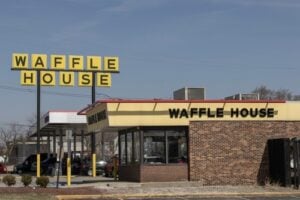
A Waffle House restaurant in Indianapolis, Indiana, photographed in March 2025. Photo: Jonathan Weiss / Shutterstock.com
For many New Yorkers like me, two iconic restaurant chains always seem to show up on road trips south or west. The first is Cracker Barrel, which I’ve already written about in depth on this site. We do have Cracker Barrel restaurants in New York, mostly Upstate, but we don’t see them on Long Island or in New York City. The second chain is even more interesting because it hasn’t established a restaurant anywhere in New York State. That chain is Waffle House.
You can’t miss a Waffle House when you’re traveling. Those enormous yellow signs, with the name spelled out in black letters, stand along interstate highways and busy commercial roads. For New Yorkers who rarely venture beyond the Northeast, they can be a curiosity. Some of us have driven past them for years without stopping. Others make a point of visiting one as soon as a southern road trip begins.
This article isn’t about the waffles or whether Waffle House serves a good breakfast. I’ve covered the food and the experience in other stories and videos. What interests me here is a different question: Why can you drive through so much of the South and Midwest and see Waffle House after Waffle House, yet travel through all of New York State without finding a single one?
The immediate answer is that Waffle House has no publicly announced plan to open in New York, and its approach to expansion is very different from that of many national restaurant chains. Its preference for direct control, its established operating territories, and the challenges of entering expensive new markets offer plausible explanations. But there is an important distinction: the company has not publicly identified any one of these factors as the definitive reason New York remains without a Waffle House.
Waffle House Has More Than 2,000 Restaurants but None in New York
Waffle House began in 1955 in Avondale Estates, Georgia, where neighbors Joe Rogers Sr. and Tom Forkner opened a round-the-clock restaurant. Their idea was simple: serve familiar food at a counter or table, keep the kitchen in view, and welcome customers at any hour. That formula proved extraordinarily durable, eventually becoming one of the South’s most recognizable restaurant traditions.
The company now operates more than 2,000 restaurants in 25 states. Much of that network is concentrated in Georgia and other Southern states, although Waffle House also has restaurants in Ohio, Indiana, Pennsylvania, and parts of the Southwest. Its expansion was never strictly limited to one geographic region, but the footprint is much denser in some states than others.
According to the company’s official restaurant locator, New York is not among the states with operating Waffle House locations. Neither are New Jersey or Connecticut. For travelers accustomed to encountering Waffle House on every other highway exit farther south, that absence can be surprisingly noticeable.
The Closest Waffle House Restaurants Are Already in Pennsylvania
It is tempting to explain the lack of New York locations by saying the chain simply hasn’t expanded far enough north. That explanation falls apart when you examine the map. Waffle House operates restaurants in Scranton and Clarks Summit, Pennsylvania, along with locations in Allentown, Bethlehem, and other communities across that state. Its official locator lists a restaurant on Davis Street in Scranton and another on South State Street in Clarks Summit.
Those Scranton-area restaurants are not hundreds of miles from the New York border. Their existence makes the question more interesting. Geography alone cannot explain why the company has entered northeastern Pennsylvania while staying out of adjoining New York.
A location in Binghamton, for example, would not require Waffle House to introduce its brand to an entirely unfamiliar part of the country. But the ability to reach a market on a map is not the same as deciding that a new restaurant will be profitable and supportable. A company must weigh the availability of sites, staffing, distribution, management, and the prospects for opening more restaurants nearby.
Waffle House Doesn’t Operate Like a Typical Franchise Chain
One major difference between Waffle House and many national restaurant companies is ownership. Some chains expand by selling franchises to independent operators eager to bring a brand to a new city or state. That arrangement can spread development costs among many investors and allow a company to enter new markets more quickly.
Waffle House has historically taken a different approach. It did franchise restaurants in earlier decades, but it has also brought many of those operations back under direct corporate ownership. In September 2026, the Atlanta Journal-Constitution reported that approximately 95 percent of Waffle House restaurants were company-owned.
The company’s own website also says it does not offer franchise opportunities to the general public. This means an enthusiastic restaurateur on Long Island cannot simply purchase a standard Waffle House franchise and open one beside the Long Island Expressway. Any serious expansion into New York would depend primarily on the company’s own decisions.
There are advantages to this system. Direct ownership gives the company more control over hiring, operations, service standards, and the experience that customers associate with the Waffle House name. The trade-off is that entering a new market becomes a corporate commitment rather than an opportunity handed to a local investor.
Why Opening One New Restaurant May Not Be Enough
Waffle House is not just a name and a menu. Its locations depend on trained managers, dependable food deliveries, equipment, maintenance, and workers who understand how the restaurants operate. A 24-hour restaurant also needs a reliable staffing plan for overnight shifts, weekends, and holidays.
That creates a practical challenge when a company enters a region where it has few or no existing restaurants. Opening one location might establish the name, but a small group of nearby locations could make employee training, supervision, deliveries, and emergency coverage more efficient.
Waffle House executives have publicly described the appeal of filling gaps within markets where the company already operates. In a 2017 interview with the Las Vegas Review-Journal, company executive Pat Warner explained that the chain had found success with small restaurant footprints and expansion opportunities in established territories. He also made clear that Waffle House did not publicly discuss specific growth plans.
That history helps explain why the company might find adding restaurants within an existing market more attractive than establishing a new presence in a state. It does not prove that Waffle House has rejected New York because of delivery routes or management distances. Those remain reasonable business considerations, not a documented corporate verdict.
New York’s Operating Costs Could Be a Factor
Anyone who has owned or operated a business in New York knows that location can make an enormous difference in operating costs. A restaurant on a high-priced commercial strip in Nassau County faces a different financial picture from one beside a highway in Central New York. Manhattan is different again, with particularly demanding real estate, delivery, and staffing conditions.
Waffle House relies on a relatively compact dining room, rapid service, familiar food, and steady customer traffic throughout the day and night. It is reasonable to ask whether that business model would produce the desired return at New York’s real estate and labor costs, especially in New York City or on Long Island.
Labor is one cost that can be measured. Beginning January 1, 2026, New York’s general minimum wage rose to $17 an hour in New York City, Long Island, and Westchester County, and $16 in the rest of the state. Different cash-wage and tip-credit rules apply to qualifying tipped food-service employees. A chain operating around the clock must account for labor expenses throughout the entire week.
Still, labor costs alone cannot explain the company’s absence. Businesses already operate diners and breakfast restaurants throughout New York, and Waffle House has expanded into states with very different wage structures and commercial markets. Without access to the company’s internal location studies, it would be misleading to claim that New York taxes or wage laws are the reason it has stayed away.
New York Already Has a Strong Diner Culture
There is another part of this story that makes New York especially interesting. We already have a long history of diners, coffee shops, luncheonettes, delis, and small family-owned restaurants. New Yorkers have spent generations stopping for eggs and coffee after overnight work shifts, late evenings out, or long drives home.
The classic New York diner is more than a place to eat breakfast. It is one of the state’s most recognizable neighborhood institutions, whether you’re talking about a busy Greek-American diner in Queens, a roadside restaurant on Long Island, or an old-fashioned lunch counter in an Upstate city. Many of these businesses have developed the kind of regular clientele and neighborhood familiarity that Waffle House cultivates in its strongest markets.
Would that competition hurt Waffle House? Possibly. But there is another way to look at it. New York’s long-standing affection for diners could also make the state a promising market for a compact, recognizable breakfast restaurant that stays open late. The presence of local competitors does not automatically mean there is no room for something different.
That is why I would not accept the argument that Waffle House simply doesn’t belong in New York culture. New Yorkers know what a diner is. They know what breakfast at two in the morning is. A Waffle House could appeal to that tradition just as easily as it could compete with it.
What About Long Island and New York City?
For me, this is where the comparison with Cracker Barrel becomes especially interesting. Cracker Barrel often uses larger restaurant buildings with adjoining retail shops, which can create challenges when a company searches for the right property in an expensive market. Waffle House operates a more compact concept, so the physical size of a typical restaurant might be less of an obstacle.
That doesn’t make opening one easy. A 24-hour location still requires a workable site, parking or pedestrian access suited to the neighborhood, room for deliveries, and enough business through the slower hours to justify remaining open. The economics of a highway-oriented Long Island site would differ considerably from those of a small storefront in Queens or Manhattan.
There is also the matter of visibility. Part of the Waffle House identity is its instantly recognizable yellow sign, which stands out to motorists along highways and commercial roads. That image translates naturally to many Southern and Midwestern locations. In New York City, a restaurant might need to adapt to smaller lots, different storefronts, and a customer base that often arrives on foot or by public transportation.
None of this rules out a New York Waffle House. The brand already serves more than highway travelers; it operates restaurants in ordinary commercial neighborhoods and urban settings as well. The real question is whether the company sees enough opportunity in a particular New York location to invest in entering an entirely new state.
Could Waffle House Eventually Open in New York?
There is no credible basis for saying Waffle House will never come to New York. On its official website, the company acknowledges questions from customers who live outside its current territory. Its answer is that it does not disclose future growth plans, although it continues opening new restaurants.
That leaves the door open, but it is not an announcement of a New York expansion. There is no publicly confirmed Waffle House opening in the state in the company’s current restaurant listings, and speculation about a future site should not be confused with an official development plan.
If Waffle House eventually does enter New York, the possibilities are intriguing. A highway community in the Southern Tier, a suburban location near a major road, or a more urban setting could each make sense for different reasons. But those are possibilities rather than reported plans, and there is no evidence that one of them has already been selected.
Why New Yorkers Keep Asking About Waffle House
Part of the appeal of Waffle House is that it represents a familiar part of American road-trip culture that many New Yorkers have experienced only while traveling. We see the yellow signs, we hear people talk about the hash browns, and we recognize the name long before we ever step inside one.
It is easy to imagine that one day we might spot that sign beside a New York highway. But for now, the real explanation is more measured than the popular theories suggest. Waffle House controls most of its restaurants directly, has historically preferred growth within established territories, and faces the same difficult calculations about property, labor, and demand that any restaurant company must make. Those factors help us understand the absence, even though the company has not provided a single definitive answer.
Until that changes, New Yorkers who want the full Waffle House experience will have to keep doing what many of us have done for years: pull off the highway during a trip outside the state, walk beneath those familiar yellow letters, and discover what has made the restaurant such an enduring part of American travel.
For another look at the restaurants New Yorkers encounter on the road, read our article about why Cracker Barrel restaurants haven’t opened on Long Island or in New York City.