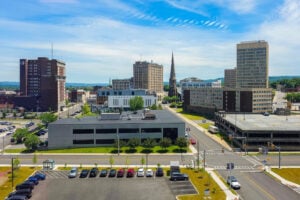
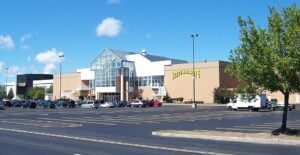
The former Irondequoit Mall, later known as Medley Centre, in Irondequoit near Rochester, New York, photographed in 2007. Photo: Matthew D. Wilson / Wikimedia Commons, CC BY-SA 2.5.
Across Upstate New York, there was a time when a trip to the mall could occupy an entire Saturday. Families from the Mohawk Valley, the Capital Region, Western New York, the Southern Tier, and the Hudson Valley drove to great enclosed shopping centers where department stores, record shops, bookstores, restaurants, and movie theaters shared the same roof. For many communities, the mall was more than a place to buy clothing. It was where teenagers met their friends, families shopped before the holidays, and generations of workers earned their first paychecks.
The shopping mall became especially important during the decades following World War II. As new neighborhoods spread outward from older city centers, retailers followed customers onto busy suburban highways. An enclosed mall offered a controlled environment where shoppers could visit numerous stores without confronting snow, summer heat, or the changing weather of New York State. The formula succeeded in communities large enough to support several department stores and in smaller markets where one mall could serve an entire county.
By the late twentieth century, however, one mall often found itself competing against a newer, larger mall only a short drive away. Department-store mergers eliminated familiar names. Discount chains and warehouse stores drew shoppers away from traditional anchors. Some shopping centers suffered as manufacturing jobs disappeared from nearby communities. Online retail would later compound problems that had already been developing for years. No single explanation accounts for what happened to every mall on this list.
Nor did all of these places experience the same ending. Midtown Plaza in Rochester and Seneca Mall in West Seneca lost their enclosed shopping structures. Penn-Can Mall in Cicero became an automotive complex. A former mall in Oneonta found a second life as a medical center. In other cases, the building still stands but the shopping concourse that residents remember is no longer operating. Calling all of them ‘demolished’ would overlook some of the most interesting stories about what happened after the retailers departed.
These 25 lost Upstate New York shopping malls tell the history of an extraordinary chapter in American commercial life. Their old store directories, surviving buildings, and redeveloped properties reveal how dramatically shopping habits have changed. They also remind us why these places remain so vivid in the memories of those who visited them, even after the original enclosed mall disappeared.
1. Midtown Plaza
Location: Rochester, Monroe County
What happened: Closed in 2008; most of the original mall complex demolished
When Midtown Plaza opened in downtown Rochester on April 10, 1962, it was considered a remarkable experiment in keeping a city’s commercial center alive. Department-store leaders associated with McCurdy’s and B. Forman worked with architect and shopping-center pioneer Victor Gruen on a project that would combine major stores, smaller retailers, public gathering areas, parking, a hotel, and office space. Unlike the suburban malls that were beginning to draw shoppers away from downtown, Midtown was designed to bring people back into the heart of the city.
The mall became inseparable from Rochester’s holiday traditions. Generations remembered the animated Clock of Nations, the Christmas displays, and the excitement of looking down onto a shopping concourse that seemed to represent an entirely new way of shopping. Its success was never guaranteed, however. Suburban competition increased, downtown retail patterns changed, and the departures of the McCurdy’s and B. Forman flagships in 1994 removed much of the complex’s original reason for existing.
Midtown Plaza closed in July 2008. The shopping concourse and much of the adjoining complex were later removed during downtown redevelopment, while portions of the site’s built environment survived or were adapted. The former mall became an important example of both the ambition behind urban renewal and the difficulty of sustaining a large, enclosed downtown shopping destination once its anchor stores and customer base have changed.
2. Seneca Mall
Location: West Seneca, Erie County
What happened: Closed and demolished in 1994
Seneca Mall opened in 1969 near the New York State Thruway and rapidly became one of the major shopping destinations south of Buffalo. Its early department-store anchors included Hengerer’s and JCPenney, and a growing collection of specialty stores gave families a reason to spend much of the day inside. The mall belonged to the first great wave of Western New York suburban shopping centers, when enclosed retail space promised convenience and a sense of modernity.
The opening of McKinley Mall in 1985 increased competition, and Walden Galleria’s arrival in 1989 shifted the region’s shopping patterns still further. Anchor stores and smaller tenants withdrew. By the early 1990s, Seneca Mall was remembered as much for its nearly empty interior and mall walkers as for its former crowds. This was not the slow disappearance of a single department store; it was the collapse of an entire regional shopping destination.
The mall was demolished in 1994. A Tops supermarket and, later, a Kmart occupied portions of the former site, but large areas remained underused for decades. Renewed development proposals and a property sale in 2024–2025 brought hope that the prominent parcel would finally gain a more substantial new purpose. The enclosed Seneca Mall itself, however, had disappeared long before those plans began.
3. Boulevard Mall
Location: Amherst, Erie County
What happened: Interior closed in February 2026; some exterior-access stores remained during transition
Boulevard Mall opened in Amherst in 1962, becoming one of Western New York’s earliest enclosed suburban shopping malls. Its location on Niagara Falls Boulevard put it within reach of Buffalo residents and the fast-growing northeastern suburbs. What began as a relatively new retail concept eventually expanded into a major commercial destination, with department stores, specialty shops, and the familiar enclosed walkways that defined the American mall experience.
For decades, a trip to Boulevard Mall meant browsing the department stores, meeting friends near the smaller shops, or spending an afternoon away from the weather. But the arrival and expansion of other regional shopping centers gave consumers more choices, while the nationwide contraction of the traditional department-store industry weakened the kind of anchors on which enclosed malls depended. The building’s large footprint gradually became harder to support with a shrinking tenant roster.
On February 3, 2026, the mall’s interior corridors were closed to public access. That did not mean every business on the property immediately closed: some stores with exterior entrances continued operating while owners and the Town of Amherst worked through plans for a new mixed-use development known as Boulevard Place. The end of the interior marked the disappearance of Boulevard Mall as generations of shoppers had known it, even as the property’s next chapter remained unsettled.
4. Great Northern Mall
Location: Clay, Onondaga County
What happened: Closed in November 2022; demolition proceeded during 2026
Great Northern Mall opened on Route 31 in Clay in October 1988, at a time when suburban shopping centers still represented a major form of regional development. It served the northern Syracuse suburbs with a broad selection of department stores and specialty retailers, offering families an alternative to shopping trips closer to downtown Syracuse or the eastern suburbs. The arrival of new stores helped make it a regular gathering place for residents of Clay, Liverpool, and surrounding communities.
The familiar anchor-store changes of the late twentieth and early twenty-first centuries gradually altered the mall’s character. Macy’s closed its location in 2017 and Sears followed in 2018, removing two names that once generated substantial foot traffic. Remaining merchants faced a more difficult situation as vacancies increased and shopping habits continued shifting toward other destinations, larger regional centers, and online retail.
The indoor mall closed in November 2022 after 34 years. Its later owner proposed replacing the old retail complex with a different combination of residential, commercial, and entertainment uses. Demolition was under way during 2026, with contemporary reporting documenting the loss of a building remembered for holiday shopping, teenage visits, and decades of everyday life in northern Onondaga County.
5. ShoppingTown Mall
Location: DeWitt, Onondaga County
What happened: Closed in March 2020; vacant site remained the subject of redevelopment efforts in 2026
ShoppingTown began as a shopping center on Erie Boulevard East in DeWitt in 1957, when retailers were following residential growth beyond central Syracuse. It later developed into an enclosed mall, offering department stores and smaller shops together under one roof. Over the decades the property reflected several generations of Central New York retailing, from regional names such as Dey Brothers and Chappell’s to the larger national chains that came to dominate mall storefronts.
ShoppingTown’s location made it convenient for residents of the eastern suburbs, but convenience alone could not preserve its tenant base. Newer destinations, changes in the department-store industry, and the pull of Syracuse’s much larger shopping complexes steadily reduced the number of viable stores. The decline was prolonged and visible, leaving large stretches of the old mall empty well before the final closure in March 2020.
Onondaga County acquired much of the property in 2020 and spent subsequent years dealing with complicated ownership and redevelopment questions. A highly publicized mixed-use proposal was withdrawn in 2025, while legal and planning steps continued during 2026. The mall did not simply vanish overnight or immediately become a completed new neighborhood; its uncertain afterlife became part of the story of commercial redevelopment in DeWitt.
6. Camillus Mall
Location: Camillus, Onondaga County
What happened: Enclosed mall demolished in the early 2000s; site redeveloped as Camillus Commons
Camillus Mall began as the Camillus Plaza shopping center, which opened in 1964 on West Genesee Street. Early tenants included department stores and supermarkets that supplied the rapidly developing western Syracuse suburbs. Like several other Upstate retail properties, the complex was not originally conceived as the enclosed mall that later generations would remember. Portions of the plaza were enclosed and expanded in the early 1980s as merchants responded to the popularity of indoor shopping.
The expanded center offered families a mixture of anchors, smaller stores, and movie theaters. The 1980s version of the mall represented a much more ambitious retail operation than the earlier outdoor plaza, but it also created the obligations associated with maintaining a large enclosed complex. As anchor tenants departed in the 1990s and early 2000s, its shopping corridors grew increasingly difficult to sustain.
Much of Camillus Mall was demolished in 2003, and the site was rebuilt as the outdoor Camillus Commons development. Big-box stores and new commercial buildings replaced the former concourse, although certain structures associated with earlier stages of the center survived. The property continued to have a retail function; what disappeared was the interconnected indoor mall where residents once moved from store to store without going outdoors.
7. Penn-Can Mall
Location: Cicero, Onondaga County
What happened: Traditional mall closed; much of the site converted into Driver’s Village
Penn-Can Mall opened in Cicero in March 1976, taking its name from the Pennsylvania-to-Canada highway corridor and serving the rapidly growing communities north of Syracuse. The early shopping complex featured Sears, numerous smaller retailers, a movie theater, and a central gathering area remembered for a large clock. Its very design suggested that northern Onondaga County could support a full regional mall of its own rather than depend entirely on older retail districts.
For a time the mall expanded with additional department stores and new wings. It hosted holiday events, promotional appearances, and the ordinary rituals of family shopping. Yet the competitive environment changed dramatically with the rise of larger shopping destinations elsewhere in the Syracuse area. Empty units and departing anchors reduced the mall’s ability to attract customers, and its life as a conventional enclosed shopping center came to an end around the turn of the century.
Local automobile dealer Roger Burdick acquired the property and transformed much of it into Driver’s Village, an unusual complex of auto dealerships and related businesses. Portions of the original structure survived while other wings were removed or reconstructed. The great central clock was preserved and returned, giving the reinvented property a tangible connection to the Penn-Can Mall that thousands of Central New Yorkers still remember.
8. Dutchess Mall
Location: Fishkill, Dutchess County
What happened: Indoor mall closed in 2001; portions of the site adapted for other uses
Dutchess Mall opened in Fishkill in 1974 as the county’s first indoor shopping mall, bringing a new retail model to southern Dutchess County near Interstate 84 and Route 9. Its original department stores and smaller tenants attracted residents who had previously relied on downtown retailers or more scattered suburban plazas. The site also had a much older history, lying in an area associated with the Revolutionary War-era Fishkill Supply Depot.
The opening of the larger Poughkeepsie Galleria in 1987 gave shoppers another powerful destination and contributed to the loss of retail traffic at Dutchess Mall. Department stores and specialty merchants gradually departed. The complex could no longer function as it had in its earlier years, and the mall closed in 2001. For residents who remembered the indoor concourse, the arrival of different businesses did not recreate the earlier shopping experience.
A Home Depot opened on part of the former mall property in 2006. Other surviving spaces later hosted a flea market and eventually educational uses, including a Dutchess Community College location. Redevelopment proposals have continued to circulate, but the site’s mixed history is important: parts were demolished or rebuilt, while other sections found new occupants instead of disappearing entirely.
9. Latham Circle Mall
Location: Latham, Town of Colonie, Albany County
What happened: Mall demolished in phases from 2013 to 2015; replaced by Shoppes at Latham Circle
Long before Latham Circle Mall became a deteriorating enclosed shopping center, the property opened in 1957 as Latham Corners Shopping Center. Its position near a heavily traveled Capital Region intersection made it a natural destination for growing northern suburbs. The property was eventually converted into an enclosed mall, joining a regional retail expansion that included increasingly ambitious department stores, entertainment venues, and indoor walkways.
At its height, the mall housed major stores such as JCPenney and later other national retailers. For many local families, it was the familiar everyday shopping center rather than the larger mall visited only for special occasions. Over time, however, competition from more successful Capital Region malls and the loss of anchors steadily undermined the enclosed format. Large vacant sections illustrated how difficult it had become to maintain a property originally built for a different era of retailing.
Demolition began in 2013, and the remaining original mall buildings came down in 2015. The site was remade as the Shoppes at Latham Circle, an outdoor shopping center with contemporary large-format retailers. In an interesting reversal, the property returned to something closer to its original open-air configuration, even though the retail buildings and most of the businesses were entirely different.
10. Mohawk Mall
Location: Niskayuna, Schenectady County
What happened: Enclosed mall demolished around 2000–2002; Mohawk Commons built on site
Mohawk Mall opened in Niskayuna in 1970, close to the Schenectady city line, as a substantial new shopping destination for the Capital Region. With stores including the Boston Store and a growing range of specialty merchants, the mall gave residents a modern indoor alternative to shopping streets in Schenectady and Albany. Its fountains, seating courts, movie theaters, and long retail corridors made it a particularly memorable example of the suburban shopping-center era.
During the 1970s and 1980s, Mohawk Mall remained part of a competitive retail market that was expanding faster than individual malls could always sustain. National chains arrived, local chains departed, and larger centers gradually commanded more of the region’s shopping traffic. Its movie theaters expanded during the 1980s, but the decline of the retail property eventually overtook even those familiar destinations.
The mall’s cinema closed in July 1999, and most of the enclosed property was removed around 2000–2002. Mohawk Commons, an open-air shopping center, took its place. The location is sometimes casually described as Schenectady, but the former mall stood in the Town of Niskayuna; that municipal distinction matters when documenting the history of these vanished regional landmarks.
11. Irondequoit Mall / Medley Centre
Location: Irondequoit, Monroe County
What happened: Lost as a traditional mall; portions remain standing under the Skyview on the Ridge name
Irondequoit Mall opened in 1990 during a period when the greater Rochester market already had several established shopping centers. It arrived with major department-store anchors and a large enclosed concourse that developers hoped would draw customers from the city’s northern suburbs. The project was physically impressive, but its timing made success difficult. By the early 2000s, a substantial share of the retail space was already vacant.
The property was sold and renamed Medley Centre in 2005, with proposals for entertainment and new commercial activity intended to reverse the decline. Those proposals failed to restore a thriving conventional mall. Subsequent ownership changes brought another name, Skyview on the Ridge, but the problem of filling the enormous former mall remained. The story was not a single catastrophic shutdown; it was a succession of efforts to find another workable use for a struggling building.
As of 2026, important portions of the former mall still stood and the site retained occupants, including a Target store and educational uses. Ownership disputes and legal proceedings concerning redevelopment complicated the next stage. This belongs among lost shopping malls because its original enclosed retail identity disappeared, not because the entire complex was demonstrably demolished.
12. Summit Park Mall
Location: Wheatfield, Niagara County
What happened: Traditional mall closed; large parts of the former structure remained in 2026
Summit Park Mall served the Niagara County communities between Niagara Falls, North Tonawanda, and Lockport. Built in the early 1970s as an enclosed regional shopping destination, it brought department stores and smaller retailers together in a market where local families previously visited a variety of separate shopping districts. For several decades, the mall’s interior offered a meeting place as well as a place to purchase everyday goods.
As regional shopping habits changed and department-store chains contracted, its original mix of retail tenants became difficult to maintain. The corridors ceased functioning as a normal enclosed mall, while various portions of the property found alternative occupants. Former anchor spaces were considered for sports, office, industrial, and other potential uses, reflecting repeated attempts to find a sustainable purpose for the large building.
Unlike malls that were completely torn down and rebuilt, Summit Park’s physical remnants continued to dominate the site. In 2025 and 2026 the property still attracted proposals for new uses and became the subject of foreclosure proceedings involving part of the complex. Its story illustrates the difference between losing a mall as a business and removing a mall as a building: the former can happen decades before the latter.
13. Northway Mall
Location: Colonie, Albany County
What happened: Original indoor mall closed in 1998; converted into an open-air shopping center
Northway Mall opened along Central Avenue in Colonie around 1970–1971, directly across from Colonie Center. It reflected the suburban development of the Capital Region, bringing together department stores and specialty shops in a part of Albany County that was becoming a major retail corridor. Familiar names such as E.J. Korvette, Woolworth, Montgomery Ward, and Lechmere formed part of its history, while smaller stores and an arcade helped make it a regular destination for younger shoppers.
Being across from another major mall created a difficult competitive relationship. Northway’s retailers changed over the years, and the simultaneous loss of several important tenants in 1997 left the enclosed center particularly vulnerable. By the end of 1998 only a handful of merchants remained, and the property closed as a conventional indoor mall after its final holiday season.
Much of the original structure was demolished or reworked beginning in 1999, and the property was redeveloped into an outdoor retail complex. The name Northway continued in a modified form, but the shopper experience did not. The present shopping center is a continuation of retail activity on the site, not a surviving version of the former enclosed Northway Mall.
14. Saratoga Mall
Location: Wilton, Saratoga County
What happened: Closed and demolished in 1999; site replaced by Wilton Square
Saratoga Mall opened in Wilton in 1973 as Pyramid Mall Saratoga, serving the Saratoga Springs area before several newer shopping centers transformed the region. Located near Route 50 and the Northway, it attracted department stores and smaller specialty merchants serving both year-round residents and the larger surrounding communities. Like many early suburban malls, its appeal came from putting an extensive selection of stores together under a single roof.
The shopping landscape shifted dramatically once nearby Wilton Mall became established. Two enclosed centers close to each other had to compete for the same customers and anchor-store investment, and the older center struggled to maintain its position. Changes among department-store brands compounded the pressure. In the final years, the economic logic of maintaining an older enclosed building became increasingly difficult to defend.
Saratoga Mall was demolished in 1999 and replaced by the open-air Wilton Square retail center. Residents sometimes confuse Saratoga Mall with the separate Wilton Mall, which operated nearby. They were distinct properties, and the disappearance of Saratoga Mall should not be mistaken for the closure of every regional mall serving the Saratoga Springs area.
15. Cortlandville Mall
Location: Cortlandville, Cortland County
What happened: Former enclosed mall converted to Cortlandville Crossing
Cortlandville Mall provided a smaller-scale shopping experience than the giant regional centers near Buffalo, Albany, or Syracuse. Developed in the early 1970s, it helped shift some local retail activity away from downtown Cortland and toward the suburban highway corridor. Department stores such as Chappell’s and other everyday tenants made the mall attractive to families who wanted a selection of stores without traveling to a larger city.
The enclosed complex was not enormous, but its smaller size made the departures of anchor stores especially consequential. Changes in department-store ownership and increasingly strong competition from discount and big-box retailers affected the property during the late twentieth century. The interior format eventually lost its value to owners even though the site continued to have retail potential.
The property was acquired for redevelopment in 1989, and its interior mall was converted into an open-air power center called Cortlandville Crossing. The developer documented that transformation, including the replacement of the central indoor shopping corridor with direct-access retail space. The result remained a shopping destination, but the original community mall no longer existed in the form people remembered.
16. Lockport Mall
Location: South Lockport, Town of Lockport, Niagara County
What happened: Interior closed in 2006; most of mall demolished beginning in 2011
Lockport Mall opened on Transit Road in 1971, serving both the City of Lockport and nearby Niagara County communities. It offered an enclosed collection of department stores, a movie theater, and smaller retailers in an era when many local shoppers were eager to exchange scattered downtown shopping trips for a modern suburban center. Its stores became part of the ordinary commercial routine of residents throughout eastern Niagara County.
Over the years, the mall confronted an increasingly difficult regional market. Larger retail destinations, expanding discount stores, and the decline of department-store chains gradually reduced demand for its indoor units. As anchors closed or changed hands, the mall became less able to sustain the continuous traffic needed by smaller merchants. The remaining Bon-Ton operation survived beyond the closure of the general indoor shopping center.
The conventional mall closed in 2006, and demolition of much of the property began in 2011 as redevelopment proceeded. Some retail activity continued on the broader site, but the interior mall that once linked its stores was gone. Lockport Mall remains a useful example of the way a recognizable commercial address can survive after the original shopping-center building has been substantially removed.
17. Rainbow Centre Mall
Location: Niagara Falls, Niagara County
What happened: Closed as a traditional mall around 2000; partially reused for education and redevelopment
Rainbow Centre Mall was developed in downtown Niagara Falls in the late 1970s as part of a wider effort to rebuild the city’s retail and tourism district. Situated close to one of the world’s best-known natural attractions, the enclosed property was intended to capture both visitor spending and local shopping activity. Its planners hoped that a major commercial building could help restore vitality to streets that had experienced disruption from earlier urban-renewal schemes.
The mall struggled to develop a dependable base of tenants and customers despite its location. Being near the falls did not guarantee that tourists would make a shopping center part of their visit, and downtown economic conditions remained challenging. By 2000, the property had stopped functioning as the lively indoor retail destination its promoters envisioned.
Rather than demolish the entire complex, public agencies and educational institutions pursued adaptive reuse. The Niagara Falls Culinary Institute opened in part of the former mall in 2012, and later plans sought to repurpose other sections of the property. Its transformation made the building part of an educational and redevelopment story even after the Rainbow Centre’s days as a conventional shopping mall ended.
18. Orange Plaza
Location: Town of Wallkill, Orange County
What happened: Enclosed sections removed during conversion to a major open-air retail center
Orange Plaza opened along Route 211 near Middletown in the early 1970s, drawing shoppers from Orange County communities that had long relied on downtown department stores. Its increasingly elaborate retail layout brought nationally familiar stores and local merchants to a commercial corridor that was growing quickly. As an enclosed shopping destination, it became a regular part of the region’s weekend routines, particularly as more families settled in suburban areas.
When the Galleria at Crystal Run opened in 1992, it altered the local market. Traditional department-store anchors and smaller tenants had new incentives to move toward the newer mall, while Orange Plaza struggled with the age and configuration of its original buildings. As retailers departed, the older enclosed complex lost its advantage over a modern center that had been designed for a larger regional audience.
The owner acquired the property in 2001 and undertook a major redevelopment, including demolition of extensive sections of enclosed mall space. The resulting open-air Orange Plaza continued to support retail activity. For longtime shoppers, however, the new big-box arrangement was a different place from the original covered shopping center, despite sharing the familiar commercial location and name.
19. Apollo Plaza
Location: Monticello, Town of Thompson, Sullivan County
What happened: Enclosed outlet mall closed by 2003–2004; subsequent reuse proposals faced difficulties
Apollo Plaza was a memorable shopping destination in Sullivan County during the final decades of the Borscht Belt resort era. The Monticello property evolved from an earlier retail complex into a factory-outlet center that offered bargain hunters a selection of clothing, household, and gift retailers. At one time, its enclosed corridors contained an unusually varied assortment of shops for a small regional market, serving year-round residents as well as visitors to the Catskills.
The tenants included outlet stores, bookstores, food businesses, and other merchants hoping to capitalize on the appeal of discount shopping. The property also suffered serious maintenance and financial problems. Vacancies, a deteriorating building, and uncertain management undermined the mall’s reputation; nearby transportation routes did not overcome those basic problems. By the early 2000s, the center was losing its remaining retailers.
Apollo Plaza stopped operating as a conventional mall in 2003–2004 and remained associated with long-running redevelopment proposals and the difficulties of reusing an aging commercial building. Official Sullivan County economic-development documents later described efforts to rehabilitate the property, while local historical accounts recorded the abandoned site’s deteriorated condition. Its story is different from a neatly completed demolition-and-replacement project.
20. Cohoes Commons
Location: Cohoes, Albany County
What happened: Opened in 1987; former enclosed outlet mall adapted primarily for offices
Cohoes Commons opened in 1987 as a downtown outlet-shopping center anchored by Cohoes Fashions. Its merchants hoped to turn the older mill city’s reputation for bargain clothing into a larger destination by assembling familiar apparel and housewares brands under one roof. At its height, the complex included upscale outlet names such as Ralph Lauren and Dansk, making it quite different from the typical regional department-store mall.
The concept initially offered an alternative to the suburban mall, but it depended heavily on the strength of its flagship retailer. Cohoes Fashions experienced major changes in ownership and direction, and other merchants gradually left. By the time its principal anchor shifted operations away from downtown around 1999, much of the Commons had ceased to function as a vigorous shopping destination. The surrounding city’s economic changes made replacement tenants difficult to attract.
The building did not disappear wholesale. Local planning documents identify the former outlet mall as a property subsequently adapted for office, medical, and government-related uses. In this instance, what was lost was the retail identity and the promise of a downtown outlet-shopping destination, not the complete physical structure. Cohoes Commons demonstrates how old malls can remain in public use without continuing as malls.
21. Como Mall / Appletree Mall
Location: Cheektowaga, Erie County
What happened: Converted to Appletree Business Park beginning in the early 1990s
Cheektowaga’s Como Mall opened in the early 1970s as a neighborhood shopping center with department stores and an entertainment component that included the Como movie theaters. It served a heavily developed portion of suburban Erie County, where shopping centers increasingly competed for the same families. By the early 1980s, its retail business was struggling, but investors believed the property could still be revitalized.
A new ownership group purchased the mall in 1984, carried out improvements, and relaunched it as Appletree Mall in 1985. The new name represented an effort to give an older property a fresh identity. The nearby Walden Galleria, which opened in 1989, made the task more difficult by attracting shoppers and major merchants to a much larger regional center. Rebranding alone could not restore the original enclosed retail operation.
Beginning in 1991, the building increasingly became Appletree Business Park, accommodating office tenants rather than rows of conventional mall stores. Some former shopping-center architectural features remained, making the property’s earlier purpose visible even as employees replaced shoppers in much of the space. It is a notable Western New York example of commercial adaptation rather than a simple wrecking-ball ending.
22. Eastern Hills Mall
Location: Clarence, Erie County
What happened: Enclosed corridors closed in 2024; selected exterior-access businesses continued
Eastern Hills Mall opened in Clarence in 1971 and became a major shopping destination in the northeast Buffalo suburbs. Its broad footprint and department-store anchors drew visitors from communities along Transit Road and beyond, while specialty stores and common areas made it a place where shoppers could spend hours under one roof. For decades, Eastern Hills competed as one of the region’s best-known conventional enclosed malls.
Like other malls, it faced the combined pressures of changing retailer strategies, department-store retrenchment, and competing places to spend leisure time. Owners eventually proposed converting the property into a more walkable mixed-use town center with housing, public areas, retail, and other commercial space. That strategy required closing much of the traditional indoor shopping operation, but not every business on the site was forced to leave.
The enclosed interior closed in January 2024, while a number of retailers with exterior entrances remained open. Planning and infrastructure work continued in 2025 and 2026, including a major proposed sewer investment necessary for broader redevelopment. Eastern Hills belongs to the history of lost enclosed malls, but descriptions of a completely demolished or fully abandoned property would be inaccurate.
23. Riverside Mall
Location: Utica, Oneida County
What happened: Original enclosed retail mall closed and was substantially converted to an outdoor center
Riverside Mall opened in North Utica in August 1974, bringing a substantial collection of retailers to an area near important highway routes. Its anchor stores included well-known regional and national department-store names, while the interior offered a movie theater and a variety of smaller businesses. For Utica-area families, Riverside became one of the most convenient places to combine ordinary shopping errands with entertainment.
The mall’s importance reflected the wider shift from older downtown shopping districts to commercial developments built around automobile access. But the new retail geography remained competitive. Changes in department-store chains and the opening or growth of other shopping options steadily weakened the conventional enclosed center. Its shops and internal common areas no longer drew the crowds needed to sustain the original arrangement.
The Riverside Mall retail format disappeared by the late 1990s. Much of the site was converted or reconstructed for direct-access retail, and the former cinema area also underwent major change. The address continued functioning commercially, but the interconnected enclosed mall known to earlier generations of Mohawk Valley shoppers was lost.
24. Pyramid Mall Oneonta
Location: Oneonta, Otsego County
What happened: Former shopping mall converted to FoxCare Center
Oneonta’s Pyramid Mall opened in 1962 on Route 7, giving residents of Otsego County an enclosed shopping center at a time when such developments were still relatively novel outside larger metropolitan areas. Its earlier shops included a supermarket, drugstore, specialty merchants, and service businesses. For years, the mall supplied the convenience of several daily errands under one roof in a community whose commercial traditions had long been centered downtown.
The opening of Southside Mall in 1983 changed the local competitive balance. The older Pyramid Mall increasingly struggled to retain customers and tenants, even though many residents had fond memories of shopping there. The property closed as a mall in the early 1990s, leaving a sizable commercial building whose future was uncertain.
In 1997, A.O. Fox Hospital acquired the property and converted it into the FoxCare Center, with outpatient medical services and related facilities. The healthcare reuse preserved a community function on the site while abandoning the original shopping-mall model. Unlike stories centered on an empty building slowly collapsing, Oneonta’s former mall became an example of a substantial, purposeful second life.
25. Amsterdam Mall
Location: Amsterdam, Montgomery County
What happened: Former downtown mall survives under the Riverfront Center name with non-mall uses
Amsterdam Mall was part of an ambitious urban-renewal effort that reshaped downtown Amsterdam during the 1970s. Its developers hoped to restore commercial strength to the Mohawk Valley city by introducing enclosed suburban-style shopping into an older street grid. The large structure interrupted historic circulation routes as well as providing a new place for stores, revealing the enormous faith that planners once placed in indoor retail complexes.
The undertaking occurred while Amsterdam faced significant economic pressure from changes in manufacturing and downtown business activity. A shopping mall alone could not reverse those broader trends. As retail uses declined, the property gradually took on a different role, and the enclosed shopping experience that had once justified the complex ceased to define it.
The city later identified the former Amsterdam Mall as the Riverfront Center, leasing space to smaller businesses, agencies, and medical providers. An official downtown revitalization plan acknowledged both the physical impact of the original mall construction and the building’s continuing reuse. It is a reminder that a lost mall can remain a large, active structure even after its original retail purpose has ended.
What Happened to Upstate New York’s Shopping Malls?
The stories of these 25 properties show that the decline of the traditional mall never followed a single pattern. Some shopping centers closed because bigger competitors opened nearby. Others struggled after department-store chains disappeared, or because the surrounding communities changed. A few remained economically useful only after owners abandoned the enclosed retail model altogether. Those distinctions matter when trying to understand why one mall was demolished, another sat vacant, and a third became a collection of offices or medical facilities.
What ties these places together is the memory of the enclosed mall as a social destination. The old department stores, movie theaters, fountains, and food courts may be gone, but they remain part of the history of the communities that supported them. Their sites continue to change, and some may yet become important local destinations again in forms that earlier generations of shoppers would never have imagined.
For a broader look at the economic and cultural changes behind these closures, read our earlier article Can New York’s Dead Malls Be Saved?, which examines the fate of shopping malls across New York State.
For more Upstate articles check out……
10 Lost Railroads of Westchester, the Hudson Valley & Upstate New York