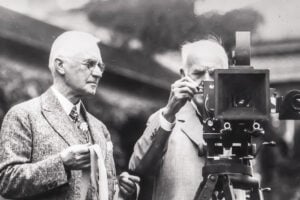
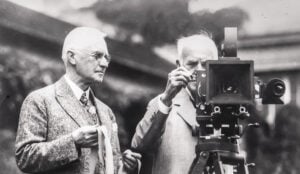
George Eastman, left, and Thomas Edison examine a motion-picture camera at Eastman’s Rochester home on July 31, 1928. Photo: U.S. National Park Service, public domain.
John D. Rockefeller helped create an oil empire in Ohio. Leland Stanford made his fortune in California. Henry Flagler helped transform Florida. The founder of Airbnb began his life in a Schenectady County suburb. These stories share something readers might not expect: the people behind them came from Upstate New York.
The region has produced entrepreneurs whose names became familiar across the country and around the world, even when their greatest accomplishments took place thousands of miles from their hometowns. Some left small farming communities for the opportunities of the Midwest or the West Coast. Others studied, worked, and failed at early ventures before finding a market for their ideas. The route from a small New York town to a national corporation was rarely direct.
The connection among these people is their birth or upbringing in Upstate New York, not the locations of their company headquarters. Some eventually built businesses in the state, but many made their fortunes elsewhere. For some, the journey began on a family farm; for others, it began in a factory town, a suburban high school, or the shopping streets of a small city. Their hometowns provide a starting point for stories that often carried them far beyond New York.
The list ranges from nineteenth-century railroad investors to contemporary technology and media entrepreneurs. It includes people who developed companies, took over struggling enterprises, or used business success to launch very different ventures. Alongside their achievements are setbacks, contentious labor histories, and decisions that affected workers and communities. Each career offers a different answer to the question of how far a person from Upstate New York might travel.
1. Brian Chesky
Upstate origins: Niskayuna, Schenectady County. Known for: Airbnb; San Francisco, California.
Brian Chesky grew up in Niskayuna, outside Schenectady, with parents who worked as social workers. His early interests were hockey, drawing, and redesigning familiar objects, particularly sneakers. He attended Niskayuna High School before studying industrial design at the Rhode Island School of Design. His hometown lacked a thriving start-up scene like Silicon Valley, but his upbringing fostered the curiosity and attention to design that later shaped his approach to business.
In 2007, after moving to San Francisco, Chesky and fellow designer Joe Gebbia tried renting space in their apartment to visitors during a busy conference. With Nathan Blecharczyk they developed the idea into Airbnb. Early on, skeptical investors and financial pressure forced the founders to sell novelty cereal boxes to raise money. Chesky eventually led a global lodging marketplace. His story is a striking contemporary example of someone raised in an Upstate suburb who built his most prominent enterprise on the opposite coast.
2. John D. Rockefeller
Upstate origins: Richford, Tioga County. Known for: Standard Oil; Cleveland, Ohio.
John Davison Rockefeller was born in Richford, New York, in 1839. His family moved among communities in the Southern Tier, including Owego, before relocating to Ohio in 1853. His father was frequently absent, and young Rockefeller developed habits of careful recordkeeping and thrift in a household that did not enjoy predictable financial security. He left conventional schooling and studied business methods before taking work as a bookkeeper in Cleveland.
In Ohio, Rockefeller entered the oil-refining business and helped establish Standard Oil in 1870. The business became enormously powerful, drawing both admiration for its efficiency and criticism for monopolistic practices. Later he donated vast sums to education, medical research, and philanthropy. Rockefeller’s early history is often overshadowed by the scale of his later fortune, but his birthplace in rural Tioga County makes him one of the most consequential business figures to have begun life Upstate.
3. Tommy Hilfiger
Upstate origins: Elmira, Chemung County. Known for: Fashion design and apparel; New York City and global markets.
Tommy Hilfiger was born and raised in Elmira, one of nine children. Music and the clothing worn by performers attracted his attention while he was still in school. According to the designer’s own account, he drove to New York City with limited savings, bought jeans that were difficult to find at home, and resold them to Elmira customers. His first serious venture, the People’s Place, was a group of stores that brought styles from major cities to the Southern Tier.
The first retail business ultimately failed, a setback that forced Hilfiger to rethink his future. He relocated to Manhattan and pursued clothing design, launching his namesake brand in 1985. The company became associated with American sportswear and later with music and youth culture across international markets. His experience selling jeans in Elmira helped him develop the instincts that he eventually carried into the international fashion business.
4. Henry Flagler
Upstate origins: Hopewell, Ontario County. Known for: Standard Oil and Florida East Coast development.
Henry Morrison Flagler was born in Hopewell, Ontario County, in 1830. He left school at fourteen and moved to Ohio, where he worked in a relative’s grain business and gradually became an experienced merchant. His path included ventures that did not all succeed, but he acquired business relationships and managerial skills that would later prove valuable. His New York beginnings were far removed from the Florida resort towns with which his name is now associated.
Flagler became a partner of John D. Rockefeller in Standard Oil, building the financial resources for another career. He invested in Florida hotels, transportation, and infrastructure, and played a central role in expanding the Florida East Coast Railway. His projects helped change communities including St. Augustine, Palm Beach, and Miami, though they also reflected the inequalities and labor conditions of their era. A boy born in the Finger Lakes region thus became one of the principal figures in modern Florida’s development.
5. Leland Stanford
Upstate origins: born in Watervliet, Albany County; raised partly in Schenectady County. Known for: Central Pacific Railroad; California.
Leland Stanford was born in 1824 in the town of Watervliet, New York, and spent part of his youth on a farm in Schenectady County. He pursued schooling in Central New York and legal training in Albany before practicing law in Wisconsin. When that venture failed to provide the future he wanted, he went west during the California Gold Rush period, entering his brothers’ mercantile business.
Stanford prospered as a Sacramento merchant and joined the investors behind the Central Pacific Railroad. He became governor of California and later a United States senator. The railroad helped connect the nation but was also built through strenuous, often dangerous labor, much of it performed by Chinese workers. After the death of his son, Stanford and his wife Jane founded the university that bears their name. California became the center of his public life, but his personal story started in the Capital Region.
6. George Westinghouse
Upstate origins: Central Bridge, Schoharie County. Known for: Railway and electrical enterprises; Pittsburgh, Pennsylvania.
George Westinghouse was born in Central Bridge in 1846 and spent formative years around his father’s machinery business in Schenectady. As a young man he learned how industrial equipment worked, served briefly during the Civil War, and pursued practical mechanical inventions. He was particularly interested in the difficulty of stopping railway trains safely as they grew longer and traveled faster.
His railroad air-brake system led to a manufacturing enterprise based in Pittsburgh, and he later became a major advocate of alternating-current electrical power. His commercial competition with other electrical interests formed an important chapter in the expansion of American power networks. Westinghouse’s career stretched across engineering and business, and his name became associated with a national industrial enterprise. Although much of his success was based in Pennsylvania, the skills that launched his career developed in Upstate New York.
7. Rachael Ray
Upstate origins: Glens Falls and Lake George, Warren County. Known for: Television, publishing, product lines, and media production.
Rachael Ray was born in Glens Falls in 1968 and grew up in the Lake George area. Food and restaurants were part of everyday family life; her mother worked in restaurant management, and Ray herself held food-service and retail jobs. She later worked at specialty food businesses, where the practical task of helping customers cook affordable meals became central to her public identity. Her Upstate upbringing was not an incidental biographical detail; it helped shape her approach to food.
Ray turned short cooking demonstrations into television opportunities and a broader media career. Her brand expanded through books, magazine publishing, kitchen products, and other ventures. After her long-running daytime program ended, she continued producing food-related content through independent partnerships. Her career illustrates an entrepreneurial path that does not begin in a factory or financial office: she made accessible home cooking the foundation of a national business identity.
8. Henry J. Kaiser
Upstate origins: Sprout Brook, Montgomery County. Known for: Construction, shipbuilding, and health care; Western United States.
Henry J. Kaiser was born in Sprout Brook, a small Montgomery County community, in 1882. His family later lived in the Utica area, where young Henry left school to help earn money. He worked in retail and photography before moving west. The early years mattered because they exposed him to selling, staffing, and completing work with limited resources rather than preparing him through a conventional university education.
Kaiser built a major construction enterprise in the West, working on highways, dams, and other large projects. During World War II his shipyards became central to industrial mobilization, particularly around Richmond, California. He also helped establish the health care system that developed into Kaiser Permanente. The distance between a small Mohawk Valley birthplace and the shipyards of the Pacific Coast shows how little the location of an entrepreneur’s later enterprise may resemble the place where the story began.
9. George A. Hormel
Upstate origins: Buffalo, Erie County. Known for: Hormel Foods; Austin, Minnesota.
George Albert Hormel was born in Buffalo in 1860 to German immigrant parents. His family moved to Ohio during his childhood, and financial pressure eventually forced him to leave school and work. He learned aspects of the meat trade through family connections and jobs in the Midwest. His early biography was one of frequent moves and practical work, rather than a direct route from inherited wealth to industrial management.
In 1891, Hormel founded a small meatpacking operation in Austin, Minnesota. He faced substantial competitors and emphasized product standards and business discipline as the enterprise grew. The company eventually became a nationally recognized food manufacturer. Most shoppers associate Hormel with Minnesota, and understandably so. Yet the man whose name remains on the products was born in Buffalo, an unexpected Western New York connection to another state’s industrial history.
10. Frank Winfield Woolworth
Upstate origins: Rodman and Watertown, Jefferson County. Known for: Five-and-dime retailing; Pennsylvania, New York City, and beyond.
Frank Winfield Woolworth was born in Rodman in 1852 and grew up in Jefferson County. He disliked the prospect of spending his life farming and sought work in Watertown’s dry-goods stores. The experience taught him that inexpensive merchandise could attract shoppers who were unwilling or unable to pay the prices of more formal department stores. He became particularly interested in organizing fixed-price counters that customers could browse without elaborate negotiations.
His first five-cent store, opened in Utica in 1879, failed. Instead of abandoning the idea, he tried again in Lancaster, Pennsylvania, where it succeeded. Woolworth expanded nationally and internationally, turning a modest approach to discount retailing into a recognizable chain. Although his origins and first experiment were Upstate, one of the decisive breakthroughs happened in Pennsylvania. His story connects a Jefferson County childhood and a failed Utica storefront with a retail empire whose first enduring success came in Pennsylvania.
11. George Draper Dayton
Upstate origins: Clifton Springs, Ontario County. Known for: Dayton’s department store; Minneapolis, Minnesota.
George Draper Dayton was born in Clifton Springs in 1857 and spent his early years in the Finger Lakes. His early adult years included business activity outside New York, and he moved toward banking and real estate opportunities in the Midwest. He ultimately settled in Minnesota, where commercial development offered openings quite different from those in the Finger Lakes community where he began life.
Dayton acquired a Minneapolis dry-goods business in 1902, creating the foundation for Dayton’s department store. His descendants eventually developed the discount-store concept that became Target, decades after his original undertaking. George Dayton himself did not open the first Target store in 1962; that expansion came decades after he established the earlier retail enterprise on which later generations built. The roots of that prominent Minnesota business family can be traced back to Ontario County, New York.
12. William G. Fargo
Upstate origins: Pompey, Onondaga County. Known for: American Express and Wells Fargo; New York and California.
William George Fargo was born in Pompey in 1818, the eldest of twelve children. As a teenager he carried mail along a lengthy route through Central New York and later found work in the express and freight business. Experience coordinating people, parcels, and schedules taught him the importance of dependable transportation at a moment when commerce was expanding beyond familiar local markets.
Fargo joined forces with Henry Wells and others to develop American Express and then Wells, Fargo & Company in 1852. The latter enterprise became especially associated with California and western banking and transportation. Fargo also served as mayor of Buffalo, demonstrating that his career combined national enterprise with continued New York ties. His birthplace in Onondaga County remains one of the more surprising origin stories behind a major American financial-services name.
13. John Butterfield
Upstate origins: Berne, Albany County. Known for: American Express and Overland Mail; cross-country routes.
John Butterfield was born in Berne in 1801 and became interested in transportation while still young. He drove stagecoaches and built a career connecting places at a time when journeys and deliveries could be slow and unreliable. Upstate New York’s canals, roads, and expanding traffic helped provide the setting in which he learned the value of networks that reached beyond a single community.
Butterfield participated in the express business that led to American Express, but his name is particularly associated with the Butterfield Overland Mail service. Beginning in 1858, the line carried mail between Missouri and California along a difficult southern route. Its operation required significant planning, stations, coaches, horses, and workers across a vast distance. A man from rural Albany County thus became a key figure in connecting the country well beyond New York’s borders.
14. George M. Pullman
Upstate origins: Brocton and Albion, Western New York. Known for: Pullman sleeping cars and company town; Chicago, Illinois.
George Mortimer Pullman was born in Brocton in 1831 and spent part of his youth in Albion, Orleans County. As a young worker he acquired experience moving buildings and using mechanical equipment. He also observed boats on the Erie Canal, where passengers could travel in cabins designed for longer journeys. Those experiences contributed to his later interest in improving comfort and convenience on railroads.
Pullman developed sleeping cars and built a manufacturing enterprise centered on Chicago. He also established a company town for his workers, whose carefully planned buildings became famous. But the company’s relationship with labor turned deeply contentious, culminating in the Pullman Strike of 1894. His career offers an important story of innovation alongside conflict over wages, rents, and corporate control. Although his industrial empire was based in Illinois, its founder was a native of Western New York.
15. Charles Crocker
Upstate origins: Troy, Rensselaer County. Known for: Central Pacific Railroad; California.
Charles Crocker was born in Troy in 1822. His family moved west when he was a teenager, and he worked in agriculture and manufacturing before following the Gold Rush to California. He learned that selling supplies could provide a steadier livelihood than searching for gold, and he opened a store in Sacramento. The financial position he established there brought him into business with other merchants who would later enter the railroad industry.
Crocker became one of the four principal investors associated with the Central Pacific Railroad and took a major role in construction. Building track across mountains and difficult terrain created enormous challenges, met by large workforces including many Chinese laborers. He became wealthy and influential in California. His story belongs to the transformation of the American West, but his origin was in the Capital Region, far from the enterprise that made his fortune.
16. Mark Hopkins Jr.
Upstate origins: Henderson, Jefferson County. Known for: Central Pacific Railroad; California.
Mark Hopkins Jr. was born in Henderson in 1813 and moved with his family to Michigan during childhood. He became a merchant and bookkeeper, working in several businesses before joining the movement to California during the Gold Rush. Unlike those drawn solely to mining, Hopkins found opportunity in the financial organization of supply businesses, eventually becoming a partner of Collis P. Huntington.
Hopkins was the careful numbers man among the California investors later known as the railroad’s Big Four. His attention to accounts complemented the work of partners whose public personalities attracted more attention. Together they helped finance and organize the Central Pacific Railroad, though the undertaking also generated substantial controversy over labor, land, and political influence. Hopkins is often remembered as a California businessman, while his biography begins in a small Jefferson County town.
17. Henry E. Huntington
Upstate origins: Oneonta, Otsego County. Known for: Pacific Electric Railway and real estate; Southern California.
Henry Edwards Huntington was born in Oneonta in 1850. He came from a family with commercial interests, and his uncle Collis P. Huntington had made a major fortune through railroad enterprises. As a young man Henry moved to New York City and entered business with his uncle’s assistance, eventually building his own knowledge of transportation and finance.
He relocated to California in the 1890s and later developed railway and property interests around Los Angeles, including the Pacific Electric Railway. The transportation network shaped Southern California’s growth. Huntington also collected art, rare books, and manuscripts, and his legacy survives in the Huntington Library, Art Museum, and Botanical Gardens. His is the story of a man born in Otsego County who became a major figure in the development of the Los Angeles region.
18. Benjamin Franklin Goodrich
Upstate origins: Ripley, Chautauqua County. Known for: B. F. Goodrich rubber company; Akron, Ohio.
Benjamin Franklin Goodrich was born in Ripley in 1841 and trained in medicine. He served as a surgeon during the Civil War before moving through medical practice, investment, and manufacturing ventures. One early rubber business in New York struggled, but the experience gave him a reason to look for a more favorable location and a different commercial strategy.
In 1870, he moved his rubber-manufacturing interests to Akron, Ohio, with financial support from local businessmen. The enterprise that carried his name helped establish Akron as a major center for the American rubber industry. Goodrich did not live to see every later development of the tire and automotive businesses associated with the brand. His own career nevertheless connects a Chautauqua County birthplace to one of Ohio’s defining industries.
19. Thomas J. Watson Sr.
Upstate origins: Campbell, Steuben County. Known for: IBM; national and international business operations.
Thomas J. Watson Sr. was born in Campbell in 1874 and spent his early life in Steuben County. He tried several jobs before developing his skills as a salesman, eventually working for the National Cash Register Company. His early career included success as well as serious setbacks. The experience made him unusually attentive to how sales organizations functioned and how company culture could encourage employees to meet demanding goals.
In 1914 Watson joined the Computing-Tabulating-Recording Company, which later became IBM. He did not invent the company’s earliest machines or personally found every predecessor business. His achievement was reshaping the organization and expanding it into a major international supplier of business technology. The man who guided IBM’s rise had been born on a farm in Steuben County, a far different setting from the international boardrooms in which he spent much of his career.
20. John North Willys
Upstate origins: Canandaigua, Ontario County. Known for: Willys-Overland automobiles; Toledo, Ohio.
John North Willys was born in Canandaigua in 1873. While still young, he sold bicycles and experimented with small commercial ventures, developing an interest in the possibilities of a fast-changing transportation market. Automobiles attracted him at a time when many buyers and sellers still regarded them as risky and unreliable. He became a vehicle dealer before taking a more direct role in manufacturing.
Willys gained control of the struggling Overland automobile enterprise and helped build Willys-Overland into a prominent manufacturer based in Toledo, Ohio. The business later became associated with the Jeep lineage, although that later product history should not be confused with Willys personally inventing the military Jeep. His story follows an entrepreneur from Canandaigua into the early national automobile industry, where selling and managing machines proved as important as designing them.
21. David Walentas
Upstate origins: Rochester, Monroe County. Known for: Two Trees Management and DUMBO redevelopment; Brooklyn.
David Walentas was born in Rochester and grew up under difficult economic circumstances. His father suffered a disabling stroke when David was young, leaving the family dependent on his mother’s work. He found opportunities through education and eventually earned a business degree at the University of Virginia. The early years contrasted sharply with the valuable real estate with which his name would later become associated.
In 1978, Walentas recognized possibilities in former industrial buildings along Brooklyn’s East River waterfront. Through Two Trees Management, he acquired and redeveloped properties in the area now commonly known as DUMBO. The transformation brought investment, businesses, and new residents, alongside debates about rising property values and neighborhood change. Whatever one’s assessment of those consequences, Walentas is an entrepreneur whose nationally recognized business story took shape far from his childhood home in Rochester.
22. Kate Gleason
Upstate origins: Rochester, Monroe County. Known for: Engineering, banking, and real estate ventures; New York and elsewhere.
Kate Gleason was born in Rochester in 1865. She joined the work of her father’s machine shop as a girl and gradually acquired an education in its accounts, operations, and equipment. She attended Cornell but did not finish a degree, returning to a family business that needed her talents. In time she was managing important financial and sales responsibilities at an enterprise operating in a field from which women were often excluded.
Gleason later worked independently in machinery, banking, and construction. She became president of a bank in East Rochester, pursued housing ideas, and invested in ventures in other parts of the country and abroad. Her reputation should not be confined to being the daughter of a manufacturer. A Rochester native who repeatedly entered business fields dominated by men, she built an entrepreneurial career extending beyond a single family company and beyond Upstate New York.
23. B. Thomas Golisano
Upstate origins: Irondequoit, Monroe County. Known for: Paychex and philanthropy; Rochester and national markets.
B. Thomas Golisano was born in Irondequoit, near Rochester, and grew up in a household where earning money required effort. He delivered newspapers and worked while still young, then attended Alfred State College. Later, while employed in payroll services, he saw that smaller businesses were not receiving the same attention as major corporate customers. He developed the conviction that this neglected market could sustain an independent company.
In 1971, Golisano began the enterprise that became Paychex with limited capital. The business expanded nationally while retaining its Rochester headquarters. He subsequently supported hospitals, educational institutions, and disability-related services through philanthropy. His best-known company remained based in the Rochester area, but its reach extended to employers throughout the United States. His story reflects the value of an Upstate education and hometown familiarity in developing a business with national reach.
24. George Eastman
Upstate origins: Waterville and Rochester, Oneida and Monroe Counties. Known for: Kodak and philanthropy; Rochester and global photography.
George Eastman was born in Waterville in 1854 and moved to Rochester when he was a child. His father’s death created financial hardship, and Eastman left school relatively young to help support the family. After working in insurance and banking, he became fascinated with photography and the difficulty of using the equipment and chemicals required at the time. He began experimenting with photographic methods before he had the position of an established industrialist.
Eastman’s innovations and attention to ordinary customers gave rise to the Kodak business, which helped make photography widely accessible. He later became a major philanthropist whose gifts supported educational, medical, and cultural institutions. Kodak’s corporate history is already part of Upstate industrial history, but Eastman’s biography is also the story of a young man from Waterville whose family obligations, experimentation, and persistence shaped his later choices.
25. Glenn H. Curtiss
Upstate origins: Hammondsport, Steuben County. Known for: Aviation and engine manufacturing; national and international markets.
Glenn Hammond Curtiss was born in Hammondsport in 1878 and grew up fascinated by bicycles and machinery. Family losses marked his early childhood, while his interest in repairing mechanical devices became a route toward paid work. He developed expertise as a bicycle mechanic and racer before building and competing with motorcycles. Working with engines eventually led him into aviation, then an uncertain and highly experimental field.
Curtiss became an important early pilot, engine designer, and aircraft manufacturer. His commercial aviation ventures reached beyond the Finger Lakes and helped shape a national industry. His story shares space with the region’s history of invention, but his entrepreneurial life belongs here because the starting point was unmistakably Hammondsport. He was not simply an inventor who happened to have a local factory; he was a native of the community whose practical fascination with machines developed into an aviation career.
For the history of businesses founded in the region, see our 25 Historic Brands That Began in Upstate New York. Our Famous People From Upstate New York and Scientists and Innovators From Upstate New York articles explore other aspects of the region’s history.