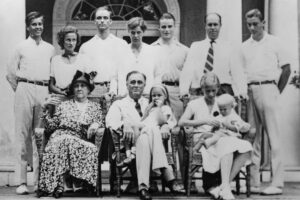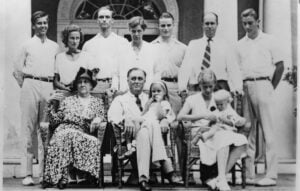
Franklin D. Roosevelt and his family in Hyde Park, New York, on September 15, 1931. Photo courtesy of the Franklin D. Roosevelt Presidential Library and Museum / National Archives.
There are names that appear again and again when you start exploring the history of Upstate New York. They are engraved on buildings, printed on road signs, attached to colleges and hospitals, and found on the gravestones in some of the state’s oldest cemeteries. Some belong to families that settled along the Hudson River when New York was still a Dutch colony. Others belong to families that came much later and built businesses whose names became familiar around the world.
Many of these families played a role in the American Revolution and the creation of New York’s state government. Others helped build the railroads, transformed American retailing, established universities, or left their mark on literature and the movies. It is remarkable that the Rockefeller, Woolworth, Stanford, and Fonda names all have connections to communities in Upstate New York, even though much of their later history unfolded elsewhere.
Not all of these stories began with wealth. Nor were the fortunes of the great colonial families always built under admirable circumstances. Enslaved people, tenant farmers, and the displacement of Indigenous communities were central to the history of many of the early estates. Understanding how these families acquired and exercised their influence is as important as remembering their accomplishments.
For this list, we include families with documented ancestral, residential, or business roots in Upstate New York, including the Hudson Valley. Some are nationally famous, while others are particularly significant in New York history. The emphasis is on the family itself, rather than simply on the birthplace of one famous individual.
1. The Schuyler Family (Albany and Saratoga)
Few families were as closely connected to the American Revolution in New York as the Schuylers. Descended from early Dutch settlers, the family established considerable landholdings and commercial interests in Albany and Saratoga. Philip Schuyler became a major general in the Continental Army in 1775 and commanded its Northern Department during the early years of the war. His work in supplying and organizing the northern army forms an important part of the history behind the Battles of Saratoga.
Philip and his wife, Catherine Van Rensselaer Schuyler, were the parents of Angelica, Elizabeth, and Margarita, better known as Peggy, whose lives became familiar to a new generation through the musical Hamilton. Elizabeth married Alexander Hamilton, while Peggy married Stephen Van Rensselaer III. The family relied extensively on enslaved labor at its Albany home and Saratoga properties. Schuyler Mansion and the Saratoga estate offer opportunities to explore both sides of that history. The National Park Service documents the family’s military career and the lives of the people it enslaved.
2. The Van Rensselaer Family (Albany and Rensselaer Counties)
The Van Rensselaers were among the largest landowning families in colonial New York. Kiliaen van Rensselaer, a Dutch merchant, established the patroonship of Rensselaerswyck in the 17th century. Its holdings extended across both sides of the Hudson River near Albany, where generations of tenant farmers occupied land controlled by the family.
Stephen Van Rensselaer III, who grew up in Albany, served in the New York Legislature, as lieutenant governor, and in Congress. In 1824 he established the school that became Rensselaer Polytechnic Institute in Troy. After his death in 1839, disputes between his heirs and their tenants intensified into the Anti-Rent movement, challenging a system of land ownership that had survived the Revolution. The family’s legacy therefore encompasses both higher education and one of the great struggles over land in New York history. The University at Albany’s historical biography provides further background on Stephen and his family.
3. The Livingston Family (Columbia County)
The Livingston family’s wealth originated with Robert Livingston, a Scottish-born merchant who established Livingston Manor in 1686. The family’s estates spread along the Hudson River, and successive generations became influential in commerce and government. Clermont, the estate of one branch of the family, remains a particularly important landmark in Columbia County.
Chancellor Robert R. Livingston helped draft the Declaration of Independence, administered George Washington’s presidential oath of office, and helped negotiate the Louisiana Purchase. His brother Edward eventually became secretary of state under Andrew Jackson. Their mother, Margaret Beekman Livingston, supervised the rebuilding of Clermont after British forces burned the house in 1777. The Clermont State Historic Site preserves the story of this remarkable household and its role in the Revolution.
4. The Roosevelt Family (Hyde Park, Dutchess County)
Hyde Park became synonymous with Franklin D. Roosevelt, but the family’s connection to the area preceded his presidency by decades. His father, James Roosevelt, acquired the estate known as Springwood in 1867. Franklin was born there in 1882 and maintained his connection to the family home throughout his life. His mother, Sara Delano Roosevelt, played an important role in his upbringing and in the management of the household.
Franklin led the United States through the Great Depression and most of World War II, while Eleanor Roosevelt developed an influential public career of her own, including her work on human rights at the United Nations. Theodore Roosevelt belonged to a different branch of the extended family associated with New York City and Oyster Bay on Long Island. The Hyde Park branch is the focus here. The Home of Franklin D. Roosevelt National Historic Site explores the lives of Franklin, Eleanor, and their relatives.
5. The Clinton Family (Orange County)
The Clinton family emerged from the Little Britain area of Orange County. Brothers George and James Clinton became prominent in the American Revolution. George served as New York’s first governor after independence and later as vice president under Thomas Jefferson and James Madison. James became a Continental Army general and participated in the 1779 Sullivan-Clinton campaign against Haudenosaunee communities.
James’s son, DeWitt Clinton, continued the family’s political tradition as a United States senator, mayor of New York City, and governor. His greatest contribution to the state’s development was his advocacy of the Erie Canal, completed in 1825. The waterway opened new commercial routes across Upstate New York and transformed New York City’s economic position. The United States House of Representatives’ historical biography documents George Clinton’s career and his family’s political connections.
6. The Bleecker Family (Albany)
The Bleeckers established themselves in Albany during the Dutch colonial period. Jan Janse Bleecker arrived in New Netherland in 1658 and became a prosperous merchant involved in the fur trade and land ownership. Two of his sons also served as mayors of Albany, reflecting the family’s influence on the city’s commercial and civic life.
Several generations later, Harmanus Bleecker, born in Albany in 1779, became a lawyer, congressman, state legislator, and American diplomatic representative to the Netherlands. His command of Dutch was a connection to the language and culture of his ancestors. His career illustrates how an early Albany mercantile family became part of the federal government’s diplomatic service. The Bleecker Family Papers at the New York State Library document the family’s business affairs and local roots.
7. The Gansevoort Family (Albany and Saratoga County)
The Gansevoorts were an Albany family involved in brewing, commerce, and public service. Colonel Peter Gansevoort became nationally significant during the Revolution when his regiment successfully defended Fort Stanwix, in present-day Rome, against a British-led siege in 1777. His defense of the fort helped disrupt British operations in the Mohawk Valley. He later returned to business in Albany, and the Saratoga County hamlet of Gansevoort bears his name.
The family also produced another Peter Gansevoort, a state legislator, and a Union officer named Henry Sanford Gansevoort. Through Colonel Gansevoort’s daughter Maria, the family became connected to one of America’s greatest literary figures, Herman Melville, author of Moby-Dick. The New York Public Library’s Gansevoort-Lansing collection contains documents relating to all three families.
8. The Ten Broeck Family (Albany)
Dirck Ten Broeck was a merchant and mayor of Albany in the 1740s. His son Abraham inherited the family’s business interests and expanded them into a substantial commercial enterprise. Abraham married Elizabeth Van Rensselaer and entered public life himself, serving in the colonial assembly and becoming a general in the New York militia during the American Revolution.
Abraham served two periods as Albany’s mayor and held judicial and other civic positions. In 1797–98, he and Elizabeth built the house they named Prospect, now known as Ten Broeck Mansion. Its history encompasses both the wealthy families who lived there and the enslaved and free workers whose labor sustained them. The mansion remains a tangible link to generations of Albany history. The University at Albany’s biography of Abraham Ten Broeck details his family and public career.
9. The Lansing Family (Albany and Lansingburgh)
The Lansing family produced merchants, lawyers, landowners, and public officials. John Lansing Jr., born in Albany in 1754, served as military secretary to Philip Schuyler during the Revolution and later became Albany’s mayor and chancellor of New York. He was one of the state’s delegates to the Constitutional Convention of 1787.
Lansing and fellow delegate Robert Yates left the convention because they believed it had gone beyond its original mandate to revise the Articles of Confederation. John’s brothers Abraham and Gerritt were also prominent Albany residents. The family’s business, legal, and private correspondence survives in the Lansing Family Papers. The National Archives provides an account of John’s constitutional and judicial career.
10. The Fonda Family (Albany and the Mohawk Valley)
Long before Henry Fonda became one of Hollywood’s most admired actors, his ancestors were living in New York. Jellis Douw Fonda arrived in Beverwyck, now Albany, in 1654. A later member of the family, Douw Fonda, established himself in the Mohawk Valley during the 18th century. The village of Fonda in Montgomery County was named for him.
Henry Fonda was born in Nebraska rather than New York, but his family’s ancestry can be traced to those early settlers. His children Jane and Peter Fonda became major film stars, and his granddaughter Bridget continued the family’s acting tradition. The connection is particularly fascinating because the name of a small Upstate New York village is shared by one of Hollywood’s most recognizable families. The New Netherland Institute documents Henry’s New York family roots.
11. The Wadsworth Family (Geneseo, Livingston County)
Brothers James and William Wadsworth came to the Genesee Valley in 1790 and became major landowners in the region around Geneseo. Their rise took place during the dispossession of the Seneca Nation, including the transfer of land rights through the 1797 Treaty of Big Tree. The brothers also brought an enslaved woman named Jenny to the area. James later became a supporter of public education and school libraries.
James’s son, James Samuel Wadsworth, became a Union general and was mortally wounded at the Battle of the Wilderness in 1864. His son James Wolcott Wadsworth served in Congress, and his grandson James Wolcott Wadsworth Jr. served in both the United States Senate and House of Representatives. Four generations of the family are documented in the James Wadsworth Family Papers at the Library of Congress.
12. The Seward Family (Florida and Auburn)
William Henry Seward was born in the Orange County village of Florida in 1801. After marrying Frances Miller, he settled in Auburn, where he practiced law and developed a political career that took him to the governor’s office, the United States Senate, and eventually the State Department under Abraham Lincoln. As secretary of state, he later negotiated the purchase of Alaska in 1867.
Frances was an abolitionist who supported the Underground Railroad and women’s rights. Their son Frederick became an assistant secretary of state, while another son, William Jr., served as a Union general. Their daughter Fanny kept diaries that provide valuable insights into the family and the Civil War era. Auburn’s Seward House Museum preserves the history of these individuals and the home they shared.
13. The Rockefeller Family (Richford, Tioga County)
One of the world’s most famous business families had relatively modest beginnings in Upstate New York. John Davison Rockefeller was born in Richford in 1839, the son of William Avery Rockefeller and Eliza Davison Rockefeller. His younger brother William was also born there. The family lived in several New York communities before relocating to Ohio in 1853.
The brothers became important figures in the development of Standard Oil, which accumulated enormous economic power and was broken up under federal antitrust law in 1911. Later generations became involved in banking, philanthropy, and government. John D. Rockefeller Jr. helped develop Rockefeller Center, while Nelson Rockefeller served as governor of New York and vice president of the United States. The Rockefeller Archive Center traces the family’s story from John’s rural New York childhood through his business and philanthropic career.
14. The Cooper Family (Cooperstown, Otsego County)
William Cooper established the settlement that became Cooperstown in the 1780s, building his wealth through land development and eventually representing New York in Congress. His son James Fenimore Cooper, born in New Jersey in 1789, grew up around Otsego Lake. The landscape of his childhood later influenced the settings of his novels, particularly The Pioneers and the other works in the Leatherstocking series.
James’s daughter Susan Fenimore Cooper became a writer and naturalist. Her 1850 book Rural Hours recorded the plants, animals, seasons, and community life around Cooperstown, making her an important figure in early American nature writing. The Cooper name continues to be associated with Otsego Lake and the village’s literary heritage. The Fenimore Art Museum and the Library of Congress document the family’s contributions.
15. The Remington Family (Ilion, Herkimer County)
Eliphalet Remington began making gun barrels in the Mohawk Valley in 1816. The enterprise developed into a major manufacturing operation in Ilion, where the family name became inseparable from the local industrial economy. His sons Philo, Samuel, and Eliphalet Jr. continued the business after their father’s death in 1861.
One of the family’s most consequential ventures had nothing to do with firearms. In 1873 the company undertook the manufacture of a typewriter developed by Christopher Latham Sholes and his associates. The machines produced in Ilion beginning in 1874 helped establish the typewriter as an essential tool in offices around the world. The Smithsonian’s National Museum of American History holds an early example manufactured by E. Remington & Sons.
16. The Corning Family (Albany)
Erastus Corning, born in Connecticut in 1794, established his career in the Capital Region, developing business interests in hardware, iron manufacturing, banking, and railroads. He helped organize the New York Central Railroad in 1853. He also served as Albany’s mayor, a state senator, and a member of Congress. His business and political connections established the family’s prominence in the city.
His grandson Edwin Corning served as lieutenant governor of New York, while Edwin’s brother Parker became a congressman. Edwin’s son Erastus Corning II was Albany’s mayor from 1942 until his death in 1983, presiding over one of the longest mayoral administrations in American history. Albany’s Corning Tower and waterfront preserve are named in his honor. The University at Albany’s biography explores the political dynasty that connected several generations of the family.
17. The Stanford Family (Watervliet and Albany)
It may surprise anyone familiar with California’s Stanford University to learn that its founders came from the Capital Region of New York. Leland Stanford was born in Watervliet in 1824, and his wife, Jane Lathrop Stanford, was born in Albany. Several of Leland’s brothers ventured west during the California Gold Rush, and Leland eventually joined them in the mercantile business.
Leland became a leader of the Central Pacific Railroad, governor of California, and a United States senator. After their only child died in 1884, Leland and Jane founded Stanford University in his memory. Jane continued to guide and support the university after her husband’s death, helping it survive a period of financial uncertainty. The university’s official history recognizes both founders and their contributions to its development.
18. The Pullman Family (Brocton and Albion)
George Mortimer Pullman was born in Brocton, Chautauqua County, in 1831. His father, James Lewis Pullman, was a carpenter and mechanic who developed equipment for relocating buildings. The family moved to Albion in Orleans County, where George worked with his father and older brothers and gained experience in moving buildings along the Erie Canal.
George took those skills to Chicago before building the railroad sleeping-car business that made his name famous. His company also became the focus of the historic Pullman Strike of 1894. Two of his brothers, Henry and James, became prominent Universalist ministers. The Pullman National Historical Park and the Dictionary of Unitarian & Universalist Biography trace the family’s roots and its varied contributions.
19. The Fargo Family (Pompey and Buffalo)
William George Fargo was born in 1818 in Watervale, a hamlet within the town of Pompey in Onondaga County. He began working in the express delivery business and became a co-founder of American Express in 1850 and Wells Fargo in 1852. He also served as mayor of Buffalo. The city of Fargo, North Dakota, was named in his honor.
His younger brother James Congdell Fargo followed him into the express business and succeeded him as president of American Express in 1881. During James’s administration, the company introduced money orders and the traveler’s cheque, expanding beyond its original freight and delivery operations. The William G. Pomeroy Foundation’s historical marker commemorates William’s birthplace in Pompey.
20. The Westinghouse Family (Central Bridge and Schenectady)
George Westinghouse was born in Central Bridge, Schoharie County, in 1846. His father, also named George, manufactured agricultural machinery and moved the family to Schenectady in the 1850s. The younger George had opportunities to experiment with machinery in his father’s workshop, an early influence on his subsequent career as an inventor and businessman.
After serving in the Civil War, George developed a railway air brake that improved railroad safety and later became a leading advocate of alternating-current electrical power. His achievements drew on the mechanical and manufacturing tradition of his New York family. The Hudson-Mohawk Genealogical and Family Memoirs documents his father’s business and the family’s Capital Region connections.
21. The Woolworth Family (Jefferson County)
Frank Winfield Woolworth was born in Rodman in 1852, and he and his younger brother Charles Sumner Woolworth grew up in Jefferson County. Frank learned the dry-goods business in Watertown, where he began developing his approach to low-priced merchandise. His first store in Utica failed in 1879, but a subsequent store in Lancaster, Pennsylvania, succeeded.
Charles, known as Sum, became a successful retailer in his own right and helped expand the Woolworth enterprise. The brothers’ businesses helped establish the five-and-dime as a familiar institution across America. The original American Woolworth stores closed in 1997, but the parent corporation continued in the athletic retail business and adopted the Foot Locker name in 2001. You can read more in our history of Woolworth’s and the Library of Congress’s account of Frank’s career.
22. The Yates Family (Schenectady and Albany)
Members of the Yates family held important legal and governmental positions in New York during the Revolution and the early republic. Robert Yates, born in Schenectady, became a judge and a delegate to the Constitutional Convention. He opposed the creation of a stronger federal government as proposed at the convention and left before the finished Constitution was signed.
His relative Joseph Christopher Yates became Schenectady’s first mayor in 1798, helped establish Union College, served on the state’s Supreme Court, and became governor in 1823. Yates County in the Finger Lakes was named in his honor. The family also included the Albany attorney Peter W. Yates, under whom Joseph studied law. The Historical Society of the New York Courts documents Joseph’s judicial and political career.
23. The Vassar Family (Poughkeepsie, Dutchess County)
Matthew Vassar came to America from England with his family as a child. His father, James, established a brewing business in the Poughkeepsie area. After a devastating brewery fire and the death of his brother John Guy Vassar in 1811, Matthew rebuilt the enterprise and assumed responsibility for his brother’s two sons.
Matthew used his wealth to establish Vassar College in 1861, creating one of the country’s pioneering institutions of higher education for women. His nephews Matthew Jr. and John Guy Jr. continued the family’s philanthropic tradition, contributing to the development of the Vassar Brothers Institute and Vassar Brothers Hospital. Their legacy can still be found across Poughkeepsie. The Vassar College Encyclopedia traces Matthew’s journey from the family brewery to his educational work.
24. The Hasbrouck Family (New Paltz, Ulster County)
Brothers Jean and Abraham Hasbrouck were French Huguenots who arrived in America in the 1670s and helped establish New Paltz. Their family was part of a community of Protestant refugees who acquired land in the Wallkill Valley and created a settlement whose early stone houses remain among the region’s most distinctive historic landmarks.
Later generations of Hasbroucks entered commerce and public service. Josiah Hasbrouck, born in New Paltz in 1755, served in the Revolutionary militia, held local and state offices, and represented New York in Congress. The family’s early homes are preserved at Historic Huguenot Street, where the Hasbrouck Family Association documents the brothers’ ancestry and descendants. The surviving houses give visitors a rare opportunity to see the physical setting of a 17th- and 18th-century New York family story.
25. The Pruyn Family (Albany)
The Pruyns were another Albany family whose roots extended into the Dutch colonial period. John Van Schaick Lansing Pruyn, born in Albany in 1811, became a lawyer and worked closely with Erastus Corning in the railroad business. He helped negotiate the consolidation that created the New York Central Railroad and later served in the United States House of Representatives and as chancellor of the University of the State of New York.
Another member of the family, Robert Hewson Pruyn, was appointed American minister to Japan by Abraham Lincoln in 1861. His diplomatic service during a period of profound political change in Japan produced a significant collection of letters and records. The New York State Library’s Pruyn papers and the Albany Institute of History & Art preserve records of these two remarkable careers.
The Legacy of Upstate New York’s Famous Families
These 25 families represent very different chapters in New York history. Some never strayed far from the Hudson River communities where their ancestors settled. Others left Upstate New York and built their reputations in California, Chicago, Cleveland, or Hollywood. The names they left behind can still be found across the state, on historic houses, university campuses, village signs, and public buildings.
For more stories about the people and places that shaped this region, explore our articles on 25 Famous People You Didn’t Know Were From Upstate New York, 25 Historic Hudson Valley Estates and Mansions With Remarkable Stories, 25 Famous People You Didn’t Know Were From Albany, New York, and 15 Famous People You Didn’t Know Were From Cooperstown.