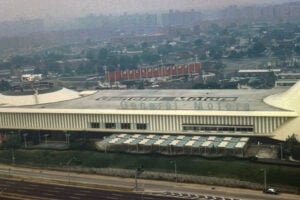
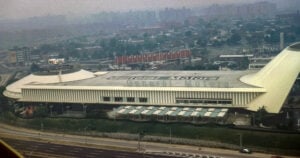
The General Motors Pavilion, home of the futuristic Futurama II exhibition, at the 1964–1965 New York World’s Fair in Queens. Original photograph from the CE Family Collection, made available by David Pirmann / Wikimedia Commons (CC BY 2.0). Image cleanup and restoration by Brian Kachejian.
When I was 3 years old, my parents took me to the 1964 World’s Fair in Flushing, Queens. I would love to tell you all about it, but the fact is I pretty much don’t remember anything except for a few things. And I’m not even sure if they’re real memories anymore. I do remember looking up at dinosaurs. I don’t remember what I was thinking, but I do have a slight memory of that. I also remember sitting in my father’s lap, thinking that I was driving a car, as they were probably all laughing at me. That’s about it. However, I do have the program, the pictures, and the stories that I’ve heard throughout the years. This article takes a look not at the history of the World’s Fair, but more specifically at some of the ideas generated throughout the fair. Some came to fruition, and others have remained science fiction.
When the 1964–1965 New York World’s Fair opened on April 22, 1964, in Flushing Meadows–Corona Park, it was billed under an unapologetically ambitious theme: “Man’s Achievement on a Shrinking Globe in an Expanding Universe”. Over two six-month seasons, more than 51 million visitors walked beneath the towering steel rings of the Unisphere to see what America’s corporate titans—General Motors, General Electric, AT&T, Ford, and IBM—believed daily life would look like by the end of the century.
Because the fair was not officially sanctioned by the Bureau International des Expositions, major European nations largely boycotted it. That left American corporations to dominate the fairgrounds with massive, elaborate pavilions that doubled as breathless showcases of mid-century technological optimism. Looking back more than sixty years later, the inventions promised in Queens reveal a fascinating mix of remarkably accurate predictions, Cold War anxieties, and extraordinary engineering ambition.
1. The Mod I Picturephone
Inside the Bell System Pavilion—a dramatic cantilevered “floating wing”—fairgoers lined up to test AT&T’s crown jewel: the experimental Mod I Picturephone. Bell Laboratories set up demonstration booths where visitors could place live, two-way black-and-white video calls to other booths in Queens, or even dial straight through to a sister station at Disneyland in Anaheim, California. The small monochrome screen showed moving pictures at 30 frames per second, and the demonstration offered an early glimpse of video calling.
Behind the scenes, Bell Labs treated the fairgrounds as a massive human-behavior experiment. Every time a fairgoer picked up the handset, toggled the speakerphone, or switched off their outgoing camera for privacy, researchers gathered feedback about how people used the equipment. AT&T executives believed that “see-as-you-talk” telephones could become familiar equipment in American homes and offices.
When AT&T finally launched commercial Picturephone service in Pittsburgh in 1970, it was a historic flop. The service cost $160 a month in 1970 dollars for just 30 minutes of video, the grainy picture flattered no one, and many potential customers saw little reason to pay so much for a video image. It took another forty years—and the arrival of the iPhone, FaceTime, and Zoom—for the World’s Fair’s favorite communication dream to finally become second nature.
2. Controlled Nuclear Fusion Power
At General Electric’s Progressland—a massive lattice-domed pavilion designed in collaboration with Walt Disney Studios—visitors didn’t just look at models of the future; they witnessed a live thermonuclear reaction. Placed on a central plinth inside a darkened amphitheater sat a real theta-pinch fusion device. Every four to six minutes, following a dramatic countdown, a powerful magnetic field squeezed a plasma of deuterium gas for a few millionths of a second at an astonishing 20 million degrees Fahrenheit.
The demonstration ended with a blinding flash of light and a thunderous “fusion bang”—actually the sound of the massive capacitor bank discharging—that rattled the pavilion so loudly that GE’s clerical staff had to get used to the constant explosions echoing through the dome. The Official Guide proudly billed it as the first controlled thermonuclear fusion ever witnessed by a general audience, leaving millions of visitors convinced that virtually free, limitless sun-powered electricity was just around the corner.
The reality beyond the exhibit was far less triumphant. The demonstration produced a brief fusion event, not a system that could supply electricity to homes or businesses. More than six decades later, scientists around the world are still chasing the sustained, commercial fusion energy that Progressland made look like a solved problem in 1964.
3. The Underground World Home
Tucked next to the Hall of Science and just north of the fair’s heliport sat one of the strangest—and most quintessentially Cold War—exhibits in Flushing Meadows: the Underground World Home. Designed by Texas architect Jay Swayze and financed by Avon investor and millionaire Girard B. Henderson just two years after the Cuban Missile Crisis, the exhibit pitched subterranean living not as a cramped fallout shelter, but as the future of luxury suburban real estate.
Visitors who paid an extra $1.00 admission descended into a roughly 5,600-square-foot exhibition home encased in 20-inch-thick steel-and-concrete walls and supported by 18-inch steel beams rated to hold two million pounds of insulating soil. To combat claustrophobia, the home featured a 384-square-foot simulated outdoor patio with artificial trees, a “snorkel-like” air-conditioning system, and large backlit murals painted by Texas artist Mrs. Glenn Smith outside the windows. Swayze earnestly argued to skeptical New Yorkers that people didn’t look out their windows 80 percent of the time anyway—and that his underground design was completely “peeping Tom proof” and free of mosquitoes.
Despite its unusual concept, the exhibit attracted visitors, but underground luxury housing did not become the suburban standard its promoters imagined. After the fair closed, the Underground World Home was quietly demolished in March 1966, though Henderson went on to build himself a lavish real-life underground mansion in Las Vegas that still exists today.
4. Underwater Resorts and Personal “Aqua-Scooters”
No attraction at the 1964–1965 fair matched the sheer spectacle of General Motors’ Futurama II. Strapped into contoured plastic chairs equipped with personal headrest speakers, visitors glided along a two-story moving track past hyper-detailed dioramas of humanity conquering every hostile corner of the Earth. One of the most dazzling stops on the ride plunged guests straight to the ocean floor.
GM’s vision of the twenty-first-century ocean was both industrial and leisurely. In the diorama, automated drills tapped the seabed for oil and submarine freight trains hauled harvested minerals across the abyss, while right nearby sat a sleek, glass-domed sub-oceanic resort. Vacationers lounged inside pressurized underwater suites or strapped on personal oxygen tanks to zip around the coral reefs on handheld “aqua-scooters”.
While modern deep-sea oil drilling certainly became a reality, the middle-class underwater vacation never materialized. A handful of underwater hotel rooms and research habitats exist, but the engineering costs and hazards have kept submerged resorts far from ordinary family travel.
5. The Five-Story Laser Jungle Road-Builder
If one exhibit from Futurama II perfectly captures how drastically American attitudes toward the environment have changed since 1964, it was GM’s colossal jungle-clearing machine. As riders glided over a dense tropical rainforest diorama, they watched a futuristic timber-cutter slice down towering trees with a futuristic cutting machine.
Directly behind the cutting machine rumbled a monstrous, all-in-one road-building machine scaled to appear five stories tall and longer than three football fields. As it lumbered forward, the mechanical behemoth swallowed the cleared terrain, leveled and graded the earth, and extruded a fully paved, striped, divided multilane superhighway straight out of its rear—connecting a brand-new industrial city built to process the rainforest’s lumber and chemicals.
In the pre-Earth Day optimism of 1964, GM’s designers presented the destruction of the jungle as a triumphant conquest of nature by American engineering. Today, the concept reads like a cautionary science-fiction nightmare. The enormous rainforest-clearing machine remained a model of the future rather than an actual product.
6. The Bell Rocket Belt (Personal Jetpacks)
While most pavilions relied on miniature dioramas and films to sell the future, Bell Aerosystems gave fairgoers the real thing right over their heads. Throughout the fair, test pilots strapped into the Bell Rocket Belt—a hydrogen-peroxide-powered personal jetpack developed for the U.S. Army—and blasted off into the Queens sky, soaring over the pavilions in deafening bursts of white steam.
Watching a lone man fly untethered above Flushing Meadows made personal airborne commuting feel practically inevitable. Newspapers and magazines speculated that within a generation, suburbanites might skip the Long Island Expressway altogether and jet straight into Midtown Manhattan.
The catch was hidden in the fuel tanks. The Rocket Belt used up its hydrogen peroxide propellant so quickly that it could stay aloft for only about twenty seconds, covering a few hundred feet at most. Its limited endurance and operational hazards presented serious obstacles. Decades later, despite modern turbine jetpacks used in stunt shows, the physics of fuel weight and safety ensured that everyday jetpack commuting stayed firmly grounded.
7. Remote-Controlled Desalinated Desert Farms
Another striking sequence in GM’s Futurama II tackled global hunger by imagining the complete transformation of the arid American Southwest. In GM’s diorama, barren desert sands had been converted into lush, geometric grids of thriving farmland irrigated by vast pipelines pumping subterranean water and desalted ocean water inland.
Even more prophetic was how those crops were tended. Rather than human farmhands driving tractors under the scorching sun, the fields were planted, monitored, and harvested entirely by sleek, unmanned agricultural machines operated by remote control from air-conditioned command centers.
Unlike underwater resorts or laser road-builders, this 1964 prediction actually aged remarkably well. Large-scale desalination plants now supplement water supplies in dry regions, while treated wastewater and other sources support irrigation, and modern precision agriculture increasingly relies on GPS-guided autonomous tractors and aerial drones—proving GM’s engineers weren’t always dreaming too big.
8. Antarctic Under-Ice Cities and Weather Forecasting
Not content with conquering the jungle, the desert, and the ocean floor, Futurama II also promised that humanity would tame the South Pole. One of the ride’s most memorable dioramas depicted a massive, all-weather shipping port carved directly into the towering Antarctic ice shelf.
Deep beneath the frozen cap sat a gleaming, brightly lit subterranean laboratory—a permanent under-ice city where meteorologists and technicians operated a weather-research center envisioned as part of a worldwide forecasting system. The exhibit reflected the era’s faith in the ability of large machines and advanced technology to overcome extreme environments.
In reality, international agreements protect Antarctica and prohibit mineral-resource activities other than scientific research, while the sheer brutality of polar winters has kept human presence concentrated in research stations, including the year-round McMurdo Station. The dream of thriving subterranean ice ports remains frozen in 1964.
9. Lifelike Audio-Animatronic Humans
While corporate engineers were pitching jetpacks and fusion reactors, Walt Disney quietly stole the show with robotics. At the Illinois Pavilion, Disney unveiled Great Moments with Mr. Lincoln—a startlingly lifelike, full-sized Audio-Animatronic figure of the sixteenth president that rose from his chair, gestured with eerie fluidity, and delivered a resonant speech on liberty. Just down the promenade at GE’s Progressland, Disney’s Carousel of Progress seated 250 guests at a time inside a rotating theater, carrying them past four stages of animated human figures demonstrating how electricity transformed the American home from the 1890s to the 1960s.
To 1964 audiences accustomed to stiff department-store mannequins, Disney’s hydraulic, magnetic-tape-driven robots looked like the dawn of lifelike androids. Commentators wondered how long it would be before humanoid robots were staffing reception desks, teaching classrooms, and performing household chores.
While domestic androids never showed up in suburban kitchens, Disney’s breakthrough permanently transformed the entertainment industry—and versions of Great Moments with Mr. Lincoln and the Carousel of Progress later became enduring attractions at Disneyland and Walt Disney World, respectively.
10. Touch-Tone Push-Button Telephony
For all its wild swing-for-the-fences predictions, one of the most consequential inventions showcased at the 1964–1965 World’s Fair was sitting right in plain sight at the Bell System Pavilion: the Touch-Tone telephone. Having only just begun limited commercial rollouts in late 1963, push-button dialing was still a thrilling novelty to the millions of New Yorkers who had spent their entire lives waiting for a rotary dial to click back into place.
At the fair, visitors delighted in tapping out numbers on the sleek ten-button grid, marveling at the crisp dual-tone musical notes that connected calls in a fraction of the time. Bell’s lower-level exhibit hall even let guests test their own musical pitch and watch their voices transform into visual symbols on a television screen through a “Visible Speech” display.
Unlike underwater hotels, personal jetpacks, or five-story jungle machines, Touch-Tone dialing didn’t just survive the transition from Flushing Meadows to the real world—it quietly reshaped global telecommunications. The familiar keypad used for dialing and automated phone menus grew out of the same technology that visitors could try in Queens.
For more about the history of New York inventions and popular attractions, explore our articles on inventions and innovations from Upstate New York and the history of the Great New York State Fair.