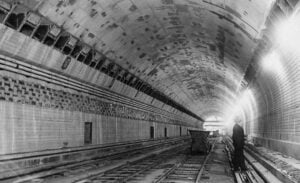
The Lincoln Tunnel under construction in 1936, showing the unfinished interior of the tube beneath the Hudson River. Associated Press, public domain, via Wikimedia Commons.
The Lincoln Tunnel remains one of the defining achievements of 20th-century civil engineering, carrying traffic between Midtown Manhattan and Weehawken, New Jersey, beneath the Hudson River. Originally known as the Midtown Hudson Tunnel, the project required engineers to solve a difficult combination of problems: soft riverbed silt, water pressure, sections of rock near the approaches, the health risks of compressed-air construction, and the buildup of automobile exhaust inside a long underwater roadway.
The first tube was built under the direction of Port Authority chief engineer Othmar H. Ammann, with Ole Singstad serving as chief tunnel consulting engineer. Singstad brought crucial experience from the Holland Tunnel, where he had helped develop the ventilation system that made long underwater vehicular tunnels practical. Construction on the first Lincoln Tunnel tube began in 1934. That center tube opened in 1937, followed by the north tube in 1945 and the south tube in 1957.
The Tunneling Shield and the Hudson River Silt
Much of the riverbed along the Lincoln Tunnel alignment consisted of soft mud and silt, although workers also encountered rock near the approaches. Engineers could not simply excavate an unsupported passage beneath the river. Water and saturated soil placed continuous pressure on the work area, creating the danger of flooding or collapse if that pressure was not controlled.
The solution was shield tunneling combined with compressed air. A huge circular steel shield protected the men working at the tunnel face while hydraulic jacks forced the shield forward through the earth. The Port Authority described the jacks as producing a combined thrust of approximately 6,000 tons. In the soft riverbed, the shield could push directly through the silt. Where crews encountered rock, workers drilled holes, loaded explosives, blasted the rock, and removed the debris before the shield could advance.
Compressed air behind the shield helped counter the pressure of water and saturated soil outside the tunnel. Temporary bulkheads and airlocks separated the pressurized work zone from the rest of the construction shaft. The system allowed workers and equipment to enter and leave without abruptly releasing the pressure that was keeping the Hudson River out of the excavation.
Building the Tunnel With Cast-Iron Rings
As the shield moved forward, the permanent tunnel shell was assembled immediately behind it. Workers fitted curved metal segments together and bolted them into circular rings approximately 31 feet in outside diameter. Each completed ring weighed roughly 20 tons. These rings formed the structural lining that resisted the surrounding pressure of the riverbed and provided the permanent cylindrical shell of the tunnel.
The shield’s hydraulic jacks pushed against the newly completed lining as the machine advanced to the next section. Ring after ring was installed until the tube extended beneath the Hudson. Concrete and the roadway structure were then built inside the circular shell, producing what the Port Authority has described as a box-like traffic space within the larger round tube.
The Sandhogs Working Under Compressed Air
The men who performed the underground excavation and assembly became known as sandhogs. Their work was difficult even by the standards of heavy construction. They drilled and blasted rock, removed mud and debris, handled massive tunnel-lining components, tightened bolts, and worked close behind the advancing shield.
Compressed-air tunneling added another physical danger. Workers passed through airlocks so their bodies could gradually adjust to the higher pressure inside the working chamber. Returning too quickly to normal atmospheric pressure could cause decompression sickness, commonly known as the bends, as dissolved gases formed bubbles within the body.
The Port Authority’s historical account notes that many skilled sandhogs on the first tube worked two three-hour shifts in a day with a three-hour rest period between them. The pressure, heat, humidity, noise, heavy equipment, and danger of a sudden loss of air pressure made tunnel work unusually demanding. Yet these crews advanced through both silt and rock until the two sides of the project were joined beneath the river.
Transverse Ventilation and the Carbon Monoxide Problem
Building an underwater roadway was only part of the engineering problem. A long automobile tunnel also had to prevent dangerous concentrations of carbon monoxide and other exhaust gases. Ole Singstad had already confronted this problem during construction of the Holland Tunnel, and the Lincoln Tunnel incorporated the same basic fully transverse ventilation principle on a larger scale.
Instead of relying on air entering from the tunnel portals, fresh air is supplied through ducts below the roadway and introduced at low level along the traffic space. Exhaust air is drawn upward into separate ducts near the tunnel ceiling and carried away by powerful fans in ventilation buildings. The supply and exhaust systems operate independently, continually replacing contaminated tunnel air with fresh air.
The ventilation structures themselves became part of the tunnel’s architecture. On the Manhattan side, surviving Lincoln Tunnel ventilator buildings and portal elements include Art Deco detailing. Their appearance above ground masks the large mechanical systems required to keep the roadway beneath the Hudson usable.
Three Tubes Built Across Three Different Eras
The Lincoln Tunnel did not reach its present three-tube configuration in one uninterrupted construction campaign. Each tube reflects a different period in the growth of automobile traffic between New York and New Jersey.
- Center Tube: Construction began in 1934, and the first tube opened on December 22, 1937. It measures 8,216 feet from portal to portal and initially carried traffic in both directions.
- North Tube: Work on the second tube began in 1938. Labor and material shortages during World War II delayed completion, and the tube opened on February 1, 1945. It measures 7,482 feet.
- South Tube: The Port Authority decided in 1951 that a third tube was needed as postwar traffic continued to grow. Major tunneling work began in the mid-1950s, and the 8,006-foot south tube opened on May 25, 1957.
Each of the three tubes carries two traffic lanes, giving the Lincoln Tunnel six lanes in all. The center tube can be operated in different directions according to traffic demand, providing the Port Authority with flexibility that would have been impossible with the original single-tube crossing.
Why the Lincoln Tunnel Was an Engineering Achievement
The Lincoln Tunnel was not the product of one invention. Its success depended on several technologies working together: shield tunneling through unstable riverbed material, compressed air to control water and soil pressure, heavy metal tunnel rings to create a permanent shell, carefully managed airlocks to protect workers, and a fully transverse ventilation system capable of removing automobile exhaust.
Just as important were the men who physically built it. The tunnel’s engineering drawings could specify shields, jacks, ducts, and structural rings, but sandhogs still had to work beneath the Hudson under conditions that few people above ground would ever experience. The completed three-tube crossing remains both a transportation artery and a monument to an era when New York and New Jersey were remaking the metropolitan region through massive public works.
Readers interested in more New York engineering and transportation history can also explore our History of the George Washington Bridge, History of the Bayonne Bridge, History of the Second Avenue Subway Project, and Grand Central Terminal, A Postmodern Cathedral.