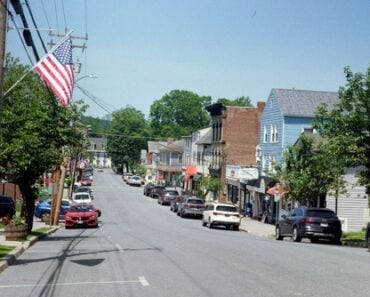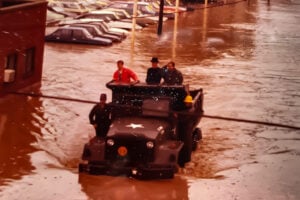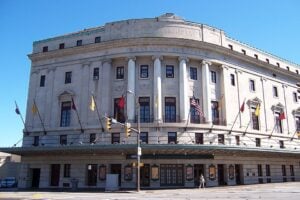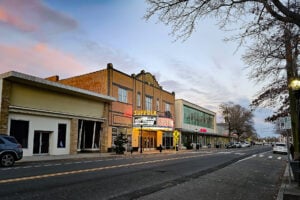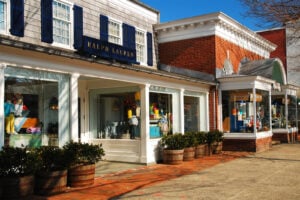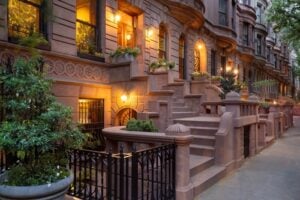
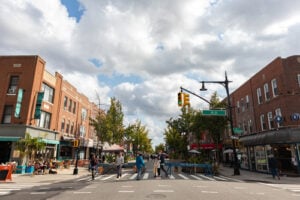
A neighborhood street scene in Astoria, Queens, New York. Photo: James Andrews1 / Shutterstock.com
There are some New York neighborhoods whose names immediately bring certain images to mind. Astoria is one of them. For generations, it has been a place of apartment houses and family-owned stores, busy shopping streets, neighborhood restaurants, and immigrant families building new lives in Queens. It’s also where I go to get the best gyros I have ever tasted.
Its streets have been home to people whose parents came from Greece, Italy, Germany, Ireland, and countless other places. Yet Astoria’s story extends far beyond its familiar reputation as one of New York City’s great Greek neighborhoods. It is also a community that helped shape American music, Broadway, movies, professional sports, and television.
Astoria occupies a remarkable corner of western Queens, facing Manhattan across the East River. Its waterfront includes Astoria Park, with views of the Hell Gate Bridge and the Robert F. Kennedy Bridge, originally known as the Triborough Bridge. Inland, Broadway, 30th Avenue, Ditmars Boulevard, and Steinway Street have long been important parts of neighborhood life. These are streets where several generations of New Yorkers shopped, worked, went to school, and developed ambitions that sometimes carried them far from the borough.
Long before Astoria became part of New York City, the waterfront settlement was known as Hallett’s Cove. In the 1830s, developer Stephen Halsey promoted the area as a village, and the name Astoria was adopted in honor of wealthy businessman John Jacob Astor. The neighborhood later became part of Long Island City in 1870, before Queens joined the consolidated City of New York in 1898. During the 19th century, factories, workshops, houses, and businesses transformed what had once been a largely rural waterfront community.
One of the area’s most important industrial stories belongs to Steinway & Sons. The piano company established manufacturing operations in this part of Queens and developed Steinway Village, a community associated with its workers and their families. Another chapter began in 1920, when the film studio complex now associated with Kaufman Astoria Studios was established. Silent pictures and early sound films were made there, and Astoria became an important part of the American motion-picture business. Today, the nearby Museum of the Moving Image preserves and celebrates that legacy.
As the neighborhood changed, its immigrant communities helped give Astoria the character for which it is known today. Italian and Greek families became particularly important to its identity, while later arrivals from across Europe, the Middle East, Latin America, Asia, and beyond added new businesses, restaurants, languages, and traditions. Through all those changes, Astoria remained a neighborhood where people with very different backgrounds often shared the same blocks, schools, playgrounds, and places of work.
That history makes the following list especially interesting. Some of these 25 people grew up in Astoria and remembered its streets throughout their lives. Others were born here but moved away as children. A few came to the neighborhood with their families and found the beginnings of remarkable careers. Together, they show just how much talent has come out of this one section of Queens.
1. Tony Bennett
Tony Bennett was born Anthony Dominick Benedetto in Astoria on August 3, 1926. His family was part of the neighborhood’s Italian American community, and music was an important presence in his childhood. His father died when Tony was only 10, leaving his mother to support the family. Bennett developed his interest in both singing and painting while growing up in Queens, and he later attended Manhattan’s High School of Industrial Arts. At the age of 10, he was selected to sing at the opening ceremony for the Triborough Bridge, an extraordinary early performance so close to home.
After serving in the Army during World War II, Bennett began the career that would make him one of America’s most admired popular singers. Recordings such as “Because of You,” “Rags to Riches,” and “I Left My Heart in San Francisco” helped establish his reputation, and he continued working successfully with younger performers decades later. He never abandoned his other passion, painting, or his belief in arts education. With his wife Susan, he helped establish the Frank Sinatra School of the Arts in Astoria, bringing a lasting part of his success back to the neighborhood where his story began.
2. Christopher Walken
Christopher Walken was born Ronald Walken in Astoria in 1943, the son of German and Scottish immigrant parents. His father operated Walken’s Bakery, a neighborhood business that became part of the family’s daily life. His mother encouraged Christopher and his brothers to pursue performing, and the boys began appearing on television while still young. Walken also studied dancing, an early discipline that would remain visible in his unusual and unmistakable style of screen performance.
Walken eventually built one of Hollywood’s most distinctive careers, winning an Academy Award for The Deer Hunter and appearing in films such as Catch Me If You Can, Batman Returns, and Hairspray. But his Astoria story has an especially wonderful connection to another name on this list. Lidia Bastianich worked at his family’s bakery as a teenager, long before she became famous as a chef. Walken has spoken about the mixture of accents, languages, and immigrant families he remembered from growing up in Astoria. Those neighborhood experiences were part of the world that shaped him long before movie audiences knew his name.
3. Ethel Merman
Broadway legend Ethel Merman was born Ethel Agnes Zimmerman in Astoria on January 16, 1908. She attended P.S. 4 and William Cullen Bryant High School, where she studied commercial subjects that might lead to secretarial work. Her parents wanted her to have a practical way to earn a living, but they also encouraged her love of music. She sang at local gatherings and listened closely to the performers she saw when her family traveled into Manhattan for vaudeville shows. Even as a young girl, her powerful voice made an impression.
After working as a secretary while performing in clubs, Merman became a Broadway sensation in the Gershwin musical Girl Crazy in 1930. Her subsequent career included Anything Goes, Annie Get Your Gun, Call Me Madam, and Gypsy. Songs such as “There’s No Business Like Show Business” became inseparable from her public image. Few singers have ever projected a voice across a theater with the authority Merman possessed. The fact that one of Broadway’s greatest performers began as an Astoria schoolgirl makes her one of the neighborhood’s most remarkable success stories.
4. Maria Callas
Maria Callas was born in Manhattan in 1923 to Greek immigrant parents who initially settled in Astoria. Although the family later lived elsewhere in New York, those early years connect one of opera’s greatest voices to the neighborhood’s Greek American history. Her childhood was not particularly easy, and the family eventually experienced serious tensions. Even so, her extraordinary musical ability emerged early, and she began studying and performing while still a girl.
In 1937, Callas traveled to Greece with her mother and continued the vocal training that would transform her career. She developed into one of the 20th century’s most influential opera singers, celebrated for her dramatic interpretations and demanding roles in works by composers such as Bellini, Donizetti, and Verdi. Her performances helped bring renewed attention to bel canto opera, while her life made her a worldwide celebrity. Her connection to Astoria was an early one rather than a lifelong residence, but it forms a small and meaningful part of an extraordinary New York immigrant-family story.
5. Iris Apfel
Iris Apfel, one of the most recognizable fashion personalities of modern times, was born in Astoria in 1921 and grew up in the neighborhood. Her family background exposed her to both business and personal style. Long before the fashion world celebrated her oversized round glasses, colorful clothing, and enormous jewelry, Apfel developed a love of collecting and of finding beauty in unexpected objects. As a young New Yorker, she explored shops and markets, learning to trust her own taste rather than follow whatever happened to be fashionable.
With her husband Carl, she founded the textile company Old World Weavers and became respected for her knowledge of antique fabrics and interior decoration. She worked on prestigious restoration projects, including assignments connected to the White House. Her public fame grew dramatically after the Metropolitan Museum of Art presented an exhibition of her clothing and accessories in 2005, when she was already in her 80s. Apfel lived to 102, becoming an unlikely fashion celebrity for several generations. Her originality made her famous, but her life began in the everyday world of Astoria, Queens.
6. Whitey Ford
Edward Charles “Whitey” Ford grew up in Astoria and became one of the greatest pitchers in New York Yankees history. As a young ballplayer, he learned the game in the city before making his major league debut with the Yankees in 1950. He was a left-hander who relied on control, intelligence, and an extraordinary ability to handle pressure rather than simply overpowering every batter he faced. Those qualities earned him the nickname “Chairman of the Board.”
Ford spent his entire major league career with the Yankees, winning 236 games and helping the team capture six World Series championships. He won the American League Cy Young Award in 1961 and established a record of 10 World Series pitching victories. Ford was elected to the National Baseball Hall of Fame in 1974, entering alongside his longtime friend and teammate Mickey Mantle. His hometown connection has not been forgotten: Whitey Ford Field on the Astoria waterfront keeps the name of the Yankees legend visible in the neighborhood where he grew up.
7. Dito Montiel
Writer, musician, and filmmaker Dito Montiel grew up in Astoria, and perhaps no one on this list has made the neighborhood itself such a central part of his work. His experiences as a young man in the working-class Astoria of the 1980s became the basis for A Guide to Recognizing Your Saints, an autobiographical book about friends, family, street life, and the difficult choices facing young people in New York. Rather than presenting a polished picture of the city, Montiel wrote about the complicated relationships and memories that stay with someone after leaving home.
Montiel adapted the book into the 2006 film of the same name, directing a cast that included Robert Downey Jr., Shia LaBeouf, Chazz Palminteri, and Channing Tatum. The film brought a very specific version of Astoria to audiences who may have known little about the neighborhood. Montiel also worked in music, including with the band Gutterboy, before turning increasingly toward filmmaking. His career is a reminder that Astoria has not simply produced famous people. It has also provided the stories that some of them went on to tell.
8. Lidia Bastianich
Lidia Bastianich was born in Istria and came to the United States with her family after a difficult period of displacement in Europe. They settled in Astoria, where she learned to navigate the languages, foods, and customs of a new country. Her connection to the neighborhood was more than a passing residence. At 14, she began working at Walken’s Bakery, the business operated by Christopher Walken’s family. She has recalled learning about cakes and baking there, and she later returned to the old neighborhood with PBS cameras to revisit places that mattered to her.
Bastianich went on to become one of America’s best-known authorities on Italian cooking, building a career as a restaurateur, cookbook author, and public television host. Her cooking reflects the traditions of her family and the experiences of immigrants adapting to life in New York. She and her husband opened their first restaurant, Buonavia, in Queens in 1971. Long before viewers welcomed her into their kitchens through television, she was a young newcomer learning the food business in Astoria. It is hard to imagine a better illustration of the neighborhood’s immigrant history.
9. Joe Bastianich
Joe Bastianich was born in Astoria in 1968, the son of Lidia and Felice Bastianich. Restaurant life was part of his upbringing from an early age, and he watched his parents work the long hours required to build a successful food business. That experience gave him a different perspective on restaurants from someone who discovered the industry only after adulthood. He later attended Boston College and worked in finance before making the restaurant business his career.
Bastianich became known as a restaurateur, wine specialist, author, and television personality. His partnerships helped create and operate acclaimed dining establishments, and he became familiar to television audiences as a judge on MasterChef. He also pursued winemaking and music. Although his career eventually reached far beyond Queens, the family business that shaped his understanding of food had deep New York roots, and his birthplace places him among Astoria’s notable culinary figures.
10. Marilyn Milian
Millions of television viewers came to know Marilyn Milian as the sharp, energetic judge of The People’s Court, but her early life began in New York. Milian spent her childhood in Astoria in a Cuban American family before moving to Miami at the age of eight. Growing up with an immigrant family in Queens was part of her background long before she entered the legal profession. She went on to graduate from the University of Miami and earn her law degree at Georgetown University.
Milian worked as a prosecutor and later became a Florida judge. In 2001, she took over The People’s Court, becoming the first Hispanic judge to preside over an English-language American television courtroom program. Her quick responses, willingness to challenge litigants, and ability to explain legal issues helped her become one of the genre’s best-known personalities. The family may have moved south when she was still young, but her Astoria childhood is an often-overlooked part of her story.
11. Melanie Martinez
Melanie Martinez was born in Astoria in 1995 before her family moved to Baldwin on Long Island when she was a young child. Her musical interests developed early, and she eventually brought a strikingly individual visual and musical style to popular music. She reached a national audience in 2012 as a contestant on The Voice, where her performances introduced listeners to a singer who was not especially interested in following ordinary pop-star conventions.
After the show, Martinez developed a career built around original songs, concept albums, music videos, and unusual storytelling. Her debut album, Cry Baby, established the fictional character and themes that became central to her early work, while later releases such as K-12 and Portals expanded her artistic world. Her connection to Astoria comes through her birthplace rather than a long childhood in the neighborhood, but she represents a younger generation of artists whose stories began in Queens.
12. Jesse Eisenberg
Jesse Eisenberg was born in Astoria in 1983, although he grew up primarily in East Brunswick, New Jersey. He developed an interest in acting at a young age and went on to establish a career built around unusual, often anxious or intensely intelligent characters. His early film work included The Squid and the Whale and Adventureland, which helped demonstrate his ability to play complicated young men without making them feel like standard Hollywood characters.
Eisenberg became internationally famous for portraying Facebook co-founder Mark Zuckerberg in the 2010 film The Social Network, earning an Academy Award nomination for his performance. He also starred in Zombieland, the Now You See Me films, and other productions while working as a playwright, writer, and director. Like several others in this article, he left Astoria very early in life. Nevertheless, his Queens birthplace is a lesser-known detail in the biography of one of his generation’s most recognizable actors.
13. Robert Davi
Robert Davi was born in Astoria in 1951 and grew up in an Italian American family. Before Hollywood audiences came to recognize his face, he developed an interest in music and acting. He studied singing as a young man and later attended Hofstra University. The combination of his deep voice, imposing screen presence, and theatrical training helped establish him as an actor who could make even a supporting role memorable.
Davi became especially well known for portraying villains and authority figures in major films. He played Jake Fratelli in The Goonies, appeared in Die Hard, and portrayed the dangerous drug lord Franz Sanchez in the James Bond film Licence to Kill. He also worked extensively in television, including the crime series Profiler. Music remained important to him, and he later recorded and performed songs associated with Frank Sinatra and the Great American Songbook. The actor’s combination of dramatic performance and traditional singing makes him a distinctive member of Astoria’s entertainment history.
14. John Frusciante
John Frusciante, best known as the guitarist of the Red Hot Chili Peppers, was born in Astoria in 1970. His family moved away from New York during his childhood, and he eventually developed his musical skills in California. As a young guitarist, Frusciante became deeply interested in rock music and the expressive possibilities of the electric guitar. His style would prove especially important to the sound of a band that mixed funk, alternative rock, and melodic songwriting.
Frusciante joined the Red Hot Chili Peppers while still a teenager and contributed to albums that became central to the band’s success, including Mother’s Milk, Blood Sugar Sex Magik, Californication, and By the Way. His playing ranges from explosive rhythmic parts to restrained, melodic guitar lines, and his work has influenced generations of younger musicians. He also pursued a substantial solo career. Although his musical identity is closely associated with the West Coast, one of alternative rock’s best-known guitarists began life in Astoria, Queens.
15. Dee Snider
Dee Snider was born in Astoria in 1955 before growing up on Long Island, particularly in Baldwin and Freeport. Music was important to him from childhood, and he sang in school and church groups before becoming involved in rock bands. Those early experiences helped him develop a powerful voice that eventually became one of the most recognizable in 1980s heavy metal. His career would take him far from the conventional image of the school chorister.
As the lead singer and songwriter of Twisted Sister, Snider helped bring the band international fame with its 1984 album Stay Hungry and songs such as “We’re Not Gonna Take It” and “I Wanna Rock.” His extravagant stage appearance and rebellious lyrics made him a major figure in the MTV era. In 1985, he also became a prominent voice in the debate over music censorship when he testified before the United States Senate. While Long Island played the larger role in his upbringing and musical development, Snider’s birthplace adds another major rock name to Astoria’s history.
16. Gordon Willis
Gordon Willis was born in Astoria in 1931 and grew up to become one of the most influential cinematographers in American film history. Audiences may not have known his name as readily as the actors he photographed, but they knew the look of his movies. His work helped create the dark interiors, carefully controlled light, and remarkable visual compositions that distinguished many of the most important films of the 1970s.
Willis served as cinematographer on The Godfather, The Godfather Part II, All the President’s Men, Annie Hall, and Manhattan, among many others. His willingness to leave faces in shadow and trust the image rather than overlight a scene earned him the nickname “Prince of Darkness.” He received two competitive Academy Award nominations and an Honorary Academy Award in 2009. The history of Astoria’s filmmaking industry provides an especially appropriate backdrop to his story: one of cinema’s great visual artists came from a neighborhood that had been connected to motion pictures since the silent-film era.
17. Bob Beckwith
Retired New York City firefighter Robert “Bob” Beckwith was born in Astoria in 1932. Unlike the entertainers and athletes on this list, Beckwith became widely recognizable because of a moment in New York history rather than a conventional celebrity career. He served the FDNY for decades before retiring in 1994. After the September 11, 2001, terrorist attacks, he returned to assist at the World Trade Center site, joining the extraordinary rescue and recovery effort undertaken by firefighters and other volunteers.
On September 14, 2001, Beckwith was beside President George W. Bush when the president addressed rescue workers from the wreckage of a fire truck at Ground Zero. The photograph became one of the most memorable images of the days following the attacks, and Beckwith appeared on the cover of Time. He never set out to become famous, and his recognition came from an act of service during one of the city’s darkest moments. His story adds a different kind of New York accomplishment to this collection of Astoria natives.
18. Chamique Holdsclaw
Chamique Holdsclaw grew up in the Astoria Houses public housing development, where basketball became an important part of her life. She lived with her grandmother, and the outdoor courts near her home offered a place to practice, compete, and develop the determination that would carry her to the highest level of women’s basketball. Her story is particularly connected to the neighborhood because she has described Astoria in her own writing, recalling the basketball courts and the grandmother who watched over her.
Holdsclaw became a high school star at Christ the King in Queens before playing for the University of Tennessee under legendary coach Pat Summitt. She helped the Lady Volunteers win three consecutive NCAA championships, became the first overall pick in the 1999 WNBA draft, and earned multiple All-Star selections. She also won an Olympic gold medal with the United States. In later years, Holdsclaw spoke publicly about her experiences with mental health and became an advocate for others. Her career is a powerful example of athletic greatness that began on an Astoria playground.
19. George Maharis
George Maharis was born in Astoria in 1928 to Greek immigrant parents, although he spent much of his upbringing in Manhattan’s Hell’s Kitchen neighborhood. He developed an interest in acting and eventually found his way onto television during the period when the medium was becoming central to American popular culture. His breakthrough came with a role that matched the country’s growing fascination with travel, highways, and changing social attitudes.
Maharis starred as Buz Murdock opposite Martin Milner on the television drama Route 66, which premiered in 1960. The series followed two young men traveling across the United States in a Corvette, with episodes filmed in different locations around the country. Maharis became a major television personality and also recorded popular music. His fame was especially significant during an era when a successful weekly television show could make an actor a household name almost overnight. The Astoria-born performer remains one of the memorable television faces of the early 1960s.
20. Jay Black
Jay Black was born David Blatt in Astoria in 1938, although he grew up in Brooklyn’s Borough Park neighborhood. His rise to fame came when he joined Jay and the Americans, taking over the lead singer’s position and giving the group one of the most powerful voices in American pop music. His rich, soaring tenor made the band’s romantic ballads particularly memorable during the 1960s.
With Jay Black singing lead, Jay and the Americans scored hits including “Come a Little Bit Closer,” “Cara Mia,” “This Magic Moment,” and “Walkin’ in the Rain.” The recordings became part of the musical soundtrack of a generation of New Yorkers who grew up listening to AM radio, going to dances, and discovering rock and roll and pop harmony groups. Black continued performing for many years after the group’s commercial peak. Although Brooklyn played the larger part in his childhood, his Astoria birthplace links one of the great voices of 1960s pop to this Queens neighborhood.
21. Al Oerter
Olympic great Al Oerter was born in Astoria in 1936 before growing up in New Hyde Park on Long Island. His introduction to the discus was almost accidental, but he developed into one of the most remarkable athletes in the history of track and field. Oerter combined unusual strength with technical skill and an extraordinary ability to perform under the pressure of international competition.
Representing the United States, Oerter won Olympic gold medals in the discus throw at Melbourne in 1956, Rome in 1960, Tokyo in 1964, and Mexico City in 1968. Winning the same event at four consecutive Olympic Games was an astonishing achievement, especially considering the injuries and challenges he overcame along the way. Even after leaving Olympic competition, he continued training and throwing at an impressive level. He later pursued painting as another important interest. For a neighborhood with such a strong baseball tradition, Oerter provides a reminder that Astoria’s athletic history reaches well beyond the ballfield.
22. Eddie Bracken
Eddie Bracken was born in Astoria in 1915 and began entertaining audiences while still a child. He performed in vaudeville and eventually made the transition to Broadway and the movies. His talent was particularly suited to comedy: he could portray an anxious, bewildered ordinary man who somehow found himself caught in situations that were completely out of control.
Bracken became a popular film star during the 1940s, particularly through his performances in Preston Sturges’s comedies The Miracle of Morgan’s Creek and Hail the Conquering Hero. These movies took advantage of his comic timing and ability to make confused, put-upon characters sympathetic to audiences. He continued working on stage, film, and television over a long career. Although his greatest period of movie stardom came decades before many younger readers were born, Bracken was once one of America’s familiar screen personalities, and his story began in Astoria.
23. Michael Malone
Basketball coach Michael Malone was born in Astoria in 1971 into a family with deep connections to the sport. His father, Brendan Malone, had a long career as a college and professional basketball coach, and Michael grew up around a game that would eventually become his own profession. Rather than making his name primarily as a player, he learned the demanding work of teaching, preparing teams, and helping athletes improve.
Malone built his reputation on NBA coaching staffs before becoming a head coach with the Sacramento Kings and later the Denver Nuggets. In Denver, he developed a championship team centered on Nikola Jokić and guided the franchise to its first NBA title in 2023. After leaving the Nuggets in 2025, he was named head coach of the University of North Carolina men’s basketball program in April 2026. His career has taken him through major professional and college basketball organizations, but it began with a Queens birthplace and a family devoted to the game.
24. Patrick McGoohan
Patrick McGoohan was born in Astoria in 1928 to Irish immigrant parents. His family returned to Ireland while he was still an infant, and he later grew up in England. That background explains why many viewers who admired his work in British television never realized he had been born in New York City. McGoohan developed a distinctive screen personality built around seriousness, intelligence, independence, and an unwillingness to play ordinary heroes.
He became widely known for the espionage television series Danger Man, marketed in the United States as Secret Agent. He then created and starred in The Prisoner, the unusual late-1960s series about a secret agent held captive in a mysterious village. The show’s themes of freedom, control, and identity made it a lasting cult favorite. McGoohan later appeared in films and other television programs, including memorable guest roles on Columbo. His connection to Astoria was brief, but the birthplace of this famous British television figure remains one of the more surprising entries on the list.
25. Melanie Safka
Singer-songwriter Melanie Safka, known professionally as Melanie, was born in Astoria in 1947. Music was part of her family life from the beginning, particularly through her mother, who sang jazz. Melanie spent much of her childhood in New Jersey, but her early New York connections remained important as she began pursuing a musical career. In the 1960s, she performed in the coffeehouses of Greenwich Village, developing the emotional and highly individual vocal style that would become her trademark.
Melanie performed at the 1969 Woodstock festival, an experience that inspired her song “Lay Down (Candles in the Rain).” She later scored a major hit with “Brand New Key” and also recorded “What Have They Done to My Song Ma” and a memorable interpretation of “Ruby Tuesday.” Her music blended folk, pop, and personal songwriting in a way that made her stand apart from many other performers of her era. Although she grew up outside Astoria, her story is another connection between a Queens birthplace and the music that helped define a generation.
Astoria’s contribution to New York history is not limited to famous entertainers, athletes, and public figures. The neighborhood itself tells the larger story of a city continually being reshaped by new arrivals, changing industries, and families working to give the next generation greater opportunities. The careers of these 25 people followed very different paths, but their Astoria connections offer a revealing look at just how much talent has passed through this part of Queens.
For more stories about the people and places of Queens, read our articles on 25 famous people you didn’t know were from Queens, how Queens neighborhoods got their names, and the Museum of the Moving Image in Queens.