
Photo: Sean Pavone / Shutterstock
The Brooklyn Bridge is one of the great engineering landmarks in American history. Built for approximately $15.5 million and completed after thirteen years of construction, the bridge opened on May 24, 1883, as the first permanent crossing of the East River between the separate cities of New York and Brooklyn. Its 1,595.5-foot main span made it the longest suspension bridge in the world, while its stone towers and steel-wire cables created a silhouette that would become inseparable from New York itself.
The bridge was also built at a terrible human cost. Approximately 27 people died during its construction, and many others suffered from accidents and caisson disease. John A. Roebling designed the bridge but died before he could build it. His son Washington A. Roebling took over as chief engineer, then became seriously ill from decompression sickness. Emily Warren Roebling became the essential link between her husband and the construction site and played a crucial role in bringing the bridge to completion.
When Was the Brooklyn Bridge Built?
Planning for the Brooklyn Bridge took shape during the 1860s, when the cities of New York and Brooklyn were growing rapidly on opposite sides of the East River. Ferries carried enormous numbers of passengers and goods between the two cities, but New York needed a permanent crossing that would work regardless of weather, river traffic, or ice.
John Augustus Roebling proposed a suspension bridge that would be unlike anything previously attempted. The project received approval during the late 1860s, and construction began in 1869. The bridge was completed in 1883 and officially opened on May 24 of that year.
When finished, its main span measured 1,595.5 feet. The bridge and its approaches extend more than 6,000 feet from end to end. Nothing comparable had ever been built across such a busy waterway at that scale.
Who Designed the Brooklyn Bridge?
The Brooklyn Bridge was designed by John A. Roebling, a German-born engineer who immigrated to the United States in 1831. Roebling had already established himself as one of America’s leading suspension-bridge engineers and had developed a successful system for manufacturing wire rope.
Roebling understood that a bridge across the East River would have to withstand enormous loads, strong winds, changing temperatures, and constant traffic. His design combined massive stone towers, four main steel-wire cables, diagonal stays, and a stiffening-truss system. The bridge would carry rail traffic, horse-drawn vehicles, and pedestrians on different levels while leaving enough clearance beneath the span for ships.
The use of steel wire was revolutionary. The Brooklyn Bridge became the first major suspension bridge to use galvanized steel wire for its main cables, helping establish a new standard for long-span bridge construction.
John Roebling Dies Before Construction
John Roebling never lived to see his bridge rise above the East River. In June 1869, while surveying the location near the Fulton Ferry landing in Brooklyn, his foot was crushed in an accident involving a ferry. He developed tetanus and died in July 1869.
The project immediately passed to his thirty-two-year-old son, Washington A. Roebling, who had worked with his father and had gained valuable experience studying bridge construction in Europe and working on other Roebling bridges. Washington became chief engineer and inherited one of the most ambitious construction projects in the world.
Building the Brooklyn Bridge Caissons
Before the towers could rise, the builders had to create foundations capable of supporting their enormous weight. Massive wooden pneumatic caissons were sunk beneath the river. These airtight structures allowed workers to excavate mud and sediment in pressurized chambers while masonry for the towers was built above them.
The Brooklyn caisson reached approximately 44.5 feet below the high-water level. The Manhattan caisson went much deeper, approximately 78.5 feet. Conditions inside were punishing. Workers labored in heat, noise, compressed air, and poor visibility while removing material from beneath the riverbed.
The most dangerous problem was not fully understood at the time. Workers who returned too rapidly from the high-pressure caissons to normal atmospheric pressure could develop what became known as caisson disease, now recognized as decompression sickness or “the bends.” Symptoms could include severe joint pain, dizziness, paralysis, neurological damage, and death.
Washington Roebling and Caisson Disease
Washington Roebling personally supervised dangerous work in the caissons and became seriously ill with decompression sickness in 1872. His health was permanently damaged, and he was no longer able to manage the construction site in the conventional way.
Roebling did not resign as chief engineer. He continued directing the bridge from his home, relying heavily on written instructions, reports from the site, and the extraordinary assistance of his wife, Emily Warren Roebling.
The construction itself remained dangerous even outside the caissons. Fires, falling equipment, explosions, and other accidents added to the human toll. New York City archival material places the number of construction deaths at approximately 27.
Emily Warren Roebling and the Brooklyn Bridge
Emily Warren Roebling became one of the central figures in the history of the Brooklyn Bridge. As Washington’s health deteriorated, she carried messages between her husband and the engineers, contractors, and trustees working on the project. She learned the technical language of bridge construction and became deeply familiar with cable construction, mathematics, materials, and engineering calculations.
For roughly eleven years, Emily served as Washington’s representative and an indispensable presence in the completion of the bridge. Her contribution was far more substantial than that of a messenger. She defended her husband’s position as chief engineer, communicated technical decisions, monitored the work, and helped keep the enormous project moving forward.
When the bridge was completed, Emily Warren Roebling was given the honor of making the ceremonial first ride across the completed span. She crossed in a carriage carrying a rooster, a traditional symbol of victory.
The Brooklyn Bridge Opens on May 24, 1883
The Brooklyn Bridge officially opened on May 24, 1883, not March 24 as an earlier version of this article stated. At the time, New York and Brooklyn were still separate cities.
The opening became one of the great public celebrations of 19th-century New York. President Chester A. Arthur and New York Governor Grover Cleveland attended, along with New York Mayor Franklin Edson, Brooklyn Mayor Seth Low, military units, bands, ships, and enormous crowds. Washington Roebling was too ill to attend the ceremonies on the bridge, but President Arthur later visited him at his home.
More than 150,000 people crossed the bridge during its first day. For New Yorkers who had spent their lives depending on ferries, walking high above the East River from one city to the other must have seemed almost impossible.
The Deadly Brooklyn Bridge Stampede
Only six days after the opening, tragedy struck. On May 30, 1883, a panic on the pedestrian promenade triggered a stampede. Twelve people were killed and dozens were injured.
The panic fed public fears that a bridge of such unprecedented size might somehow be unsafe. The structure itself had not failed, but confidence in the new bridge had been badly shaken.
Why Did P.T. Barnum Walk Elephants Across the Brooklyn Bridge?
On May 17, 1884, P.T. Barnum staged one of the most famous publicity stunts in New York history. Barnum led 21 elephants and 17 camels across the Brooklyn Bridge, including his enormous celebrity elephant Jumbo.
The procession was spectacular advertising for Barnum’s circus, but it also helped reassure the public that the bridge could carry extraordinary weight. Thousands watched as the animals crossed successfully. The sight of elephants marching between the great stone towers became one of the most enduring stories in the bridge’s history.

Photo: TTstudio / Shutterstock
Why the Brooklyn Bridge Was an Engineering Breakthrough
The Brooklyn Bridge changed bridge engineering. Its 1,595.5-foot main span broke the world record for suspension bridges, and its 276.5-foot stone towers rose higher than the city’s tallest office buildings when completed.
The four main cables contain thousands of individual galvanized steel wires. Roebling’s system distributed enormous forces through the cables, towers, anchorages, and stiffening structure. The bridge was designed with substantial strength beyond what normal traffic required, one of the reasons it has survived more than 140 years of constant use.
The original deck was very different from what New Yorkers see today. It accommodated elevated railway tracks, streetcars, horse-drawn vehicles, and pedestrians. Over the decades, each transportation system changed as the city changed around the bridge.
How the Brooklyn Bridge Changed New York City
The Brooklyn Bridge did more than move people across the East River. It physically connected two of America’s largest cities at a time when Brooklyn was still independent from New York City.
The bridge encouraged commerce, commuting, residential growth, and a stronger relationship between Brooklyn and Manhattan. Brooklyn officially became part of the consolidated City of Greater New York on January 1, 1898. The bridge did not by itself cause consolidation, but it had already demonstrated how economically and socially connected the two cities had become.
For generations, the bridge also altered the balance between ferry and land transportation. Ferries remained important, but the permanent crossing transformed the daily movement of workers, residents, goods, and businesses between the two sides of the East River.
The Bridges That Followed the Brooklyn Bridge
The Brooklyn Bridge proved that enormous fixed crossings of the East River were possible, but New York’s population quickly outgrew a single bridge. The Williamsburg Bridge opened in 1903 and surpassed the Brooklyn Bridge’s main-span record. The Manhattan Bridge followed in 1909.
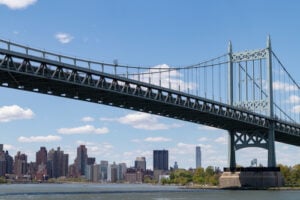
That same year, the Queensboro Bridge, commonly called the 59th Street Bridge and officially the Ed Koch Queensboro Bridge, opened between Manhattan and Queens. In 1936, the Triborough Bridge, now officially the Robert F. Kennedy Bridge, created a much larger three-borough connection among Manhattan, Queens, and the Bronx.
Each of these bridges belongs to a different engineering era, but the Brooklyn Bridge remains the landmark that first proved New York could conquer the East River with a permanent monumental crossing.
The Brooklyn Bridge Wine Vaults
One of the strangest chapters in Brooklyn Bridge history lies inside its massive stone anchorages. Wine and liquor storage vaults were built beneath the approaches years before the bridge opened.
The vaults helped compensate businesses displaced by construction and also generated rental income that helped offset bridge expenses. Wine distributors used the cool, dark spaces for storage beginning in the 19th century. The vaults later went through periods of closure and other uses, including during Prohibition, before returning to wine storage after repeal.
The spaces eventually became part of the bridge’s cultural history as well. Public arts organization Creative Time used the Brooklyn anchorage for exhibitions and performances from the 1980s until security concerns ended regular public access after September 11, 2001.
The Brooklyn Bridge in the 20th Century
As automobiles replaced horse-drawn traffic and rail systems changed, the Brooklyn Bridge had to be rebuilt for a new transportation age. A major reconstruction between 1944 and 1954 strengthened the trusses, installed new horizontal stays, removed the railroad and trolley tracks, widened the roadways, and rebuilt portions of the approaches.
The bridge also became part of Cold War civil-defense planning. In 2006, workers discovered a cache of emergency supplies inside the Manhattan anchorage. The stored materials included hundreds of thousands of survival crackers, water containers, medical supplies, blankets, and other items dated from the late 1950s and early 1960s.
By the late 20th century, age and heavy use required another generation of rehabilitation. The bridge has undergone repeated structural, masonry, roadway, cable, lighting, and approach projects as New York works to preserve a 19th-century structure carrying 21st-century traffic.
The Brooklyn Bridge Becomes a National Landmark
The Brooklyn Bridge was designated a National Historic Landmark in 1964. New York City designated the bridge and its approaches as city landmarks in 1967, and the American Society of Civil Engineers named it a National Historic Civil Engineering Landmark in 1972.
An earlier version of this article incorrectly stated that UNESCO designated the Brooklyn Bridge a World Heritage Site in 2017. That did not happen. In 2017, the United States placed the Brooklyn Bridge on UNESCO’s World Heritage Tentative List, meaning it was proposed for possible future nomination. It has not been inscribed as a UNESCO World Heritage Site.
The Brooklyn Bridge Today
The Brooklyn Bridge remains one of New York City’s busiest and most recognizable crossings. According to NYC DOT’s 2024 counts, an average day brought approximately 103,051 vehicles, 28,845 pedestrians, and 5,504 cyclists across the bridge.
The modern traffic arrangement is also different from the one many New Yorkers remember. In September 2021, NYC DOT converted one vehicle lane into a two-way protected bicycle lane. The famous elevated promenade, once shared by pedestrians and cyclists, became pedestrian-only.
The change was one of the biggest reconfigurations of the bridge since trolley lines disappeared in 1950. It relieved one of the most persistent conflicts on the landmark: tourists, walkers, runners, and cyclists trying to share the narrow historic promenade.
New York continues to maintain and restore the bridge through major capital projects and routine repairs. A rehabilitation program that began in 2010 involved projects totaling approximately $800 million, including work on the approaches, masonry, towers, arch blocks, foundations, granite, brickwork, painting, and lighting.
Brooklyn Bridge Park
The Brooklyn waterfront beneath and around the bridge has changed almost as dramatically as the bridge itself. Brooklyn Bridge Park now stretches approximately 1.3 miles along the East River and covers about 85 acres from the area near Atlantic Avenue north toward Jay Street.
The waterfront had once been dominated by ferries, warehouses, shipping, and industrial activity. By the late 20th century, community groups and public agencies began developing plans to reclaim the shoreline as public space. Construction on Brooklyn Bridge Park began in 2008, and Pier 1 became the first major section to open in March 2010.
The park now includes piers, lawns, playgrounds, sports facilities, historic structures, waterfront paths, and some of the most dramatic views of Lower Manhattan and the Brooklyn Bridge anywhere in the city.
The Brooklyn Bridge in Art, Film, and Music
The Brooklyn Bridge became a cultural symbol almost immediately after it opened. Painters, photographers, poets, filmmakers, advertisers, and musicians have used the bridge as shorthand for New York ambition, romance, engineering, and possibility.
Georgia O’Keeffe painted the Brooklyn Bridge in 1949 as one of her final New York works before permanently moving to New Mexico. The bridge has appeared in countless movies, television programs, commercials, photographs, and documentaries.
Frank Sinatra also recorded “The Brooklyn Bridge” for the 1947 film It Happened in Brooklyn. The song turned the bridge into a romantic image of New York, exactly the kind of role the structure has continued to play in popular culture.
More New York Bridge History
Continue exploring New York’s bridge history with our in-depth features on the Williamsburg Bridge, Manhattan Bridge, 59th Street Bridge, and Triborough Bridge. Readers can also see how these spans compare in our guide to the 10 Most Iconic Bridges in New York.
Brooklyn Bridge History at a Glance
| Year | Milestone |
|---|---|
| 1869 | Construction begins; John A. Roebling dies after a surveying accident |
| 1872 | Washington A. Roebling becomes seriously ill from caisson disease; Emily Warren Roebling assumes an increasingly important role |
| 1883 | Brooklyn Bridge opens on May 24 with the world’s longest suspension-bridge span |
| 1884 | P.T. Barnum leads 21 elephants and 17 camels across the bridge |
| 1898 | Brooklyn joins the consolidated City of Greater New York |
| 1944–1954 | Major reconstruction removes rail and trolley tracks and expands automobile roadways |
| 1964 | Designated a National Historic Landmark |
| 1967 | Designated a New York City Landmark |
| 1972 | Named a National Historic Civil Engineering Landmark |
| 2021 | Protected two-way bicycle lane opens in a former vehicle lane |
| 2024 | NYC DOT records daily averages of 103,051 vehicles, 28,845 pedestrians, and 5,504 cyclists |
History of the Brooklyn Bridge article published on ClassicNewYorkHistory.com © 2026