
Feature Photo: MaruokaJoe / Shutterstock.com
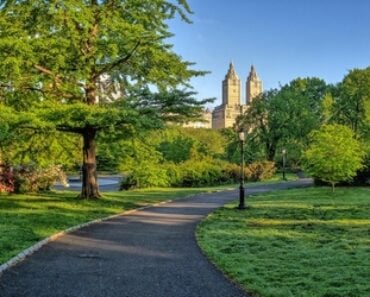
Strawberry Fields is a small hidden sanctuary within New York’s Central Park. This 5.3-acre landscape is the pride of every Beatles fan. It serves as a reminder of the tragedy that befell The Beatles vocalist and songwriter John Lennon who was fatally shot on December 8, 1980, at the archway of the Dakota Building, his New York residence. That’s why you can find this memorial right across the Dakota Building.
Strawberry Fields is a popular place for Beatles fans who come to pay tribute to John Lennon. It’s also an ideal place to relax and unwind for those living and visiting New York. Read on to learn more about its history.
Strawberry Fields in New York
Strawberry Fields is located in Central Park West on 72nd Street and directly across the Dakota. The Memorial Park is a five minutes drive from the Rockefeller Center and a 19 minutes walk to the Metropolitan Museum of Art. You could get to the Park from the subway station on 42nd or 50th street by taking the uptown B or C train and then getting off at 72nd street. Once you cross the street, you’ll see a sign: “Strawberry Fields” next to a walkway leading to the Park.
How Strawberry Fields Got its Name
Strawberry Fields is named after a famous song by the Beatles, Strawberry Fields Forever. This song was released In 1967 and was written by John Lennon. It was one of his favorite songs. He drew inspiration from a field known as Strawberry Fields belonging to a Salvation Army Children’s home, where he used to play as a child. After Lennon’s untimely death, a patch of land that overlooked the Dakota Building was christened “Strawberry Fields” in honor of this song.
Construction of Strawberry Fields
Plans to set up a memorial for John Lennon began soon after his death. The city suggested that the area across the Dakota Building where Lennon lived and was killed be set aside for his memorial. He and his wife used to walk in this space. The idea to set up a memorial landscape was shaped by Yoko Ono’s experience as a conceptual artist and her understanding that Lennon would not have wanted his memorial to be conceived as a statue.
The area where Strawberry Field sits today was not as it looks today. Central Park was run down and littered with garbage. There was graffiti all over, and its infrastructure was deteriorating. Thanks to the suggestion of setting up a memorial landscape for Lennon, Strawberry Fields became the first place to be designed and rehabilitated through the Central Park Conservancy funding. The project’s sponsor was Yoko Ono, who donated one million dollars. Bruce Kelly, a renowned landscape architect, was hired by the commission to manage the Park’s rehabilitation and worked together with Yoko.
Yoko invited John Lennon’s fans worldwide to donate plants, shrubs, and stones to create an international garden of peace. Some countries even sent their native plants like Maples from Canada, oaks from Great Britain, and Netherlands’ tulip bulbs. The Central Park Conservancy planted the strawberries found in this memorial. Today, a plaque curved inside a rock at the Park lists the 121 countries that contributed to the memorial.
Yoko Ono and Mayor Ed Koch would later dedicate the Park on October 9, 1985, on what would have been John Lennon’s 45th birthday.
Nowadays, Strawberry Fields is a sanctuary made up of small meadows lined with shrubs and trees and a winding path through a small wooded area. It also includes a mosaic with the word “imagine” written in the center. There are also benches where visitors can sit and relax. This section is also designated a “quiet zone” since it’s intended to be a quiet place for reflection.
Strawberry Fields “Imagine” Mosaic
During the Park’s rehabilitation, a circular grey and white mosaic with the word “Imagine” at the center was installed. This Greco-Roman mosaic was a gift from the City of Naples, Italy. The mosaic represents a copy of a design that Yoko had chosen.
The word “Imagine” at the center of the mosaic refers to John Lennon’s track by the same title. The song describes a world where peace reigns and everyone is accepted, a befitting word for mosaic art.

Photo: ULU_BIRD / Shutterstock.com
Activities at Strawberry Fields
There are plenty of activities that you can take part in while at Strawberry fields. Take a walk and admire the blossoming flowers while enjoying the shade from the Elm trees. It’s also an excellent place for a picnic or to catch up on some book reading. If you fancy bike rides, the Park is connected by pathways, ready to take you anywhere in the Park.
John Lennon’s fans also gather here every October 9 to celebrate his birthday and on December 8 to mourn his death. You might also be interested in boat riding at Central Park Lake or visiting the Central Park Zoo.
Final Words
Despite being born out of tragedy, Strawberry Fields is a beautiful place filled with different plants and shrubs from different parts of the world. It is a quiet sanctuary where you can relax and get away from it for a while. The memorial also played a role in the start of Central Park’s rehabilitation process to what it is today.
Above all else, however, it is a place where John Lennon’s fans can come together and share fond memories of their fallen star. It’s where people like Gary dos Santos or the Mayor of Strawberry Fields, as he was referred to, devoted his life to keeping John Lennon’s memory alive. It’s where everyone is accepted, no matter who they are or where they come from, just like he wanted.
John Lennon might not be here anymore, but his message of peace, love, and equality will live on in Strawberry Fields for years to come, a feat no statue could ever accomplish.

Photo: Anna ART / Shutterstcok
History Of Strawberry Fields In New York’s Central Park – ClassicNewYorkHistory.com ©2022
ClassicNewYorkHistory.com claims ownership of all its original content and Intellectual property under United States Copyright laws and those of all other foreign countries. No one person, business or any organizations is allowed to republish any of our original content anywhere on the web or in print without our permission.