The Williamsburg Bridge is far more than a steel crossing between Manhattan and Brooklyn. Opened in 1903 as the world’s longest suspension span, it changed bridge engineering, reshaped immigrant neighborhoods, survived a near-crisis in the 1980s, and remains one of New York City’s busiest and most distinctive East River landmarks.
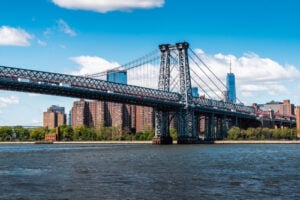
Rising above the East River between the Lower East Side of Manhattan and the Williamsburg section of Brooklyn, the Williamsburg Bridge is one of New York City’s three great East River suspension crossings, standing alongside its more famous neighbor, the Brooklyn Bridge, and its younger sibling, the Manhattan Bridge. As a native New Yorker, I have seen these bridges hundreds, if not thousands, of times, and I still stand in awe every time I cross them and every time I look at them. I think about the lives sacrificed while building these bridges. They were incredible feats of engineering constructed by brave men who risked their lives to complete them.
Anchored on the Manhattan side at Delancey and Clinton Streets and touching down in Brooklyn near South Fifth Street and Driggs Avenue, the bridge has quietly shaped the daily rhythm of New Yorkers for well over a century. I think we could argue that many people never even think about these bridges; they just cross them. What they do think about, and I can attest to this, is the traffic in which we sit on these bridges. New York City traffic is the worst. However, I always try to remind myself to take a breath, accept it, roll down the window, and look at the steel, the metal, the cables, and the design that remains so spellbinding.
Although it often lives in the shadow of the Brooklyn Bridge’s romantic Gothic towers, the Williamsburg Bridge tells a story that is, in its own way, just as central to the history of New York City. It is a story of political infighting, engineering ambition, mass displacement, industrial grit, and the slow, hard-won survival of a structure that very nearly did not make it to its second century.
Planning And Building The Williamsburg Bridge
The idea for the bridge emerged even before the Brooklyn Bridge, completed in 1883, had finished settling into daily use. City planners already understood that a single crossing could never keep pace with Brooklyn’s explosive growth. On March 9, 1892, New York’s governor signed legislation incorporating the East River Bridge Company and granting it the right to build a new span connecting Manhattan with the growing immigrant neighborhoods of Williamsburg. The project was originally known simply as the East River Bridge, a name it carried for years before the public settled on calling it the Williamsburg Bridge.
Construction began in 1896, while Brooklyn was still technically its own city. By the time the bridge was finished, Brooklyn had been absorbed into the newly consolidated Greater New York of 1898. The lead engineer was Leffert L. Buck, a respected bridge designer of the era, while architect Henry Hornbostel contributed to the design. The project was not without political drama. In 1902, Mayor Seth Low appointed Gustav Lindenthal as the city’s bridge commissioner. Lindenthal, who had his own ideas about how the bridge should look, attempted to push through design changes even though construction was already well underway. Mayor Low ultimately intervened to keep the original design largely intact. The Williamsburg Bridge opened to the public on December 19, 1903.
Building the bridge came at a steep human cost that is easy to overlook today. Workers died in falls, construction accidents, and other incidents during the seven-year project. To make way for the structure and the widening of Delancey Street on the Manhattan side, the city also cleared a broad strip of densely packed tenement blocks and relocated approximately ten thousand people. Entire streets were shortened, rerouted, or erased from the map to accommodate the new crossing and its approaches. This pattern of large-scale urban displacement would repeat itself in later New York infrastructure projects, from the Cross Bronx Expressway to Lincoln Center.
A World Record In Steel
When it opened, the Williamsburg Bridge was, by a slim but symbolically important margin, the longest suspension bridge span in the world. Its main span measured 1,600 feet, surpassing the Brooklyn Bridge by approximately four and a half feet. It held the world record for twenty-one years, until the Bear Mountain Bridge surpassed it in 1924. The Williamsburg Bridge measures 7,308 feet from end to end, including its approaches.
More importantly from an engineering standpoint, the Williamsburg Bridge broke sharply from the design language of the Brooklyn Bridge. Where the Brooklyn Bridge relied on massive masonry towers built from limestone, granite, and cement, the Williamsburg Bridge was supported by steel towers approximately 310 feet tall. It was the first suspension bridge with a span longer than 1,000 feet to use steel towers. The bridge’s 1,600-foot central span rises to a clearance of approximately 135 feet above the East River. Its four main cables are approximately eighteen inches in diameter, and the wire within them would extend roughly 17,500 miles if laid end to end. Critics at the time found the exposed steel trusswork stark and unlovely compared with the Brooklyn Bridge’s elegant stonework. That same unadorned industrial skeleton later became an essential part of the bridge’s identity.
The finished bridge was also remarkable for the amount of traffic it was built to carry. It originally accommodated four trolley lines, two elevated railway lines, four lanes for horse-drawn carriages, and two pedestrian walkways, making it one of the most heavily loaded bridges constructed up to that time. On opening day, pedestrians and horse-drawn vehicles crossed the bridge, but rail service was not yet operating. New York City’s first subway opened in October 1904, and elevated trains began running across the Williamsburg Bridge in 1908. Tolls were charged during the bridge’s earliest years, but the city abolished tolls on the East River bridges in July 1911. Today, the Williamsburg Bridge carries eight vehicular lanes, two subway tracks used by the J, M, and Z lines, a pedestrian walkway, and a bicycle path.
How The Bridge Reshaped Williamsburg
The bridge’s opening had an enormous effect on the social geography of New York City. For decades, Manhattan’s Lower East Side had been one of the most densely populated immigrant neighborhoods in the country, crowded with Jewish, Italian, and Eastern European families living in cramped tenement housing. The Williamsburg Bridge offered a relatively quick and inexpensive path across the river, and large numbers of Jewish residents moved from the Lower East Side into Williamsburg after 1903. The bridge helped establish Williamsburg as a major Jewish neighborhood, while later generations of Hasidic families deepened that identity in South Williamsburg. In a very real sense, a bridge built partly to relieve congestion also helped redraw the ethnic, religious, and residential map of Brooklyn.
The 1988 Shutdown And The Fight To Save The Bridge
For much of the twentieth century, the Williamsburg Bridge simply did its job, carrying trains, cars, and pedestrians across the East River with little fanfare. Beneath its roadways, however, a slow-moving structural crisis was developing. The wires within the bridge’s main cables had not been galvanized, the standard rust-protection process used on many comparable structures. Instead, the wires were protected with linseed oil. Decades of exposure to moisture and salt air, combined with years of deferred maintenance during New York City’s fiscal crisis, allowed corrosion to spread through the cables, floor beams, approach structures, and steel supports.
The reckoning came on April 12, 1988, when inspectors found severe corrosion and large cracks in critical structural members. City officials closed the Williamsburg Bridge to motor vehicles and subway trains. At the time, it was carrying approximately 104,000 vehicles and 85,000 subway passengers each day, so the shutdown created a transportation crisis on both sides of the East River. Emergency crews installed temporary supports and completed urgent repairs. The bridge partially reopened to automobiles in late May, subway service resumed in June, and all vehicular lanes were back in service by July.
The shutdown forced New York City to confront an uncomfortable question: Was it worth saving the Williamsburg Bridge, or should it be torn down and replaced? The city ultimately chose rehabilitation. Beginning in 1991, the New York City Department of Transportation undertook a series of major contracts that rehabilitated the main cables, replaced the suspenders, reconstructed the north and south roadways, rebuilt the transit approaches, strengthened towers and trusses, and added seismic improvements. Those contracts continued through 2012 and represented an investment of more than one billion dollars. Additional structural repairs and seismic work followed under a later rehabilitation contract. This long-term effort was arguably as impressive an engineering achievement as the original construction because crews rebuilt enormous portions of the bridge while keeping much of its traffic moving.
In 2009, the American Society of Civil Engineers designated the Williamsburg Bridge a National Historic Civil Engineering Landmark. A plaque near the Manhattan approach commemorates the bridge’s world-record span, steel-tower design, enormous original traffic capacity, and lasting importance to civil engineering.
The Williamsburg Bridge In Popular Culture
Beyond its engineering and social history, the Williamsburg Bridge has developed a distinct identity in American popular culture. Its raw steel trusses and industrial surroundings have made it a powerful backdrop for New York crime dramas, thrillers, and period films. The bridge has appeared in or shaped memorable scenes and locations connected with films including The French Connection, Serpico, Live and Let Die, Once Upon a Time in America, Scent of a Woman, American Gangster, The Siege, and The Amazing Spider-Man. The bridge’s construction also provides the dramatic opening setting of Caleb Carr’s bestselling novel The Alienist, which begins in 1896, the year construction started.
The bridge also holds a special place in jazz history. From 1959 through 1961, saxophonist Sonny Rollins regularly climbed onto the Williamsburg Bridge to practice, using the open air and the noise of the city as part of his musical environment. His 1962 album The Bridge was named in recognition of those sessions, giving the structure a cultural legacy that reaches well beyond engineering and transportation.
The Williamsburg Bridge Today
More than a century after it first opened to horse-drawn carriages and pedestrians, the Williamsburg Bridge remains one of the busiest connections between Brooklyn and Manhattan, carrying subway trains, automobiles, cyclists, and pedestrians across the East River every day. It is easy to take a structure like this for granted and see it simply as a piece of infrastructure rather than a living artifact of the city’s history. However, the Williamsburg Bridge carries within its steel the story of New York’s consolidation into a single city, the displacement of thousands of working-class families in the name of progress, a genuine engineering leap in bridge design, a demographic shift that reshaped an entire Brooklyn neighborhood, a near-catastrophic encounter with structural failure, and one of the most ambitious bridge rehabilitation programs the city has ever undertaken. Overlooked by many in favor of its more photogenic neighbor, the Williamsburg Bridge nonetheless stands as one of the truest physical records of what it has taken, generation after generation, to keep New York City connected to itself.
Readers interested in New York City’s other historic East River crossings can continue with our History Of The Brooklyn Bridge and History Of The Manhattan Bridge.