For more than a quarter century, the sight and sound of Concorde became part of the international air travel story at New York’s John F. Kennedy International Airport. The slender Anglo-French supersonic jet could cross the Atlantic in roughly three and a half hours, cruising at about Mach 2 and as high as 60,000 feet. Because of the time-zone difference, westbound passengers could even arrive in New York by the local clock before the time they had departed London.
Getting Concorde to New York was far more difficult than crossing the Atlantic. British Airways and Air France had federal authorization to operate limited Concorde service to JFK in 1976, but the Port Authority of New York and New Jersey blocked the aircraft while it studied noise and vibration concerns. The resulting court battle lasted more than a year before scheduled Concorde service finally began at JFK on November 22, 1977.
From that point until 2003, Concorde became one of the most recognizable aircraft associated with John F. Kennedy International Airport, carrying business leaders, entertainers, politicians, and other travelers between New York and Europe at speeds no scheduled passenger airliner has matched since.
How Fast Was the Concorde Flight From New York to London?
A typical Concorde crossing between New York and London took about three hours and twenty minutes to three hours and thirty minutes, compared with roughly seven hours for a conventional subsonic jet. Concorde cruised at approximately Mach 2, around 1,350 miles per hour, and could operate at altitudes approaching 60,000 feet.
The aircraft carried 100 passengers in a narrow 2-by-2 cabin. At cruising altitude, passengers could see the curvature of the Earth and a noticeably darker sky above them.
The most famous New York speed record came on February 7, 1996, when British Airways Concorde G-BOAD flew from JFK to London Heathrow in 2 hours, 52 minutes, and 59 seconds. That aircraft is now preserved in New York City.
Who Built Concorde?
Concorde was not developed by British Airways and Air France, as an earlier draft of this article stated. It grew out of a joint British-French government and aerospace program. Britain and France signed a formal cooperation agreement in 1962, with the British Aircraft Corporation and Sud Aviation, later part of Aérospatiale, sharing development and production work.
The first French prototype flew on March 2, 1969. The British prototype followed on April 9. Concorde entered scheduled commercial passenger service on January 21, 1976, with British Airways flying from London to Bahrain and Air France flying from Paris through Dakar to Rio de Janeiro.
Both airlines considered New York the most important long-term destination. The London-New York and Paris-New York markets offered the business traffic, international connections, and prestige that made the economics of supersonic travel more plausible than on many other routes.
Why Was Concorde Initially Banned From JFK?
The controversy at JFK centered on aircraft noise and low-frequency vibration, not on routine sonic booms over Queens. Federal operating restrictions prohibited Concorde from flying supersonically over populated land areas. The more immediate concern was the tremendous noise produced during takeoff and landing and whether the aircraft’s low-frequency sound would create unacceptable disturbance in communities surrounding Kennedy Airport.
On February 4, 1976, U.S. Secretary of Transportation William T. Coleman Jr. authorized a limited trial program that would have permitted British Airways and Air France to operate up to two Concorde flights per day each at JFK and one per day each at Washington Dulles International Airport. The authorization included strict operating conditions, noise-abatement procedures, a nighttime curfew, and a sixteen-month trial period.
The Port Authority, which operated JFK, was not satisfied. On March 11, 1976, it denied permission for supersonic aircraft to use Kennedy while it conducted its own study of Concorde noise, vibration, and community reaction.
Concorde service to Washington Dulles began in May 1976, but New York remained closed to the aircraft.
The Court Battle Over Concorde at JFK
British Airways and Air France challenged the Port Authority’s restriction in federal court. The legal fight became an unusual collision between federal authority over international aviation and the Port Authority’s responsibility as an airport operator to protect surrounding communities from excessive noise.
In June 1977, the U.S. Court of Appeals for the Second Circuit recognized that the Port Authority had authority to impose reasonable, nondiscriminatory airport noise standards, but it also warned that the agency had to act fairly and without unreasonable delay.
After an evidentiary hearing, a federal district court ruled in August 1977 that the continuing ban had become discriminatory, arbitrary, and unreasonable. On September 29, 1977, the Second Circuit affirmed the order preventing the Port Authority from continuing to block Concorde unless it adopted a reasonable and nondiscriminatory noise rule applicable to aircraft using JFK.
The Port Authority sought review by the United States Supreme Court, but the Supreme Court declined to take the case in October 1977. That left the lower-court decision in place and cleared the final legal obstacle to scheduled Concorde service at Kennedy Airport.
November 22, 1977: Concorde Finally Comes to JFK
Scheduled Concorde service to New York began on November 22, 1977. Air France inaugurated its Paris-New York service that morning, landing at JFK after a transatlantic flight of only a few hours. British Airways began its London-New York Concorde service the same day.
The arrival ended one of the most closely watched aviation disputes of the 1970s. New York had finally joined Washington as an American destination for the world’s only long-running supersonic passenger airliner.
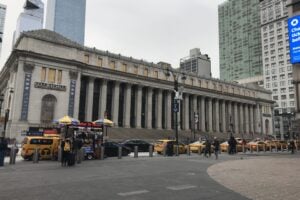
British Airways operated its Concorde service through Terminal 7, the terminal originally developed for BOAC, British Airways’ predecessor. Air France initially used JFK’s International Arrivals Building and later operated through Terminal 1.
Why Didn’t Concorde Create Sonic Booms Over New York City?
Concorde’s famous sonic boom occurred only when the aircraft was flying faster than the speed of sound. Scheduled flights did not accelerate through Mach 1 over New York City or Long Island. Supersonic acceleration took place after the aircraft had moved out over the Atlantic, and westbound flights slowed to subsonic speed before approaching the metropolitan area.
Takeoff noise was still substantial. Concorde’s four Rolls-Royce/SNECMA Olympus 593 engines used reheat, commonly called afterburners, during takeoff. Pilots then followed specific noise-abatement procedures as they climbed away from the airport.
The legal dispute therefore focused on takeoff and landing noise, low-frequency vibration, and the Port Authority’s airport noise standards rather than on repeated sonic booms striking neighborhoods around JFK.
What Was It Like to Fly Concorde From JFK?
Concorde was built around speed rather than spaciousness. Its fuselage was narrow, with 100 seats arranged two on each side of the aisle. What passengers paid for was time, exclusivity, and an aviation experience unlike anything available on a conventional airliner.
During the transatlantic cruise, the cabin display allowed passengers to watch the aircraft pass Mach 1 and continue toward Mach 2. At high altitude, the sky darkened and the curvature of the Earth became visible.
Supersonic flight also heated the aircraft. Concorde’s highly reflective white paint helped manage temperatures that could exceed 200 degrees Fahrenheit on portions of the airframe. Thermal expansion caused the aircraft to lengthen by roughly seven inches during high-speed flight before contracting again as it cooled.
The Fastest Concorde Flight From JFK
On February 7, 1996, British Airways Concorde G-BOAD departed JFK and reached London Heathrow in 2 hours, 52 minutes, and 59 seconds. The flight established the record for the fastest transatlantic crossing by a commercial passenger airliner.
The record demonstrated just how extraordinary Concorde’s performance could be under favorable winds and operating conditions. Even routine Concorde service was dramatically faster than conventional transatlantic travel, but the 1996 crossing pushed that advantage to its extreme.
The Air France Flight 4590 Crash
Concorde’s reputation changed permanently on July 25, 2000. Air France Flight 4590 crashed shortly after takeoff from Paris Charles de Gaulle while operating a charter flight bound for New York.
All 100 passengers and nine crew members aboard were killed, along with four people on the ground. The French air-safety investigation found that a tire was damaged after striking a metal strip on the runway, and debris from the tire contributed to a catastrophic fuel leak and fire.
The Concorde fleet was grounded while modifications were developed. The aircraft later returned to passenger service, but the crash, rising maintenance costs, an aging fleet, and the collapse in premium international travel after September 11, 2001 all weighed heavily on the future of the program.
The Final Concorde Flight From JFK
British Airways and Air France announced in 2003 that Concorde service would end. Air France stopped flying the aircraft first, while British Airways continued through October.
On October 24, 2003, British Airways Flight BA002 departed JFK for London Heathrow as the final scheduled commercial Concorde flight. The aircraft operating that last passenger service was G-BOAG.
The end of Concorde closed a remarkable chapter in New York aviation history. For twenty-six years, the aircraft had linked JFK with London and Paris at a speed that remains unmatched by scheduled passenger service today.
Where Can You See a Concorde in New York City Today?
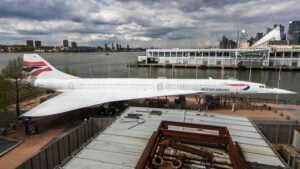
One of the great pieces of this history is still in New York. British Airways Concorde Alpha Delta, registration G-BOAD, is displayed at the Intrepid Museum on Pier 86 along the Hudson River.
This is the same aircraft that set the 1996 JFK-to-London speed record of 2 hours, 52 minutes, and 59 seconds. After its flying career ended, G-BOAD was transported from JFK to the Intrepid, where it became one of the museum’s most recognizable aircraft.
The Intrepid Museum currently offers a separate guided Concorde tour that allows visitors to board the aircraft and learn about its passenger cabin and engineering. In 2026, the museum also added a new exhibition beside G-BOAD examining the history, science, crew experience, and culture of supersonic travel.
Concorde’s New York Legacy
Concorde never became ordinary transportation. That was both its attraction and one of the reasons it could not become the future of mass air travel. It was expensive to operate, carried only 100 passengers, consumed enormous amounts of fuel, and faced severe restrictions because of noise and sonic booms.
Yet for New York, Concorde represented something irresistible: speed, ambition, international commerce, engineering, and spectacle arriving together on a runway in Queens. From the legal fight that delayed its arrival to the record-breaking aircraft now sitting beside the Hudson River, Concorde’s New York story remains one of the most unusual chapters in the history of JFK Airport.
More New York Aviation and Transportation History
Continue exploring New York aviation with our History of New York’s John F. Kennedy International Airport, our History of New York’s LaGuardia Airport, and our History of the Intrepid Sea, Air & Space Museum.
Concorde at JFK: Key Dates and Facts
| Date | Event |
|---|---|
| January 21, 1976 | Concorde begins scheduled commercial passenger service with British Airways and Air France. |
| February 4, 1976 | U.S. Transportation Secretary William T. Coleman Jr. authorizes limited Concorde service to JFK and Washington Dulles under strict conditions. |
| March 11, 1976 | The Port Authority blocks Concorde operations at JFK while it studies noise and vibration concerns. |
| May 1976 | Concorde begins scheduled service to Washington Dulles while JFK remains closed to the aircraft. |
| September 29, 1977 | The Second Circuit affirms an order preventing the Port Authority from continuing an unreasonable discriminatory ban. |
| November 22, 1977 | British Airways and Air France begin scheduled Concorde service to JFK. |
| February 7, 1996 | British Airways G-BOAD flies JFK to Heathrow in a record 2 hours, 52 minutes, and 59 seconds. |
| July 25, 2000 | Air France Flight 4590 crashes after takeoff from Paris while bound for New York, killing 113 people. |
| October 24, 2003 | British Airways Flight BA002 leaves JFK for Heathrow as the final scheduled commercial Concorde flight. |
| 2026 | The Intrepid Museum expands its Concorde interpretation with a new exhibition beside record-setting G-BOAD. |
Published August 9, 2026.
Concorde Flights to JFK: How Supersonic Travel Came to New York article published on ClassicNewYorkHistory.com © 2026