Photo by Brian Kachejian
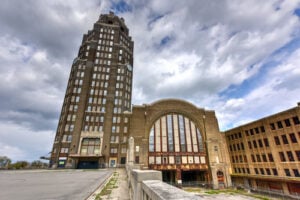
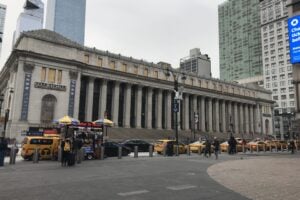
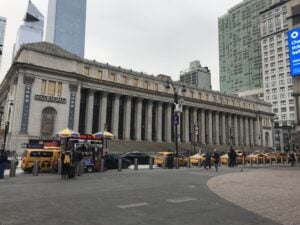
The James A. Farley Building at 421 Eighth Avenue is one of the great surviving civic monuments of early 20th-century New York. Designed by McKim, Mead & White as the architectural companion to the original Pennsylvania Station across the avenue, the building opened for postal business in 1914 and later became New York City’s General Post Office.
For generations, New Yorkers knew the building for its immense Corinthian colonnade, its grand postal lobby, and the famous inscription beginning “Neither snow nor rain nor heat nor gloom of night.” Today, the Farley Building has a second life. Its former mail-sorting spaces have been transformed into Moynihan Train Hall, while the United States Postal Service continues to operate an active post office in the historic Eighth Avenue portion of the building.
The result is one of New York’s most ambitious examples of adaptive reuse: a Beaux-Arts post office built for the railroad age now functions simultaneously as a post office, transportation hub, office complex, retail destination, and gateway to Penn Station.
Where Is the James A. Farley Building?
The James A. Farley Building occupies the enormous superblock bounded by Eighth and Ninth Avenues and West 31st and West 33rd Streets in Midtown Manhattan. Its monumental Eighth Avenue facade faces Pennsylvania Station and Madison Square Garden.
The working James A. Farley Post Office remains at 421 Eighth Avenue, New York, NY 10001. In 2026, the U.S. Postal Service identifies Farley as its largest retail postal space in the country, with approximately 33,100 square feet devoted to retail operations.
Why Was the Farley Building Built Next to Penn Station?
The story of the Farley Building is inseparable from the original Pennsylvania Station.
At the beginning of the 20th century, Pennsylvania Railroad president Alexander Cassatt led the extraordinary project that brought railroad tracks beneath the Hudson River and into Manhattan. The new Pennsylvania Station opened in 1910, giving the railroad a monumental Beaux-Arts terminal between Seventh and Eighth Avenues.
The federal government acquired the adjoining site west of Eighth Avenue for a new postal facility. The location was ideal because mail could move directly between the post office and the railroad infrastructure beneath the building. At a time when trains carried enormous quantities of mail around the country, placing a major postal center beside and above the rail tracks made logistical sense.
The government selected McKim, Mead & White, the same architectural firm responsible for the original Penn Station. William Mitchell Kendall, a partner in the firm, played a major role in the design of the post office.
McKim, Mead & White Designs a Companion to Penn Station
The Farley Building was conceived as an architectural companion to Pennsylvania Station rather than an unrelated government building.
McKim, Mead & White gave the post office a monumental Beaux-Arts composition dominated by a vast Eighth Avenue staircase and giant Corinthian colonnade. The scale deliberately answered the grandeur of the original Penn Station across the avenue.
The building’s stone exterior, classical proportions, monumental steps, and long colonnade created a civic presence suitable for one of the largest postal operations in the country. Rather than hiding the practical work of mail sorting behind an ordinary industrial building, the federal government presented the postal system as a major public institution.
When Did the Farley Post Office Open?
The building opened for postal business on September 1, 1914, as the Pennsylvania Terminal Post Office.
In 1918, it became the U.S. General Post Office, serving as headquarters for the New York postmaster and as the city’s central post office. Historical photographs from the period show enormous quantities of mail being sorted inside the building and document the pneumatic-tube equipment that was part of New York’s sophisticated early postal network.
The building New Yorkers see today was created in two major stages. The original eastern portion faced Eighth Avenue. Between 1932 and 1934, an annex, also designed by McKim, Mead & White, extended the complex westward to Ninth Avenue and approximately doubled its size.
What Does the Famous “Neither Snow Nor Rain” Inscription Mean?
The Farley Building carries one of the most recognizable inscriptions in New York:
“Neither snow nor rain nor heat nor gloom of night stays these couriers from the swift completion of their appointed rounds.”
Despite generations of popular belief, those words are not the official motto of the United States Postal Service. The Postal Service has no official motto.
The wording was supplied by William Mitchell Kendall of McKim, Mead & White and was adapted from a passage in Book 8 of the ancient Greek historian Herodotus’s Histories. Herodotus was describing the remarkable reliability of mounted Persian couriers who carried messages through difficult weather and darkness.
Kendall recognized that the ancient description could serve as an ideal tribute to modern postal workers. Placed across the immense Eighth Avenue facade, the sentence became so closely identified with American mail delivery that it eventually took on the status of an unofficial postal creed.
Why Was the Building Renamed for James A. Farley?
In 1982, the General Post Office was renamed the James A. Farley Building in honor of James Aloysius Farley.
Farley was one of the most influential Democratic political figures in New York during the first half of the 20th century. He served as chairman of the Democratic National Committee and was a close political ally and campaign strategist for Franklin D. Roosevelt.
After Roosevelt became president, Farley served as the 53rd Postmaster General of the United States from 1933 through 1940. His tenure coincided with the New Deal era and with the 1930s expansion of the New York General Post Office that carried the building west to Ninth Avenue.
The Farley Building Becomes a New York City Landmark
The architectural importance of the General Post Office was formally recognized as New Yorkers became increasingly concerned about the destruction of major historic buildings.
On May 17, 1966, the New York City Landmarks Preservation Commission designated the building an individual landmark. The designation came only a few years after the demolition of the original Penn Station across Eighth Avenue, an event that helped galvanize New York’s modern historic-preservation movement.
The building was added to the National Register of Historic Places in 1973.
The survival of the Farley Building later made something possible that could not be done with the original Penn Station: instead of demolishing a monumental civic structure after its original function declined, New York found a new use for it.
Did the Farley Building House ISC NEW YORK NY?
Not in the way modern international package tracking can make it appear.
When tracking an international package, customers may see the routing label ISC NEW YORK NY (USPS). ISC stands for International Service Center, a Postal Service facility that receives and dispatches international mail.
The modern New York International Service Center is located at John F. Kennedy International Airport in Queens, not inside the Farley Building. USPS says the New York ISC opened at JFK in 1980, and current Postal Service materials continue to identify the JFK facility as the New York International Service Center.
The Farley Building historically handled important international postal functions and later housed offices dealing with international claims and inquiries, which helps explain why older references can create confusion. But a modern tracking update reading “ISC NEW YORK NY” should not be interpreted as meaning that a package is physically inside the Farley Post Office on Eighth Avenue.
Can You Still Get a PO Box at the Farley Post Office?
Yes. The James A. Farley Post Office remains a working Postal Service facility and currently offers PO Box service.
USPS pricing for PO Boxes varies by location, box size, rental term, and availability, so fixed price charts can become outdated quickly. Anyone considering a box at Farley should use the Postal Service’s current PO Box Online system for the live price and available sizes at 421 Eighth Avenue.
The Farley location also continues to offer retail postal services, passport appointments, self-service kiosks, general delivery, and other customer services. Hours and individual services can change, so visitors should check the current USPS location listing before making a special trip.
USPS Sells the Farley Building to New York State
By the late 20th century, changes in mail processing had left large portions of the Farley Building underused. The Postal Service began moving major processing functions elsewhere, opening the possibility that the vast building could serve another civic purpose.
In 2007, the Postal Service sold the James A. Farley Building to the Empire State Development Corporation for $190 million, with provisions for additional proceeds tied to redevelopment. USPS retained the right to continue postal operations in a smaller portion of the building under a long-term lease.
The sale created the legal and physical framework for the transformation that Senator Daniel Patrick Moynihan had championed for years: turning part of the great post office into a new rail gateway for New York.
Daniel Patrick Moynihan’s Vision for a New Penn Station
After the original Penn Station was demolished in the 1960s, passengers were left with the underground station beneath Madison Square Garden. The rail platforms remained, but the soaring Beaux-Arts terminal above them was gone.
U.S. Senator Daniel Patrick Moynihan became one of the most persistent advocates for using the Farley Building to restore some of the grandeur that New York had lost. Beginning in the 1990s, Moynihan championed the idea of expanding Penn Station westward into the landmark post office.
The concept went through decades of proposals, design changes, political negotiations, and financing plans. Skidmore, Owings & Merrill became deeply involved in the design process, developing multiple versions before the final train hall took shape.
The West End Concourse Opens in 2017
The transformation happened in stages.
The first major completed phase was the West End Concourse, which fully opened in 2017. The expanded underground concourse improved circulation between Penn Station and the Farley Building and created new access to railroad platforms from the western side of the station complex.
That same year, major construction began on the main Moynihan Train Hall project.
Empire State Development led the $1.6 billion project in partnership with transportation agencies and a private development team. The goal was not simply to renovate the post office, but to combine historic preservation, transportation infrastructure, offices, retail, and public space inside the enormous building.
Moynihan Train Hall Opens in 2021
Moynihan Train Hall opened to the public on January 1, 2021.
The 255,000-square-foot train hall dramatically expanded the Penn Station complex and created a new gateway for Amtrak and Long Island Rail Road passengers. The hall provides access to nine platforms and 17 tracks beneath the building.
The centerpiece is a spectacular skylight rising approximately 92 feet above the concourse. Rather than hiding the old building’s engineering, Skidmore, Owings & Merrill exposed three enormous original steel roof trusses and incorporated them into the new skylight structure.
The result deliberately connects the present train hall with two layers of New York history: the industrial structure of the old mail-sorting facility and the memory of the light-filled original Pennsylvania Station that once stood across Eighth Avenue.
How the Farley Building Became a Mixed-Use Complex
The modern Farley Building is much more than a railroad station.
The redevelopment created hundreds of thousands of square feet of commercial, retail, and dining space surrounding Moynihan Train Hall. A Vornado Realty Trust and Related Companies joint venture entered into a 99-year lease with Empire State Development for the commercial portion of the property in 2017.
Vornado later increased its ownership interest in that commercial joint venture to 95 percent. The office component includes a major Meta campus, while retail and dining businesses occupy spaces throughout the complex and around Moynihan Train Hall.
The United States Postal Service also remains in the building. More than a century after the first customers entered the Pennsylvania Terminal Post Office, New Yorkers can still climb the Eighth Avenue steps, walk beneath the Corinthian columns and famous inscription, and conduct postal business inside the historic lobby.
Why the Farley Building Is One of New York’s Great Adaptive-Reuse Stories
The James A. Farley Building survived because New York eventually recognized that an old building can outlive its original purpose without outliving its usefulness.
The original Penn Station was demolished when its owners considered the monumental structure economically obsolete. The Farley Building faced a different future. Its architecture was protected, its postal operations were reduced rather than erased, and enormous portions of the complex were adapted for transportation and commercial use.
That contrast gives the building special meaning. McKim, Mead & White designed Penn Station and the Farley Post Office as companions more than a century ago. One was destroyed. The other survived long enough to become part of Penn Station itself.
Today, the Farley Building simultaneously represents the history of American mail, the golden age of Beaux-Arts architecture, the rise and fall of the original Penn Station, New York’s preservation movement, and the continuing transformation of Midtown’s West Side.
More Penn Station and Midtown History
Readers can continue with our History of New York’s Pennsylvania Station, which tells the story of the original McKim, Mead & White masterpiece and its demolition. Across Eighth Avenue, our History of Madison Square Garden follows the arena that rose above the modern Penn Station complex. For another great New York rail terminal, see Grand Central Terminal, A Postmodern Cathedral.
Sources
U.S. Postal Service, James A. Farley Post Office current location and service information.
U.S. Postal Service, Postal Facts, James A. Farley Post Office retail space and postal inscription.
U.S. Postal Service, 2007 Annual Report, sale of the James A. Farley Building.
Empire State Development, Moynihan Train Hall and Farley Building Redevelopment.
Skidmore, Owings & Merrill, Moynihan Train Hall project history.
Vornado Realty Trust, Farley Building commercial redevelopment and leasehold.
Library of Congress, Pennsylvania Terminal Post Office historical photographs.
James A. Farley Building History at a Glance
| Year | Milestone |
|---|---|
| 1910 | The original Pennsylvania Station opens across Eighth Avenue. |
| September 1, 1914 | The Pennsylvania Terminal Post Office opens for postal business. |
| 1918 | The facility becomes the U.S. General Post Office in New York. |
| 1932–1934 | A McKim, Mead & White annex extends the building west to Ninth Avenue and roughly doubles its size. |
| 1966 | The building is designated a New York City landmark. |
| 1973 | The building is added to the National Register of Historic Places. |
| 1982 | The General Post Office is renamed the James A. Farley Building. |
| 2007 | USPS sells the building to Empire State Development while retaining postal space under a long-term lease. |
| 2017 | The West End Concourse opens and major construction begins on Moynihan Train Hall. |
| January 1, 2021 | Moynihan Train Hall opens to the public. |
| 2026 | The Farley Building continues to function as Moynihan Train Hall, a major office and retail complex, and an active United States Post Office. |
Published August 11, 2026.
History of the James A. Farley Building: From NYC Post Office to Moynihan Train Hall article published on ClassicNewYorkHistory.com © 2026