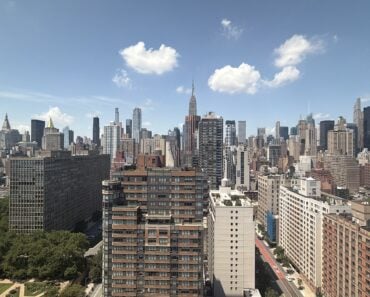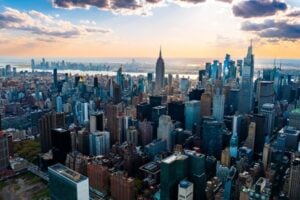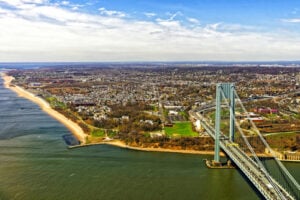
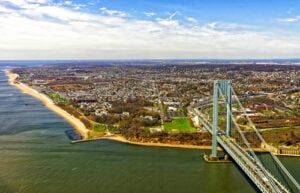
Aerial view of Staten Island and the Verrazzano-Narrows Bridge. Photo by Roman Babakin / Shutterstock.com.
Staten Island is often treated as New York City’s forgotten borough, overshadowed by Manhattan, Brooklyn, Queens, and the Bronx. Yet its neighborhoods have produced or helped shape an extraordinary range of business leaders, actors, musicians, writers, comedians, artists, and historical figures whose influence reached far beyond the island.
Some of the people on this list were born on Staten Island, some were raised there, and a few built important parts of their lives there. What ties them together is a genuine connection to the borough rather than a passing address. Their stories stretch from Port Richmond, Rosebank, and New Brighton to Great Kills, Grymes Hill, Midland Beach, and the South Shore. Those places are part of the larger history explored in our article on how Staten Island neighborhoods got their names.
1. Cornelius Vanderbilt
Long before Cornelius Vanderbilt became the railroad and steamship titan known as the Commodore, he was a Staten Island boy working the waters of New York Harbor. Born on Staten Island in 1794, Vanderbilt grew up in a family connected to farming and ferrying. As a teenager, he began carrying passengers and freight between Staten Island and Manhattan, building the foundation of a transportation empire that eventually extended into railroads and helped create one of America’s great fortunes. Vanderbilt’s later business interests transformed transportation across the country, but the story began on the island and the harbor surrounding it. His railroad legacy would eventually become inseparable from New York institutions such as Grand Central Terminal.
2. Joan Baez
Joan Baez became one of the defining voices of the American folk revival and the civil rights movement, yet her story began on Staten Island. Baez was born there in 1941 to physicist Albert Baez and Joan Bridge Baez. Her father’s academic career caused the family to move frequently, so Staten Island was only the beginning of a childhood that eventually took her across the United States and overseas. By the late 1950s and early 1960s, her crystalline voice and commitment to political activism had made her one of the central figures of the folk movement.
3. Christina Aguilera
Christina Aguilera was born on Staten Island in 1980 while her father was serving in the U.S. Army. Because of his military career, the family moved frequently during her early childhood before eventually settling in Pennsylvania. Aguilera’s Staten Island years were brief, but the borough remains her birthplace. She went on to become one of the most powerful pop vocalists of her generation, breaking through with “Genie in a Bottle” and building a career that has included Grammy Awards, hit albums, television, and decades of international performances.
4. Emilio Estevez
Emilio Estevez was born in New York City in 1962 while his parents, actor Martin Sheen and Janet Templeton, were living on Staten Island. Sheen was still struggling to establish himself as an actor, and the family spent an important period in St. George before his career began to take off. Estevez later became one of the most recognizable actors of the 1980s through films such as The Breakfast Club, St. Elmo’s Fire, Repo Man, and The Mighty Ducks. His Hollywood career may have flourished in California, but his life began in a Staten Island household.
5. Alyssa Milano
Alyssa Milano was born in Brooklyn but raised on Staten Island, where her childhood quickly became intertwined with show business. At age seven, she was selected from a huge open audition for a national touring production of Annie. Television fame followed when she was cast as Samantha Micelli on Who’s the Boss?, making her one of the best-known young stars of the 1980s. She later built a long television career that included Melrose Place and Charmed. Staten Island was the home from which her remarkable childhood career began.
6. Ricky Schroder
Ricky Schroder was raised in Great Kills on Staten Island and began working in front of cameras almost before he was old enough to understand what a career was. His mother brought him to modeling and commercial jobs as a small child, and by age nine he had landed the role that made him famous opposite Jon Voight in The Champ. He later became a television star through Silver Spoons and continued acting as an adult in productions including Lonesome Dove and NYPD Blue. Staten Island was the childhood home behind one of the most recognizable young actors of his generation.
7. Dorothy Day
Dorothy Day was not born on Staten Island, but few major American social activists developed a more meaningful connection to the borough. In the 1920s, she bought a small seaside cottage on the South Shore and lived there with Forster Batterham. Staten Island became the setting for the birth of her daughter Tamar and for Day’s conversion to Catholicism, a spiritual turning point that eventually helped lead to the founding of the Catholic Worker Movement. She returned to Staten Island during later periods of her life and was buried at Resurrection Cemetery in Pleasant Plains after her death in 1980.
8. David Johansen
David Johansen was born on Staten Island in 1950 and grew up there before becoming one of the most important figures in New York’s downtown rock scene. As lead singer of the New York Dolls, Johansen helped create a raw mixture of glam, hard rock, street fashion, and attitude that influenced punk musicians on both sides of the Atlantic. He later reinvented himself as Buster Poindexter and scored a major hit with “Hot Hot Hot.” Behind the Lower Manhattan club mythology was a Staten Island musician whose career became part of New York rock history.
9. Mabel Normand
Mabel Normand was born on Staten Island in 1892 and became one of the great pioneering women of silent film. Before moving into motion pictures, she worked as an artist’s model in New York. Her extraordinary screen career eventually brought her together with Mack Sennett, Roscoe “Fatty” Arbuckle, and Charlie Chaplin. Normand was not simply an actress; she also worked as a director and writer during an era when women rarely held that kind of creative control in the film industry. Her rise from Staten Island to the earliest years of Hollywood makes her one of the borough’s most remarkable entertainment figures.
10. Antonio Meucci
Italian inventor Antonio Meucci settled in the Clifton section of Staten Island in 1850 and remained on the island for the rest of his life. Meucci experimented with devices designed to transmit the human voice electrically and became a central figure in the long historical debate over the development of the telephone. He also provided a home for Italian revolutionary Giuseppe Garibaldi during part of Garibaldi’s American exile. Meucci’s Staten Island house is preserved today as the Garibaldi-Meucci Museum, keeping alive the story of one of the borough’s most unusual links to the history of communications and Italian unification.
11. Alice Austen
Alice Austen was born on Staten Island in 1866 and spent most of her life at Clear Comfort, her family’s home in Rosebank overlooking the Narrows. She became one of America’s most important early women photographers, producing thousands of images that documented Staten Island society as well as immigrants, workers, street life, and a rapidly changing New York City. Austen carried heavy photographic equipment into the city at a time when photography itself was still developing as an art and profession. Her Staten Island home survives as the Alice Austen House and remains one of the borough’s most important cultural landmarks.
12. Colin Jost
Colin Jost grew up in the Grymes Hill neighborhood of Staten Island before attending Regis High School in Manhattan and Harvard University. He joined the writing staff of Saturday Night Live in 2005 and eventually became one of the show’s head writers and the longtime co-anchor of “Weekend Update.” Staten Island has remained an important part of his public identity and comedy. Jost even drew on his experiences working as a lifeguard on the island for the film Staten Island Summer, making his hometown part of the material that followed him into national television.
13. Paul Zindel
Paul Zindel was born in Tottenville in 1936 and grew up in a series of homes around Staten Island. Before becoming a celebrated playwright and young-adult novelist, he studied chemistry at Wagner College and worked as a science teacher. His breakthrough play, The Effect of Gamma Rays on Man-in-the-Moon Marigolds, won the Pulitzer Prize for Drama, while novels such as The Pigman became staples of young-adult literature. Staten Island’s schools, houses, teenagers, and working-class neighborhoods repeatedly surfaced in the emotional landscape of his writing.
14. Ingrid Michaelson
Ingrid Michaelson grew up on Staten Island in an artistic household and began studying piano when she was still very young. She performed with Staten Island Kids On Stage, continued her musical training on the island, and graduated from Staten Island Technical High School before attending Binghamton University. Michaelson later became one of the best-known independent singer-songwriters of her era, with songs including “The Way I Am” and “Girls Chase Boys.” Her career eventually reached Broadway as the composer and lyricist of The Notebook, but her musical education began on Staten Island.
15. Theo Rossi
Theo Rossi was born and raised on Staten Island and grew up in the borough before pursuing an acting career. He became widely known as Juan Carlos “Juice” Ortiz on Sons of Anarchy and later played Hernan “Shades” Alvarez in Marvel’s Luke Cage. His film and television work has continued across crime dramas, independent films, and major streaming productions. Rossi has frequently carried an unmistakably New York presence into his roles, and Staten Island remains an important part of his background.
16. Pete Davidson
Pete Davidson was born and raised on Staten Island, and few modern entertainers have made the borough such a visible part of their public identity. His father, New York City firefighter Scott Davidson, was killed while responding to the September 11 attacks when Pete was seven years old. Davidson later became one of the youngest cast members in the history of Saturday Night Live. He brought Staten Island directly into his work through his stand-up comedy and the semi-autobiographical film The King of Staten Island, turning the borough itself into part of his story.
17. Robert Loggia
Robert Loggia was born on Staten Island in 1930 to Sicilian immigrant parents and attended New Dorp High School before beginning the path that eventually took him to stage, television, and film. His gravelly voice and forceful screen presence made him one of America’s most recognizable character actors. Loggia appeared in films including Scarface, Jagged Edge, Big, and Independence Day, as well as television series including The Sopranos. Long before Hollywood, his story began in an Italian-American Staten Island family.
18. RZA
Robert Fitzgerald Diggs, better known as RZA, became the chief architect and producer behind the Wu-Tang Clan, the hip-hop collective that transformed Staten Island into “Shaolin” in rap mythology. RZA spent formative years in the Park Hill section of the borough, where the relationships and musical ideas that became Wu-Tang took shape. As producer, rapper, composer, actor, and filmmaker, he built one of hip-hop’s most distinctive bodies of work. Few artists did more to put Staten Island on the cultural map for an entire generation.
19. Method Man
Clifford Smith Jr., better known as Method Man, divided his childhood between Long Island and his mother’s home in the Park Hill section of Staten Island. That Staten Island connection placed him in the orbit of the musicians who would become the Wu-Tang Clan. Method Man emerged as one of the group’s most immediately recognizable voices and later built a major solo career, a celebrated partnership with Redman, and a substantial acting career. His music remains inseparable from the Staten Island world that helped produce Wu-Tang.
20. Ghostface Killah
Ghostface Killah, born Dennis Coles, grew up on Staten Island and became one of the most acclaimed members of the Wu-Tang Clan. Known for his emotionally charged storytelling, dense imagery, and unmistakable voice, Ghostface helped define the group’s sound before establishing a major solo career of his own. Albums such as Ironman and Supreme Clientele became hip-hop landmarks. Like RZA and Method Man, he helped turn Staten Island from an overlooked borough into one of the most famous locations in the history of East Coast rap.
21. Bebe Rexha
Bebe Rexha was born in Brooklyn but moved to Staten Island with her family when she was six and grew up there. She attended Tottenville High School, sang in the choir, and developed the musical skills that eventually carried her into songwriting and pop stardom. Before becoming famous as a performer, Rexha earned major songwriting credits, including work on Eminem and Rihanna’s “The Monster.” She later scored hits of her own, including “Meant to Be.” Rexha has spoken publicly about taking the Staten Island Ferry and looking toward Manhattan while dreaming of a music career.
22. Chris Terrio
Oscar-winning screenwriter Chris Terrio grew up in Midland Beach on Staten Island and attended St. Joseph by-the-Sea High School. He later studied at Harvard and entered filmmaking, eventually writing the screenplay for Argo, which earned him the Academy Award for Best Adapted Screenplay. Terrio went on to work on major studio films including Batman v Superman: Dawn of Justice, Justice League, and Star Wars: The Rise of Skywalker. His path from Staten Island classrooms and ferry rides to Hollywood’s largest productions is one of the borough’s more unexpected success stories.
23. Father Vincent R. Capodanno
Vincent R. Capodanno was born on Staten Island in 1929, the youngest of ten children in an Italian-American family. He attended Curtis High School before entering the Maryknoll missionary priesthood and later became a U.S. Navy chaplain serving with Marines during the Vietnam War. Known as the “Grunt Padre,” Capodanno was killed in combat in 1967 while moving among wounded and dying Marines under intense fire. He was posthumously awarded the Medal of Honor. His extraordinary life is explored in greater depth in our article Father Vincent R. Capodanno, Remembering Staten Island’s U.S. Navy Chaplain.
24. Gianni Russo
Gianni Russo was born in Manhattan but spent important childhood years in Little Italy and Rosebank, Staten Island. He became internationally recognizable as Carlo Rizzi in The Godfather, one of the most famous films ever made about an Italian-American crime family. Russo went on to appear in dozens of films and television productions and later developed a career as a singer and nightclub performer. His Staten Island upbringing forms part of the distinctly New York background he carried into one of cinema’s most memorable supporting roles.
25. Carmine Giovinazzo
Carmine Giovinazzo was born and raised in Port Richmond on Staten Island and originally hoped that baseball would become his profession. He played at Port Richmond High School and continued at Wagner College before a back injury changed the direction of his life. Giovinazzo turned toward acting and eventually became best known for playing Detective Danny Messer on CSI: NY. His career also included roles in Black Hawk Down, For the Love of the Game, and numerous television series. His road into acting began with a very Staten Island combination of neighborhood life, baseball, and persistence.
For more Staten Island history, read How Staten Island Neighborhoods Got Their Names, History of Staten Island’s St. George Theatre, History of the Verrazano Narrows Bridge, and History of Staten Island’s Outerbridge Crossing and Goethals Bridges.
Updated September 12, 2026.