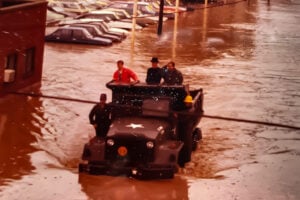
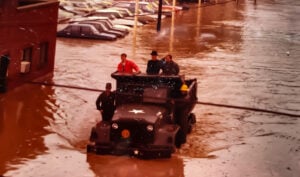
New York National Guard personnel driving through flooded streets in Elmira, New York, during the devastating 1972 flood caused by Tropical Storm Agnes. Photo by Maxq32, CC BY-SA 4.0, via Wikimedia Commons.
The history of Upstate New York is filled with disasters that tested entire communities. Floods have swept through the Southern Tier and Catskills, blizzards have buried Western and Central New York, fires have destroyed whole sections of cities, epidemics have frightened growing towns, and ice storms have left thousands without heat or power.
What stands out in those moments is how often survival depended on ordinary people. Some were doctors, firefighters, deputies, utility workers, soldiers, or volunteers. Others were simply neighbors who happened to have a working well, a snowmobile, a chainsaw, a warm building, or the willingness to go back outside when everyone else was trying to get indoors. These ten stories come from different eras, but they share the same theme: when disaster struck Upstate New York, everyday people stepped forward.
1. Ashbel W. Riley and Rochester’s Cholera Epidemic of 1832
When cholera reached Rochester in the summer of 1832, the village had few of the public-health resources a modern city would consider essential. Local leaders formed a board of health that included physicians and prominent residents, and Dr. Anson Coleman was sent to Montreal to study the disease and learn the treatment methods then being used there. One of the most extraordinary figures in the local response was Ashbel W. Riley. A nineteenth-century Rochester history records that Riley attended the city’s first known cholera victim and continued going wherever the disease appeared, helping the sick and even placing many of the dead in their coffins himself. The same account states that 118 people died during the outbreak and that Riley personally handled the burial preparation for roughly eighty of them. Whatever medical limitations existed in 1832, his willingness to remain present during an epidemic that terrified the community was remarkable.
2. Troy’s Bucket Brigades and Fire Companies During the Great Fire of 1862
On May 10, 1862, sparks from a locomotive ignited the wooden Green Island railroad bridge and high winds carried burning material into downtown Troy. The resulting firestorm destroyed hundreds of buildings in only a few hours. Contemporary accounts preserved by the Rensselaer County Historical Society describe residents working with pails to extinguish burning cinders landing on roofs, barns, and sheds while fire companies fought desperately to stop the flames from crossing major streets. Firefighters and engines also rushed in from surrounding communities including Albany, West Troy, Cohoes, Lansingburgh, and Waterford. The fire reshaped Troy, but the surviving accounts are equally striking for what ordinary residents were doing while the city burned: carrying water, protecting buildings, helping neighbors escape, and opening their homes to people who had suddenly lost everything.
3. Morey G. Lippincott’s Well During the 1935 Hornell Flood
The devastating Finger Lakes Flood of July 1935 struck a wide section of central and southern New York, killing more than forty people and causing enormous damage from the Catskills west toward Hornell. One small story from Hornell shows how survival often depended on resources that suddenly became priceless. Maurice Brill, who was five years old at the time, later recalled that his uncle, Morey G. Lippincott, had sunk a well beneath his Armory Place home years earlier. Because the house stood above the floodwaters, the well remained usable while much of the surrounding neighborhood lost access to safe water. Brill remembered lines of people coming to the family’s driveway to fill containers from the spigot. It was not a dramatic rescue in a raging river, but in a flooded city where clean drinking water was suddenly scarce, one private well became a lifeline for an entire neighborhood.
4. Deputy Alfred A. Antonello and a Blizzard Birth in 1966
The Blizzard of 1966 buried parts of Central New York beneath extraordinary amounts of snow and made ordinary road travel nearly impossible. Snowmobiles, still relatively new machines at the time, suddenly became emergency vehicles. A later Congressional account of the storm described Onondaga County Deputy Sheriff Alfred A. Antonello using a snowmobile to reach a couple in Baldwinsville when the woman went into labor. Antonello arrived in time to deliver the baby boy himself. The same record described deputies using snowmobiles to reach other isolated residents who had lost heat or electricity. The storm helped demonstrate that in deep-snow emergencies, a machine associated mainly with recreation could become a tool for lifesaving work.
5. The Corning Museum Staff and Volunteers After the Flood of 1972
Tropical Storm Agnes devastated Corning and much of the Southern Tier in June 1972. More than 6,000 people were displaced in the Corning area, and the Corning Museum of Glass was inundated along with homes and businesses across the city. More than half of the museum library’s collection was saturated with floodwater and covered in mud and slime. What followed became one of the most remarkable cultural recovery efforts in New York disaster history. Museum employees, residents, students, and volunteers from other museums worked together to wash glass objects, salvage documents, and rescue waterlogged books. The museum eventually used freezing techniques to slow mold growth, and staff and volunteers dried, cleaned, and restored thousands of damaged volumes. Their work did not save lives in the immediate sense, but it saved an irreplaceable collection while the surrounding community was rebuilding from one of the worst floods in Southern Tier history.
6. Red Cross Snowmobile Volunteers During the Blizzard of 1977
The Blizzard of 1977 remains one of the most feared storms in Western New York history. Buffalo had already accumulated a deep snowpack before fierce winds arrived on January 28, driving snow into enormous drifts and reducing visibility to zero. Twenty-nine people died in storm-related incidents, many of them found in vehicles buried by snow. With roads nearly useless, four-wheel-drive vehicles and snowmobiles became some of the only reliable forms of transportation. NOAA records show Red Cross volunteers heading out on snowmobiles to search cars for stranded survivors, sometimes approaching vehicles that had almost disappeared beneath the drifts. These volunteers were entering the same conditions that had trapped the people they were trying to find, making every trip into the storm a risk.
7. The North Country Shelter Volunteers of the 1998 Ice Storm
For five days in January 1998, freezing rain coated northern New York with extraordinary amounts of ice. Trees and utility poles collapsed, roads became nearly impassable, and some residents remained without electricity for weeks. North Country Public Radio later recalled how volunteer fire departments, schools, churches, colleges, the Red Cross, the National Guard, and ordinary residents improvised an enormous relief network. SUNY Potsdam’s field house became a temporary village of mattresses and tents, while St. Lawrence University housed local residents, utility crews, and military personnel. Volunteer firefighters traveled through damaged communities checking isolated homes and transporting people to shelters. Neighbors shared generators, fuel, food, wood heat, and whatever else they had. The 1998 Ice Storm is remembered for its destruction, but just as strongly for the way small North Country communities kept one another alive.
8. Sgt. Windollyn Patino and Pfc. Daniel Paul During Tropical Storm Irene
When Tropical Storm Irene flooded the Schoharie Valley in August 2011, roads disappeared beneath water and mud, homes were cut off, and debris blocked access to entire neighborhoods. New York Army National Guard soldiers from the 719th Transportation Company used high-axle military trucks to reach residents who could not get out on their own. Among them were Sgt. Windollyn V. Patino and Pfc. Daniel Paul, who helped rescue a woman from a Schoharie home where flood debris had trapped her for two days. Elsewhere in the valley, Guard troops used Humvees and military trucks to rescue residents from rising water in North Blenheim and Middleburgh. The images of Patino and Paul helping residents into high-clearance vehicles became a powerful record of the human side of Irene’s destruction.
9. The “Snow Angels” of Western New York’s 2014 Snowvember Storm
In November 2014, an intense lake-effect storm buried parts of Erie County beneath several feet of snow in a matter of days. Roads vanished, motorists were stranded, roofs strained under the weight, and emergency vehicles struggled to move. Yet the storm also produced dozens of stories of ordinary people helping one another. Volunteer snowmobilers delivered food and water to stranded travelers, while firefighters, police officers, tow-truck drivers, plow operators, doctors, nurses, EMTs, restaurant workers, and neighbors worked through the storm. Contemporary accounts described Buffalo firefighters carrying a patient through deep snow toward a hospital and helping deliver a baby in a firehouse. Snowmobile volunteers also reached people who conventional vehicles could not. Western New Yorkers began calling many of these helpers the “Snow Angels” of the storm.
10. Jay Withey and the Pine Hill School Rescue During the 2022 Buffalo Blizzard
One of the most remarkable recent survival stories in Western New York began with a stranded mechanic named Jay Withey. During the deadly Christmas blizzard of 2022, Withey became trapped in his truck in Cheektowaga and spent part of the night with two strangers as fuel ran low and conditions worsened. Realizing they could not survive indefinitely in the vehicle, he broke a window at Pine Hill School to get inside. Once he found heat and shelter, he went back out into the blizzard looking for other stranded people. Withey ultimately brought twenty-four people into the school, including elderly motorists who had run out of fuel. He left a note apologizing for the broken window and explaining that he had acted because people needed shelter. Police later sought him out not to arrest him, but to thank him.
These stories span nearly two centuries, but the pattern is remarkably consistent. Disaster strips away routine quickly. Roads close. Communications fail. Electricity disappears. Institutions become overwhelmed. In those moments, survival often depends on the people who are already there: the neighbor with a well, the volunteer on a snowmobile, the worker who keeps showing up, the person willing to open a shelter, or the stranger who decides to go back outside and look for somebody else.
For more on New York’s history of extreme weather and disaster, read 20 Most Destructive Hurricanes and Coastal Storms in New York History, 10 Submerged and Vanished Communities of Upstate New York, and Where Does Upstate New York Begin? Defining New York State’s Regions and Boundaries.
Sources
Central Library of Rochester and Monroe County — Semi-Centennial History of the City of Rochester
Times Union — 1862 Fire Deadly and Devastating
New York Heritage — The Finger Lakes Flood of 1935
Hornell Home — Memories of the 1935 Hornell Flood
Congressional Record — Emergency Snowmobile Use During the Blizzard of 1966
Corning Museum of Glass — The Flood of ’72: Community, Collections, and Conservation
NOAA — Weather Profile of 1977
North Country Public Radio — 25 Years Later: Remembering the 1998 Ice Storm