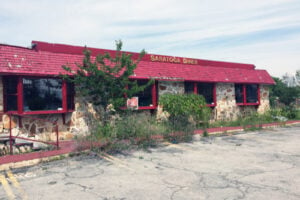
The abandoned Saratoga Diner in Saratoga Springs, New York, photographed in 2016. Photo: James R. Martin / Shutterstock.com
For generations, restaurants across Upstate New York were woven into the lives of the communities they served. Buffalo had its waterfront dining rooms and neighborhood lunch counters. Rochester families celebrated milestones in elaborate restaurants or stopped for burgers at local drive-ins. Syracuse had old-school Italian dining rooms and family restaurants where a special meal became a tradition. In Albany, generations of customers returned to fish-fry counters, diners, and restaurants where state politics and everyday life frequently crossed paths. The Southern Tier had its own familiar landmarks.
These businesses reflected a changing New York. As cities grew and families moved into suburbs, restaurants followed new roads, shopping districts, and entertainment centers. Some establishments endured for decades, passing from one generation to another. Others were known for a particular experience: a revolving dining room, a distinctive building, a lavish Sunday meal, or the comfort of being recognized by the staff. People tied their names to birthdays, first dates, family reunions, and ordinary evenings out.
Not every restaurant closed for the same reason. Owners retired, properties were sold, customer habits changed, and redevelopment altered entire neighborhoods. Sometimes the original building survived under a new name; sometimes it was demolished. And a restaurant that closed at one address may have had a related business that continued elsewhere. Those distinctions matter when looking back on places that people remember.
The following 25 restaurants, diners, and dining establishments no longer operate under the names and at the locations discussed here. They range from well-known institutions to smaller local favorites. What they share is a documented place in Upstate New York’s dining history.
1. Crawdaddy’s (Buffalo)
Crawdaddy’s brought waterfront dining to Buffalo’s Erie Basin Marina long before the city’s present-day waterfront redevelopment became a major attraction. Opening in 1982, it gave customers a place to eat while looking out over the marina and the activity along Lake Erie. Its setting was central to the experience, making a meal there feel like part of a summer outing rather than an ordinary stop at a restaurant. Crawdaddy’s operated until 1999. The original building was subsequently demolished and replaced by Shanghai Red’s, which opened in 2004. The property’s later restaurant identities don’t change the fact that Crawdaddy’s disappeared from Buffalo’s dining scene.
2. The Cloister (Buffalo)
The Cloister was one of Buffalo’s most distinctive restaurants, remembered for its unusual setting and elaborate atmosphere. It opened in 1964 in a converted carriage house on Delaware Avenue, on property historically associated with a house where Mark Twain had once lived. The original house had been demolished, but the carriage house survived and became the restaurant. Guests encountered a richly decorated interior that made the place especially popular for celebrations and evenings out. The Cloister closed on April 6, 1988, after 24 years, when its owners retired. Plans to reopen it never materialized, and they demolished the building in 2012. Its story illustrates how even a beloved restaurant can disappear along with the structure that made it memorable.
3. Deco Restaurants (Buffalo)
Deco was not a single elegant Art Deco dining room. It was a Buffalo-based network of inexpensive lunch counters that began in 1918 and eventually grew to dozens of locations. Customers stopped in for coffee, hot dogs, hamburgers, and quick meals served across the counter. Deco belonged to a period when workers could find a familiar place to eat along the city’s commercial streets without driving to a suburban restaurant. Local historian Steve Cichon has documented its expansion, decline, and the last restaurant near the Hotel Lafayette. Historical accounts differ slightly about the final closing year, placing the end around 1979–1981. What is clear is that the once-familiar Deco counters had vanished by the early 1980s.
4. Your Father’s Mustache (Buffalo)
Your Father’s Mustache was among the restaurants and entertainment establishments that occupied a former industrial building on Michigan Avenue in Buffalo. The complex had been associated with the E. M. Hager & Sons woodworking business before being adapted for hospitality and nightlife. Preservation records identify Spaghetti Warehouse as an earlier tenant, followed by Your Father’s Mustache and later establishments. Its place on this list reflects a particular chapter in the reuse of an old Buffalo commercial building, when dining and entertainment moved into spaces originally constructed for manufacturing. The venue eventually disappeared, though the building later housed other occupants and drew redevelopment proposals. The surviving historical record does not establish a reliable closing year for Your Father’s Mustache, so one should not be assumed.
5. Kathryn Lawrence’s Dining Rooms (Buffalo)
Few Buffalo restaurants occupied a building with a more extraordinary history than Kathryn Lawrence’s Dining Rooms. It operated from 1938 to 1961 in the former Ansley Wilcox house on Delaware Avenue, where Theodore Roosevelt took the presidential oath in 1901 after William McKinley’s assassination. Oliver and Kathryn Lawrence converted the property into a restaurant, removing some earlier interior features and creating spaces for meals and banquets. The restaurant displayed presidential decorations that reminded visitors of the building’s past. It became a popular place for dining and celebrations before closing in 1961. The house later became the Theodore Roosevelt Inaugural National Historic Site, which helped it survive even though the restaurant did not.
6. Don & Bob’s, Monroe Avenue Location (Brighton / Rochester Area)
Don & Bob’s was one of the names associated with Rochester-area burgers, hot dogs, and summer food traditions. Don Barbato helped family establish the original business near Sea Breeze, and the company later opened another location on Monroe Avenue in the Brighton area. For customers who remember the Monroe Avenue restaurant, its disappearance meant losing a familiar neighborhood stop. The distinction is important: the original Sea Breeze location became Don’s Original under the Barbato family’s ownership and continued operating under that name. This entry is about the former Don & Bob’s location on Monroe Avenue, not a claim that every successor to the business has closed.
7. Rio Bamba (Rochester)
For decades, Rio Bamba was associated with a special night out in Rochester. It operated in a Victorian-era house at 282 Alexander Street, an address that became part of the city’s celebrated Restaurant Row. The building’s distinctive architecture provided a setting unlike an ordinary storefront dining room, and Rio Bamba developed a reputation for formal service and fine dining. In 2005, the restaurant rebranded as Bamba Bistro, with a more casual approach and lower prices. Other restaurants subsequently occupied the building, including Ox and Stone and The Alexander. Although the house survives, Rio Bamba’s name and its particular era of elegant Rochester dining are gone.
8. The Changing Scene (Rochester)
The Changing Scene offered Rochester diners an experience that few other Upstate restaurants could match. Opened in 1977 on the 21st floor of First Federal Plaza, it was promoted as New York State’s first revolving restaurant. A ring of the dining-room floor moved slowly, changing the view beyond the windows while customers ate. Downtown Rochester, the Genesee River, and the surrounding landscape became part of the attraction. The restaurant changed operators during its run and ultimately closed in October 1988. Its former space was adapted for office and other uses. The building remains a landmark, but the chance to dine while the room revolved above the city belongs to an earlier Rochester.
9. Edwards (Rochester)
Edwards was a downtown Rochester dining institution for roughly two decades. It became associated with 13 South Fitzhugh Street, where its distinctive interior included woodwork and architectural elements connected to the former St. Bernard’s Seminary. A meal at Edwards offered a very different experience from a neighborhood grill or fast-food restaurant. The business later moved to the Jonathan Child House on South Washington Street, but its final chapter was comparatively short. Rochester Business Journal reported in February 2004 that Edwards had closed after approximately 20 years. Its former locations remain part of the memory of downtown’s changing restaurant scene.
10. The Manhattan Restaurant (Rochester)
The Manhattan Restaurant was one of Rochester’s older dining establishments, remembered for its East Avenue location. Its name survives in historical restaurant photographs and newspaper archives, reminders of a time when East Avenue offered a variety of city restaurants and gathering places. The Manhattan closed in 1984. For people who knew the neighborhood at the time, its disappearance was just another change in Rochester’s social geography: a restaurant that once offered a familiar destination became part of the city’s dining history. Available archival references support its location and closure, but not the more elaborate menu and ownership stories informal recollections sometimes attach to lost restaurants.
11. Pat’s Coffee Mug (Rochester)
Pat’s Coffee Mug was much more recent than some of the vanished restaurants on this list, but it served Rochester long enough to become a neighborhood institution. Located on South Clinton Avenue in the South Wedge, the small, homey diner was known for breakfast, coffee, and personal service that kept regulars coming back. Owner Pat Hall operated the business for more than three decades, working alongside family members. In November 2025, local television reported that she had decided to retire and close the restaurant after 33 years. The loss of Pat’s Coffee Mug shows that restaurant nostalgia isn’t limited to places that disappeared generations ago.
12. Trivet House (Syracuse / Liverpool Area)
Trivet House is remembered as part of Syracuse entrepreneur Julie Nestico’s restaurant career. It operated on Seventh North Street and belonged to a larger group of dining establishments he opened or managed in Central New York. Nestico’s restaurant history included Julie’s Coffee Shop, Regency Grill, Julie’s Place, and several other names familiar to longtime Syracuse diners. Contemporary recollections and later restaurant menus preserve Trivet House’s name, including references to its lasagna recipe. Historical sources reviewed do not firmly establish its closing date or the details of its full menu, but they document its existence and connection to the Syracuse-area restaurant scene.
13. Plainville Farms Restaurant (Cicero)
For Central New Yorkers who wanted a turkey dinner at almost any time of year, Plainville Farms Restaurant in Cicero was an unusual destination. Opened in 1974 on Brewerton Road, it was associated with the Bitz family’s Plainville turkey business and became known for generous turkey dinners, stuffing, bakery items, and a country-style dining experience. Customers traveled from around the region, particularly for holiday meals. The business also operated other restaurant locations over the years. The Cicero restaurant closed on February 2, 2010. Contemporary reporting attributed the closure to declining business, changing dining habits, economic pressure, and food-safety problems. The turkey brand continued, but the restaurant itself did not.
14. Casa Di Copani (Syracuse)
Casa Di Copani was a fixture of Syracuse’s Italian-American dining scene on Burnet Avenue. The restaurant served customers for about 30 years and became familiar to generations of families who valued established neighborhood places. Joanne Copani operated it, and her later obituary documented her long career as its owner. Local coverage of Central New York restaurant closings identified Casa Di Copani as one of the longstanding restaurants lost during 2017. Its disappearance reflected a broader shift in Syracuse dining, as small, family-run establishments gave way to newer businesses and different patterns of restaurant ownership.
15. Papa Gallo Mexican Restaurant (Fayetteville)
Papa Gallo brought Mexican cooking to Fayetteville diners for 17 years. The restaurant became a regular choice for family meals, celebrations, and people who appreciated having a locally operated Mexican restaurant in the eastern Syracuse suburbs. Its owners announced the closure in 2025, saying they had been approached about selling the business and were ready to move on. The last day was reported as June 3, 2025. The restaurant’s website later posted a farewell message to customers and said a new Mexican dining concept was expected to take over. Papa Gallo’s closing reminds us that even popular, long-running restaurants can disappear when owners decide to begin another chapter.
16. Saratoga Diner (Saratoga Springs)
For decades, Saratoga Restaurant and Diner at 153 South Broadway welcomed people looking for early-morning breakfast or late-night food. The 24-hour diner stood along a busy entrance into Saratoga Springs, and its rooftop horse sculpture became a familiar local landmark. It closed without much warning in late January 2012. The building remained vacant for years; by July 2016, the red roof, stone exterior, and overgrown grounds still bore the old Saratoga Diner name, as seen in the photograph featured with this article. The long-abandoned restaurant was demolished in late December 2019. The former owner’s family preserved its horse sculpture, but the diner itself was gone. For longtime residents, the loss meant losing a familiar stop on South Broadway.
17. Miss Albany Diner (Albany)
The Miss Albany Diner was housed in a 1941 Silk City dining car at 893 Broadway, one of the Capital Region’s best-known surviving diner buildings. The business became particularly famous under owners Cliff and Jane Brown and their family, whose distinctive menu included creations such as Mad Irish Toast. The building also appeared in the 1987 film Ironweed, helping draw attention to its vintage architecture. The Miss Albany Diner served its final meal under that name on February 10, 2012. The historic diner car survived and later housed different restaurants, including Tanpopo Ramen and Sake Bar. Customers lost the Miss Albany operation, its menu, and the unique atmosphere the Brown family created.
18. Quintessence (Albany)
Quintessence combined the atmosphere of a classic silver diner with a more adventurous Albany restaurant menu. Located at 11 New Scotland Avenue, it occupied a historic dining-car structure and became particularly known for its chicken teriyaki dish. Quintessence operated under that name from 1981 to 2004, then returned in 2009 after new owners restored it. The revival ended on October 31, 2012, after Albany Medical Center acquired the property for neighborhood redevelopment. The building was later demolished. For longtime customers, the closing meant losing both a distinctive dining experience and a piece of Albany’s roadside architecture.
19. Bob & Ron’s Fish Fry (Albany and Latham)
Bob & Ron’s Fish Fry was part of the Capital Region’s longstanding tradition of serving fried fish in a hot-dog-style bun. Its original Albany restaurant on Central Avenue operated for 67 years, becoming familiar to customers who returned for fish fries and other seafood rather than an elaborate sit-down dinner. The Albany location closed in 2015. A later Latham location remained open for a time, but that restaurant served its last customers in April 2016. Contemporary news coverage recorded both closures and the disappointment expressed by regular patrons. The business name remains a nostalgic reminder of a distinctive regional food tradition.
20. The Cranberry Bog (Colonie)
The Cranberry Bog helped establish Wolf Road in Colonie as a major dining and commercial corridor. At 56 Wolf Road, it offered a dark dining room, a tavern, and an outdoor patio that became especially popular in warm weather. The restaurant operated for 24 years and was remembered for its more formal atmosphere and social gatherings. In 1997, Times Union readers selected it as their favorite restaurant for outdoor dining. The Cranberry Bog closed in 2001, and they demolished its building in 2002. Its loss marked another change on a busy road where restaurants, hotels, and retail buildings have repeatedly replaced one another.
21. Lombardo’s Restaurant (Albany)
Lombardo’s was among Albany’s most enduring Italian-American restaurants. Founded in 1919, it operated for almost a century on Madison Avenue, attracting generations of local families and people connected to state government. Its old-fashioned dining room, decorative murals, and familiar menu helped preserve a sense of continuity even as the surrounding neighborhood changed. Governors and other prominent figures ate there, but the restaurant’s long history also depended on ordinary customers who returned year after year. Lombardo’s closed after serving dinner on December 31, 2018. Its last evening brought out patrons who wanted one more meal in a place tied to decades of Albany memories.
22. Sam’s Italian American Restaurant (Albany)
The Rappoccio family opened Sam’s Italian American Restaurant on Southern Boulevard in Albany on April 6, 1971. Over the next half-century, it became a family-run institution known for traditional Italian-American dinners and the familiarity that comes with repeat customers. Carmela Daubney and her brother Paul Rappoccio continued the business their parents started and worked there for decades. In 2021, just months after the restaurant’s 50th anniversary, the siblings decided to close. Their decision reflected the personal demands of running a restaurant for much of a lifetime, not a simple claim that changing tastes destroyed the business. Sam’s belongs to the history of Albany’s neighborhood family restaurants.
23. The Vestal Steak House (Vestal)
One of the Southern Tier’s most memorable restaurant signs was not a sign at all, but a giant fiberglass Angus bull displayed above the Vestal Steak House. The restaurant on Vestal Parkway opened during the 1940s and became a well-known destination for steaks and seafood. As ownership and the business changed over the decades, the bull remained a local landmark visible to passing motorists. The restaurant eventually closed, and people moved the distinctive figure to the Discovery Center area in Binghamton in the 2000s. For people who grew up in the region, the bull was as closely associated with the restaurant as the meals served inside.
24. Sharkey’s Bar & Grill (Binghamton)
Sharkey’s Bar & Grill was a gathering place in Binghamton’s First Ward for more than seven decades. The restaurant at 56 Glenwood Avenue was known for its informal atmosphere and for the role local bars and neighborhood dining rooms have traditionally played in the Southern Tier’s social life. Sharkey’s closed in November 2020 after 73 years. Later reports described plans to open another restaurant on the property, but any new business would be distinct from the long-running Sharkey’s. Its closure left a familiar name missing from a neighborhood where customers had returned for generations.
25. Burger Mondays Bar & Grille (Binghamton)
Burger Mondays was newer than many on this list, but it became an important part of downtown dining over nearly 15 years. Located at 23 Henry Street, it offered burgers, drinks, private gatherings, and meals before or after downtown activities. Owners Matt and Suzie Jones announced that the restaurant would close on February 9, 2025, thanking customers and staff for helping them through both successful and difficult years. They said they expected to remain involved in Binghamton’s restaurant community, but Burger Mondays ended its run. Its inclusion shows that the restaurants people miss are not always the ones that closed decades ago.
For more stories about vanished New York businesses and the places people remember, read our articles on 25 Lost Supermarkets Upstate New Yorkers Still Miss and 25 Lost Westchester Restaurants Locals Still Miss.