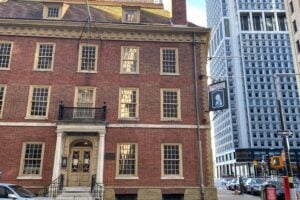
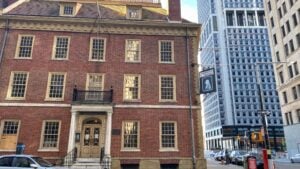
Fraunces Tavern, established in 1762, is one of New York City’s most historic surviving businesses. Photo by Brian Kachejian.
Some New York City businesses are remembered by their addresses, not their names. A favorite corner bakery, the pharmacy that knew the family, the restaurant where they celebrated birthdays and anniversaries. When one closes, a neighborhood loses more than a place to spend money. It loses a piece of its everyday history. In a city where rents rise, buildings are demolished, and entire commercial districts can change within a generation, a business’s survival for more than 100 years deserves a closer look.
Think about what New York looked like when some of these businesses began. Fraunces Tavern was serving customers before the United States existed. C.O. Bigelow opened when Greenwich Village was still a very different place from the neighborhood we know today. Peter Luger was serving steaks in German Williamsburg before the Williamsburg Bridge opened. The founders of Russ & Daughters and Moscot made a living among the immigrant families and crowded streets of the Lower East Side long before their names became famous outside New York.
These businesses are interesting not simply because of their age. Each has a story about the city around it. Some grew with immigrant neighborhoods and continued serving their customers as those neighborhoods changed. Others survived by moving, expanding, or finding new owners who understood the value of an established name. A few survived through historic preservation, while others stayed in business through family succession and the stubborn loyalty of regular customers.
Another important difference exists between a business founded a century ago and one that has operated without interruption ever since. Fraunces Tavern, for example, has an authentic 1762 tavern history, but the present restaurant was reopened after a major restoration in 1907. McSorley’s uses an 1854 founding date that historians have questioned. A researcher examining contemporary records has also challenged Katz’s traditional 1888 date. These are histories worth telling accurately, not reasons to ignore the businesses.
The following 25 businesses have active New York City locations and histories reaching back more than a century. They include family-run shops, famous restaurants, a department store, neighborhood pharmacies, and institutions known worldwide. Together, they show how much of old New York remains for anyone willing to look.
1. Fraunces Tavern
Location: 54 Pearl Street, Financial District, Manhattan. Historic origin: 1762.
Long before the Financial District became a landscape of office towers, the waterfront near Pearl Street was filled with merchants, sailors, and people bringing news into colonial New York. Merchants built the brick building that became Fraunces Tavern in 1719 as the home of merchant Stephen De Lancey. Samuel Fraunces purchased it in 1762 and opened the Queen’s Head Tavern, also known as the Sign of Queen Charlotte. In that period, a tavern was much more than a place to drink. It was somewhere to discuss politics, conduct business, dine, and gather with other New Yorkers.
Its connection to the American Revolution is extraordinary. The Sons of Liberty met there, and on December 4, 1783, George Washington said farewell to his officers in the building’s Long Room. The tavern also figured in the proceedings surrounding the evacuation of Black Loyalists from New York after the war. Later alterations and fires changed the property considerably. The Sons of the Revolution acquired it in 1904, undertook a major restoration, and reopened it as a museum and restaurant in 1907. Today’s dining rooms and museum preserve a site of genuine national importance, although the restaurant has not operated continuously since Washington’s time.
2. C.O. Bigelow Apothecaries
Location: 414 Sixth Avenue, Greenwich Village, Manhattan. Founded: 1838.
Dr. Galen Hunter established the Village Apothecary Shop in Greenwich Village in 1838, when pharmacies compounded many of their own remedies and the relationship between a customer and a neighborhood druggist could last for decades. Clarence Otis Bigelow acquired the business in 1880 and gave it the name that has survived. The pharmacy moved to its present Sixth Avenue location in the early 20th century, but its identity remained tied to the Village rather than to a national drugstore chain.
C.O. Bigelow’s history has some wonderfully specific New York details. A soda fountain opened in 1920 and became a gathering place for people from the surrounding neighborhood. The company also preserves correspondence connected with Eleanor Roosevelt, who shopped there. William Ginsberg purchased the pharmacy in 1939, beginning another family chapter that continues through later generations. The pharmacy still sells prescriptions alongside hard-to-find toiletries and traditional personal-care preparations. Its survival is especially noteworthy because the old independent apothecary has become an increasingly rare sight on Manhattan’s commercial streets.
3. Kiehl’s
Location: 109 Third Avenue, East Village, Manhattan. Founded: 1851.
Kiehl’s began in 1851 as a neighborhood apothecary at Third Avenue and East 13th Street, a corner once known as Pear Tree Corner. The business grew out of the tradition of the neighborhood pharmacy, where preparations for skin and hair care were sold alongside everyday remedies. Over time, the store developed a reputation for distinctive products and personal service, turning what had begun as a local operation into a widely recognized skincare name.
The story is also one of change. Kiehl’s moved from a family-run apothecary into the international cosmetics business and is now part of a much larger corporate organization. Yet its original East Village flagship remains at the same corner, still identified with its 19th-century beginnings. The store is worth including not because its ownership or products have remained unchanged, but because the business can still be found where generations of New Yorkers first encountered it.
4. McSorley’s Old Ale House
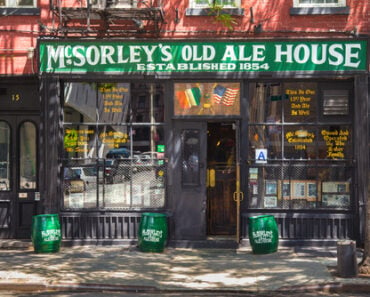
Location: 15 East Seventh Street, East Village, Manhattan. Traditional founding date: 1854; the precise year is disputed.
McSorley’s is one of those New York establishments whose atmosphere is almost as famous as its address. The sawdust on the floor, the old photographs and newspaper clippings, and the choice between light and dark ale have helped the East Seventh Street saloon retain an unusually strong sense of its past. The establishment traditionally dates itself to 1854, but contemporary records are not so clear. Historical research has found John McSorley in city directories by the early 1860s, while property records complicate the earlier claim. Whatever the exact opening year, its 19th-century origins are secure.
Its history is not all warm nostalgia. For many years, McSorley’s refused to admit women, a policy challenged in a federal lawsuit brought by Faith Seidenberg and Karen DeCrow. A federal court ruled against the exclusion in June 1970, and the bar began admitting women that August. That struggle is as much a part of the institution’s history as the beer mugs and old wooden furnishings. McSorley’s remains open, offering a rare chance to experience a historic saloon while also recognizing the social changes that finally reached its door.
5. Macy’s
Location: Herald Square, Manhattan. New York City founding: 1858.
Rowland Hussey Macy had already experienced failures in retail before opening R.H. Macy & Co. at Sixth Avenue and 14th Street on October 28, 1858. Its first day’s sales amounted to just over eleven dollars, a modest beginning for a name that would become inseparable from New York shopping. The business prospered, took on the Straus family as partners, and moved to Herald Square in 1902 as the city’s retail trade moved north. The new location placed Macy’s in the middle of one of Manhattan’s busiest developing commercial districts.
The Herald Square flagship became a destination in its own right, eventually filling a vast section of the block between Broadway and Seventh Avenue. The Thanksgiving Day Parade began in 1924, and Macy’s holiday windows and seasonal displays became part of the city’s public traditions. Despite enormous changes in department-store retail, the Herald Square store continues to trade. Our separate history of Macy’s department store takes a closer look at the building, its shopping floors, and the details that have made it a New York landmark for generations.
6. Pete’s Tavern
Location: 129 East 18th Street, Gramercy, Manhattan. Tavern origin: 1864.
The building at Irving Place and East 18th Street dates to the 1850s, and a drinking establishment opened there in 1864. It later became Healy’s Café before taking the Pete’s Tavern name in the early 1920s. Some of its enduring character comes from the room itself: the long wooden bar, decorative ceiling, mirrors, and booths give the place a connection to an older style of Manhattan neighborhood tavern. During Prohibition, the business reportedly concealed its drinking operation behind the appearance of a flower shop.
The author O. Henry lived nearby on Irving Place and frequented the establishment during its Healy’s years. Pete’s tells the story that he wrote “The Gift of the Magi” in one of its booths, although that precise claim is part of restaurant lore rather than a settled literary fact. His connection to Healy’s is more secure: the café appears under a disguised name in his fiction. The restaurant still operates near Gramercy Park, preserving a piece of New York’s literary and social life.
7. P.J. Clarke’s
Location: 915 Third Avenue, Midtown East, Manhattan. Saloon established: 1884.
The small red-brick building at Third Avenue and East 55th Street was constructed in 1868 and became a saloon in 1884, serving a Midtown very different from today’s office district. Irish immigrant Patrick J. Clarke came to work there and purchased the place in 1912, giving it the name it carries today. It developed the kind of clientele that could mix neighborhood regulars with nationally famous entertainers. Frank Sinatra frequented the restaurant, and Nat King Cole’s praise for its bacon cheeseburger helped establish the enduring “Cadillac of Burgers” nickname.
Its greatest historical drama may have taken place outside the bar. As surrounding properties were assembled for modern development in the 1960s, the owners resisted selling the old building. P.J. Clarke’s survived as a low-rise holdout beside the newer skyscrapers, a striking illustration of the struggle between old New York businesses and a changing skyline. The company has expanded to other locations, but the original Third Avenue restaurant is the one that carries this extraordinary physical history.
8. Keens Steakhouse
Location: 72 West 36th Street, Manhattan. Founded: 1885.
Keens opened independently in 1885 under Albert Keen, having grown out of an association with the Lambs Club and the world of actors and theatrical professionals. At the time, Herald Square was an entertainment district as well as a shopping destination. Performers and theater people could slip into Keens between engagements, and its dining rooms became gathering places for writers, publishers, and businessmen. The restaurant outlasted the theaters that originally supplied much of its trade.
Its extraordinary collection of long-stemmed clay smoking pipes makes the history visible. The pipe club attracted members from the entertainment and business worlds, and the pipes are still displayed overhead. Keens also tells the story of actress Lillie Langtry challenging its men-only policy in 1905 and winning the right to dine there. Its celebrated mutton chop remains part of the menu. Rather than recreating a historic steakhouse from scratch, Keens occupies rooms filled with evidence of the one that actually existed.
9. Peter Luger Steak House
Location: 178 Broadway, Williamsburg, Brooklyn. Founded: 1887.
When Carl Luger’s Café, Billiards and Bowling Alley opened in 1887, Williamsburg had a substantial German immigrant community and a commercial life built around factories, workshops, and neighborhood businesses. Peter Luger owned the establishment, while his nephew Carl worked in the kitchen. The opening of the Williamsburg Bridge in 1903 gave the area a more direct connection to Manhattan, but the steakhouse’s identity remained closely bound to Brooklyn.
By the middle of the 20th century, the restaurant faced a very uncertain future. After Peter Luger’s death, the operation declined, and in 1950 it was sold at auction. Sol Forman, whose metalware business operated across the street, helped purchase and revive the establishment. His family built the modern reputation of Peter Luger around carefully selected beef and its traditional service. The ownership change and interruption are essential parts of the story: the restaurant survived not because nothing changed, but because new owners believed the old place could still matter.
10. Katz’s Delicatessen
Location: 205 East Houston Street, Lower East Side, Manhattan. Traditional founding date: 1888; the early chronology has been questioned.
Katz’s is now famous around the world, but its history begins with the crowded immigrant streets of the Lower East Side. The deli’s traditional account places its beginning in 1888 with the Iceland brothers and identifies Willy Katz as a partner beginning in 1903. Food historian Robert F. Moss has questioned those early dates using immigration and business records, so the 1888 claim is best treated as a traditional company chronology rather than an independently settled fact. The business was firmly established in the early 20th century and moved to its present position as construction reshaped the surrounding streets.
During the heyday of Second Avenue’s Yiddish theater district, performers and neighborhood families frequented the delicatessen. The World War II slogan about sending salami to soldiers grew from packages sent to relatives serving overseas. Its appearance in When Harry Met Sally… in 1989 introduced the crowded dining room to a much wider audience. What survives is not only the sign but the hand-cut pastrami, ticket system, and bustle of a working deli. I have written about eating there, its history, and why I believe its pastrami remains worth the trip in my review of Katz’s Delicatessen.
11. Neergaard Pharmacy
Location: Fifth Avenue and Seventh Avenue, Park Slope, Brooklyn. Founded: 1888.
Julius de Neergaard, an immigrant from Denmark, qualified as a pharmacist in New York and opened his business in 1888. The pharmacy became particularly well known for the convenience of its around-the-clock service, a practical necessity for families who needed medicine outside ordinary business hours. That tradition set Neergaard apart long before chain drugstores began competing for neighborhood customers.
The family business passed through generations. Julius’s son William entered the profession in 1916, and later members of the family developed additional pharmacy and surgical-supply services. Neergaard today operates two Park Slope locations, at 454 Fifth Avenue and 120 Seventh Avenue. Ownership and hours have evolved, but its continued existence shows how a neighborhood pharmacy can survive by offering services, medical equipment, and local knowledge that go beyond the prescription counter.
12. Ferrara Bakery & Café
Location: 195 Grand Street, Little Italy, Manhattan. Founded: 1892.
Ferrara began in 1892, as Italians were establishing a thriving community of shops, cafés, and restaurants in Lower Manhattan. Enrico Scoppa and Antonio Ferrara are associated with the original business, which developed into one of Little Italy’s best-known pastry cafés. Espresso, cannoli, cookies, and Italian desserts helped make the Grand Street location a stopping place for both neighborhood families and people visiting the district.
The business advertises itself as an early American espresso and Italian pastry establishment, sometimes using the claim that it was the country’s first espresso bar. Such a national first is difficult to establish from the surviving evidence and should not be presented as unquestionable. What is clear is that Ferrara became a durable fixture in Little Italy even as much of the neighborhood’s original Italian population moved elsewhere. The café still operates on Grand Street, continuing a baking tradition that began in the 19th century. Watch my video of this fabulous place below.
13. Veniero’s Pasticceria & Caffè
Location: 342 East 11th Street, East Village, Manhattan. Founded: 1894.
I love this place. It makes the best Italian Cheesecake I have ever eaten. Antonio Veniero arrived in New York from Sorrento and established his business in 1894. The original establishment combined a café with a place for customers to gather and play billiards before expanding its pastry trade. The growing demand for its cakes and confections transformed it into a bakery that became familiar far beyond the surrounding Italian neighborhood.
Veniero’s is remarkable not only for its age but for its continued family operation. Generations have maintained the shop at East 11th Street, where the old metal ceilings, etched glass, mirrors, and marble details give the interior a character that cannot simply be purchased as decoration. The bakery still produces biscotti, cookies, cheesecakes, and Italian pastries, making the setting as important to the experience as the food itself.
14. Sahadi’s
Location: 187 Atlantic Avenue, Brooklyn. Family business founded: 1895; Brooklyn store opened in 1948.
Sahadi’s history begins not in Brooklyn but on Washington Street in Lower Manhattan, once the center of a Middle Eastern immigrant district known as Little Syria. Abraham Sahadi established a shop there in 1895, selling an assortment of imported goods to a community whose merchants supplied food and products from across the eastern Mediterranean. The old neighborhood was later transformed by large public works projects, including construction of the Brooklyn–Battery Tunnel.
Wade Sahadi moved the family business to Atlantic Avenue in 1948, helping make the Brooklyn street an important destination for Middle Eastern groceries. Bins of nuts and dried fruit, barrels of coffee, olives, spices, and specialty ingredients became a signature of the store. Later generations expanded the operation, including a location at Industry City in 2019. The Atlantic Avenue market remains a direct link to a Manhattan immigrant community whose old streets largely disappeared.
15. Rao’s
Location: 455 East 114th Street, East Harlem, Manhattan. Founded: 1896.
Charles Rao purchased a small tavern at 114th Street and Pleasant Avenue in 1896, when East Harlem contained a large and growing Italian community. The business passed to later generations, surviving changing neighborhood conditions and the Prohibition years. What began as a local saloon gradually became a dining room whose reputation spread across New York’s restaurant world.
A turning point came in the 1970s when Anna Pellegrino Rao brought home-style Southern Italian recipes into the kitchen, helping define the restaurant’s menu. Rao’s became renowned for its intimate, ten-table dining room and a reservation system built around longstanding regulars. The restaurant’s branded pasta sauce later became a separate national retail success, but the original East Harlem restaurant still operates. Its almost impossible-to-obtain tables are not a marketing invention; they reflect the unusual way a neighborhood gathering place developed into one of New York’s most exclusive restaurants.
16. Bamonte’s
Location: 32 Withers Street, Williamsburg, Brooklyn. Founded: 1900.
Pasquale Bamonte and his family settled in Williamsburg after arriving from southern Italy and opened a neighborhood gathering place in 1900, originally associated with the name Liberty Hall. The establishment became a restaurant serving the Italian-American families who lived and worked nearby. Over time it developed a reputation for traditional red-sauce cooking and large family meals rather than culinary fashion.
Its survival is all the more striking because Williamsburg changed so dramatically around it. Factory buildings became apartments, new restaurants arrived, and the neighborhood gained a different identity, while Bamonte’s retained its old-school dining room and family connection. The restaurant has also appeared in film and television, but its real importance lies in its long role as a place for neighborhood celebrations and ordinary family dinners. It remains open on Withers Street.
17. Gargiulo’s Restaurant
Location: 2911 West 15th Street, Coney Island, Brooklyn. Founded: 1907.
The Gargiulo family opened a small restaurant on Mermaid Avenue in 1907, during the years when Coney Island drew enormous crowds to its amusement parks and shoreline. The business eventually moved to West 15th Street and became as well known for weddings and family occasions as for its Neapolitan food. Its grand ballroom hosted generations of celebrations through the middle decades of the 20th century.
In 1965, brothers Michael, Nino, and Victor Russo acquired the restaurant and continued its Italian dining tradition. Gargiulo’s survived the changes that swept Coney Island after the decline of its old amusement landscape. Today, the restaurant and its event rooms remain part of the neighborhood’s social history, showing that Coney Island’s past was not confined to rides, boardwalks, and hot dog stands.
18. Yonah Schimmel Knish Bakery
Location: 137 East Houston Street, Lower East Side, Manhattan. Storefront established: 1910.
Yonah Schimmel’s story, as preserved by the business, begins with a pushcart operated by Schimmel and his wife before the bakery opened its East Houston Street storefront in 1910. The product was the knish, a filling baked or fried pastry associated with Eastern European Jewish food traditions. Potato and kasha knishes offered an inexpensive meal for people living and working in one of America’s busiest immigrant neighborhoods.
The shop survived as the Lower East Side’s population, buildings, and commercial life changed around it. Its distinctive signs and old-fashioned bakery atmosphere are familiar to generations of visitors, but the real continuity is the knish itself. In a district that once had many businesses serving Eastern European Jewish customers, Yonah Schimmel’s is one of the few specialist shops still operating from that earlier world.
19. Russ & Daughters
Location: 179 East Houston Street, Lower East Side, Manhattan. First shop opened: 1914.
Joel Russ came to New York from what is now Poland and began by selling herring in the streets of the Lower East Side. He worked his way from a barrel and pushcart to a storefront on Orchard Street in 1914, then moved the business to East Houston Street in 1920. It became an appetizing shop, the Jewish food tradition centered on fish, dairy foods, and accompaniments rather than the meat sandwiches associated with a delicatessen.
The most unusual part of the company’s history is in its name. Joel Russ had three daughters, Hattie, Ida, and Anne, who worked in the business and became partners. In the 1930s, the shop took the name Russ & Daughters, a deliberate departure from the more familiar “& Sons” used by family firms. The family has continued the business across generations, with smoked salmon, herring, caviar, and other traditional foods keeping the original Houston Street counter important even as the company expanded.
20. Moscot
Location: Lower East Side, Manhattan. First permanent shop opened: 1915.
Hyman Moscot arrived from Eastern Europe in 1899 and began selling eyeglasses from a pushcart on Orchard Street. At a time when the Lower East Side was crowded with newly arrived immigrant families and small independent merchants, his business depended on building relationships with people who returned to the same vendor. By 1915, he had established a permanent shop at 94 Rivington Street.
His son Sol entered the business in 1925, and the company later occupied a well-known Orchard Street storefront for decades. Subsequent generations brought optometry, modern eyewear design, and international expansion to the name. Moscot has moved within the Lower East Side rather than retaining the original Rivington Street shop, but the family has maintained its connection to the neighborhood through five generations. It is one of the city’s most striking examples of a pushcart operation growing into a recognizable brand.
21. Teitel Brothers
Location: 2372 Arthur Avenue, Belmont, the Bronx. Founded: 1915.
The history of Teitel Brothers tells a more complicated and interesting New York immigrant story than the label “Italian grocery” might suggest. Jacob and Morris Teitel were Jewish brothers from Austria who arrived in the United States in 1912. They settled in the Bronx’s Italian neighborhood and opened a market on Arthur Avenue in 1915, selling imported Italian provisions. The brothers learned Italian to communicate with customers and built a business serving a community to which they did not themselves belong by ancestry.
One of the store’s most revealing details is the Star of David mosaic at its entrance. According to family accounts, it was installed after the brothers were warned against making their Jewish identity obvious during the rise of antisemitism in the 1930s. The mosaic remains a statement about who founded the business and the diversity that existed within the Bronx’s Little Italy. Teitel Brothers still sells cheeses, cured meats, olive oils, and imported groceries under the family name.
22. Nathan’s Famous
Location: Surf and Stillwell Avenues, Coney Island, Brooklyn. Founded: 1916.
Nathan Handwerker worked at Feltman’s, the established Coney Island hot dog business, before striking out on his own with his wife, Ida, in 1916. With a small investment and a five-cent hot dog, they competed in a place where visitors were looking for affordable food between the beach and the amusement attractions. The original location became a defining feature of Coney Island, even as Nathan’s expanded into supermarkets and franchises far from Brooklyn.
The Fourth of July hot dog-eating contest became part of the Nathan’s identity, but its supposed origin in a spontaneous patriotic competition in 1916 is a promotional legend, not a documented continuous tradition. The contest’s modern history dates to the 1970s. The original Coney Island stand also closed temporarily after Hurricane Sandy caused serious damage in 2012, reopening the following year. For the much fuller story, including its early competition and expansion, see our history of Nathan’s Famous at Coney Island.
23. Orwashers Bakery
Location: Upper East Side, Manhattan. Founded: 1916.
Abraham Orwasher and his family opened their bakery in Yorkville in 1916, when the Upper East Side neighborhood was home to many Central and Eastern European immigrants. Rye, pumpernickel, and other dark breads associated with the family’s baking traditions supplied customers who wanted the familiar foods of home. The business’s early history included bread baked in brick ovens and delivered to neighborhood customers and restaurants.
The bakery remained in the family for generations before Keith Cohen purchased it in 2008. He retained its traditional breads while broadening the offerings to include newer styles of artisan bread and pastries. Orwashers continues to operate its original Upper East Side bakery, along with other locations. The business reflects both the immigrant roots of Yorkville and the way a historic bakery can remain relevant without abandoning its original trade.
24. Mario’s Restaurant
Location: 2342 Arthur Avenue, Belmont, the Bronx. Bronx restaurant established: 1919.
Mario’s grew out of a family food business associated with Scolastica Migliucci and her son Giuseppe. The family opened a small pizzeria on Arthur Avenue in 1919, eventually expanding into the full-service Italian restaurant that became a landmark of the Bronx’s Belmont neighborhood. Arthur Avenue was developing into a commercial center for Italian families, with butcher shops, bakeries, markets, and restaurants serving residents from across the borough.
Mario’s became especially well known for its long family operation and the traditional Neapolitan-American dishes on its menu. The restaurant received a James Beard Foundation America’s Classics honor in 2000. It is also associated with a story from the production of The Godfather: Francis Ford Coppola wanted to use the dining room for a scene, but the family declined. Mario’s remains on Arthur Avenue, part of a neighborhood where the businesses themselves are an essential part of the history.
25. Nom Wah Tea Parlor
Location: 13 Doyers Street, Chinatown, Manhattan. Founded: 1920.
Nom Wah opened in 1920 as a bakery and tea parlor on Doyers Street, the short, sharply curving Chinatown street once nicknamed the Bloody Angle. Its early trade included Chinese pastries, steamed buns, almond cookies, and mooncakes. Ed and May Choy became associated with the establishment, and Wally Tang began working there as a teenager in 1950 before eventually becoming its owner.
The business moved next door in 1968 after losing part of its original space. In 2010, Wally Tang’s nephew Wilson Tang took over and updated the operation, placing a greater emphasis on made-to-order dim sum while retaining the old dining room’s character. The café still operates on Doyers Street. Its history connects the early Chinese-American food business of the neighborhood with later generations of immigrants, customers, and restaurant owners.
What These Businesses Tell Us About New York City
These businesses survived for different reasons, and their histories are not interchangeable. At Fraunces Tavern, preservation saved an important building after its original use had long changed. At Peter Luger, a new owner brought life back to a restaurant that had declined. At Sahadi’s, a move from Manhattan to Brooklyn carried an immigrant family’s commercial traditions into another neighborhood. At Teitel Brothers, a Jewish family built a lasting Italian grocery in the Bronx. And at places such as Veniero’s, Moscot, and Russ & Daughters, descendants took part in extending a family business across generations.
What they share is a connection to the people and neighborhoods that made them possible. Their signs may be famous today, but their histories began with customers coming through the door, often looking for nothing more complicated than bread, medicine, dinner, or a place to sit. That is why their continued presence means something. New York City has lost so much of its commercial past that the businesses still here deserve to have their stories told properly.
Quick Reference: 25 Historic NYC Businesses Still Open
| Business | New York City location | Founding year or historic origin |
|---|---|---|
| Fraunces Tavern | Financial District, Manhattan | 1762; reopened 1907 |
| C.O. Bigelow | Greenwich Village, Manhattan | 1838 |
| Kiehl’s | East Village, Manhattan | 1851 |
| McSorley’s Old Ale House | East Village, Manhattan | 1854 claimed; disputed |
| Macy’s | Herald Square, Manhattan | 1858 |
| Pete’s Tavern | Gramercy, Manhattan | 1864 |
| P.J. Clarke’s | Midtown East, Manhattan | 1884 |
| Keens Steakhouse | Herald Square area, Manhattan | 1885 |
| Peter Luger Steak House | Williamsburg, Brooklyn | 1887 |
| Katz’s Delicatessen | Lower East Side, Manhattan | 1888 claimed; disputed |
| Neergaard Pharmacy | Park Slope, Brooklyn | 1888 |
| Ferrara Bakery & Café | Little Italy, Manhattan | 1892 |
| Veniero’s | East Village, Manhattan | 1894 |
| Sahadi’s | Atlantic Avenue, Brooklyn | 1895; Brooklyn since 1948 |
| Rao’s | East Harlem, Manhattan | 1896 |
| Bamonte’s | Williamsburg, Brooklyn | 1900 |
| Gargiulo’s Restaurant | Coney Island, Brooklyn | 1907 |
| Yonah Schimmel Knish Bakery | Lower East Side, Manhattan | 1910 storefront |
| Russ & Daughters | Lower East Side, Manhattan | 1914 |
| Moscot | Lower East Side, Manhattan | 1915 shop |
| Teitel Brothers | Arthur Avenue, the Bronx | 1915 |
| Nathan’s Famous | Coney Island, Brooklyn | 1916 |
| Orwashers Bakery | Upper East Side, Manhattan | 1916 |
| Mario’s Restaurant | Arthur Avenue, the Bronx | 1919 |
| Nom Wah Tea Parlor | Chinatown, Manhattan | 1920 |
Readers interested in the businesses New York has lost can explore our articles about classic New York restaurants we miss and famous New York City department stores. Our histories of Macy’s and Nathan’s Famous in Coney Island look more closely at two names that continue operating today.