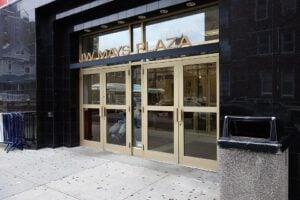
The entrance to J.W. Mays Plaza in Jamaica, Queens, photographed in 2018. The building formerly housed a J.W. Mays department store. Photo: Tdorante10 / Wikimedia Commons, CC BY-SA 4.0.
Whatever happened to J.W. Mays department stores? The New York discount chain closed its last three stores in December 1988 after years of declining retail business and a Chapter 11 bankruptcy filing in 1982. But unlike many of the department stores that disappeared around the same time, J.W. Mays did not cease to exist as a corporation. It continued in a very different business: leasing and managing commercial property. The Mays name survived long after the familiar store signs came down.
For shoppers who remember Fulton Street in Brooklyn, Jamaica Avenue in Queens, or the stores on Long Island, that answer is only part of the story. Mays was one of the distinctly New York retail chains that gave working families a place to buy clothing, household goods, and everyday necessities at affordable prices. It grew as the boroughs and suburbs changed, but it was still associated with the kind of street-front department store that people could reach on foot or by public transportation. Its paper shopping bags and bargain advertisements belonged to an era when shoppers had many more local department-store names to choose from.
J.W. Mays also left an unusual trail of historical records. A photograph documents the company’s major Brooklyn expansion in 1959. Federal court decisions explain what happened when it entered bankruptcy. A government report records a later battle for control of the business. And modern Securities and Exchange Commission filings show that the company still operates properties connected to its retail past. The story of Mays is therefore not simply one more account of a store chain closing. It is the history of a Brooklyn retailer whose storefronts disappeared while its underlying company endured.
How J.W. Mays Began in Brooklyn
J.W. Mays traces its beginnings to 1924, when immigrant merchant Joe Weinstein established a women’s clothing business in Brooklyn. The company was incorporated in New York on July 6, 1927, a date confirmed in its modern annual reports. Historical accounts associate Weinstein’s early retail operation with Fulton Street, one of Brooklyn’s most important shopping thoroughfares. The small clothing venture grew into a department store carrying merchandise for the many families who lived and worked in the borough.
Weinstein came from Eastern Europe and chose a store name different from his surname. According to an account of the retailer’s history, he liked the name Mays because it evoked the countryside and spring flowers. The initials J.W. came from Joe Weinstein. Whatever the appeal of the name, the business’s real foundation was a straightforward retail idea: give customers practical merchandise at prices that made them willing to return.
Fulton Street suited that approach. A busy commercial corridor, it was served by transit and lined with stores competing for shoppers throughout Brooklyn. Rather than asking customers to travel to a distant suburban shopping center, Mays was part of a shopping district where families could visit several stores during the same trip. As the business expanded, the original neighborhood clothing shop grew into something much more substantial, eventually occupying a large portion of the block near Bond Street.
The Bargain Department Store New Yorkers Remember
Mays was not intended to offer the same shopping experience as an expensive Manhattan specialty store. Its appeal was value. The retailer became known for clothing, household items, small appliances, and other goods that people needed for their homes and families. Advertising and recollections of the chain emphasized frequent sales, including special Monday promotions. One of its familiar advertising lines was “Every day’s a sale day at Mays!” The promise was simple enough to remember, and the name became a regular part of shopping conversations in Brooklyn and Queens.
There was an important difference between Mays and the later big-box discount retailers. At many locations, Mays still looked and functioned like an urban department store. Customers entered from the sidewalk, passed window displays, and walked through departments inside a multistory building. The experience belonged to a kind of neighborhood shopping that grew around transit, busy commercial avenues, and established retail streets. Even when Mays expanded beyond Brooklyn, it retained much of that regional identity.
Those were also years when New Yorkers had strong opinions about where they preferred to shop. Mays competed for price-conscious customers with chains such as Ohrbach’s, Alexander’s, and E.J. Korvette, while traditional department stores offered another level of selection and service. Each retailer developed its own following. For a family shopping for school clothes or ordinary household necessities, the difference in prices could determine which store received their business.
J.W. Mays Expands from Brooklyn to Queens
Mays opened a store in Glen Oaks, Queens, in October 1950. The move reflected changes in New York’s population after World War II, as families settled in eastern Queens and nearby Nassau County. A contemporary opening announcement, reproduced in a later retail-history collection, advertised free bus transportation serving the surrounding area. That small detail tells us how retailers were trying to build customer loyalty in places where suburban shopping habits were still developing.
The Glen Oaks store brought Mays closer to families who might otherwise have shopped in established Brooklyn or Queens commercial districts. The neighborhood was growing, and a recognizable department-store name helped create a new shopping destination. As Mays opened additional stores, it followed a broader pattern in metropolitan retailing: established city businesses began serving customers whose homes, commutes, and shopping routines had shifted outward.
The company was also investing in its original home. On May 21, 1959, a ribbon-cutting ceremony marked the opening of a new Mays wing at Livingston Street and Hanover Place in downtown Brooklyn. A surviving press photograph identifies Joe Weinstein, company president Max L. Schulman, City Council President Abe Stark, and Brooklyn Borough President John Cashmore at the event. The ceremony gives a clear picture of how important the store had become to the borough’s commercial identity.
From Long Island to the Hudson Valley
Over time, J.W. Mays established stores beyond its Brooklyn and Queens base, including locations in Levittown and Massapequa on Long Island, on 14th Street in Manhattan, and in Fishkill in Dutchess County. By the early 1970s, the chain had reached nine stores and employed approximately 5,000 people, according to historical accounts. It was not a national department-store giant, but it had become a significant employer and retailer in the New York metropolitan area.
Its expansion into Fishkill reflected the ambitions of regional retailers at the time. A 1982 New York appellate court decision records that Mays became involved with a proposed shopping-center development at the intersection of Route 9 and Interstate 84. Construction of its store began in 1972, and the location opened in October 1974. The neighboring mall developer encountered financial difficulties, and Mays found itself operating within a project whose broader retail plans did not proceed smoothly.
That legal record is especially useful because it takes us beyond nostalgic memories and shows the business decisions involved in expansion. Large stores required major investments in buildings, land, foundations, equipment, and inventory. In the Fishkill case, difficult soil conditions required more expensive construction work. The costs of entering a growing suburban market could be substantial even before a store sold its first item.
Why J.W. Mays Began to Struggle
By the late 1970s, Mays was confronting the same pressures affecting other regional department stores. More shopping was taking place in enclosed malls and in increasingly large discount outlets. Customers had more choices, and retailers needed the financial resources to keep stores attractive, maintain inventory, and compete on price. The older formula of a relatively small regional chain with large traditional department-store buildings became harder to sustain.
It would be too simple to blame the failure of Mays on a single competitor or on the construction of shopping malls alone. The chain had expanded into properties with substantial ongoing costs, and its retail operation struggled in a changing market. Its eventual bankruptcy indicates serious financial distress, but it does not by itself prove that one particular expense, advertising decision, or competitor caused the collapse. The available court records are much more precise about when Mays sought bankruptcy protection and how it attempted to continue operating.
This was also a difficult period for other names New Yorkers remember. Korvettes closed in 1980, and the changing economics of urban and suburban shopping would continue to affect department stores throughout the decade. Readers interested in that broader story can explore our history of Korvettes department stores and our article about Alexander’s department stores.
J.W. Mays Filed for Bankruptcy in 1982, but It Did Not Close Then
On January 25, 1982, J.W. Mays filed a voluntary petition for Chapter 11 bankruptcy protection. That exact date is established by a published 1983 federal bankruptcy decision involving the company’s Glen Oaks store lease. The court considered whether Mays could retain the Union Turnpike premises while making required payments to its landlord. The dispute shows that the company was not simply closing every store and walking away. It was trying to preserve parts of its retail operation while reorganizing its debts and obligations.
The company closed five stores following the bankruptcy filing, according to a later Government Accountability Office report. The remaining business continued in a smaller form, and the same federal report establishes another date missing from many retellings: J.W. Mays emerged from Chapter 11 on February 14, 1984. That distinction changes the history. Bankruptcy in 1982 was a major turning point, but the company recovered sufficiently to leave court-supervised reorganization and keep operating several stores.
The survivors still had to contend with a difficult retail environment. Leaving bankruptcy did not restore the nine-store chain of the early 1970s or guarantee that the remaining stores would thrive. Mays now faced the challenge of running a reduced department-store business while holding real estate that had attracted attention from outside investors.
The 1985 Fight for Control of Mays
One of the least remembered chapters in the history of J.W. Mays came after the bankruptcy reorganization. In January 1985, real estate investor Sol Goldman and J.J.J. Financial Associates were involved in an attempt to gain control of the company. A Government Accountability Office examination of corporate takeover attempts included Mays among its case studies. The report records that Goldman’s group had accumulated a substantial shareholding while an insider group associated with company management held an even larger voting interest.
The episode helps explain why the business was becoming interesting for reasons other than selling clothing and housewares. A department-store chain might have difficulties earning money at its cash registers while still controlling valuable urban and suburban property. The store buildings, leases, and land holdings could attract investors who believed the real estate offered greater value than the retail operation. That tension was increasingly important during Mays’ final years.
The company remained under its existing corporate structure rather than disappearing in a takeover. But the 1985 episode foreshadowed the eventual decision to abandon retailing and concentrate on property. The value of the locations was beginning to tell a different story from the performance of the department stores occupying them.
When Did J.W. Mays Department Stores Finally Close?
The end came in December 1988. After years of reduced operations, Mays announced that it would close its three remaining department stores. Contemporary reporting identified the decision as a move away from retailing and toward commercial real estate. The final store closings occurred at the end of the year, ending more than six decades of the Mays retail business.
The distinction between the store closings and the corporate company’s survival matters. J.W. Mays was not liquidated out of existence in the way many people assume when they hear that a store chain has closed. Its later SEC filings describe its department-store operation as discontinued during the fiscal year that ended July 31, 1989. The remaining company continued to own or lease property and collect rent from tenants.
For customers, of course, the corporate distinction was not the part that mattered. The places where they had shopped were gone. A familiar sign disappeared from Fulton Street and other shopping districts, and the chain no longer supplied the goods for which customers had visited for years. From a shopper’s perspective, Mays had ended in 1988, regardless of what happened to the corporation afterward.
How the J.W. Mays Company Survived as a Real Estate Business
The remarkable part of the story is that Mays already had something of lasting value: commercial property in established New York neighborhoods and other regional locations. Rather than maintaining a struggling department-store operation, the company continued by leasing space to other businesses and organizations. Its real estate holdings and long-term leases became the center of a new business model.
The old Brooklyn connection survived in corporate form. J.W. Mays maintained its executive offices at 9 Bond Street, close to the Fulton Street shopping district where the retailer had become a household name. The company’s later filings identify buildings and property interests in Brooklyn, Jamaica, Levittown, Massapequa, Fishkill, and Circleville, Ohio. Some properties are owned, while other interests are based on leases. It would therefore be inaccurate to describe every building as a property the corporation owns outright.
The modern company’s business is commercial leasing, not department-store sales. Office tenants, retail businesses, health-care providers, and other organizations occupy space that Mays manages. There is a historical irony in that arrangement: people can still work or shop in properties tied to the Mays corporation without seeing a Mays cash register or purchasing a single item from a Mays department store.
Is J.W. Mays Still in Business Today?
Yes. J.W. Mays, Inc. remains an active publicly traded real estate company. Its common stock is listed on Nasdaq under the symbol MAYS, and it files annual and quarterly reports with the Securities and Exchange Commission. The 2025 annual report identifies Lloyd J. Shulman as chairman, president, and chief executive officer and lists the company’s Brooklyn headquarters at 9 Bond Street.
Its current business should not be exaggerated into a story of effortless financial success. For the fiscal year ended July 31, 2025, the company reported approximately $22.47 million in revenue but a net loss of about $136,000. That was an improvement over the prior year’s reported loss, but a loss nevertheless. Its filings also discuss the pressures facing commercial landlords, including vacancies, tenant turnover, borrowing costs, property taxes, and the expense of preparing older buildings for new tenants.
The business continues to evolve. In an April 2026 SEC filing, the company disclosed that it had engaged a broker to market its property at 25 Elm Place in Brooklyn for a potential sale while continuing to operate it. The filing specifically cautioned that a sale was not assured. This is a useful reminder that the company did not preserve every old retail property unchanged, and that surviving as a real estate business still requires decisions about expenses, leases, renovations, and possible disposals.
Where Did the Former Mays Stores Go?
The answer differs by location. Some of the former retail properties were adapted for new commercial tenants. Others changed uses or underwent alterations over time. The company’s 2025 filings still identified property interests at Fulton Street and Bond Street in Brooklyn, Jamaica Avenue at 169th Street in Queens, Hempstead Turnpike in Levittown, Sunrise Highway in Massapequa, and Route 9 near Interstate 84 in Fishkill. These records establish the company’s present property interests; they do not mean each address remains an unchanged former department store.
Jamaica Avenue and Fulton Street offer particularly clear examples of the historical continuity. Both were major shopping districts long before modern shopping centers changed where New Yorkers spent their money. A property owner can remain part of those districts even after the original retailer has disappeared. In that sense, the surviving company is also a record of the commercial geography that made Mays successful in the first place.
Why New Yorkers Still Remember J.W. Mays
The history of department stores is sometimes told through mergers, bankruptcies, and financial statements. Those records are necessary, especially in a story as unusual as this one. But they do not fully explain why people remember Mays decades after its last sale. The stores were part of the ordinary rhythms of New York life: shopping trips with parents, looking for bargains, picking out clothing, and visiting busy streets where several department stores competed for the same customers.
J.W. Mays came from a time when a New Yorker could choose among a remarkable collection of local retail names, each with its own character. Some chains disappeared completely. Others survived in altered forms. Mays belongs in the second group. The department stores vanished in 1988, but the company founded by Joe Weinstein is still part of New York’s commercial landscape. That makes its story more complicated, and more interesting, than the history of a retail chain that simply went bankrupt and closed.
For more New York retail history, read our articles about Korvettes department stores, Alexander’s department stores, Times Square Stores (TSS), and what happened to Caldor discount stores.