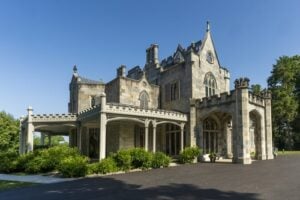
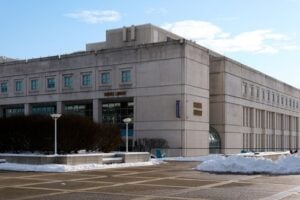
The Science Library at the University at Albany in Albany, New York. Photo: Francis W Naung / Shutterstock.com
Long before the technology industry became synonymous with Silicon Valley, scientists, engineers, physicians, and inventors working across Upstate New York were making discoveries that changed how Americans lived. The region’s contribution to scientific history extends far beyond its celebrated factories. It includes the laboratories where researchers experimented with electricity, the hospitals where physicians developed lifesaving treatments, the college classrooms that trained future Nobel Prize winners, and the workshops where practical inventors turned difficult problems into working machinery.
Geography and transportation helped create this extraordinary concentration of talent. The Erie Canal connected the Hudson and Mohawk valleys with the Great Lakes and encouraged the growth of industrial cities. Waterpower along the Genesee and Niagara rivers supported ambitious manufacturing enterprises, while railroads carried finished products and raw materials across the country. Rochester became known for photography and optics, Buffalo for heavy industry and medical innovation, Schenectady for electrical engineering, and Troy for technical education. Scientific progress was closely connected to the growth of these communities, but it was never limited to their factory floors.
The state’s universities and research institutions added another dimension. Rensselaer Polytechnic Institute challenged the old idea that science was best taught through lectures alone. Cornell University developed into a center of agriculture, physics, chemistry, and food science. The University of Rochester and institutions in Buffalo made important contributions to medicine and engineering. Meanwhile, men and women born in smaller communities, including Peru, Sauquoit, Waterville, and Central Bridge, carried their early New York experiences into careers that reached national and international prominence.
These careers also reveal that scientific discovery rarely belongs entirely to one person or one location. Willis Carrier was born in Erie County and worked for a Buffalo company, yet he made his breakthrough air-conditioning installation in Brooklyn. The scientists who developed practical cardiac pacemakers worked together, not in isolation. Other figures on this list, including Hans Bethe, Peter Debye, and Robert C. Baker, were born outside New York but made decades of consequential discoveries while living and working Upstate. Their connections to the region are substantial, though different from those of people born and raised here.
The following twenty-five stories span more than two centuries of American history. Some names will be immediately familiar; others are better known through the inventions that outlived them. Together, they show how the laboratories, schools, hospitals, and communities of Upstate New York helped shape modern life, from electricity and communications to medicine, computing, food production, and the science of the stars.
1. Joseph Henry
Upstate New York connection: Albany, Albany County — born and conducted early research there
Joseph Henry was born in Albany in 1797, long before electricity had become an ordinary part of daily life. His route into science was anything but predetermined. As a young man he worked as a watchmaker’s apprentice, became interested in theater, and eventually began studying scientific books. The Albany Academy provided the setting where curiosity grew into systematic experimentation and a teaching career.
In the late 1820s and early 1830s, Henry made dramatic improvements to electromagnets by winding insulated wire around iron cores. The resulting devices could lift impressive loads and showed how electrical current could be used in practice. He also investigated electromagnetic induction, a principle essential to the development of motors, generators, and other electrical equipment. His experiments with electrical signaling laid the technical groundwork for the telegraph.
Henry later taught at the College of New Jersey, now Princeton University, before becoming the first secretary of the Smithsonian Institution in 1846. There, he advocated scientific research, information exchange, and an early national network of weather observations. His subsequent national reputation did not erase the importance of the experiments he performed in Albany, where an American physicist helped establish the possibilities of applied electromagnetism.
2. Asa Gray
Upstate New York connection: Sauquoit, Town of Paris, Oneida County — born and raised in the area
Asa Gray was born in Sauquoit in 1810, in the Oneida County countryside south of Utica. His childhood included work around his family’s tannery, and he attended schools in Clinton and Fairfield. Although he earned a medical degree, his fascination with collecting and identifying plants proved stronger than the prospect of practicing medicine. An early interest cultivated in Central New York ultimately drew him into a scientific field still developing its professional methods.
Gray became one of the leading authorities on the plants of North America. He collaborated with botanist John Torrey and later taught at Harvard University, where his manuals, collections, and correspondence helped organize a rapidly expanding body of botanical knowledge. Scientists and collectors sent specimens to him for identification, making his work central to the understanding of American plant diversity.
Gray also entered one of the nineteenth century’s defining scientific debates. He corresponded with Charles Darwin and became an important American defender of natural selection, even while working through questions about science and religion in his own way. His influence extended from the quiet fields of Oneida County to international discussions about evolution, taxonomy, and the history of life.
3. James Dwight Dana
Upstate New York connection: Utica, Oneida County — born and educated in the city
Born in Utica in 1813, James Dwight Dana became a geologist and mineralogist whose career reached far beyond the Mohawk Valley. He studied at Yale under Benjamin Silliman and showed an early aptitude for understanding the natural world through direct observation. In an era when geology was assembling its basic framework, Dana was willing to travel widely in search of evidence.
He served with the United States Exploring Expedition of 1838–1842, which investigated the Pacific and other regions and returned immense scientific collections. Dana’s studies of minerals, volcanic islands, coral reefs, and marine life became influential publications. His work helped explain relationships among geological processes, the growth of islands, and the distribution of organisms.
Back at Yale, Dana taught and wrote textbooks that introduced generations of students to mineralogy and geology. His long career connected laboratory classification with field exploration and made him an important figure in nineteenth-century earth science. It began with a young student in Utica looking beyond familiar surroundings to the history of the planet.
4. Lewis Henry Morgan
Upstate New York connection: Near Aurora, Cayuga County — born; later conducted research from Rochester
Lewis Henry Morgan was born near Aurora in 1818 and studied at Union College before establishing a law practice in Rochester. His professional interests expanded when he began researching the history and social organization of the Haudenosaunee, or Iroquois Confederacy. His friendships and conversations with Seneca people, including Ely S. Parker, became crucial to that work.
In 1851 Morgan published League of the Ho-dé-no-sau-nee, or Iroquois, an important early study of Haudenosaunee political organization, customs, and material culture. He later investigated kinship systems across societies, asking how relationships and social categories could be compared. Those studies influenced the development of anthropology as an academic discipline.
Morgan’s legacy is significant but requires historical perspective. His broad theories about stages of social evolution reflected assumptions that modern anthropologists have challenged, and Haudenosaunee knowledge deserves recognition as more than raw material for an outsider’s scholarship. Nonetheless, the Cayuga County native helped establish an enduring field of inquiry while working closely with people and communities in Western New York.
5. Willis Carrier
Upstate New York connection: Angola, Erie County — born; educated at Cornell; early engineering career in Buffalo
Willis Haviland Carrier was born in Angola in 1876, growing up in Erie County before studying engineering at Cornell University. After graduating in 1901, he went to work for the Buffalo Forge Company. Factories of that period depended on stable conditions as much as on powerful machines, and fluctuations in temperature and moisture could ruin valuable manufactured products.
In 1902 Carrier designed a system to regulate humidity at the Sackett & Wilhelms printing plant in Brooklyn. The immediate problem was that paper changed dimensions as moisture levels shifted, making multicolor printing difficult. Carrier recognized that the control of humidity could be engineered systematically. His later formulas and cooling systems helped turn an industrial solution into the basis of modern air conditioning.
Carrier formed an independent company with fellow engineers in 1915, and the enterprise eventually developed a major industrial presence around Syracuse. Air conditioning reshaped factories, theaters, hospitals, offices, and homes, but the story links several New York locations rather than one invented hometown scene: Angola gave Carrier his beginnings, Cornell his education, Buffalo his first professional opportunity, and Brooklyn the site of his breakthrough installation.
6. Wilson Greatbatch
Upstate New York connection: Buffalo and Western New York, Erie County — born, educated, and worked in the region
Wilson Greatbatch was born in Buffalo in 1919 and attended West Seneca High School. His interest in electronics developed before his career as an engineer, and he served as a radio operator during World War II. After the war he studied at Cornell and the University of Buffalo, where he later worked in electrical engineering. The combination of electronics and medicine eventually became the center of his life’s work.
While experimenting with a circuit for recording heart activity, Greatbatch recognized that repeated electrical pulses might help control a dangerously irregular heartbeat. Working with Buffalo physicians William Chardack and Andrew Gage, he helped develop a practical implantable cardiac pacemaker. Their work culminated in successful human implants in 1960, providing a new treatment for patients whose hearts could not maintain a dependable rhythm.
Greatbatch continued working on power sources and eventually helped develop long-lasting batteries that improved the reliability of implanted devices. The pacemaker was not the achievement of an isolated inventor acting alone; it required engineers, surgeons, experimental work, and patient care. Buffalo’s medical and engineering communities were central to this important chapter in modern cardiology.
7. Elmer Ambrose Sperry
Upstate New York connection: Cortland, Cortland County — born and educated locally
Elmer Ambrose Sperry was born in Cortland in 1860, when steam power and electrical engineering were opening new technological possibilities. From a young age he displayed an interest in building devices and solving practical mechanical problems. He attended the local normal school before pursuing work as an inventor and entrepreneur, ultimately establishing several businesses.
His best-known contribution was the development of a practical gyrocompass, an instrument that uses the behavior of a spinning gyroscope to indicate true north. Unlike a magnetic compass, a gyrocompass could operate reliably in steel ships, where magnetic influences presented difficulties. Sperry also helped develop gyroscopic stabilizers and automatic steering devices for ships and aircraft.
Naval vessels and commercial ships adopted his systems in the early twentieth century, and related technologies later became essential to aviation and navigation. Sperry’s career demonstrates how mechanical ingenuity could extend into entire industries. The path from Cortland to international navigation technology made him one of the most consequential American inventor-entrepreneurs of his generation.
8. George Westinghouse
Upstate New York connection: Central Bridge, Schoharie County — born; grew up around family workshops in Schenectady
George Westinghouse was born in Central Bridge in 1846 and spent much of his youth around his father’s agricultural machinery works in Schenectady. The shop exposed him to tools, metalworking, and the everyday problems of mechanical design. By the time he reached adulthood, the nation’s railroads were expanding rapidly but remained hazardous, particularly when trains needed to stop.
Westinghouse developed an air-brake system that allowed railway cars to be braked together rather than relying on individual workers to operate brakes by hand. The invention greatly improved railroad safety and helped make faster, longer trains practical. He later founded companies engaged in electrical manufacturing and became an influential supporter of alternating-current power, whose advantages for long-distance transmission helped transform the electric industry.
His business activities carried him beyond New York, but his early training in the Mohawk Valley helps explain his practical approach to invention. He was not the sole inventor of alternating current; his accomplishment was helping organize, finance, and commercialize systems built on work by many engineers, including Nikola Tesla. Westinghouse connected manufacturing skill with the infrastructure of a new industrial age.
9. Herman Hollerith
Upstate New York connection: Buffalo, Erie County — born in 1860
Herman Hollerith was born in Buffalo in 1860, when the federal government still depended on immense amounts of handwritten data. As the country’s population grew, the task of counting people and tabulating census information became increasingly laborious. Hollerith studied engineering and mathematics and worked with the federal census operation, giving him a close view of the difficulty.
His response was a system in which information was encoded in punched cards and counted by electromechanical machines. The technology proved especially valuable for the 1890 United States Census, allowing large volumes of data to be organized more efficiently than before. It also demonstrated that machine processing could become a practical tool for businesses and institutions far beyond the census office.
The company Hollerith established later became part of the Computing-Tabulating-Recording Company, which was renamed International Business Machines in 1924. IBM’s subsequent association with Endicott added another major Upstate New York chapter to the history of computing. Hollerith’s birthplace was Buffalo, but the legacy of punched-card data processing connected several parts of the state to the emergence of the information age.
10. Frances E. Allen
Upstate New York connection: Plattsburgh and Peru, Clinton County — born in Plattsburgh; raised on a farm near Peru
Frances Elizabeth Allen grew up on a family farm in Peru, not far from Plattsburgh, after her birth in the North Country in 1932. She was the oldest of six children and came from a household where education and hard work mattered. Her early career was in teaching mathematics, and she initially viewed the computer industry as an opportunity to pay off her education expenses rather than a lifelong professional destination.
After studying at what is now the University at Albany and the University of Michigan, Allen joined IBM in 1957. She became a pioneer of compiler optimization, developing methods that let computer programs execute more efficiently by reorganizing instructions without changing the results. Her research was essential to the productive use of increasingly powerful processors and parallel computing systems.
Allen spent decades at IBM Research and became the first woman named an IBM Fellow. In 2006 she became the first woman to receive the ACM A. M. Turing Award, a leading honor in computer science. Her career took her into the heart of modern computing, but the beginning was on a Clinton County farm and in the schools of northern New York.
11. Theodore Case
Upstate New York connection: Auburn, Cayuga County — born and established his research laboratory there
Theodore Case was born in Auburn in 1888 and carried out some of his most important experiments in the city. He came from a family able to support scientific investigation and established a laboratory on the grounds of his home. While movies were becoming a major form of entertainment, synchronizing recorded sound with the pictures on a strip of film remained a serious technical challenge.
Case and his colleague Earl Sponable developed technologies that helped make sound-on-film recording practical. Their work included advances in photoelectric detection and the recording of an optical soundtrack on motion-picture film. Fox Film Corporation adopted the resulting Movietone technology, helping usher in a new era of sound newsreels and motion pictures.
The popular history of talking pictures often concentrates on Hollywood, yet crucial parts of the technological story took place in an Auburn laboratory. The former Case property became part of the Cayuga Museum of History and Art, preserving a physical connection between a Central New York city and the transformation of the motion-picture industry.
12. John Wesley Hyatt
Upstate New York connection: Starkey, Yates County — born; developed celluloid technology in Albany
John Wesley Hyatt was born in Starkey, Yates County, in 1837. He entered the printing trade while young and eventually worked in Albany, where a search for a substitute for ivory drew him into chemical experimentation. Billiard balls depended heavily on ivory, a material that was expensive and increasingly difficult to obtain. The practical need for an alternative helped inspire years of trial and error.
Working with his brother Isaiah, Hyatt developed processes for molding nitrocellulose-based materials, including the use of camphor and heat to create celluloid. The result was an early commercially important plastic capable of being shaped into a wide variety of goods. Hyatt also devised equipment needed to manufacture products from the new material and established ventures connected with billiard balls and dental plates.
Celluloid later appeared in collars, combs, toys, and photographic film, and its success helped establish the possibilities of industrial plastics. Not every later plastic descended directly from Hyatt’s exact formulation, but his work was a significant early step in synthetic materials manufacturing. His story runs from a small Finger Lakes community to experiments and businesses in Albany.
13. Amos Eaton
Upstate New York connection: Chatham, Columbia County — born; became a leading science educator in Troy
Amos Eaton was born in what is now Chatham in 1776, the year of the Declaration of Independence. His path to science included studying and practicing law, working as a land agent, and eventually turning toward natural history. By the early nineteenth century he had developed an enthusiasm for teaching people to understand their environment through direct observation.
Eaton published books on botany and geology and conducted geological surveys of the region around the Erie Canal. He argued that practical scientific education should not be confined to memorizing lectures and textbooks. Students, he believed, needed to examine specimens, perform experiments, and experience the application of scientific principles outside the classroom.
That philosophy found a powerful institutional home when Stephen Van Rensselaer established the Rensselaer School in Troy in 1824. Eaton served as its leading professor and helped shape the methods that distinguished the institution, later Rensselaer Polytechnic Institute. His legacy includes the educational system that helped turn the Capital Region into an important center of American engineering.
14. Birdsill Holly
Upstate New York connection: Auburn, Cayuga County — born; pursued major inventions in Lockport, Niagara County
Birdsill Holly was born in Auburn in 1820, but many of the inventions associated with his name emerged from his work in Western New York. In the nineteenth century, municipal water systems were often unable to provide dependable pressure, especially when firefighters needed large quantities of water quickly. Holly focused on machinery that could meet changing demand more effectively.
His direct-pressure waterworks systems supplied municipal pipes without relying entirely on elevated reservoirs, and his improved fire-hydrant designs contributed to safer urban water distribution. Holly also worked on pumping engines and began experimenting with district steam heating, in which a central plant sends heat through pipes to multiple buildings. These were infrastructure inventions rather than flashy consumer products, but they affected everyday city life.
Lockport became closely associated with Holly’s manufacturing companies and technical experiments. His career shows how Upstate engineers could influence cities across North America by solving basic problems in water, fire protection, and heating. Although he was born in Auburn, Holly’s long years of work in Lockport made Niagara County central to the story of his inventions.
15. Arthur C. Parker
Upstate New York connection: Cattaraugus Reservation, Erie County — born and spent his early childhood there
Arthur Caswell Parker was born on the Cattaraugus Reservation in 1881 and grew up with Seneca family connections that informed his scholarly interests. He entered a world in which Indigenous histories and material culture were too often studied without sufficient recognition of the people who created them. Parker developed a professional career in archaeology, anthropology, history, and museum work.
He held important museum positions, including many years leading the Rochester Museum of Arts and Sciences. Parker documented archaeological materials, worked to strengthen professional practices, and wrote about Haudenosaunee history and culture. His scholarship also reflected active concerns about Native American identity, civic rights, and representation in museums and public life.
When the Society for American Archaeology was established in the 1930s, Parker became its first president. His career linked the Cattaraugus Reservation, Rochester, and the broader development of American archaeology. His place on this list is not merely as a scholar of Indigenous culture but as a person of Seneca ancestry who helped shape professional institutions and public understanding.
16. Nathaniel Rochester
Upstate New York connection: Buffalo, Erie County — born
Nathaniel Rochester was born in Buffalo in 1919, years before electronic computers became common tools for business and scientific research. He studied engineering at the Massachusetts Institute of Technology and worked on wartime radar technology before joining IBM in 1948. His career placed him at the transition from specialized electronic machinery to programmable digital computers.
Rochester became chief architect of the IBM 701, the company’s first major scientific computer. He also contributed to symbolic assembly-language programming, which made it easier for programmers to give complex instructions to machines. His engineering work helped establish the architecture and software methods that supported commercial computing’s rapid expansion in the 1950s.
He was one of the four researchers who proposed the 1956 Dartmouth Summer Research Project on Artificial Intelligence, along with John McCarthy, Marvin Minsky, and Claude Shannon. The meeting became an important moment in the development of artificial intelligence as a named field. Rochester’s work shows that Buffalo is connected to computing history through the birthplace of an engineer who helped shape both mainframes and early AI research.
17. Lorin Blodget
Upstate New York connection: Busti, Chautauqua County — born near Jamestown
Lorin Blodget was born near Jamestown in Chautauqua County in 1823. At a time when weather observations were scattered among individual observers, military posts, and government offices, he recognized the value of assembling those measurements into an organized picture of climate. His interests combined physics, statistics, geography, and the economic needs of agriculture and transportation.
His landmark 1857 book, Climatology of the United States, compared regional patterns of temperature, rainfall, and seasonal conditions using a broad collection of observations. It helped move discussion of North American climate toward systematic measurement rather than assumptions based on latitude or local anecdotes. Blodget’s work made extensive use of maps and statistical comparisons.
The Chautauqua County native later worked in several fields, including statistical research and economic affairs, but his early contribution to climatology remains an important scientific achievement. He belonged to a generation trying to understand an enormous and varied continent through evidence gathered from many places.
18. Mary Edwards Walker
Upstate New York connection: Town of Oswego, Oswego County — born and raised
Mary Edwards Walker was born in the Town of Oswego in 1832, on a family farm where her parents encouraged education and independent thought. The family’s commitment to abolition and women’s equality influenced her development in an era when professional medicine remained overwhelmingly closed to women. Walker studied at Syracuse Medical College and earned her medical degree in 1855.
During the Civil War, she worked as a physician and surgeon despite resistance to women serving in military medical roles. She treated wounded and sick people in difficult conditions and was taken prisoner while working in Confederate-controlled territory. Her service was recognized with the Medal of Honor, and she remains the only woman to have received that distinction. The honor was later rescinded in a broad review and restored posthumously in 1977.
Walker was also an outspoken advocate for women’s rights and practical clothing reform. Her career belongs as much to the history of social and professional barriers as to the history of medical practice. The specific location of her birth matters: she came from rural Oswego County, not a birthplace documented within the City of Oswego itself.
19. George Eastman
Upstate New York connection: Waterville, Oneida County — born; built his photography enterprise in Rochester
George Eastman was born in Waterville in 1854, in the Oneida County countryside southwest of Utica. His family moved to Rochester while he was still young, and financial hardship after his father’s death forced him to leave school and work. He became fascinated with photography at a time when taking a picture required bulky equipment, fragile plates, and considerable technical patience.
Eastman began experimenting with photographic materials and developed methods that helped replace cumbersome wet-plate processes with more convenient dry plates and eventually roll film. In 1888 he introduced the Kodak camera with a service model in which customers sent cameras away to have their pictures processed. The approach transformed photography from a specialized pursuit into an increasingly accessible activity for ordinary families.
His business built Rochester into a leading photographic manufacturing center and influenced the emerging motion-picture industry. Eastman was also an important benefactor of educational, medical, and cultural institutions. His story has two unmistakable Upstate roots: his birth in Waterville and the industrial revolution in photography that he led in Rochester.
20. Simeon De Witt
Upstate New York connection: Wawarsing, Ulster County — born; later served in statewide surveying and mapping
Simeon De Witt was born in Wawarsing, Ulster County, in 1756, before the American Revolution. He trained in mathematics and surveying and later served the Continental Army as a geographer and surveyor. Accurate maps were essential to a military force moving across unfamiliar terrain, and surveying demanded mathematical discipline as well as practical field experience.
In 1784 De Witt became surveyor general of New York State, a position he held for roughly fifty years. His work included the mapping and organization of large areas of Upstate New York, including lands set aside for Revolutionary War veterans. He helped create geographic frameworks that influenced later settlement, property boundaries, roads, and development.
De Witt also maintained a significant connection to Ithaca, where he spent his later years. His work may not resemble laboratory science, but cartography and geodesy were crucial to the state’s growth. He translated mathematical measurement into maps that shaped the physical organization of New York for generations.
21. Edward Livingston Trudeau
Upstate New York connection: Saranac Lake, Adirondacks — lived, practiced medicine, and established research institutions
Edward Livingston Trudeau was born in New York City in 1848, so his Upstate connection rests on where he chose to live and work rather than where he was born. After contracting tuberculosis in the 1870s, he came to the Adirondacks and found his health improving. He established himself in Saranac Lake, a community that became inseparable from his medical career.
In 1884 Trudeau founded the Adirondack Cottage Sanitarium, emphasizing rest, nutrition, and fresh air at a time when doctors had limited means of treating tuberculosis. He also pursued scientific research into the disease, establishing the Saranac Laboratory for the Study of Tuberculosis in the 1890s. This helped make a remote Adirondack village an important American center for the study of an infectious disease that caused immense suffering.
Modern tuberculosis treatment ultimately depended on later developments, including effective antimicrobial drugs, but Trudeau’s institutional work was influential. He combined patient care with laboratory inquiry and helped build a community of physicians and researchers in the Adirondacks. Saranac Lake was not a brief stop in his life; it was the place where his major work took form.
22. Robert C. Baker
Upstate New York connection: Ithaca and Lansing, Tompkins County — longtime Cornell researcher and resident
Robert C. Baker was born outside New York, but his lasting reputation was forged at Cornell University in Ithaca. Trained in poultry and food science, he devoted his career to developing new ways to prepare, preserve, and market chicken and other poultry products. The research reflected practical economic concerns in agricultural communities where growers needed reliable markets for their products.
Baker and his teams developed processes for binding chopped poultry into convenient portions, coating them, and keeping the coating attached during cooking. These innovations contributed to the development of the modern chicken nugget, although the product sold by any one fast-food chain should not automatically be credited to Baker alone. He also became known for Cornell chicken barbecue sauce, a regional favorite strongly associated with New York fairs and community events.
His career demonstrates that food science is an important branch of applied research. Work on texture, processing, refrigeration, and preparation changed the way food was sold and consumed. Baker’s long residence and research career in Tompkins County make him a substantial Upstate figure even though he was not born there.
23. George Franklin Grant
Upstate New York connection: Oswego, Oswego County — born and began learning dentistry there
George Franklin Grant was born in Oswego in 1846, the son of parents who had escaped enslavement and built a life in Upstate New York. As a teenager he worked for a local dentist, first running errands and then learning technical tasks in the office. That early experience helped open a professional path that remained difficult for Black Americans in the nineteenth century.
Grant moved to Boston and graduated from Harvard Dental School in 1870, later becoming Harvard University’s first Black faculty member. He became skilled in the treatment of cleft palate and worked on dental devices intended to help patients speak and eat. His technical curiosity extended outside medicine to a simple difficulty encountered on golf courses, where players traditionally raised their balls on small piles of sand.
In 1899 Grant received a patent for a golf tee designed to support the ball above the ground. He did not establish a major commercial business around the device, and later tees became more widely used. Yet the Oswego-born dentist stands out as an innovator whose contributions crossed medicine, mechanical design, and sporting history.
24. Peter Debye
Upstate New York connection: Ithaca, Tompkins County — Cornell professor and researcher for more than two decades
Peter Debye was born in the Netherlands in 1884 and had already achieved international prominence before establishing himself in Ithaca. His research in physical chemistry and physics explored molecular behavior, the properties of materials, and the ways matter responds to electric fields. He received the Nobel Prize in Chemistry in 1936, before the Cornell chapter of his life began.
Debye came to Cornell for lectures in 1939 and joined its faculty in 1940, subsequently leading the chemistry department. He continued research and teaching at the university for many years, including after becoming professor emeritus in 1952. His work influenced generations of chemists and physicists who used models of molecular interactions and the structure of matter.
The Nobel Prize is not an award he received for a discovery made exclusively in Upstate New York, and his Dutch origins should not be obscured. His inclusion rests instead on a substantial academic career and long residence in Ithaca, where his influence became part of Cornell’s scientific history.
25. Hans Bethe
Upstate New York connection: Ithaca, Tompkins County — Cornell professor from 1935 until his death
Hans Bethe was born in Germany in 1906 and came to the United States after the rise of Nazi rule made his academic future in Europe untenable. He joined the Cornell University physics faculty in 1935. Ithaca became his permanent professional home, and some of his most important scientific work developed while he was part of Cornell’s growing community of theoretical physicists.
Bethe helped explain how stars produce energy by fusing lighter atomic nuclei into heavier ones, work that earned him the Nobel Prize in Physics in 1967. During World War II, he led the theoretical division at Los Alamos, where scientists worked on the first atomic weapons. His knowledge of nuclear physics also made him an influential participant in later national debates about the risks of nuclear warfare.
After the war he returned to Cornell and remained active in research, teaching, and public discussion for decades. His work connected the smallest particles of matter with the forces driving distant stars. Although his birthplace was in Europe, his nearly seventy-year association with Ithaca makes him one of the region’s most distinguished adopted scientific figures.
Upstate New York and the History of Scientific Discovery
The scientific history of Upstate New York is not limited to the laboratories of major corporations or the celebrated achievements of a few famous inventors. It includes people who learned to observe the natural world in rural communities, engineers who solved the practical problems of growing cities, physicians who improved the treatment of serious disease, and university researchers whose discoveries became part of international science.
Their connections to the state also reflect different experiences. Some were born and raised here and carried those beginnings elsewhere. Others came to New York to teach, work, and build their lives. Across those different paths, the region provided ideas, institutions, colleagues, and opportunities that helped important discoveries take shape.
For more on the industries and technologies associated with these achievements, explore our articles on inventions and innovations from Upstate New York and historic brands that began in Upstate New York.