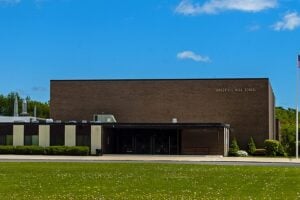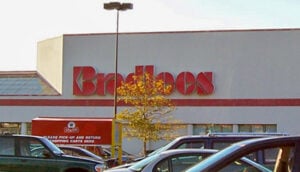
Photo: Richjenkins / Wikimedia Commons. Public domain. Photographed October 22, 2007, at a vacant former Bradlees store in West Deptford, New Jersey.
Bradlees was a popular Northeastern discount chain closed after filing for Chapter 11 bankruptcy protection for the second time on December 26, 2000. Unlike its first bankruptcy, this filing was intended to liquidate the business rather than save it. Bradlees announced the closure of its 105 remaining stores, and federal bankruptcy court records show that the going-out-of-business sales ended and store operations ceased by February 5, 2001. The chain’s financial troubles reflected corporate debt, difficult expansion decisions, shifting consumer spending, competition, and lost supplier confidence.
For more than four decades, Bradlees anchored suburban community life and consumer culture across the Northeast. Recognized by its familiar marquee signs and immortalized in living rooms by its legendary advertising campaign featuring “Mrs. B,” Bradlees grew from a single Connecticut storefront into a massive regional enterprise with well over 100 stores and nearly $1.5 billion in annual sales near the end of its life. For generations of families from New England down through New York, New Jersey, and Pennsylvania, a weekend trip to Bradlees, where one could unearth discounted apparel, home furnishings, toys, and electronics under one roof, was a quintessential ritual of suburban life.
Yet, despite its deep regional loyalty, Bradlees ultimately fell victim to a difficult combination of leveraged buyouts, shifting corporate ownership, and the relentless march of larger discount competitors. Its disappearance was not the result of a single bad Christmas season or one failed store. The company had spent years struggling with financial pressures that eventually became impossible to overcome.
How Bradlees Department Stores Got Started
The origins of the chain trace back to March 1958, when the first Bradlees store opened its doors in New London, Connecticut. The founders, having held their early strategic planning meetings at Bradley International Airport near Windsor Locks, chose to name the enterprise after the airport. Recognizing the potential of the burgeoning discount department store format, the regional supermarket company Stop & Shop acquired Bradlees in 1961, setting the stage for a period of rapid growth.
Under Stop & Shop’s corporate umbrella, Bradlees expanded across New England, New York, New Jersey, and, for a time, markets farther south. Pairing supermarket operations with general-merchandise retailing offered shoppers the convenience of buying groceries and household goods during the same trip. The chain established itself as a trusted neighborhood destination, especially as suburban shopping centers became central to everyday American life.
The Golden Years and the Famous Mrs. B Commercials
During the 1970s and 1980s, Bradlees enjoyed what many longtime customers remember as its golden era. The stores were tailored to working- and middle-class families of the Northeast, offering a shopping experience that balanced practical household goods with fashionable apparel, toys, and electronics. They were places where parents shopped for necessities and children wandered the aisles looking at games, bicycles, and holiday merchandise.
Much of the brand’s cultural footprint during this period was cemented by its iconic television advertising campaign featuring the fictional character “Mrs. B,” played by actress Cynthia Harris. Mrs. B was depicted as the chain’s tireless buyer, constantly hunting down bargains on behalf of customers. The catchy jingle, with its familiar line “Nobody can buy like Mrs. B,” became part of the regional advertising landscape. For shoppers who grew up with those commercials, the character remained inseparable from the Bradlees name long after the stores disappeared.
At various points in its history, Bradlees operated more than 130 locations. The chain employed thousands of workers and played a major role in shopping centers throughout the region. Its scale made it a significant retailer, even though its name never became as nationally familiar as Walmart or Target.
Bradlees in New York City and on Long Island
Although Bradlees originated in Connecticut, it also became part of the retail landscape familiar to New Yorkers. One of its most ambitious projects was a massive Manhattan store at Union Square, which opened in November 1994 in the former J.W. Mays department store building. It was the largest Bradlees location at the time, with six floors of selling space containing clothing, housewares, toys, hardware, and electronics. Bringing a regional discount-store format into a large Manhattan building demonstrated how aggressively the company was trying to expand.
Bradlees also operated in the New York suburbs, including Nassau County on Long Island. Its presence varied by community, however, and its Long Island history was shorter than that of some older regional discount chains. For New Yorkers who shopped at Bradlees, the chain belonged to the same era of familiar local retail names as Caldor, Korvettes, and J.W. Mays, each of which had its own identity and loyal following.
How the Stop & Shop Buyout Changed Bradlees
The foundational stability of the chain was severely undermined in the late 1980s by corporate maneuvering far removed from the retail floor. In 1988, parent company Stop & Shop became the target of a hostile takeover bid by the Dart Group. To fend off the takeover, Stop & Shop’s board arranged a leveraged buyout involving the investment firm Kohlberg Kravis Roberts & Company (KKR). The transaction was completed in June 1988, taking Stop & Shop private and leaving the parent company with substantial debt.
To streamline operations and pay down that debt, the company began shedding assets, pulling Bradlees out of much of its southern territory and concentrating on its Northeastern markets. Ultimately, Bradlees became an independent, publicly traded company in July 1992. The separation gave it responsibility for its own financial future at a moment when retail competition was growing more intense.
The buyout was an important turning point, but it would be too simple to blame the entire eventual collapse on KKR. Bradlees remained in business for more than a decade after the transaction, and its management made additional expansion and merchandising decisions along the way. Still, the earlier debt-driven restructuring was part of the larger financial history that shaped the company’s final years.
Why Bradlees Filed for Bankruptcy in 1995
Operating as a standalone entity without the same relationship to its grocery parent, Bradlees found itself fighting for survival in a rapidly transforming retail environment. The early 1990s brought pressure from national discount giants, including Walmart and Target, whose enormous purchasing power and increasingly sophisticated distribution systems challenged regional retailers. Simultaneously, economic weakness in the Northeast, unseasonable weather, and the expense of opening and updating stores strained Bradlees’ finances.
The mounting pressure culminated on June 23, 1995, when Bradlees filed for Chapter 11 bankruptcy protection for the first time. Management attempted a rigorous turnaround, closing underperforming stores, cutting overhead, and restructuring its operations. Unlike the company’s later filing, this bankruptcy was intended to preserve the retailer as a going concern. Bradlees eventually emerged from bankruptcy in early 1999, giving management and employees hope that the chain might survive.
Why Bradlees Closed All Its Stores in 2001
That breathing room was short-lived. By 2000, Bradlees was again confronting weakening sales, rising interest rates, higher gasoline and heating costs, and stiff competition. Particularly damaging was the company’s inability to secure favorable credit from suppliers. When manufacturers and distributors reduced shipments or demanded stricter payment terms, it became even harder for Bradlees to keep merchandise on its shelves and generate the sales needed to meet its obligations.
On December 26, 2000, Bradlees filed for Chapter 11 bankruptcy protection for the second time and announced that it would liquidate its remaining 105 stores. Although the ultimate goal was to close the business, the filing was under Chapter 11, not Chapter 7. Bradlees had reported approximately $1.5 billion in sales for 1999, but that substantial revenue could not overcome its losses and financial difficulties. At the time, the chain employed approximately 9,800 people. Bradlees shares closed at just 22 cents when Nasdaq halted trading following the announcement.
This time there would be no corporate rescue. Going-out-of-business sales began in January 2001. The historical closing date is sometimes reported as March 15, but federal bankruptcy court records provide a clearer timeline: by February 5, 2001, the sales at all Bradlees stores had concluded and retail operations had ceased. The legal bankruptcy proceedings continued afterward, but the stores that generations of Northeastern families remembered were already gone.
Why People Still Remember Bradlees Department Stores
Long after the physical storefronts vanished, with many former locations finding new retail tenants or being converted into multi-tenant shopping centers, Bradlees lives on as a symbol of regional retail nostalgia. For millions of Northeasterners who grew up browsing its aisles during the golden age of regional discount department stores, Bradlees is remembered not merely as a defunct corporation but as an integral piece of community history.
The chain’s story also reflects a larger change in American retailing. Regional companies that once dominated local shopping centers increasingly struggled against national chains with greater resources, while corporate debt, uncertain credit, and expensive expansion left little margin for error. The Bradlees name disappeared in early 2001, but memories of Mrs. B, the sale signs, the seasonal displays, and the routine weekend shopping trips have lasted much longer.
For more stories about the department stores and discount chains New Yorkers remember, read our histories of what happened to Caldor Discount Stores, what happened to J.W. Mays Department Stores, and New York’s Korvettes Department Stores.