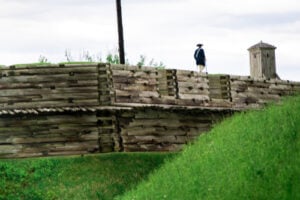
A Revolutionary War interpreter stands on the battlements of Fort Stanwix in Rome, New York, where Peter Gansevoort commanded the American defense during the British siege of 1777. Photo: Scott Chimber Photography / Shutterstock.com.
The history of Upstate New York is filled with reminders of the wars that shaped America. The forts along the Mohawk River, the defenses near Lake Ontario, the military communities of the Hudson Valley, and the monuments in cities such as Albany and Buffalo all tell parts of that story. What fascinates me is how many of the people associated with those national events actually came from towns and neighborhoods across New York State. Some became famous generals. Others earned recognition because of what they did at a single, terrifying moment in battle.
This is not a list of military officers who happened to pass through New York. A military commander could win an important battle in Plattsburgh, spend years at West Point, or train at Fort Drum without being from Upstate New York. For this article, the connection must be more substantial: birth, upbringing, or a genuine home in the region. Where someone was born elsewhere but made Upstate New York a longtime home, that distinction is explained rather than hidden.
The names also represent different kinds of service. Philip Schuyler and Nicholas Herkimer were involved in the Revolutionary War in their own backyard. Civil War commanders from small New York towns helped shape campaigns fought hundreds of miles from home. A surgeon from Oswego cared for wounded soldiers despite the obstacles placed before women in nineteenth-century medicine. Later generations included men who received the Medal of Honor in France, the Pacific, and Vietnam. These stories cannot all be judged by the same measure of rank, battlefield command, or personal sacrifice.
Their careers deserve historical context as well as recognition. Some officers took part in military operations whose consequences for Native communities were devastating. Other soldiers faced discrimination within the very armed forces they served. Acknowledging those realities does not diminish documented acts of courage; it gives readers a more complete picture of the people and periods involved. The following 25 military figures have verified Upstate New York connections, spanning the eighteenth century through the Vietnam War.
1. Philip Schuyler
Upstate New York connection: Albany, Albany County — born and raised. Military era: French and Indian War and American Revolution.
Philip Schuyler was born in Albany in 1733, into a prosperous Dutch-descended family whose interests included large landholdings in the Hudson Valley. He had military experience with provincial forces during the French and Indian War before becoming a major general in the Continental Army. During the Revolution, his knowledge of the northern waterways and supply routes made him a major figure in planning the defense of New York against invasions from Canada.
Schuyler’s reputation suffered after the Americans abandoned Fort Ticonderoga in 1777, and Horatio Gates replaced him before the decisive Saratoga battles. Even so, preparations, delays, and logistical work under Schuyler helped build the resistance Burgoyne later faced. He subsequently served in national politics. His story also has a more difficult dimension: the Schuyler family’s wealth depended in part on enslaved labor. Recognizing that history alongside his military service provides a fuller account of an influential Albany family.
2. Nicholas Herkimer
Upstate New York connection: German Flatts, present-day Herkimer County — born and lived in the Mohawk Valley. Military era: American Revolution.
Nicholas Herkimer belonged to the Mohawk Valley’s Palatine German community. Born in German Flatts around 1728, he became a farmer, businessman, and militia leader in the region where his family had established roots. By 1777, as British forces threatened the valley from the west, he commanded Tryon County militia and set out to relieve the American garrison besieged at Fort Stanwix.
On August 6, his men encountered an ambush near Oriskany involving Loyalist troops and British-allied Native warriors. The fighting was devastating and divided families and Indigenous communities already drawn into the Revolution on opposing sides. Herkimer suffered a serious leg wound yet remained with his men during the battle; he died days later. The famous image of him directing the defense beneath a tree became a symbol of local resistance. Oriskany was not a simple, decisive battlefield victory, but the western British expedition ultimately failed to reach Albany.
3. Peter Gansevoort
Upstate New York connection: Albany, Albany County — born and raised. Military era: American Revolution.
Peter Gansevoort was born in Albany in 1749 and came from a prominent merchant family with deep ties to the city. He entered military service before the Revolution and became colonel of the 3rd New York Regiment in the Continental Army. In the spring of 1777, his regiment moved to Fort Schuyler, better known today as Fort Stanwix, at present-day Rome.
The fort was besieged in August by an expedition led by Barry St. Leger. Gansevoort refused demands to surrender, and the defenders endured roughly three weeks before the besiegers withdrew. That resistance helped frustrate the British plan to approach Albany from the Mohawk Valley while Burgoyne advanced from the north. Gansevoort later took part in the Sullivan–Clinton campaign against the Haudenosaunee, an operation that destroyed Native villages and food supplies. His record therefore belongs both to military history and to the larger, often painful history of New York’s frontier.
4. James Clinton
Upstate New York connection: Little Britain, Orange County — born and raised. Military era: French and Indian War and American Revolution.
James Clinton was born in 1736 at Little Britain in what is now Orange County. His family’s home stood in a region deeply connected with the Hudson River and the military routes between the coast and the interior. Clinton gained experience in the French and Indian War, then became a general in the Continental Army during the struggle for independence. Unlike commanders remembered only for a single battle, his service extended across several years and theaters of war.
Clinton helped defend the Hudson Highlands when British troops advanced against the forts guarding the river in 1777. In 1779 he joined John Sullivan in an expedition against British-allied Haudenosaunee communities in western New York. The campaign damaged those nations’ settlements and food sources, a consequence that should be described plainly rather than celebrated without context. Clinton later returned to public life in New York. He was also the father of DeWitt Clinton, whose name became closely associated with the Erie Canal.
5. Jacob Brown
Upstate New York connection: Brownville, Jefferson County — longtime settler and militia leader; born in Pennsylvania. Military era: War of 1812.
Jacob Brown did not begin life in Upstate New York. Born in Pennsylvania in 1775, he moved north in the 1790s and became a pioneer settler in Jefferson County, giving his name to Brownville near the eastern end of Lake Ontario. His life there and his service in the New York militia make the North Country connection substantial, rather than an incidental military posting.
When the War of 1812 brought fighting to the Canadian border, Brown proved an energetic commander. He helped defend Sackets Harbor in 1813 and later commanded American forces in the Niagara campaign, including the Battle of Chippawa. Lundy’s Lane, another battle of that campaign, was fiercely contested rather than a straightforward American victory. Brown became commanding general of the U.S. Army after the war and pursued military improvements. His career links the settlement of northern New York to the early development of the regular American army.
6. John E. Wool
Upstate New York connection: Newburgh, Orange County, and Troy, Rensselaer County — born in Newburgh, raised in Troy. Military era: War of 1812, Mexican-American War, and Civil War.
John Ellis Wool was born in Newburgh in 1784 and moved to Troy after losing his parents. He began working at a young age and had little formal education, yet built one of the longest careers of any nineteenth-century American general. He entered the Army during the War of 1812, later became an inspector general, and spent years examining the training and readiness of troops.
Wool held important responsibilities in the Mexican-American War and was already an elderly officer when the Civil War began. His Union command at Fort Monroe in Virginia helped preserve an essential Federal stronghold. But his career cannot be described solely as a sequence of heroic battles. In the 1830s he was involved in preparations for the forced removal of Cherokee people from their homeland. Wool’s military experience shows both the changing responsibilities of the Army and the difficult moral legacies of national expansion.
7. James S. Wadsworth
Upstate New York connection: Geneseo, Livingston County — born and lived in the Genesee Valley. Military era: American Civil War.
James Samuel Wadsworth was born in Geneseo in 1807 into a family whose large estate shaped much of the Genesee Valley’s early development. He was an educated landowner, reformer, and political figure with the means to remain outside military service. Instead, when the Civil War began, he offered his resources and leadership to the Union cause despite being older than many new officers.
Wadsworth eventually commanded a division in the Army of the Potomac. On July 1, 1863, his troops fought in the hard opening phase of Gettysburg as Union units resisted a larger Confederate advance north and west of town. The following year he was mortally wounded during fighting in the Wilderness campaign. His military career lasted only a few years, but his death was keenly felt in Geneseo, where the Wadsworth name remains part of local history.
8. Elmer E. Ellsworth
Upstate New York connection: Malta, Saratoga County — born in the town of Malta. Military era: American Civil War.
Elmer Ephraim Ellsworth was born in Malta in 1837 and developed an early fascination with military drill and organization. Before the Civil War he became known for leading Zouave-style drill companies, whose elaborate movements attracted public interest. He also formed a close relationship with Abraham Lincoln and worked in Lincoln’s Springfield, Illinois, circle before the presidency.
When war began, Ellsworth organized New York volunteers popularly known as the Fire Zouaves. In May 1861, while Union troops occupied Alexandria, Virginia, he removed a Confederate flag from a hotel and was shot and killed by the proprietor. His death made him one of the first widely publicized Union officer casualties and provoked an outpouring of grief in the North. At just 24, Ellsworth had scarcely begun his wartime career. His place in history rests on the extraordinary symbolism of his death and the military enthusiasm he helped channel into service.
9. Abner Doubleday
Upstate New York connection: Ballston Spa, Saratoga County — born; later educated in Auburn and Cooperstown. Military era: Mexican-American War and American Civil War.
Abner Doubleday was born at Ballston Spa in 1819 and grew up with strong connections to central and eastern New York. After attending school in Auburn and Cooperstown, he entered the U.S. Military Academy at West Point and became an Army officer. His early service included the Mexican-American War, but his national reputation grew during the Civil War.
Doubleday was stationed at Fort Sumter when Confederate artillery opened fire in April 1861 and later became a general in the Union Army. At Gettysburg he briefly took command of the I Corps after the death of John Reynolds during the first day’s battle. His military record is substantial, but another claim often attached to him is not: historians do not credit Doubleday with inventing baseball. Separating that popular myth from his actual career makes the Saratoga County-born soldier more interesting, not less.
10. Daniel Butterfield
Upstate New York connection: Utica, Oneida County — born. Military era: American Civil War.
Daniel Adams Butterfield was born in Utica in 1831 and became a prominent Union general during the Civil War. He held field commands in the Army of the Potomac and received the Medal of Honor for his actions at Gaines’ Mill in June 1862, when he rallied troops under intense fire. Butterfield later served as chief of staff to General Joseph Hooker, putting him at the center of Army administration as well as combat operations.
He is also associated with the bugle call known as ‘Taps.’ While camped at Harrison’s Landing in Virginia in 1862, Butterfield worked with bugler Oliver Willcox Norton to revise an existing call. What began as an evening signal eventually became familiar at military funerals and memorial services. It would be inaccurate to describe Butterfield as simply having composed the entire melody alone. His story combines battlefield service with an unexpected contribution to the sound of American military remembrance.
11. Emory Upton
Upstate New York connection: Batavia, Genesee County — born. Military era: American Civil War.
Emory Upton was born in Batavia in 1839 and became one of the Union Army’s most notable younger officers. A West Point graduate, he showed an uncommon interest in how battlefield tactics might be improved. During the Civil War he commanded infantry, cavalry, and artillery forces, gaining experience in several of the Army’s major combat branches.
At Spotsylvania Court House in May 1864, Upton led an assault against entrenched Confederate defenses using a concentrated column designed to break through quickly rather than pause for prolonged firing. The attack initially succeeded but could not be adequately reinforced. Upton’s ideas helped influence later thinking about assaults and organization. After the war he studied foreign military systems and advocated professional reforms in the American Army. His writings were published after his death in 1881 and continued to influence military debate long beyond his life.
12. Henry Warner Slocum
Upstate New York connection: Delphi, Onondaga County — born. Military era: American Civil War.
Henry Warner Slocum was born in the hamlet of Delphi in Onondaga County in 1827. He graduated from West Point, briefly left the Army, and practiced law in Syracuse before returning to military service at the outbreak of the Civil War. His experience in western and central New York was not merely a passing connection; the region shaped his early life and professional development.
Slocum eventually rose to major general and commanded the Union XII Corps, whose defense of Culp’s Hill formed an important part of the Battle of Gettysburg. He later served in the western theater and commanded a wing of William T. Sherman’s forces during the campaigns toward Atlanta and through the Carolinas. Like other officers, his achievements belonged to larger armies and depended on countless soldiers. Still, the scale of his command made Slocum one of the most prominent Civil War military leaders born in central New York.
13. Gordon Granger
Upstate New York connection: Joy, Town of Sodus, Wayne County — born and raised. Military era: Mexican-American War, Civil War, and emancipation in Texas.
Gordon Granger was born in the Wayne County hamlet of Joy in 1821 and spent his early years in the Sodus area. He graduated from West Point, served during the Mexican-American War, and became a Union general in the Civil War. Among his wartime assignments was service at Chickamauga in 1863, where his forces helped reinforce Union troops during one of the war’s important western battles.
Granger’s name is remembered for an event after the Confederacy’s military collapse. On June 19, 1865, after arriving in Galveston, Texas, his command issued General Order No. 3 announcing freedom for enslaved people in Texas. The date became the foundation of Juneteenth commemorations. The order did not by itself end slavery everywhere in the United States, but its announcement carried enormous meaning to Texans who had remained enslaved despite the Emancipation Proclamation. That episode connects a Wayne County-born officer to a central chapter in the history of emancipation.
14. George H. Sharpe
Upstate New York connection: Kingston, Ulster County — born and raised. Military era: American Civil War and military intelligence.
George Henry Sharpe was born in Kingston in 1828. Trained as an attorney, he studied at Rutgers and Yale and worked abroad before the Civil War brought him back into military service. He helped raise the 120th New York Infantry, an Ulster County regiment, and then was called into a different assignment that would have a lasting effect on how American armies gathered information.
In 1863, Sharpe became head of the Army of the Potomac’s Bureau of Military Information. His staff collected reports from scouts, prisoners, deserters, newspapers, signals, and other sources, then tried to reconcile them into a reliable picture of Confederate strength. This work gave Union commanders better intelligence during the Gettysburg campaign and subsequent operations. A soldier did not have to lead a bayonet charge to make a major wartime contribution. Sharpe’s work from behind the lines makes him one of the important military innovators with roots in the Hudson Valley.
15. Benjamin F. Tracy
Upstate New York connection: Owego, Tioga County — born and began his career. Military era: American Civil War.
Benjamin Franklin Tracy was born in Owego in 1830 and became a lawyer before joining the Union Army. During the Civil War he served as colonel of the 109th New York Infantry. His actions at the Battle of the Wilderness in May 1864 later brought him the Medal of Honor: he seized the regimental colors when the line was under severe pressure and helped rally his men.
Tracy continued in public service after the war, including a term as U.S. secretary of the Navy from 1889 to 1893. His later work was connected with the expansion of a modern steel-hulled fleet and the changing position of the United States as a naval power. The combination of battlefield recognition and national office makes his career unusually broad. His Owego origins also provide a direct Southern Tier connection to the military history of both the Civil War and the early modern Navy.
16. Dr. Mary Edwards Walker
Upstate New York connection: Town of Oswego, Oswego County — born and raised. Military era: American Civil War, military medicine.
Mary Edwards Walker was born on a farm in the Town of Oswego in 1832 and grew up in a family that encouraged education and challenged conventional expectations for women. She studied medicine in Syracuse at a time when women physicians faced considerable opposition. When the Civil War began, Walker volunteered to care for wounded soldiers and persisted in seeking work as a surgeon despite restrictions on women’s roles.
She served as a contract acting assistant surgeon associated with Union forces, worked near battlefields, and was held for months as a Confederate prisoner in 1864. In 1865 she received the Medal of Honor, becoming the first and, to date, only woman to receive it. Because she had served as a civilian contract surgeon, her award was removed from the roll during a later review and restored in 1977. Walker’s military service was medical, not combat command, but that is precisely why she belongs in a broader history of courage and sacrifice.
17. William T. Sampson
Upstate New York connection: Palmyra, Wayne County — born and educated locally. Military era: American Civil War and Spanish-American War.
William Thomas Sampson was born in Palmyra in 1840 and studied locally before winning an appointment to the U.S. Naval Academy. He finished first in his class in 1861, just as the Civil War began, and served in the Navy through decades of rapid changes in shipbuilding, weapons, and naval organization. He survived the sinking of the monitor USS Patapsco during the Civil War.
Sampson later became superintendent of the Naval Academy and commander of the North Atlantic Squadron during the Spanish-American War. His fleet maintained the blockade of Santiago de Cuba, where the Spanish squadron was destroyed in July 1898. Credit for that victory became controversial because Sampson’s flagship was absent from the immediate fighting and Commodore Winfield Scott Schley commanded the ships engaged. Sampson’s naval planning and senior command remain important, but the actual battle should not be credited to him alone. His life reflects both the possibilities and tensions of America’s emerging naval power.
18. William ‘Wild Bill’ Donovan
Upstate New York connection: Buffalo, Erie County — born and raised. Military era: World War I and World War II intelligence.
William Joseph Donovan was born in Buffalo in 1883 and went from local schools and college studies into law and military service. He commanded soldiers in the 165th Infantry of the 42nd Division during World War I, gaining a reputation for remaining close to troops under fire. His courage near Landres-et-St. Georges, France, in October 1918 earned him the Medal of Honor.
Donovan’s best-known later work came in World War II, when he led the Office of Strategic Services, the wartime intelligence agency that preceded the Central Intelligence Agency. The OSS gathered intelligence and conducted operations across several theaters of war. Donovan did not personally create modern American intelligence on his own, but he became one of the most influential architects of its wartime organization. His path from Buffalo to the battlefields of France and the intelligence offices of Washington is among the widest-ranging careers on this list.
19. Henry Johnson
Upstate New York connection: Albany, Albany County — longtime prewar resident; born in North Carolina. Military era: World War I.
Henry Johnson was born in North Carolina and moved to Albany as a young man. He held a series of jobs, including work as a porter at Albany’s Union Station, before enlisting in a New York National Guard regiment. That unit became the 369th Infantry, remembered as the Harlem Hellfighters, whose Black soldiers served in combat under French command during World War I because of discrimination within the segregated American Army.
In May 1918, Johnson and fellow soldier Needham Roberts were attacked while on sentry duty in France. Although wounded, Johnson fought off the raiders and prevented the capture of Roberts. He received a French decoration for his bravery, but meaningful American recognition came much later: the Medal of Honor was awarded posthumously in 2015. His Albany story is inseparable from both his battlefield actions and the racial barriers that shaped how Black soldiers’ service was recognized in their lifetimes.
20. Matt Urban
Upstate New York connection: Buffalo, Erie County — born. Military era: World War II.
Matt Urban was born in Buffalo in 1919 and became an Army officer during World War II. Serving with the 9th Infantry Division, he fought in North Africa and Europe, where he repeatedly placed himself in danger while directing and supporting his men. He was wounded several times and returned to action when many others would have been unable to continue.
Urban’s Medal of Honor recognized a series of actions in France and Belgium during the 1944 campaign, including taking an antitank weapon forward to disable enemy vehicles and helping restore the momentum of attacks stalled by heavy fire. He received the decoration decades after the war, in 1980. His record is frequently cited in accounts of the most decorated American combat veterans. The Buffalo connection is documented by his birth, but the significance of his story is the sustained personal leadership described in official citations.
21. Francis S. Currey
Upstate New York connection: Loch Sheldrake and Hurleyville, Sullivan County — born and raised. Military era: World War II.
Francis Sherman Currey was born at Loch Sheldrake in Sullivan County in 1925 and entered the Army during World War II. His early years in the Catskills were far removed from the freezing fighting in Belgium that later brought him national recognition. He served in the 30th Infantry Division during the Battle of the Bulge, when German forces launched a major offensive through the Ardennes.
On December 21, 1944, near Malmedy, Currey used multiple weapons against advancing German forces and helped rescue fellow soldiers while his position was under attack. His actions contributed to stopping an armored thrust threatening his unit. For that service he received the Medal of Honor. Currey eventually returned to New York and remained active in veterans’ remembrance. He offers a powerful example of how someone from a small Upstate community could find himself at the center of a critical episode in an international war.
22. John Basilone
Upstate New York connection: Buffalo, Erie County — born; raised primarily in New Jersey. Military era: World War II, U.S. Marine Corps.
John Basilone was born in Buffalo in 1916, but his family moved to Raritan, New Jersey, when he was young. New Jersey was his childhood home, and Buffalo should be identified as his birthplace rather than the city where he grew up. He served in the Army before joining the Marine Corps and ultimately became one of the most recognized enlisted Marines of World War II.
During the Guadalcanal campaign in October 1942, Basilone helped maintain machine-gun defenses through a determined Japanese attack, actions for which he received the Medal of Honor. After returning home to public acclaim, he sought further combat service. He was killed during the invasion of Iwo Jima in February 1945 and received the Navy Cross posthumously. His example connects a Buffalo birth record to a national story of endurance, public recognition, and a voluntary return to danger.
23. Thomas A. Baker Jr.
Upstate New York connection: Troy, Rensselaer County — born and raised. Military era: World War II, Battle of Saipan.
Thomas Alexander Baker Jr. was born in Troy in 1916 and entered the New York National Guard before serving overseas during World War II. He belonged to the 105th Infantry Regiment of the 27th Infantry Division, a unit with deep connections to New York State. In the summer of 1944, its soldiers fought on Saipan in the Mariana Islands against heavily defended Japanese positions.
Baker repeatedly advanced against strongpoints under fire and helped protect fellow soldiers during the fighting. When he was badly wounded during a major Japanese counterattack, he refused to let others risk their lives carrying him farther to safety. He was found dead after the battle, having continued to resist the attack. His Medal of Honor was awarded posthumously. The United States Army has also preserved his memory at Fort Drum, linking a man from Troy to the modern military presence in the North Country.
24. William J. O’Brien
Upstate New York connection: Troy, Rensselaer County — born and raised. Military era: World War II, Battle of Saipan.
William Joseph O’Brien was born in Troy in 1899 and had spent much of his adult life in military service before World War II. Like Thomas Baker, he served in the 105th Infantry Regiment of the 27th Infantry Division, but as a lieutenant colonel commanding a battalion. His experience and leadership placed him in the middle of the fierce fighting for Saipan in June and July 1944.
O’Brien repeatedly exposed himself to enemy fire to direct tanks and rally his troops. During a massive counterattack on July 7, he continued leading his men and was killed in action. The Medal of Honor recognized the example he set while trying to hold the position. The presence of two Troy men in the same New York National Guard regiment, both later receiving posthumous Medals of Honor for actions on Saipan, is one of the most striking local connections in this collection.
25. Gary B. Beikirch
Upstate New York connection: Rochester, Monroe County — born; later lived in the Rochester area. Military era: Vietnam War.
Gary Burnell Beikirch was born in Rochester in 1947 and entered the U.S. Army during the Vietnam War. He served as a Special Forces medic, a role in which emergency care often had to be delivered under combat conditions far from a conventional hospital. On April 1, 1970, he was working at a camp in Kontum Province, South Vietnam, when it came under heavy attack.
Beikirch repeatedly exposed himself to enemy fire to treat and move wounded personnel even after being seriously wounded himself. His actions earned him the Medal of Honor, presented in 1973. Following the war, he struggled with the effects of his injuries but eventually devoted much of his life to counseling and supporting others, including veterans and young people. He died in Greece, New York, in 2021. His career closes this list with a different kind of reminder: military service can continue to shape a person’s life long after the fighting ends.
The Military History Found Across Upstate New York
These men and women did not all serve in the same wars, rise to the same ranks, or come from the same kind of New York community. Some were born in Albany or Buffalo; others came from places such as Geneseo, Owego, Loch Sheldrake, and the villages of the Mohawk Valley. A few, including Jacob Brown and Henry Johnson, were born elsewhere but developed meaningful personal and professional ties to Upstate New York before their best-known service. John Basilone represents the opposite situation: born in Buffalo, he grew up mainly in another state.
What unites these stories is not a claim that New York alone produced the people who fought America’s wars. It is the more personal and historically grounded observation that nationally important military lives emerged from communities across the state. To remember their achievements responsibly is to recognize courage without overlooking the costs of war, the civilians affected by campaigns, and the contributions of people whose service was long undervalued.
For more New York history connected to war and the people who shaped the state, explore the history of the Battle of Plattsburgh, the MacDonough Monument in Plattsburgh, Revolutionary history at the Odell House and 25 Famous People From Upstate New York.