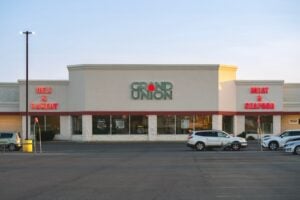
Grand Union supermarket in Rome, New York, photographed July 23, 2025. Photo: Mahmoud Suhail / Shutterstock.com.
For generations of New Yorkers, the Grand Union sign meant something familiar. Whether the store stood in a Hudson Valley shopping center, a village in the Adirondacks, or a busy suburban neighborhood, it was the place families went for the week’s groceries, a forgotten ingredient, or a quick stop on the way home. The chain became such a regular part of life across New York and the Northeast that many shoppers could scarcely imagine their communities without it.
Grand Union was once among the nation’s major grocery chains, with roots stretching all the way back to the nineteenth century. It began as a small tea and coffee business in Scranton, Pennsylvania, and developed into an enormous retail organization. The red-and-white Grand Union identity eventually became particularly familiar in New York, New Jersey, Vermont, and neighboring states.
So whatever happened to Grand Union Supermarkets? The original company collapsed after three Chapter 11 bankruptcy filings in 1995, 1998, and 2000. Most of its stores were sold in 2001, and the smaller chain that continued under the Grand Union name was acquired by Tops in 2012. But that wasn’t the end of the story. The brand returned in 2022 when C&S Wholesale Grocers reopened a group of former Tops stores as Grand Union supermarkets.
Even that unexpected comeback has faced difficulties. Stores that reopened only a few years ago have since closed, including locations in Upstate New York. Yet Grand Union has not disappeared completely. As of October 2026, its official website still lists supermarkets in Peru and Saranac Lake, New York, and Rutland, Vermont. To understand how a name that dates back to 1872 could vanish and then return, it helps to start with the brothers who built the original business.
The Jones Brothers and the Birth of Grand Union
Grand Union’s history begins in Scranton, Pennsylvania, in September 1872. Cyrus D. Jones and his brothers developed a business selling tea, coffee, spices, and other household necessities, initially through direct selling and small retail outlets. It was an era when families did not shop in supermarkets as we know them today. Groceries were purchased at neighborhood shops, from specialty merchants, and through delivery routes that brought products directly to customers.
The enterprise became known as the Jones Brothers Tea Company and the Grand Union Tea Company as it expanded. Historical accounts identify Cyrus and his brothers Frank and Charles with its early development. The business did not begin with a modern supermarket, nor is there reliable evidence for the promotional phrase sometimes offered as the supposed origin of the Grand Union name. What the records do show is a growing organization that used centrally purchased merchandise, multiple outlets, and home delivery to reach customers in many communities.
By 1912, Grand Union had approximately 200 retail outlets. Its Brooklyn headquarters and warehouse helped support a business that was already operating across state lines. The company bought other chains during the 1920s, extending its reach still further. In 1931, company histories place the total at more than 700 stores, although these were generally much smaller grocery shops than the supermarkets that would later carry the Grand Union name.
That distinction matters. A chain with hundreds of little stores in 1931 was not the same kind of operation as a chain with several hundred full-sized supermarkets in the 1970s. Grand Union’s remarkable longevity came partly from its willingness to change the size and character of the stores themselves.
How Grand Union Became a Supermarket Giant
During the 1930s and 1940s, the American grocery business was transformed by the supermarket. Instead of visiting different counters or neighborhood shops for meat, produce, dairy products, and dry groceries, customers could buy much of their food under one roof. Self-service shopping, shopping carts, larger floor plans, and eventually ample parking became central features of the experience.
Grand Union embraced the change. Under president Lansing P. Shield in the 1940s, the chain pursued larger supermarkets and worked on making their layouts approachable to shoppers accustomed to smaller stores. The number of locations declined from the heights of the early 1930s as small shops were consolidated or replaced, but the larger stores could generate much greater sales.
For New York shoppers, this was the Grand Union that became part of everyday life. The company operated in the New York metropolitan area, the Hudson Valley, and Upstate communities, while also building a major presence in Vermont, New Jersey, and other Northeastern markets. By the late twentieth century, its supermarkets ranged from modest local stores to much larger modern facilities, reflecting the different kinds of communities they served.
Grand Union was more than a place to buy packaged groceries. Like other established supermarket chains, it developed fresh-food departments, store brands, and services intended to make it a reliable neighborhood destination. The details varied by location and era, but the larger story was one of a regional business adapting to how American families shopped.
Grand Way: When Grand Union Tried Discount Department Stores
Grand Union also experimented with a business that went beyond conventional groceries. In 1956, it opened a general-merchandise discount store called Grand Way in Keansburg, New Jersey. A second followed in Albany, New York. By 1962, the company was operating 21 Grand Way discount stores, hoping to capture shoppers interested in clothing and household merchandise at competitive prices.
The Grand Way experiment deserves attention because it shows that Grand Union understood the growing importance of suburban discount retailing. It was not simply a supermarket company that failed to notice the arrival of larger general-merchandise competitors. Management actively tried to participate in that market, sometimes pairing food retailing with broader merchandise concepts.
Grand Way should not, however, be described as one uniform modern hypermarket format in which every store combined a full supermarket and a discount department store. It was a related discount-store venture, and Grand Union experimented separately with larger superstores carrying groceries and other merchandise. By the early 1970s, the company was finding that some of those ventures were less profitable than hoped and began withdrawing from parts of the business.
Grand Union’s willingness to experiment made it an innovative retailer, but innovation did not guarantee success. Its attempts to operate multiple retail formats would become part of a much more complicated corporate story.
The Goldsmith Years and a Changing Supermarket Business
In 1973, Grand Union came under the control of Cavenham Ltd., the British conglomerate associated with financier Sir James Goldsmith. The new ownership reorganized operations and emphasized low prices, while the company continued to grow through acquisitions and changes in its supermarket formats. Grand Union was no longer merely the family-rooted tea business established a century earlier. It had become a large corporation whose fortunes depended on investors, financing decisions, and competition across several regions.
The company expanded outside its strongest Northeastern markets as well. It acquired southern supermarket businesses, including Colonial Stores and the Big Star name, and developed interests in Texas. But a chain operating very different markets faced difficult decisions about store sizes, merchandise, prices, and regional customer expectations. Stores that worked in one area did not necessarily perform the same way somewhere else.
In the 1980s, Grand Union struggled with declining performance in several markets and sold or closed substantial parts of its broader business. The familiar supermarkets in New York and New England remained important, but they were now part of a company trying to repair its finances and adjust to a changing grocery industry.
That industry was becoming increasingly demanding. Supermarket operators needed capital for renovations, refrigeration, distribution, technology, and new stores. A strong name and loyal customers could help, but they did not eliminate the cost of keeping an aging store network competitive.
The $1.2 Billion Buyout and Grand Union’s Debt Problems
In April 1989, an investor group led by Salomon Brothers and Miller Tabak Hirsch & Company announced an agreement to acquire Grand Union in a transaction valued at about $1.2 billion, including debt and other obligations. At that time, contemporary reporting described a business with more than 300 supermarkets operating under the Grand Union and Big Star names.
The takeover added to the financial pressures facing the chain. The deal relied on substantial borrowing, leaving the company with obligations that consumed money it could otherwise have directed toward stores, customer service, or expansion. Management continued trying to improve the business, but heavy debt made it much harder to respond to setbacks.
Grand Union also faced increasingly formidable competition. Other supermarket groups modernized, consolidated, and pursued larger purchasing networks. Warehouse clubs and discount retailers were changing consumer expectations, and later the growth of supercenter grocery departments created another challenge. It would be inaccurate to blame the company’s entire collapse on Walmart alone, or to pretend debt was the only problem. Grand Union’s difficulties developed through a combination of financing, operating performance, acquisitions, and competitive change.
As losses mounted during the early 1990s, the company sold more stores and businesses. In 1993, it arranged the sale of most of its remaining Big Star supermarkets to A&P. Grand Union increasingly concentrated on its Northeastern namesake stores, but the debt burden remained.
Grand Union Filed for Bankruptcy Three Times
Grand Union’s financial crisis did not involve just one bankruptcy. Federal court records document three separate Chapter 11 filings by the original company: January 25, 1995; June 24, 1998; and October 3, 2000. Those dates are essential to understanding what happened because the chain survived the first two reorganizations before the final bankruptcy led to the sale of its remaining business.
In 1995, the company entered Chapter 11 with a restructuring plan intended to reduce its debt. It emerged later that year, operating a smaller network of supermarkets. The bankruptcy had been serious, but it did not immediately end the business or remove the Grand Union signs from New York shopping centers.
A second Chapter 11 case followed in June 1998. That filing was also organized around a financial restructuring, and Grand Union emerged in August with management talking about renovation, better technology, and renewed growth. But the underlying challenge remained: the company needed customers and profits from its stores, not just a less burdensome balance sheet.
The third Chapter 11 filing came on October 3, 2000. This time, the outcome was different. The remaining assets were sold in a process overseen by the bankruptcy court, and the original Grand Union Company did not emerge as an independent supermarket operator. Although the last major disposals occurred in 2001, describing this as a separate Chapter 7 filing in 2001 would be historically incorrect.
What Happened to the Grand Union Stores in 2001?
C&S Wholesale Grocers, a major food distributor based in New Hampshire, became central to the sale of the bankrupt chain. Through a group of purchasers and related arrangements, C&S acquired rights to stores and assets that had belonged to Grand Union. But it did not keep every location and reopen them all as a new, unified supermarket chain.
Instead, many stores were sold to established competitors. Ahold, which then owned Tops and Stop & Shop, received approval in February 2001 to buy 56 Grand Union supermarkets and eight development sites. Of those stores, 36 were intended for Stop & Shop and 20 for Tops. Other locations went to companies such as Price Chopper, Hannaford, and Shaw’s, while some stores were closed.
For customers, the result varied by town. A familiar grocery store might continue operating under a new sign. In another community, the supermarket might disappear altogether. Even where people could still buy groceries in the same building, the chain they had known had changed ownership and identity.
C&S did continue operating a smaller group of stores under the Grand Union name, often serving communities where a modest local supermarket could be useful. The Grand Union Family Markets name appeared during this period. That survival explains why some Upstate New Yorkers continued shopping at Grand Union well after the original national company had collapsed.
The 2012 Tops Purchase and the End of the Old Grand Union Name
In 2012, Tops Friendly Markets acquired 21 remaining Grand Union supermarkets in eastern Upstate New York and Vermont from C&S-related businesses. The purchase was part of Tops’ broader effort to strengthen its regional footprint, especially in smaller communities where supermarkets had long served local residents.
The changeover did not happen overnight. At first, the acquired stores could continue operating under their existing name while plans were made. During 2013, the stores were converted to the Tops banner. For shoppers who had associated Grand Union with several generations of family shopping, that was the moment when the historic name seemed to disappear for good.
There was an important corporate distinction, however. The original Grand Union supermarket corporation had already ceased operating as an independent chain. C&S still controlled rights associated with the Grand Union brand. Those rights would make an unexpected comeback possible years later.
Grand Union Returns to Upstate New York in 2022
The return of Grand Union came about through a merger involving two other familiar Upstate supermarket names. When Price Chopper/Market 32 and Tops planned to combine, the Federal Trade Commission raised concerns about the loss of supermarket competition in several local markets. In November 2021, regulators required the sale of 12 Tops stores in communities across New York and Vermont.
C&S Wholesale Grocers agreed to acquire the stores and bring back the Grand Union name. Its announcement identified locations in Cooperstown, Cortland, Norwich, Owego, Peru, Rome, Saranac Lake, Sherrill, Warrensburg, two Watertown-area sites, and Rutland, Vermont. The stores reopened under the revived branding in 2022, operated through a C&S affiliate called GU Markets LLC. The revival involved a small group of existing grocery stores, not the resurrection of the former nationwide Grand Union corporation.
For customers who remembered the old chain, seeing the name again was striking. The return also had a practical purpose: the divested locations needed an operator separate from the merged Price Chopper and Tops business. C&S already owned the Grand Union name and had the wholesale distribution capabilities to supply the stores.
The new stores were promoted as neighborhood markets with national brands, private-label products, and assortments selected for local customers. Whether a familiar name would be enough to keep those locations competitive was a different question, especially in small towns where grocery margins can be difficult and a closing store may leave residents with a longer journey for food.
Why Are Some of the Revived Grand Union Stores Closing?
The 2022 revival proved much smaller and less durable than Grand Union’s history might have suggested. The Owego store, which reopened under the revived banner in January 2022, closed in March 2025. In early 2026, other locations were slated to close, including Warrensburg, Rome, Norwich, Cooperstown, and a Watertown-area supermarket in the Town of Pamelia.
The local effects could be serious. In Warrensburg, community officials discussed how losing a centrally located supermarket would affect residents, particularly people who walked to the store or depended on nearby services. Similar concerns appeared in Cortland, where city officials considered the needs of shoppers who might have difficulty reaching other supermarkets.
In September 2026, C&S confirmed that its Cortland store was scheduled to close; local reporting identified December 5 as the planned final day. There were also reports that the Sherrill store was preparing to close, although those reports did not establish a firm final date. The company cited store performance and market conditions in its statement about Cortland. Those explanations should not be turned into unsupported claims that every location closed for precisely the same reason.
As of October 2026, the official Grand Union store locator lists Peru and Saranac Lake in New York and Rutland in Vermont. The Cortland closing announcement concerns a future date, and reports about other stores may not be reflected at the same moment on the website. For that reason, a precise claim about the total number of stores still trading on a particular day needs care. The supported conclusion is that the revived chain has been sharply reduced but that Grand Union still has a presence in the Northeast.
Why New Yorkers Remember Grand Union Supermarkets
Grand Union’s importance to New York supermarket history cannot be measured only through store counts or bankruptcy filings. For people who grew up shopping there, the name belongs to ordinary routines: a weekly trip with a parent, a stop after work, or the grocery store everyone in town knew. The experience was not necessarily glamorous, and that was part of its significance. Grand Union was woven into the everyday life of neighborhoods and small communities.
The chain also illustrates the transformation of American grocery retailing across more than 150 years. It began when merchants delivered tea and coffee to customers, became a network of small grocery shops, moved into modern supermarkets, experimented with discount department stores, and then struggled in an industry increasingly dominated by larger and better-financed competitors.
The most unusual chapter is the one still unfolding. Most lost supermarket names never come back. Grand Union returned because a wholesaler still controlled the brand and a federal competition settlement created an opportunity to operate stores under it. The recent closures show that an old name alone cannot guarantee a supermarket’s future, but they do not erase the history that made the name worth reviving.
Whatever Happened to Grand Union Supermarkets?
The original Grand Union Company, whose roots dated to Scranton in 1872, went through three Chapter 11 bankruptcies between 1995 and 2000. Its stores were largely sold to competitors in 2001. A smaller group continued under the Grand Union name until Tops bought the remaining 21 supermarkets in 2012 and converted them in 2013. C&S Wholesale Grocers revived the name in 2022 on a new group of former Tops stores, several of which have since closed.
Grand Union is therefore not simply another vanished supermarket. The national chain that generations knew is gone, but the name lives on in a reduced group of markets. The distinction matters, especially to New Yorkers who remember when the red Grand Union sign appeared across so many shopping centers. The story began with a tea business, passed through the age of the supermarket, and now has a small but remarkable second life.
For more New York supermarket history, read our articles on 25 Lost Supermarkets Upstate New Yorkers Still Miss, The Ultimate List of New York Supermarkets Past and Present, A&P Supermarket History and Memories, and The History of Pathmark Supermarkets.
Sources
International Directory of Company Histories: The Grand Union Company
Groceteria: Grand Union — Historical Store Research
Florida–UCLA Bankruptcy Research Database: Grand Union, 1995 Case
Florida–UCLA Bankruptcy Research Database: Grand Union, 1998 Case
Florida–UCLA Bankruptcy Research Database: Grand Union, 2000 Case
Ahold: Acquisition of 56 Grand Union Supermarkets, February 2001
Times Union: Tops Plans to Buy 21 Grand Unions, July 2012
Federal Trade Commission: Final Order Requiring Sale of 12 Tops Markets, January 2022
C&S Wholesale Grocers: Grand Union Revival Announcement
Owego Pennysaver: Grand Union Closes Its Doors, March 2025
Glens Falls Chronicle: Warrensburg Grand Union Closing, January 2026