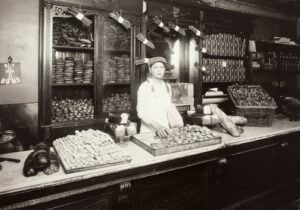
An eleven-year-old bakery worker stands behind a counter filled with breads and pastries in 1910. The bakery’s location is unknown. Photograph by Lewis Wickes Hine, via Rawpixel.com / Shutterstock.com.
There was a time when the smell of fresh bread was part of the morning in many Upstate New York neighborhoods. Before every supermarket had an expansive bakery department and before bread traveled long distances through national distribution systems, towns and cities depended on their own bakers. Some worked behind small storefront counters, while others employed entire shifts in plants that filled the surrounding blocks with the aroma of dough rising in the ovens.
Buffalo had Polish bakeries serving the families around the Broadway Market and industrial bread factories producing thousands of loaves a day. Rochester shoppers could buy elaborate cakes from department stores as well as neighborhood shops. In the Southern Tier, bakery delivery trucks carried Italian bread and familiar boxed treats into local groceries. Across the Hudson Valley and Capital Region, stopping for a loaf, a pastry or a birthday cake was part of an ordinary shopping trip.
Those memories have a way of lasting long after the businesses close. A particular seeded rye bread might be impossible to duplicate. A family might still talk about a bakery’s rolls at Thanksgiving or the cake they ordered for every birthday. And in places where the ovens operated on an industrial scale, the loss also meant jobs and a familiar part of the neighborhood’s identity disappearing.
These 25 stories span more than a century of Upstate baking, from long-vanished commercial bread companies to neighborhood shops that closed as recently as 2026. A few entries concern the loss of a particular retail location while the bakery’s products continue elsewhere. We make those distinctions clearly, because closing a beloved storefront is not the same thing as losing a brand altogether.
1. Kaufman’s Bakery — Buffalo
Kaufman’s was one of those Buffalo names that seemed to belong as much to the city as to the company that carried it. Its seeded rye bread, rolls and other baked goods were familiar throughout Western New York. The bakery’s advertising featured an animated little baker, a character that helped turn an everyday loaf of bread into something people recognized immediately in local stores and on television.
Sam Freedman purchased the operation in 1937, and the business grew during the decades when neighborhood groceries and restaurants depended on reliable local bread suppliers. After expanding from its East Ferry Street location, Kaufman’s moved in 1968 into the former Hall’s Bakery building on Fillmore Avenue near Main Street. The larger plant put production on a scale far beyond that of a small retail shop.
When Kaufman’s closed in 2004, Buffalo lost both a familiar brand and an operating bakery whose ovens had been part of the daily life of the surrounding neighborhood. Residents remembered the bread itself, but also the aroma that had drifted through the streets around Fillmore Avenue. The closure left a particularly noticeable gap in the city’s longstanding rye-bread tradition.
2. Burczynski Bakery — Buffalo
Buffalo’s Broadway-Fillmore neighborhood once supported a thriving collection of Polish bakeries, groceries, butcher shops and social institutions. Burczynski Bakery was among its best-known baking businesses. The family sold Polish breads and pastries in the neighborhood and at the Broadway Market, where shoppers came looking for foods associated with Easter, Christmas and ordinary family meals.
The family’s bakery building on Stanislaus Street dates to the early twentieth century and formed part of a distinctive commercial landscape shaped by Buffalo’s Polish-American community. Over time, Burczynski grew from a neighborhood enterprise into a regional operation with a network of retail outlets. Its history reflected the era when immigrant baking traditions could support substantial local businesses.
After approximately eight decades, Burczynski closed in 1983. Its disappearance was more than the loss of another place to buy bread: it marked the fading of a particular shopping culture built around the Broadway Market and nearby streets. The old bakery building remains part of the physical record of an industry that once defined much of the neighborhood.
3. D&L Bakery — Depew
For nearly a century, D&L Bakery served Depew and the greater Buffalo area. Established in 1926, the family business survived changes in shopping habits, competition from supermarkets and the enormous transformation of Western New York’s food industry. Its longevity made the shop a rare surviving connection to an earlier generation of neighborhood bakers.
Polish-American baking was central to its identity. Customers knew the business for traditional breads and pastries, especially the seasonal foods that families wanted to purchase from someone who understood the recipes and occasions behind them. Four generations of the family were involved during its long history, giving D&L a continuity that few small food businesses achieve.
The bakery completed its final full day of operation on July 25, 2025, just short of a hundred years after it opened. The family thanked customers for supporting four generations of their work. For people who had been stopping there since childhood, the closing meant losing not only a favorite bakery but also a place where the same traditions had been practiced for decades.
4. Wolter’s Bakery — Williamsville
Wolter’s Bakery began serving the Buffalo region in 1957 and became known for European-style pastries, breads and holiday specialties. Its shop at Georgetown Square on Sheridan Drive in Williamsville attracted customers looking for items that were not necessarily part of an ordinary supermarket bakery display.
The bakery was especially associated with seasonal treats, including paczki and other sweets that brought customers back at particular times of year. That calendar mattered. For a neighborhood bakery, Fat Tuesday and the Christmas season often produced lines of people buying things their families had enjoyed for years. Wolter’s built its reputation by maintaining those familiar foods.
In June 2025, the owners announced that the Sheridan Drive bakery would close after 68 years of business, with June 28 as its final day. The space was later associated with plans for a different Italian bakery concept, but that did not bring back the old Wolter’s counter. Its closing removed another longstanding name from Western New York’s baking landscape.
5. Chrusciki Bakery — Greater Buffalo
Chrusciki Bakery took its name from a traditional Polish fried pastry, often prepared in thin, twisted strips and dusted with powdered sugar. Over roughly four decades, the Western New York business became particularly associated with the holiday baking traditions of Buffalo’s Polish-American families. Its products were familiar to people who shopped at the Broadway Market as well as at later suburban locations.
The bakery’s history included expansions and changes in its retail footprint. After the Broadway Market era, its locations included the Eastern Hills Mall area and a shop in Depew associated with the Delavan Hotel. Each move reflected a familiar challenge for specialty food businesses: maintaining an established customer base as shopping patterns and operating costs changed.
In May 2026, Chrusciki announced that it would close its final retail bakery location on May 31. News of the decision brought an outpouring of memories from customers who associated the shop with family gatherings and Polish holiday tables. For those customers, buying chrusciki and other pastries was never merely another errand; it was part of a tradition handed down through generations.
6. Mazurek’s Bakery’s South Park Avenue Storefront — Buffalo
For generations, a visit to Mazurek’s on South Park Avenue was part of life in Buffalo’s Old First Ward and South Buffalo communities. The bakery’s breads, placek and Polish pastries carried traditions that were especially important to families celebrating religious holidays and neighborhood gatherings. The old storefront was a recognizable part of the local streetscape.
The business continued through changes in ownership, eventually coming under the umbrella of OLV Human Services. Its bakery operations became connected to vocational training, adding an educational purpose to the longstanding food business. The owners later determined that the South Park facility was no longer the best location for its wholesale work.
In 2025, the organization announced that the South Park retail storefront would close and production would move to an educational facility in Lackawanna. Importantly, Mazurek’s did not simply vanish: its products continued through wholesale channels and selected retail opportunities. What Buffalo lost was the experience of entering the longstanding South Park shop and buying the bread directly from that familiar counter.
7. Hall’s Bakery — Buffalo
Before Kaufman’s name became associated with the big baking plant on Fillmore Avenue, Hall’s Bakery occupied an important place in Buffalo’s commercial bread industry. The operation belonged to an earlier generation of businesses that had to bake in volume and distribute fresh bread through an extensive network of stores and delivery routes.
By the early twentieth century, the Fillmore Avenue location was already tied to bread production. Images and local histories describe the era of bread wagons and the large facilities required for commercial baking. Hall’s represented the shift from a modest neighborhood bakery to an industrial enterprise able to supply a growing city.
The Hall’s identity ultimately disappeared from the site, and Kaufman’s moved into the former Hall’s building in 1968. That change provides an unusual opportunity to see two generations of Buffalo baking history in one place. The same property became associated with another celebrated bakery, but Hall’s deserves to be remembered as a distinct business that came first.
8. Freihofer’s Bakery Outlets — Capital Region and Beyond
Freihofer’s developed a long relationship with the Capital Region after its bread operations expanded into Upstate New York in the early twentieth century. The company opened a large bakery in Troy in 1913, and the Freihofer name became familiar through bread, cookies and local advertising. Generations of children even watched Freddie Freihofer’s Breadtime Stories on television.
For many customers, the most personal connection came through the bakery outlet stores. Unlike a regular supermarket bread aisle, these shops offered the opportunity to purchase familiar bakery products at discounted prices. The outlets became useful stops for families shopping on a budget and for people who had made them part of their weekly routine.
On March 27, 2024, customers discovered that Freihofer’s outlets in the Albany area and other parts of New York had been permanently closed as part of a broader company decision. Freihofer’s products did not disappear from supermarkets, but the retail outlet tradition ended at those locations. It was the loss of a particular way of shopping, rather than the disappearance of the entire brand.
9. Spaulding Bakeries — Binghamton and the Southern Tier
Spaulding was once one of the most recognizable regional bakery names in the Southern Tier. Its delivery network reached communities beyond Binghamton, and the business operated bakeries in other New York cities, including Oneonta and Elmira. The company produced everyday bread alongside sweet baked goods that became especially memorable to children.
One of its best-remembered products was the powdered-sugar Kruller. Packaged in distinctive boxes, the little doughnuts were the kind of grocery-store treat people could recognize before even opening the package. Spaulding also sold Table Queen bread, reflecting how the same company could provide both the family’s sandwich loaf and an occasional sweet snack.
The disappearance of Spaulding’s bakeries and brands left a gap in a region that had long depended on locally manufactured food. Memories of the Krullers still come up whenever Southern Tier residents talk about vanished products. The company’s importance lay partly in its scale: it was a regional network of bakeries, not simply a single shop in Binghamton.
10. The Wonder Bread Factory — Buffalo
Buffalo’s Wonder Bread factory was an industrial landmark, not a small corner bakery. Its large complex on Fougeron Street stood near the city’s East Side neighborhoods and produced the kind of packaged bread that became a staple of twentieth-century American kitchens. For people living nearby, the factory’s most immediate presence was often the smell of bread baking.
The building’s history reached back to the Ward baking enterprise and the subsequent development of Continental Baking. Over the decades, the plant was associated with Wonder Bread and Hostess products. Its production required a substantial workforce and an industrial distribution system capable of sending bread and snack cakes across the region.
Interstate Bakeries announced that the Buffalo operation would close in October 2004. The decision ended commercial baking at a site that had supported such work for generations. The former factory remained a prominent reminder of Buffalo’s industrial food production, but the daily routines of the workers, delivery drivers and surrounding neighborhood were gone.
11. Naditz Bakery — Rochester
Rochester’s Joseph Avenue neighborhood once held an important concentration of Jewish-owned businesses, religious institutions and community organizations. Naditz Bakery was part of that commercial world. Its name appears in historical accounts of the area, including material preserved by the Rochester Public Library.
A photograph from 1956 shows the corner of Joseph Avenue and Vienna Street, where Naditz sold kosher breads and pastries. The bakery was the kind of neighborhood establishment that served everyday dietary needs while also supplying foods associated with Sabbath meals and religious celebrations.
The bakery eventually disappeared as the surrounding neighborhood changed. Its story is now preserved more clearly in archives than in the present streetscape. Unlike the large bread factories, Naditz represents the smaller family business whose importance was measured by the people who stopped there and the traditions it helped sustain.
12. McCurdy’s Department Store Bakery — Rochester
In downtown Rochester, department stores once competed not just through clothing and household goods but also through the food they sold. McCurdy’s had a bakery whose reputation extended far beyond the department store counters. A shopping trip could include a stop to bring home dessert for the family.
The best-remembered specialty was McCurdy’s Seven Layer Cake, with its alternating layers of cake and chocolate filling. Its popularity outlasted the department store itself. When a baker from McCurdy’s went to work at Malek’s Bakery in Brighton, the recipe traveled along, allowing Rochester customers to continue purchasing a cake associated with a vanished shopping institution.
That survival is an important distinction. The original McCurdy’s bakery and department store are gone, but the famous cake did not disappear with them. In a city where department-store shopping played such a prominent role in downtown life, the continued popularity of the dessert has become an unusually tangible connection to the past.
13. Sibley’s Department Store Bakery — Rochester
Sibley, Lindsay & Curr was one of the great retail institutions of downtown Rochester. Its Main Street store offered a remarkable range of departments and services, including groceries and an in-house bakery. For shoppers arriving from the city and surrounding towns, it was possible to buy a gift, eat a meal and bring home fresh baked goods in the same building.
The bakery had enough of an independent operational identity to appear in the store’s archival records and in later legal proceedings involving bakery workers. Customers remembered stopping at the counter as part of a larger day in the store. Food was not an incidental addition to the business; it helped make the department store a destination.
Sibley’s ended its in-store bakery operation on May 31, 1980, and closed its grocery department the following year. The larger department-store business remained for a time afterward, but a distinctive part of its retail experience had already disappeared. Today, the building’s survival offers a reminder of the downtown shopping world that once included its own working bakery.
14. Sweet Times Bakery — Victor
In Victor, Ontario County, Sweet Times Bakery became a familiar gathering place for residents who wanted something more personal than a supermarket display case. The business served pastries and other baked treats alongside lunch, giving customers reasons to stop in throughout the day rather than only when they needed a cake.
Kim and Jeff Roberge operated the bakery for decades and got to know families across several generations. That continuity was one of the shop’s strengths. Customers who arrived as children later returned with children of their own, making the bakery part of the changing life of the community.
In August 2026, the owners announced that Sweet Times would close after 36 years. The announcement emphasized the relationships built during those years as much as the baked goods themselves. For regular customers, the loss was not just a place to buy a pastry but a familiar independent business in the heart of a growing Finger Lakes-area community.
15. The Cookie Factory Retail Shops — Troy and Halfmoon
The Cookie Factory built a following in the Capital Region with cookies, cakes, cupcakes and other bakery products. Brothers Chris and Joe Alberino developed the business over approximately two decades, operating retail shops where customers could choose fresh baked goods directly from the case.
The retail experience was part of the appeal. A bakery counter offered the possibility of buying a single treat, ordering something for a celebration or stopping by with children after another errand. The company also developed a wholesale business that placed its products in other local stores.
In August 2026, The Cookie Factory closed its retail locations in Troy and Halfmoon amid financial difficulties. Its owners said customers could still find products through grocery and other distribution partners, so the closing should not be confused with the complete disappearance of every Cookie Factory product. What ended was the familiar experience of entering one of its own shops.
16. Torino Bakery — Newburgh
Torino Bakery opened on Broadway in Newburgh around 1970 and became a longstanding family business in the Hudson Valley. The bakery supplied Italian bread, cookies, pastries and cakes to customers who often returned for the same products at birthdays, family dinners and religious holidays.
According to the family, three brothers-in-law established the business and worked to build it into an institution that could be handed to the next generation. For more than half a century, customers came to recognize both the bread and the people working behind the counter. In an era of changing downtown retail, that sort of familiarity was increasingly rare.
In June 2026, the family announced that Torino had closed after 56 years, following the sale of the property at 404 Broadway. Customers responded with memories of favorite purchases and years of visits. Newburgh lost another place where an ordinary loaf of bread had become inseparable from local family traditions.
17. The Cake Box Bakery & Cafe — Kingston
In Kingston, a distinctive building on Fair Street became home to The Cake Box Bakery & Cafe. The bakery’s roots reached back roughly six decades, beginning in the Woodstock area before the business settled into its later Uptown Kingston location. For many customers, the recognizable storefront and its cases of baked goods became part of the neighborhood’s everyday life.
The Cake Box supplied desserts for celebrations as well as smaller treats for ordinary days. It was the sort of business where regulars returned for particular cakes and cookies, and where the counter itself was part of the charm. Its long history meant that people remembered visiting at very different stages of their lives.
The shop closed in March 2024 after the owner’s retirement. Local reports documented the end of a business that had served the region for approximately sixty years. The Fair Street building later attracted a new bakery enterprise, but that did not restore The Cake Box as the bakery generations of Kingston customers had known.
18. Sugar Grove Cafe & Bakery’s Downtown Shop — Syracuse
Sugar Grove grew out of a baking business with roots in Central New York’s smaller communities. Its owners, Tonya Duffy and Kylie Ginnup, developed a retail and wholesale operation in Cazenovia before deciding to establish a presence in downtown Syracuse. The move followed economic difficulties in Cazenovia after the closure of the local college.
The downtown cafe on South Salina Street offered baked goods directly to customers while the company also supplied coffee shops and other businesses. The distinction mattered because the work taking place behind the scenes was not always visible to people stopping in for a pastry. Retail was only one part of the bakery’s business.
In January 2026, Sugar Grove closed its Syracuse cafe while retaining its wholesale operations. Customers lost the downtown counter, but the company’s baked goods could continue reaching consumers through other establishments. It is an example of how the disappearance of a bakery storefront does not always mean the end of its production.
19. Syracuse Bread Company — Syracuse
Long before the modern craft-bakery movement, Syracuse supported substantial bread-making businesses that supplied the city’s shops and households. One of them was the Syracuse Bread Company, associated with a commercial bakery building at 200 Maple Street. The structure was designed by the noted Syracuse architect Ward Wellington Ward.
The site operated as a bakery for decades before taking on other industrial uses, including occupancy by Cooper Decoration Company. Its history demonstrates how major a part commercial bread-making once played in a city whose factories supplied much of the surrounding region. Baking required specialized buildings, employees and distribution systems, not merely an oven behind a shop counter.
By the twenty-first century, the former bakery building was empty and awaiting redevelopment. Plans to convert the property for new residential and commercial uses brought fresh attention to its history. The Syracuse Bread Company was long gone, but the survival of the building offered a rare physical reminder of a lost industry.
20. Felix Roma & Sons Bakery — Endicott
Felix Roma & Sons began as an Italian bread business in Endicott during the middle of the twentieth century. Its early operations were on the village’s North Side before the family moved into a purpose-built facility on South Page Avenue in 1969. The bakery developed into an important supplier for grocery stores and food-service businesses across the Southern Tier.
Its bread and rolls became a regular sight in local stores, making the Roma name familiar even to customers who never visited the bakery building. That relationship between a regional bread producer and neighborhood grocers was central to the business model of many family bakeries. The ovens supported a distribution network, but the brand still carried a distinctly local identity.
The business baked its last loaves in May 2023 after roughly eight decades. Owner Gene Roma acknowledged the continuing difficulties created by the pandemic as one factor in the closing. Workers who had spent many years at the bakery suddenly faced the end of an institution that had been part of Endicott’s commercial life for generations.
21. Wagner’s Cakes & Cookies — Binghamton
Wagner’s Cakes & Cookies served Binghamton for more than thirty years and held a special place in the area’s Jewish food community. Its kosher baked goods made it an important local source for families who needed products prepared according to particular dietary requirements. Customers could not simply substitute any ordinary supermarket bakery for the services it provided.
The shop emphasized baked goods made from scratch and the use of ingredients selected for their quality. Those choices also created financial pressures as food and operating costs rose. Smaller independent bakeries often lacked the purchasing power of grocery chains and had to make difficult decisions about whether to change their recipes or absorb higher expenses.
Wagner’s closed in 2008. Reports at the time described the pressures of taxes, utilities and supermarket competition, along with the difficulty customers faced in finding comparable kosher baked goods locally. Its departure illustrates how a bakery can serve a community in ways that go well beyond ordinary convenience.
22. Yonder Farms’ Colonie Bakery and Shop — Colonie
Yonder Farms was known to Capital Region customers for produce, pies and other baked goods. Its Colonie shop on Albany Street opened in 1983, connecting a farm business to shoppers who wanted a convenient place to buy products associated with the region’s orchards and agricultural traditions.
The bakery counter became a particularly familiar part of the operation. People came for baked goods for holidays and ordinary family meals, while the shop also sold seasonal produce and other products. Customers had the opportunity to buy something associated with a working farm without traveling out into the countryside.
The Colonie retail shop closed on December 31, 2024, after more than forty years. Its owners were retiring, but reporting at the time made clear that the larger orchard business would continue. What disappeared was the specific neighborhood bakery and farm-store experience that local customers had made part of their routines since the 1980s.
23. Mr. Rick’s Bakery — Watertown
Mr. Rick’s Bakery on Route 11 in the Town of Watertown served North Country customers for nearly two decades. It represented the kind of independent bakery where people could order cakes and pick up baked goods made locally rather than relying entirely on national chains.
The business was operated by members of the Alberry family. Like many family-run shops, it depended on the energy of a relatively small group of people who managed production, customer service and the financial demands of running a bakery. Its customers came to associate the business with the family behind it.
In August 2019, the family announced that the bakery would close after eighteen years, affecting fourteen employees. The owners cited health concerns and the growing difficulty of competing with supermarket bakery departments and national coffee-and-doughnut chains. Watertown’s loss was another example of the pressures facing small, independently operated bakers.
24. Hong Kong Bakery & Bistro — Colonie
Hong Kong Bakery began in the Capital Region in 2003, initially opening on Route 7 in Latham. The business later occupied locations on Central Avenue in Albany before moving to Wolf Road in Colonie in 2013. Over time, it expanded beyond its baking roots to serve a broader menu of Cantonese dishes.
The combination of bakery and restaurant made it distinctive. Customers could enjoy foods associated with Chinese and Hong Kong culinary traditions while also stopping for pastries and other baked specialties. Its growth reflected the increasing variety of food businesses serving the Capital Region during the early twenty-first century.
In August 2024, the owners announced the closing of Hong Kong Bakery & Bistro after twenty-one years in business. Customers responded with affectionate memories of meals and visits over the years. The closure meant losing a business that had helped broaden the area’s bakery traditions beyond the breads and sweets more commonly associated with old-fashioned Upstate shops.
25. Annabelle’s Village Bake Shop — Red Hook
In the Dutchess County village of Red Hook, Annabelle’s Village Bake Shop became one of the small businesses that made a walk through the village center appealing. Its North Broadway storefront offered an assortment of pastries and baked treats that brought customers in for breakfast, a snack or something to take home.
Independent village bakeries occupy a different place in a community than large commercial bread plants. Their importance comes from the everyday encounter: a familiar display case, a regular order and the chance to stop in while shopping along the main street. Annabelle’s became part of that rhythm for local residents and visitors to northern Dutchess County.
In 2024, the owners announced that the bakery would close after several years in business, citing financial pressures and the desire to spend more time with family. Its run was shorter than those of many bakeries on this list, but the loss was still felt in the village. Red Hook’s experience reminds us that an independent bakery does not need to be a century old to become part of a community’s memories.
Why These Lost Bakeries Still Matter
The stories of these bakeries are not all the same. Some lost their buildings to redevelopment. Some were absorbed by larger companies, and others were overwhelmed by the economics of producing food on a small scale. Several survived as brands or wholesale suppliers even after the shops that customers knew had closed. Still others ended when families decided they could no longer keep the ovens running.
What connects them is the place they occupied in Upstate New York’s daily life. A bakery was a workplace, a neighborhood landmark and often a link to an immigrant family’s traditions. Its bread and pastries found their way onto kitchen tables, into school lunches and into celebrations that people remember long after the last sale.
For more of this history, explore our 25 Lost Upstate New York Food Brands We Still Miss, our look at 20 Famous Foods Invented in Upstate New York, and 25 Lost Supermarkets Upstate New Yorkers Still Miss. Together, those stories show how much of New York’s food history once came from businesses close to home.