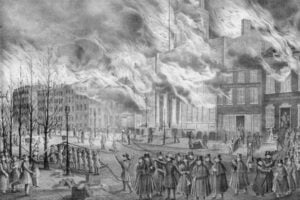
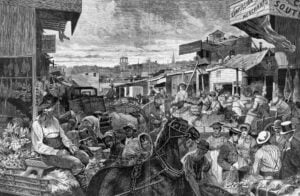
Thanksgiving at Washington Market in New York City, 1872. Wood engraving after Jules Tavernier, published in Harper’s Weekly on November 30, 1872. Library of Congress / Wikimedia Commons / Public Domain.
Today, Thanksgiving in New York City follows a familiar rhythm. Giant balloons travel down Central Park West, the smell of turkey drifts through apartment hallways and football games play on television. Yet if we could walk through the streets of Manhattan a century or two ago, we would encounter a holiday with an entirely different character.
New Yorkers once celebrated Thanksgiving with elaborate costume parades, competitive shooting excursions, crowded poultry markets and horse-drawn coaches carrying college football fans up Fifth Avenue. Children collected pennies from strangers, while wealthy benefactors provided holiday dinners for the young newspaper sellers who worked the streets of Manhattan and Brooklyn.
Some of these customs predate the establishment of Thanksgiving as a national annual holiday in 1863. Others developed during the city’s extraordinary nineteenth-century growth or disappeared as automobiles, refrigeration and organized entertainment transformed daily life. Although a few have modern counterparts, their original forms belong to another era. Here are ten forgotten Thanksgiving traditions of Old New York.
1. New Amsterdam’s Days of Thanksgiving and Prayer
More than two centuries before Abraham Lincoln proclaimed a national Thanksgiving in 1863, the Dutch inhabitants of New Netherland observed special days of religious thanksgiving. These were not necessarily autumn celebrations or occasions for an elaborate family dinner. Colonial authorities proclaimed them in response to particular events, and religious services were central to the observance.
One particularly significant example followed the conclusion of Kieft’s War in 1645. After a devastating period of warfare between Dutch settlers and Indigenous communities, a peace agreement was concluded at Fort Amsterdam on August 30. The colonial council subsequently designated September 6 as a day of thanksgiving throughout New Netherland, with services in its Dutch and English churches.
Another thanksgiving observance in 1654 marked the restoration of peace between England and the Netherlands. The colonial government called for morning religious services, followed by an opportunity for residents to celebrate. These occasions remind us that the history of thanksgiving in New York began long before the familiar November holiday took shape.
2. Celebrating Evacuation Day Alongside Thanksgiving
November 25 was once one of the most important dates on New York City’s calendar. On that day in 1783, British troops departed the city after seven years of occupation during the Revolutionary War. The anniversary became known as Evacuation Day, commemorated with military processions, flag ceremonies and patriotic gatherings.
New York was serving as the nation’s capital when President George Washington issued his Thanksgiving proclamation on October 3, 1789. He designated November 26 as a national day of thanksgiving and prayer, just one day after the sixth anniversary of the British evacuation. For New Yorkers, the two occasions carried related themes of peace, independence and gratitude.
Evacuation Day gradually lost its prominence as Thanksgiving became a nationwide annual observance. Although historical organizations have revived commemorative ceremonies at Bowling Green, the citywide holiday of the nineteenth century is gone. Most New Yorkers now pass through the final week of November without realizing that it once contained an entirely different major celebration.
3. Thanksgiving Target Excursions
In nineteenth-century New York and Brooklyn, Thanksgiving was an opportunity for neighborhood military companies, volunteer firemen and shooting clubs to organize outings. Known as target excursions, these gatherings combined marksmanship competitions with the social life of local associations. Participants sometimes marched through the streets in uniform before traveling to their chosen grounds.
An 1858 Thanksgiving newspaper account preserved by the Walt Whitman Archive describes an excursion by the Bernard Haver Guards to East New York. The group consisted of approximately sixty men, and its activities included target practice. The same account records the donation of bread to help provide a holiday dinner for needy children, showing how recreation and charitable work could form part of the same observance.
The custom belonged to an era when volunteer fire companies and neighborhood associations occupied a prominent place in urban life. As the city expanded, open land disappeared and municipal institutions became more professionalized, the old neighborhood target excursion ceased to be a familiar Thanksgiving spectacle.
4. The Fantasticals’ Costume Parades
Before Thanksgiving parades became carefully organized commercial spectacles, New Yorkers witnessed much less restrained processions. Nineteenth-century groups known as the Fantasticals, or Fantastics, dressed in outlandish clothing and marched through the streets on various holidays, including Thanksgiving. Their performances often mocked the solemnity of formal military and civic parades.
Some participants wore exaggerated uniforms, while others dressed as recognizable public figures or adopted entirely absurd disguises. Noise and comic behavior were part of the entertainment. The custom gave ordinary residents an opportunity to turn familiar social conventions upside down, even if only for an afternoon.
The Fantasticals were not exclusively a Thanksgiving institution, and similar masquerading customs existed elsewhere in the northeastern United States. Nevertheless, their appearances on New York’s holiday streets help explain the city’s long association with costumed Thanksgiving celebrations. The later tradition of children dressing as ragamuffins shared elements of this earlier street culture, although the precise relationship between the two remains uncertain.
5. When New York’s Governors Chose Thanksgiving Day
For much of the nineteenth century, New Yorkers could not simply look at the calendar and assume Thanksgiving would fall on the fourth Thursday of November. The date was determined by the governor, who issued a proclamation designating a day of public thanksgiving and prayer. Governor DeWitt Clinton established the annual tradition in New York in 1817, decades before Abraham Lincoln established an annual national observance in 1863.
During those early decades, New York governors selected Thanksgiving dates ranging from November 5 to December 21. Families, churches, merchants and local communities made their holiday preparations according to the governor’s announcement rather than a permanently established calendar date.
The arrangement became particularly confusing in 1871 when New York Governor John T. Hoffman designated November 23 as Thanksgiving, while President Ulysses S. Grant selected November 30. Hoffman subsequently withdrew his original proclamation and adopted the president’s date. It was not until 1941 that federal legislation permanently established Thanksgiving as the fourth Thursday in November, bringing an end to the uncertainty surrounding the holiday’s national date.
6. Thanksgiving Eve at Washington Market
Long before supermarkets and household freezers transformed holiday shopping, Washington Market in Lower Manhattan was one of the city’s great destinations for Thanksgiving provisions. Located near the Hudson River waterfront between Fulton and Vesey Streets, the market brought together meat, poultry, produce and other foodstuffs from farms and suppliers serving the growing metropolis.
In its November 30, 1872, issue, Harper’s Weekly published a large illustration of Washington Market at Thanksgiving time, based on the work of artist Jules Tavernier. The crowded scene captures the commercial activity surrounding the holiday. An 1885 account likewise described the familiar commotion at the market on Thanksgiving Eve.
Even in the early twentieth century, newspaper market reports followed the cost of Thanksgiving poultry closely. In November 1908, the New-York Tribune reported that Washington Market dealers were selling turkeys for approximately 25 cents a pound and anticipated an increase before the holiday. For families watching their household budgets, timing a purchase could make a difference.
Washington Market eventually disappeared as the city’s wholesale food distribution system changed. The annual rush to purchase a Thanksgiving bird has certainly survived, but the old waterfront market and its holiday crowds belong to a different chapter of New York’s commercial history.
7. The Newsboys’ Lodging House Thanksgiving Dinners
The newspaper boys who sold papers on the streets of nineteenth-century New York were an important part of the city’s daily life. Some lived with their families, while others lacked stable housing. The Children’s Aid Society established lodging facilities that offered boys shelter and educational opportunities. One of its best-known establishments was the Duane Street Newsboys’ Lodging House, which opened a new building in 1873.
Thanksgiving dinners became a notable occasion at these institutions. A report in The New York Times on November 26, 1897, described a holiday feast arranged by William Waldorf Astor for approximately a thousand newsboys and guests at the Duane Street lodging house. The scale of the gathering reflected both the number of children working in the city and the resources that wealthy benefactors could bring to charitable efforts.
Brooklyn had its own tradition of feeding newsboys on Thanksgiving. A photograph dated 1892, preserved in the Brooklyn Public Library’s collections, documents a holiday meal at the Newsboy’s Home on Poplar Street in Brooklyn Heights.
Although charitable Thanksgiving dinners remain an important part of New York life, the large holiday gatherings specifically associated with street newsboys faded as newspaper distribution and childhood labor changed. They offer a window into an era when children earning pennies by selling newspapers were a conspicuous part of the city’s streetscape.
8. Horse-Drawn Football Processions Along Fifth Avenue
Decades before the NFL established its Thanksgiving television traditions, college football was already drawing enormous holiday crowds in New York City. The rivalry between Yale and Princeton became a particularly important social and sporting event during the late nineteenth century, with Thanksgiving games played at venues including Manhattan Field near the Polo Grounds.
For many spectators, the celebration began well before kickoff. A newspaper account from November 27, 1891, preserved in research by Princeton University archivists, describes horse-drawn coaches and other vehicles traveling along Fifth Avenue and through Central Park on their way to the game. Fans displayed their college colors, and the journey itself became an opportunity for socializing and celebration.
The spectacle brought together football supporters, wealthy New Yorkers and curious onlookers. College colors appeared along fashionable streets, and the crowds heading uptown offered a nineteenth-century counterpart to the tailgate parties associated with football today.
Princeton’s last Thanksgiving game of that era against Yale took place in 1893. Football remained a holiday tradition, but the remarkable horse-drawn procession that carried spectators through Manhattan faded into history as college athletics and urban transportation changed.
9. Oysters and the Elaborate Thanksgiving Menus of Old New York
Anyone examining Thanksgiving menus from nineteenth-century New York will recognize the roast turkey and cranberry sauce, but some of the other dishes may come as a surprise. Oysters, clams, elaborate soups, multiple meat courses and rich pastries appeared on holiday menus at the city’s hotels and dining establishments.
New York’s proximity to productive shellfish waters helped make oysters a familiar part of its food culture. Surviving menus in the New York Public Library’s collection show that seafood also figured prominently in holiday dining. An 1899 Thanksgiving menu from the Broadway Central Hotel, for example, included clams and a choice of soups before the main courses. Other period menus offered oysters as part of the feast.
These elaborate dinners were not necessarily representative of what every New York family could afford. Hotel guests and affluent households enjoyed choices that working families might rarely encounter. Chicken pie and mince pie were also familiar dishes in period Thanksgiving cookery, although their presence varied from table to table.
Oysters and other traditional dishes have not disappeared altogether, but the sprawling Victorian holiday menu is much less familiar to modern diners. The surviving menus remind us that even the food we associate with Thanksgiving has changed considerably over time.
10. Live Animals and the Great Macy’s Balloon Hunt
When Macy’s staged its first Thanksgiving parade in 1924, the event looked quite different from the spectacle we know today. Originally promoted as a Christmas parade, it featured costumed employees, floats and live animals from the Central Park Zoo. The animals were among the attractions before large character balloons became the parade’s signature feature.
Working with theatrical designer and puppeteer Tony Sarg, Macy’s introduced large balloons in 1927. Helium-filled versions followed in 1928, when the company began letting balloons rise into the sky at the conclusion of the festivities. In subsequent years, Macy’s offered rewards for recovering balloons or returning their identifying tags.
What began as a novel holiday promotion became increasingly troublesome. In 1932, student aviator Annette Gibson attempted to retrieve a large cat-shaped balloon while flying over Queens. The balloon became entangled with the aircraft, causing a dangerous loss of control. The plane recovered, but the incident brought an end to the practice of releasing parade balloons into the sky.
Today, the giant balloons are deflated after completing the parade route. The old tradition of New Yorkers watching the skies in hopes of recovering a Macy’s balloon is one of the more extraordinary chapters in the history of a celebration that still defines Thanksgiving in the city.
For more stories about the customs and celebrations of generations past, explore our 10 Lost New York City Traditions That Once Defined Life, our History of Macy’s Thanksgiving Day Parade and our look at 18 Languages in New Amsterdam: NYC’s Multilingual Roots.