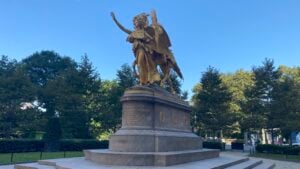
William Tecumseh Sherman Monument at Grand Army Plaza near Central Park in Manhattan. Photo by Brian Kachejian © 2026
In a city defined by relentless forward momentum and glass-curtain skyscrapers, public monuments serve as New York’s permanent anchors. Cast in bronze, carved from stone, and sometimes covered in gold leaf, these figures stand amid rushing pedestrians, traffic, park paths, and constantly changing skylines.
Some were commissioned to celebrate civic achievement, military service, literature, music, or political leadership. Others became New York landmarks almost by accident. One famously arrived as an unsanctioned guerrilla art installation, while another came from France and became one of the most recognizable symbols in the world.
Here are 25 of the most iconic statues in New York City and the stories behind them.
1. Statue of Liberty (1886)
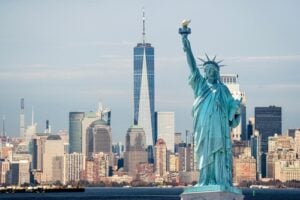
Photo: Paparacy Shutterstock.com
Location: Liberty Island, New York Harbor
Sculptor: Frédéric-Auguste Bartholdi
Material: Copper over an internal metal framework
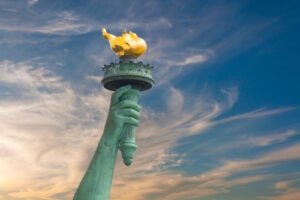
The Story: No list of New York City statues could begin anywhere else. Formally titled Liberty Enlightening the World, the Statue of Liberty was a gift from the people of France to the United States and was dedicated on October 28, 1886. Bartholdi designed the colossal figure, while the engineering of its internal structure was associated with Gustave Eiffel’s firm. The statue itself rises more than 151 feet from heel to torch, and the full monument reaches more than 305 feet from the base of the pedestal to the tip of the torch.
Lady Liberty stands holding a torch in her raised right hand and a tablet in her left inscribed with the date of the Declaration of Independence. Over time, the monument grew far beyond its original commemorative purpose. For generations of immigrants arriving in New York Harbor, the statue became a symbol of arrival, freedom, and the possibility of a new life in America.
2. William Tecumseh Sherman (1903)
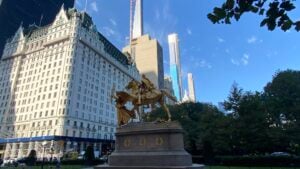
Location: Grand Army Plaza, Fifth Avenue and 59th Street
Sculptor: Augustus Saint-Gaudens
Material / Finish: Gilded bronze on a granite base
The Story: Overlooking the busy intersection of Fifth Avenue and Central Park South, this equestrian monument is widely regarded as one of Augustus Saint-Gaudens’s great public works. The monument depicts Civil War Union General William Tecumseh Sherman on horseback, led by an allegorical winged figure of Victory. African American artist’s model Hettie Anderson posed for Victory, while Sherman’s horse was modeled after an animal named Ontario.
Dedicated on Memorial Day in 1903, the bronze figures are covered in gold leaf, giving the monument its unmistakable brilliance at the southeastern corner of Central Park. The gilding has been renewed during conservation campaigns to preserve the dramatic appearance Saint-Gaudens intended.
3. Atlas (1937)
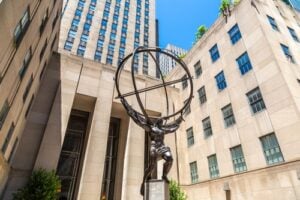
Photo: Sergii Figurnyi / Shutterstock.com
Location: 630 Fifth Avenue, Rockefeller Center
Sculptors: Lee Lawrie and René Paul Chambellan
Material / Scale: Bronze; 15-foot figure on a 9-foot pedestal with a 21-foot-wide armillary sphere
The Story: Positioned directly across Fifth Avenue from St. Patrick’s Cathedral, Atlas is one of the great Art Deco sculptures of Rockefeller Center. Created by Lee Lawrie with René Paul Chambellan, the muscular Titan supports an enormous celestial armillary sphere marked with the signs of the zodiac.
The figure weighs several tons, and the axis of the sphere points toward the North Star. The sculpture’s combination of mythology, geometry, and machine-age design made it a natural fit for Rockefeller Center’s larger architectural program celebrating art, commerce, science, and human achievement.
4. Prometheus (1934)
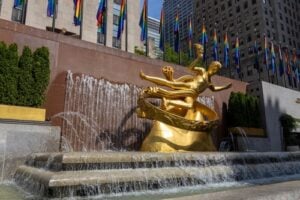
Photo: Cynthia Shirk / Shutterstock.com
Location: The Sunken Plaza at Rockefeller Center
Sculptor: Paul Manship
Material / Scale: Gilded cast bronze; approximately 18 feet tall and eight tons
The Story: Paul Manship’s gleaming Prometheus is the focal point of Rockefeller Center’s Lower Plaza. The sculpture depicts the Greek Titan carrying fire to humanity as he moves across a circular band representing the heavens.
Installed in 1934, the gilded bronze sculpture became inseparable from the visual identity of Rockefeller Center, particularly during the winter skating season and the annual Christmas celebrations. Its sweeping pose and brilliant gold surface remain among the most instantly recognizable images associated with Midtown Manhattan.
5. Charging Bull (1989)
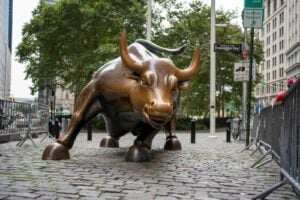
Photo: Remo Peer / Shutterstock.com
Location: Bowling Green, Financial District
Sculptor: Arturo Di Modica
Material / Weight: Bronze; approximately 7,000 pounds
The Story: Charging Bull was not commissioned by the city or Wall Street. Italian-born sculptor Arturo Di Modica created the massive bronze bull after the 1987 stock market crash as a symbol of resilience and strength. In December 1989, he and a crew installed it overnight outside the New York Stock Exchange without authorization.
Police removed the sculpture, but the story did not end there. The bull was soon placed at Bowling Green, where it evolved into one of Lower Manhattan’s best-known landmarks. Visitors have polished portions of the bronze through years of touching and rubbing the sculpture for luck, turning an unauthorized art installation into a permanent part of New York’s financial-district identity.
6. Balto (1925)
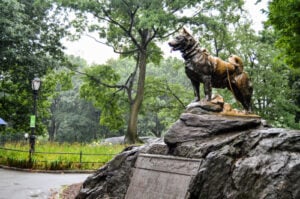
Photo: Ece Chianucci / Shutterstock.com
Location: Central Park, East Drive near 67th Street
Sculptor: Frederick George Richard Roth
Material: Bronze on natural rock
The Story: Dedicated in December 1925, Balto occupies a special place in Central Park history because the real Balto was present when his own monument was unveiled. Earlier that year, an outbreak of diphtheria threatened Nome, Alaska. A relay of dog-sled teams carried lifesaving antitoxin across nearly 700 miles of brutal winter conditions, with Balto leading the final team into Nome.
New Yorkers quickly embraced the story. Frederick Roth’s bronze sled dog stands on a natural rock outcropping with a plaque honoring the endurance, fidelity, and intelligence of the sled dogs involved in the serum relay. Generations of visitors have rubbed Balto’s ears and back, leaving parts of the bronze noticeably polished.
7. Father Francis P. Duffy (1937)
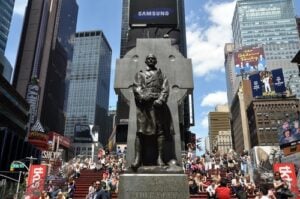
Photo: LEE SNIDER PHOTO IMAGES / Shutterstock.com
Location: Father Duffy Square, Broadway and West 47th Street
Sculptor: Charles Keck
Material: Bronze with granite monument
The Story: Standing in the northern portion of Times Square, Father Francis Patrick Duffy is remembered as the celebrated chaplain of New York’s famed Fighting 69th Infantry Regiment. During World War I, Duffy ministered to soldiers under fire and became one of the regiment’s most respected figures.
After the war, he returned to Manhattan and served as pastor of Holy Cross Church on West 42nd Street. The 1937 monument by Charles Keck depicts Duffy in military dress with a Bible in hand, backed by a large Celtic cross. Today, Father Duffy Square is one of the busiest gathering points in Times Square.
8. Angel of the Waters at Bethesda Fountain (1873)
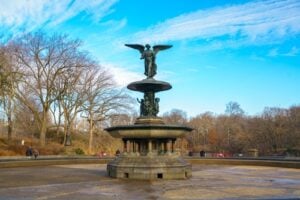
Photo: NoyanYalcin / Shutterstock.com
Location: Bethesda Terrace, Central Park
Sculptor: Emma Stebbins
Material: Bronze
The Story: Crowning Bethesda Fountain, Angel of the Waters is one of Central Park’s defining works of public art. Sculptor Emma Stebbins became the first woman to receive a public art commission from the City of New York when she was chosen to create the work.
Unveiled in 1873, the statue was inspired by the biblical story of an angel blessing the pool of Bethesda. It also commemorates the Croton Aqueduct, which brought a dependable supply of fresh water to New York City beginning in the 1840s. The angel carries a lily in one hand while four cherubs below symbolize temperance, purity, health, and peace.
9. Alice in Wonderland (1959)
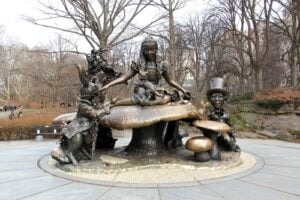
Photo: ARK NEYMAN / Shutterstock.com
Location: Central Park, north of Conservatory Water near East 74th Street
Sculptor: José de Creeft
Material: Bronze
The Story: Publisher and philanthropist George T. Delacorte commissioned this beloved Central Park sculpture in memory of his wife, Margarita. Spanish-born sculptor José de Creeft drew inspiration from John Tenniel’s original illustrations for Lewis Carroll’s Alice’s Adventures in Wonderland.
Alice sits on a giant mushroom surrounded by the Mad Hatter, White Rabbit, March Hare, Dormouse, and other figures from the story. Since its dedication in 1959, the sculpture has become one of the park’s most interactive monuments, climbed and explored by generations of visitors.
10. George Washington at Federal Hall (1882)
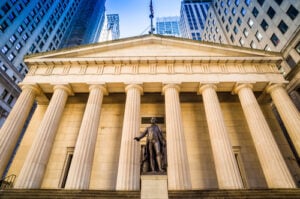
Photo: f11photo/Shutterstock.com
Location: Federal Hall National Memorial, 26 Wall Street
Sculptor: John Quincy Adams Ward
Material: Bronze on granite
The Story: Standing on the steps of Federal Hall National Memorial, this monumental bronze marks the approximate site where George Washington took the oath of office as the first President of the United States on April 30, 1789. The original Federal Hall building where the inauguration occurred no longer stands; the present building opened in the 19th century.
John Quincy Adams Ward’s statue was erected in 1882. Washington extends his right hand toward the place associated with the first presidential inauguration, creating one of the most powerful historical connections between present-day Wall Street and the beginnings of the federal government in New York City.
11. Joan of Arc (1915)
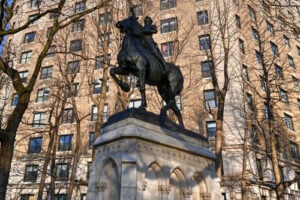
Photo: Felix Lipov / Shutterstock.com
Location: Riverside Park at West 93rd Street
Sculptor: Anna Hyatt Huntington
Material: Bronze on a granite pedestal
The Story: The Joan of Arc monument on Riverside Drive was a landmark in New York public sculpture. Dedicated in 1915, it became the city’s first commemorative sculpture honoring a historical woman. Sculptor Anna Hyatt Huntington carefully researched medieval armor and horses while developing the equestrian figure.
Joan is shown rising in her stirrups with her sword lifted toward the sky. The pedestal incorporates limestone blocks from the tower in Rouen, France, where Joan was imprisoned, giving the New York monument a physical link to the life of the woman it honors.
12. Alexander Hamilton (1880)
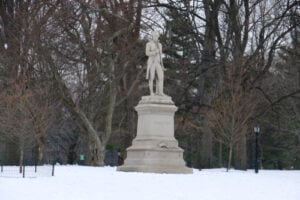
Photo: quiggyt4 / Shutterstock.com
Location: Central Park, East Drive near 83rd Street
Sculptor: Carl H. Conrads
Material: Granite
The Story: Central Park’s monument to Alexander Hamilton was commissioned and donated by his son, John C. Hamilton. Sculptor Carl H. Conrads carved the standing figure from granite, depicting Hamilton in period clothing with a roll of documents in one hand.
Dedicated in 1880, the monument stands near the Metropolitan Museum of Art. It is one of several places in Manhattan associated with the nation’s first Secretary of the Treasury, whose financial policies helped shape the economic system that would become so closely connected with New York City.
13. Hans Christian Andersen (1956)
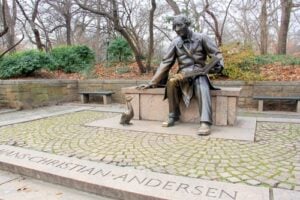
Photo: ARK NEYMAN / Shutterstock.com
Location: Central Park, near Conservatory Water
Sculptor: Georg J. Lober
Material: Bronze on granite
The Story: Hans Christian Andersen sits with an open book across his lap while the Ugly Duckling looks up beside him. Dedicated in 1956 to mark the 150th anniversary of Andersen’s birth, the sculpture was created by Georg J. Lober and supported in large part by Danish-American fundraising and contributions from schoolchildren.
The monument became more than a static tribute to the famous storyteller. Since 1957, the area around the statue has hosted a summer storytelling tradition, making Andersen’s memorial one of the rare New York monuments whose public programming directly reflects the life and work of its subject.
14. Duke Ellington Memorial (1997)
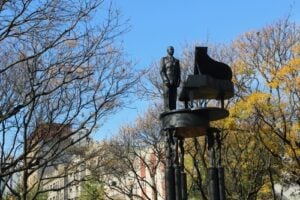
Photo: Here Now / Shutterstock.com
Location: Duke Ellington Circle, Fifth Avenue and East 110th Street
Sculptor: Robert Graham
Material: Bronze
The Story: Marking the northeastern gateway to Central Park and Harlem, this soaring monument honors one of the greatest composers and bandleaders in American music. Singer Bobby Short helped lead a long campaign for a permanent Ellington memorial, which was ultimately created by sculptor Robert Graham and dedicated in 1997.
The bronze figure of Ellington stands beside a grand piano high above street level. The platform is supported by three columns topped by groups of female caryatid figures, giving the entire monument a dramatic vertical presence at the entrance to Harlem.
15. Nathan Hale (1893)
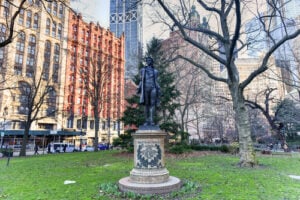
Photo: Felix Lipov / Shutterstock.com
Location: City Hall Park
Sculptor: Frederick William MacMonnies
Material: Bronze
The Story: Frederick MacMonnies portrayed the young Continental Army officer moments before his execution by the British in 1776. Hale stands bound at the wrists and ankles, his posture conveying defiance despite his capture.
The monument was unveiled in 1893 and honors the schoolteacher-turned-spy whose final moments became part of Revolutionary War legend. Hale is traditionally credited with declaring that he regretted having only one life to lose for his country, words that have remained closely associated with his memory for generations.
16. Benjamin Franklin (1872)
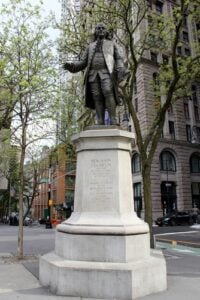
Photo: ARK NEYMAN / Shutterstock.com
Location: Printing House Square near Park Row and Spruce Street
Sculptor: Ernst Plassmann
Material: Bronze on granite
The Story: Benjamin Franklin stands in what was historically one of the centers of New York’s newspaper industry. Sculptor Ernst Plassmann depicted Franklin holding a copy of the Pennsylvania Gazette, emphasizing his work as a printer and publisher as much as his better-known roles as scientist, diplomat, and statesman.
Dedicated in 1872, the monument was particularly appropriate for Printing House Square, once surrounded by the offices and presses of major New York newspapers. The setting connected Franklin’s pioneering work in American printing with the city’s own enormous newspaper culture.
17. Horace Greeley (1890)
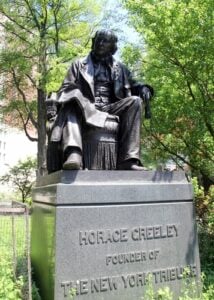
Photo: ARK NEYMAN
/Shutterstock
Location: City Hall Park
Sculptor: John Quincy Adams Ward
Material: Bronze on granite
The Story: Horace Greeley, longtime editor of the New-York Tribune, is portrayed seated in a heavy chair with a newspaper resting across his lap. John Quincy Adams Ward’s sculpture captures the famous editor in a contemplative pose rather than presenting him as a conventional heroic statesman.
The statue was dedicated in 1890 outside the Tribune Building and was later moved to City Hall Park. Greeley remains closely associated with the phrase “Go West, young man,” although the precise origin and authorship of that famous expression have long been debated.
18. Abraham De Peyster (1896)
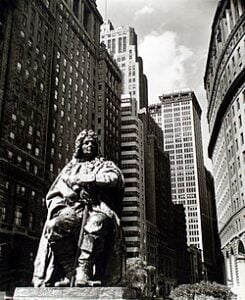
Berenice Abbott, Public domain, via Wikimedia Commons
Location: Thomas Paine Park, Foley Square
Sculptor: George Edwin Bissell
Material: Bronze
The Story: Abraham De Peyster served as mayor of New York during the late 17th century. George Edwin Bissell depicted him seated in elaborate period clothing, complete with a large wig and ceremonial dress that immediately separates this monument visually from the many 18th- and 19th-century military figures around the city.
Dedicated in 1896, the statue originally stood in Bowling Green. It was moved several times as Lower Manhattan changed and was eventually returned to public display in Thomas Paine Park near Foley Square, carrying a piece of colonial New York into the modern civic center.
19. George Washington Equestrian Statue (1856)
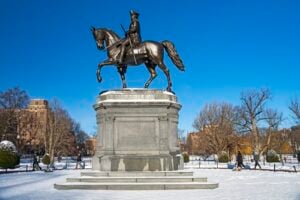
Photo: Steven Phraner / Shutterstock.com
Location: Union Square South
Sculptor: Henry Kirke Brown
Material: Bronze on granite
The Story: Unveiled on July 4, 1856, Henry Kirke Brown’s equestrian George Washington is the oldest sculpture in the New York City Parks collection. Washington is depicted on horseback with his right arm extended, representing his return to New York on Evacuation Day in 1783 as British forces departed the city.
The monument became an important milestone in American public sculpture and remains one of Union Square’s defining works. Its location is especially fitting in a park that later became a gathering place for political rallies, labor demonstrations, public celebrations, and moments of national mourning.
20. Abraham Lincoln (1870)
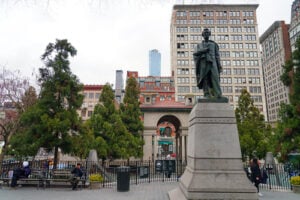
Photo: EQRoy / Shutterstock.com
Location: Union Square North
Sculptor: Henry Kirke Brown
Material: Bronze
The Story: Following Abraham Lincoln’s assassination in 1865, New Yorkers raised funds for a permanent monument to the fallen president. Henry Kirke Brown depicted Lincoln in contemporary clothing with a classical drapery and a copy of the Emancipation Proclamation in his hand.
The statue was dedicated in 1870. Union Square had been the site of enormous pro-Union rallies during the Civil War, giving the memorial an especially strong connection to the city’s wartime history.
21. Marquis de Lafayette (1876)
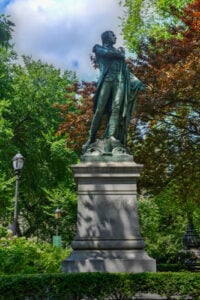
Photo: Felix Lipov
/ Shutterstock
Location: Union Square East
Sculptor: Frédéric-Auguste Bartholdi
Material: Bronze on granite
The Story: A decade before the Statue of Liberty was dedicated, Frédéric-Auguste Bartholdi created this monument to the Marquis de Lafayette. The young French aristocrat had crossed the Atlantic to support the American Revolution and became one of George Washington’s most trusted foreign allies.
The statue was dedicated in 1876, the nation’s centennial year, and was connected with French gratitude for American relief efforts during the Franco-Prussian War. Lafayette stands with one hand over his heart and a sword offered forward, capturing his willingness to place himself in the service of the American cause.
22. Giuseppe Garibaldi (1888)
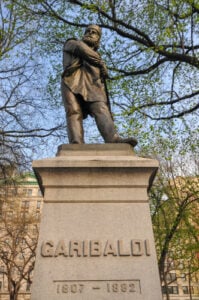
Photo: Felix Lipov / Shutterstock.com
Location: Washington Square Park
Sculptor: Giovanni Turini
Material: Bronze on granite
The Story: Dedicated in 1888, Giovanni Turini’s monument honors Giuseppe Garibaldi, the military leader closely associated with the unification of Italy. New York’s Italian community played an important role in raising funds for the statue, making it a powerful expression of immigrant pride in the late 19th century.
Garibaldi is shown in a military stance with his sword at his side. The monument has moved within Washington Square Park as the park itself has been redesigned, but it remains one of Greenwich Village’s most recognizable historical statues.
23. Eleanor Roosevelt (1996)
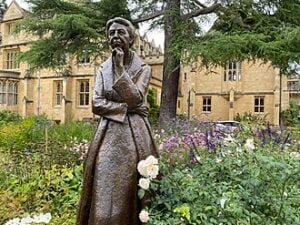
Photo: Set in Stone Project, CC BY-SA 4.0 <https://creativecommons.org/licenses/by-sa/4.0>, via Wikimedia Commons
Location: Riverside Park at West 72nd Street
Sculptor: Penelope Jencks
Material: Bronze with natural stone setting
The Story: Dedicated in October 1996, this quiet monument honors former First Lady, diplomat, and human-rights advocate Eleanor Roosevelt. Sculptor Penelope Jencks rejected the traditional heroic pedestal and instead portrayed Roosevelt at a human scale, resting against a natural boulder in a reflective pose.
The memorial was historically significant in another way: Roosevelt became the first American woman for whom a statue was commissioned for a New York City park. The setting along Riverside Park gives the work an intimacy that fits Roosevelt’s public image while still recognizing the enormous international influence of her life and work.
24. General Henry Warner Slocum (1905)
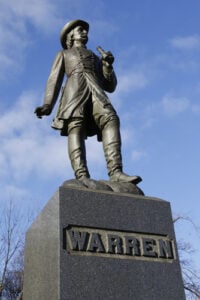
Photo: Leonard Zhukovsky / Shutterstock.com
Location: Grand Army Plaza, Brooklyn
Sculptor: Frederick William MacMonnies
Material: Bronze on granite
The Story: This equestrian monument honors Major General Henry Warner Slocum, a Union commander who served at Gettysburg and during Sherman’s campaigns and later represented New York in Congress. Sculptor Frederick MacMonnies created an energetic military portrait of Slocum on horseback.
The monument was dedicated on Memorial Day in 1905 and was later relocated as Brooklyn’s street and park approaches changed. Today it stands near the entrance to Prospect Park at Grand Army Plaza, surrounded by one of the city’s richest concentrations of Civil War memorial architecture and sculpture.
25. Henry Ward Beecher Monument (1891)
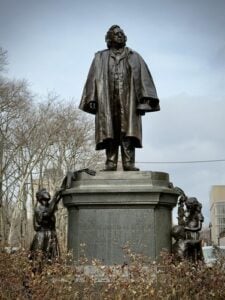
Photo: HM Scott / Shutterstock.com
Location: Columbus Park near Brooklyn Borough Hall
Sculptor: John Quincy Adams Ward
Material: Bronze with granite pedestal
The Story: This multi-figure monument commemorates Henry Ward Beecher, the celebrated preacher and abolitionist associated with Plymouth Church in Brooklyn Heights. John Quincy Adams Ward depicted Beecher standing in a heavy overcoat, an image very different from the military uniforms and classical robes common to 19th-century public monuments.
Companion figures at the base include a young African American girl and children presenting a garland, imagery tied to Beecher’s abolitionist reputation and public ministry. Dedicated in 1891, the monument remains one of the most substantial historical sculptures in Brooklyn’s civic center.
NYC’s 25 Iconic Statues at a Glance
| # | Statue / Monument | Location | Year | Sculptor |
|---|---|---|---|---|
| 1 | Statue of Liberty | Liberty Island | 1886 | Frédéric-Auguste Bartholdi |
| 2 | William Tecumseh Sherman | Grand Army Plaza, Manhattan | 1903 | Augustus Saint-Gaudens |
| 3 | Atlas | Rockefeller Center | 1937 | Lee Lawrie and René Paul Chambellan |
| 4 | Prometheus | Rockefeller Center | 1934 | Paul Manship |
| 5 | Charging Bull | Bowling Green | 1989 | Arturo Di Modica |
| 6 | Balto | Central Park | 1925 | Frederick G. R. Roth |
| 7 | Father Francis P. Duffy | Times Square | 1937 | Charles Keck |
| 8 | Angel of the Waters | Bethesda Terrace, Central Park | 1873 | Emma Stebbins |
| 9 | Alice in Wonderland | Central Park | 1959 | José de Creeft |
| 10 | George Washington | Federal Hall | 1882 | John Quincy Adams Ward |
| 11 | Joan of Arc | Riverside Park | 1915 | Anna Hyatt Huntington |
| 12 | Alexander Hamilton | Central Park | 1880 | Carl H. Conrads |
| 13 | Hans Christian Andersen | Central Park | 1956 | Georg J. Lober |
| 14 | Duke Ellington Memorial | Duke Ellington Circle | 1997 | Robert Graham |
| 15 | Nathan Hale | City Hall Park | 1893 | Frederick W. MacMonnies |
| 16 | Benjamin Franklin | Printing House Square | 1872 | Ernst Plassmann |
| 17 | Horace Greeley | City Hall Park | 1890 | John Quincy Adams Ward |
| 18 | Abraham De Peyster | Thomas Paine Park | 1896 | George Edwin Bissell |
| 19 | George Washington Equestrian Statue | Union Square | 1856 | Henry Kirke Brown |
| 20 | Abraham Lincoln | Union Square | 1870 | Henry Kirke Brown |
| 21 | Marquis de Lafayette | Union Square | 1876 | Frédéric-Auguste Bartholdi |
| 22 | Giuseppe Garibaldi | Washington Square Park | 1888 | Giovanni Turini |
| 23 | Eleanor Roosevelt | Riverside Park | 1996 | Penelope Jencks |
| 24 | General Henry Warner Slocum | Grand Army Plaza, Brooklyn | 1905 | Frederick W. MacMonnies |
| 25 | Henry Ward Beecher | Brooklyn Civic Center | 1891 | John Quincy Adams Ward |
New York’s statues are inseparable from the parks, plazas, streets, and institutions around them. Readers interested in exploring more of the city’s history can also visit our History of New York’s City Hall, History of the New York Stock Exchange, and History of Ellis Island.
Sources
- National Park Service — Statue of Liberty Facts
- Central Park Conservancy — William Tecumseh Sherman Monument
- Rockefeller Center — Atlas
- Rockefeller Center — The Story of Prometheus
- NYC Parks — Charging Bull
- Central Park Conservancy — Balto
- City of New York — Father Duffy Square Monument History
- Central Park Conservancy — Bethesda Fountain and Angel of the Waters
- Central Park Conservancy — Alice in Wonderland
- National Park Service — Federal Hall National Memorial
- Riverside Park Conservancy — Joan of Arc Memorial
- Central Park Conservancy — Alexander Hamilton Monument
- Central Park Conservancy — Hans Christian Andersen
- Central Park Conservancy — Duke Ellington Memorial
- Smithsonian Institution — Benjamin Franklin Sculpture
- Riverside Park Conservancy — Eleanor Roosevelt Memorial
- Smithsonian Institution — Henry Ward Beecher Memorial
Updated September 4, 2026.