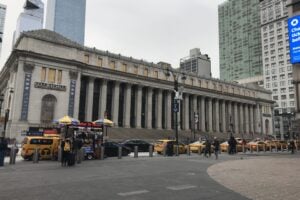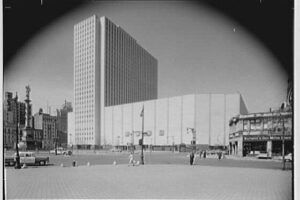
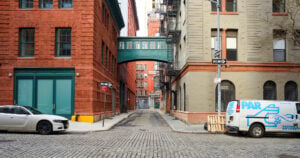
The Staple Street Skybridge crossing the narrow cobblestone lane in Tribeca, Manhattan. Photo: Mariusz Lopusiewicz / Shutterstock.com
Manhattan has no shortage of famous landmarks, but some of the places that make the borough most interesting sit just beyond the usual tourist checklist. Hidden above office lobbies, tucked behind gates, squeezed into narrow alleys, built into old railroad and water systems, or quietly preserved between much larger attractions, these places reveal a different side of the city.
This first guide in our Hidden New York City series skips traditional museums and focuses on places built into Manhattan itself: pocket parks, historic lanes, unusual structures, architectural curiosities, gardens, bridges, and public spaces that are easy to overlook. Some can be freely entered, while others are private residential enclaves best admired from the sidewalk or gate. Access and hours can change, so check current conditions before making a special trip.
1. The Elevated Acre
Location: 55 Water Street, Financial District
The Elevated Acre is one of Lower Manhattan’s most unexpected public spaces. Hidden above street level at 55 Water Street, the roughly one-acre plaza sits atop a parking structure and is reached by escalator and stairs from Water Street. Although it feels like a private rooftop garden, it is actually one of New York City’s privately owned public spaces.
The current landscape was created during a major 2005 redesign and includes a broad lawn, a tiered amphitheater, landscaped paths, and views toward the East River, Brooklyn Bridge, and Brooklyn Heights. Because the entrance is easy to pass without noticing, many people walking through the Financial District never realize that a small elevated park is sitting above them.
2. The Whispering Gallery at Grand Central Terminal
Location: Dining Concourse, near the Grand Central Oyster Bar, Midtown East
One of the best-known secrets inside Grand Central Terminal is hidden beneath a beautifully tiled archway near the Oyster Bar. The Guastavino tile vaults create an unusual acoustic effect that allows two people standing at opposite diagonal corners to hear each other’s whispers across the space.
Stand facing one corner while another person stands at the corner diagonally across from you. Speak quietly toward the wall and the curved tiled surface carries the sound along the arch. Grand Central is visited by enormous crowds every day, yet many travelers pass through without ever trying it.
3. Greenacre Park
Location: 217 East 51st Street, between Second and Third Avenues
Greenacre Park is a tiny Midtown oasis that feels much farther from traffic than it actually is. The approximately 6,000-square-foot park opened in 1971 through the Greenacre Foundation, created by Abby Rockefeller Mauzé, and was designed by landscape architect Hideo Sasaki.
The star attraction is a dramatic 25-foot waterfall at the rear of the park. Its rushing water helps mask the sounds of Midtown traffic while trees, terraces, movable seating, and plantings create a remarkably peaceful space on a narrow city lot. The park operates seasonally, so it is worth checking current hours before visiting.
4. The Ford Foundation Atrium
Location: 320 East 43rd Street, Midtown East
The Ford Foundation Center for Social Justice contains one of Manhattan’s most remarkable interior gardens. The landmark building opened in 1967 and was designed by Kevin Roche John Dinkeloo and Associates around a soaring 12-story atrium, with the original landscape design by Dan Kiley.
Instead of a conventional office lobby, visitors encounter terraces filled with mature trees, subtropical plants, pathways, and water features beneath a huge glass-and-steel enclosure. The garden is open to the public during designated visiting hours, but the building has security procedures and visitor requirements that can change, so check the foundation’s visitor information before going.
5. Paley Park
Location: 3 East 53rd Street, between Fifth and Madison Avenues
Paley Park is one of the great examples of how much can be done with a tiny piece of Manhattan. The 4,200-square-foot pocket park opened in 1967 after CBS chairman William S. Paley commissioned it in memory of his father, Samuel Paley.
Designed by Zion Breen Richardson Associates, the park is dominated by a 20-foot-high waterfall stretching across the rear wall. Honey locust trees, ivy-covered walls, and movable chairs soften the tight urban space. It sits only steps from Fifth Avenue, yet it is remarkably easy to walk past without ever realizing it is there.
6. The Berlin Wall at 520 Madison Avenue
Location: 520 Madison Avenue, near East 53rd Street, Midtown
Five full-height panels from the Berlin Wall are preserved at 520 Madison Avenue. Developer Jerry Speyer purchased the sections in 1990 after the fall of the wall. Their western faces carry colorful work by artists including Thierry Noir and Kiddy Citny, while the opposite sides preserve the stark concrete appearance associated with East Germany.
The panels were once displayed outdoors at the building’s plaza but are now exhibited inside the lobby. Because 520 Madison Avenue is a private office building, public access can depend on building hours and security procedures. Even many New Yorkers who remember seeing the wall outside do not realize the panels are still preserved there.
7. The Channel Gardens at Rockefeller Center
Location: Between 49th and 50th Streets, from Fifth Avenue toward Rockefeller Plaza
Millions of people visit Rockefeller Center, but many rush straight toward the skating rink, Christmas tree, or observation deck without knowing the name or history of the landscaped promenade they are walking through. The Channel Gardens form the narrow passage between the British Empire Building and La Maison Française.
The approximately 200-foot promenade opened as part of Rockefeller Center in the 1930s. Its name is a playful reference to the English Channel separating Britain and France. Fountain pools, sculptural figures, and elaborate seasonal plantings make the gardens worth visiting even when the famous Christmas tree is nowhere in sight.
8. The Staple Street Skybridge
Location: Staple Street between Jay and Harrison Streets, Tribeca
Few Manhattan streets look more like a movie set than tiny Staple Street. Suspended above the narrow cobblestone lane is an enclosed pedestrian bridge connecting buildings at 67 Hudson Street and 9 Jay Street.
The bridge dates to the early 20th century, when the buildings were associated with New York Hospital’s House of Relief. It connected the hospital facility with supporting operations across the lane. The structures are now privately owned, so the bridge itself is not a public walkway. The best experience is simply to stand on Staple Street and take in one of Tribeca’s most unusual surviving architectural scenes.
9. Pomander Walk
Location: Between West 94th and West 95th Streets, near Broadway, Upper West Side
Behind a gate on the Upper West Side is a tiny lane that looks almost nothing like Manhattan. Pomander Walk was built in 1921 by developer and theater operator Thomas Healy and designed by the architectural firm King & Campbell.
The private enclave contains 27 small Tudor-style houses arranged along a narrow pedestrian passage. Its design was inspired by the theatrical English-village setting of Louis N. Parker’s play Pomander Walk. Because it is a private residential community, visitors should admire it from the entrance unless invited inside.
10. Washington Mews and MacDougal Alley
Location: Near Washington Square Park, Greenwich Village
Greenwich Village still contains several lanes that reveal how different Manhattan looked before apartment towers and dense commercial blocks filled the neighborhood. Washington Mews and MacDougal Alley preserve the scale of 19th-century carriage-house lanes, with low buildings that were adapted over time from stables and service structures into homes, studios, and institutional spaces.
The lanes are part of the layered architectural history that makes Greenwich Village so different from most of Manhattan’s grid. Access can be restricted because these are private or semi-private spaces, but their entrances and historic character can still be appreciated from the surrounding public streets.
11. Sniffen Court Historic District
Location: East 36th Street, between Third and Lexington Avenues, Murray Hill
Sniffen Court is a tiny gated mews lined with ten two-story former stables dating from the 1860s. The court was named for builder John E. Sniffen and remains one of Manhattan’s smallest designated historic districts.
The former carriage houses have long since been converted to residences, but their scale and architecture still evoke the horse-and-carriage era. Sculptor Malvina Hoffman, who maintained a studio in the court, added decorative plaques depicting horsemen to the rear wall. The court is private, so visitors should view it from the East 36th Street entrance.
12. Patchin Place and Milligan Place
Location: Near West 10th Street and Sixth Avenue, Greenwich Village
Two small gated courts near Sixth Avenue preserve another side of old Greenwich Village. Patchin Place contains a row of houses built in 1848 for Aaron D. Patchin, while nearby Milligan Place contains four houses dating from the early 1850s.
Over the generations, the intimate lanes became associated with writers, artists, and Village residents attracted to their privacy and unusual scale. They remain residential and gated, so the experience for most visitors is a glimpse through the iron entrances rather than a walk through the courtyards.
13. Grove Court
Location: 10-12 Grove Street, between Bedford and Hudson Streets, Greenwich Village
Grove Court is hidden behind an iron gate on one of Greenwich Village’s most picturesque streets. A narrow passage opens onto six connected brick houses set back from Grove Street, creating a courtyard that feels almost detached from the surrounding city.
The houses were completed in the 1850s for grocer and developer Samuel Cocks and were originally modest rear dwellings. The little enclave was once nicknamed Mixed Ale Alley. Later alterations and restoration transformed the houses into highly desirable private residences. Visitors can enjoy the view through the gate, but Grove Court itself is private.
14. Sylvan Terrace
Location: Between Jumel Terrace and St. Nicholas Avenue at West 160th Street, Washington Heights
Sylvan Terrace is one of those Manhattan streets that can make you question what century you are standing in. Twenty nearly matching two-story wooden houses line a narrow passage that follows the route of an old carriage drive leading toward the Morris-Jumel Mansion.
The present houses were built in 1882 for developer James E. Ray. Their wooden facades, high stoops, and uniform proportions create one of the most distinctive surviving 19th-century residential scenes in Manhattan. Unlike several of the gated mews downtown, Sylvan Terrace can be experienced directly from the public street, but it remains a residential block and should be treated accordingly.
15. The Clocktower at 346 Broadway
Location: 108 Leonard Street, formerly 346 Broadway, Civic Center / Tribeca
High above the former New York Life Insurance Company headquarters is one of Manhattan’s great surviving clocktowers. The monumental building, designed by McKim, Mead & White and completed during the 1890s, occupies a prominent site near Broadway and Leonard Street.
The clocktower and its historic mechanical system survived the building’s conversion into luxury residences now known as 108 Leonard. The interior is private, but the tower remains an extraordinary piece of the skyline when viewed from the surrounding streets. It is the sort of landmark many people pass repeatedly without stopping to look up.
16. Blockhouse No. 1 in Central Park
Location: North Woods near West 109th Street, Central Park
Deep in the northern reaches of Central Park stands a rough stone fortification that predates the park itself. Blockhouse No. 1 was constructed in 1814 during the War of 1812 as part of a defensive system intended to protect northern Manhattan from a possible British attack.
Built largely from local Manhattan schist, it is the oldest surviving building constructed within what later became Central Park. Its remote location in the North Woods gives it a completely different atmosphere from the heavily visited southern half of the park. The exterior can be viewed from the park, while interior access is generally limited to occasional official programs.
17. The High Bridge
Location: Harlem River between West 174th Street in Manhattan and University Avenue in the Bronx
The High Bridge opened in 1848 as part of the Old Croton Aqueduct and is the oldest surviving bridge in New York City. Its original stone arches carried Croton water across the Harlem River into Manhattan, helping supply the rapidly growing city with clean water.
Several central masonry arches were removed in the 1920s and replaced with the single steel span seen today to improve river navigation. After decades of closure, the bridge reopened in 2015 as a pedestrian and bicycle crossing. It is one of the quietest major bridge walks in the city and a far different experience from the Brooklyn Bridge. For more pedestrian crossings, see our guide to which bridges you can walk across in NYC.
18. The Highbridge Water Tower
Location: Highbridge Park near West 174th Street and Amsterdam Avenue, Washington Heights
Rising above Highbridge Park is a 200-foot stone water tower completed in 1872 as part of New York’s expanding Croton water system. Engineer John B. Jervis was closely associated with the city’s Croton infrastructure, and the tower was built to help provide adequate water pressure to the increasingly developed high ground of northern Manhattan.
The tower’s exterior can be seen from Highbridge Park and pairs naturally with a walk across the nearby High Bridge. Interior access is much more limited and is generally available only during scheduled NYC Parks tours or special programs.
19. 6BC Botanical Garden
Location: 624 East 6th Street, between Avenues B and C, East Village
The 6BC Botanical Garden is a volunteer-run community garden created in 1980 on land reclaimed after buildings had disappeared from the block. Over the decades, volunteers transformed the lots into a dense neighborhood garden filled with winding paths, trees, flowers, ponds, seating areas, and an elevated treehouse.
It is part of the remarkable community-garden movement that reshaped vacant land across the East Village and Lower East Side. The garden operates on a seasonal volunteer schedule, so opening hours can vary. Check the garden’s official visitor information before making a special trip.
20. The Octagon on Roosevelt Island
Location: 888 Main Street, Roosevelt Island
At the northern end of Roosevelt Island stands the surviving octagonal entrance structure of the former New York City Lunatic Asylum. Architect Alexander Jackson Davis designed the distinctive stone rotunda in the 1830s, and the complex opened in 1839.
The asylum became internationally notorious after journalist Nellie Bly went undercover there in 1887 and exposed brutal conditions in Ten Days in a Mad-House. Most of the asylum disappeared, but the Octagon survived and was restored as the centerpiece of a modern residential development. Because it is part of a private residential complex, visitors should not assume unrestricted interior access, but the surviving structure remains one of Roosevelt Island’s most unusual historic landmarks.
If you enjoy finding pieces of New York that are easy to overlook, continue with our 20 New York City Secrets Hiding in Plain Sight. You can also dig deeper into the history of Grand Central Terminal, history of Central Park, and our Greenwich Village history and visitor guide.
Sources
New York City Department of City Planning — Privately Owned Public Spaces
Grand Central Terminal — What to See
Greenacre Park — Official Site
Ford Foundation — Visitor Information
MdeAS Architects — 520 Madison Avenue and the Berlin Wall
Rockefeller Center — Channel Gardens History
New York City Landmarks Preservation Commission — Tribeca West Historic District
New York City Landmarks Preservation Commission — Riverside-West End Historic District Extension II
New York City Landmarks Preservation Commission — Sniffen Court Historic District
New York City Landmarks Preservation Commission — Jumel Terrace Historic District
New York City Department of Design and Construction — High Bridge Restoration
6BC Botanical Garden — Visitor Information
Roosevelt Island Historical Society — Octagon Tower