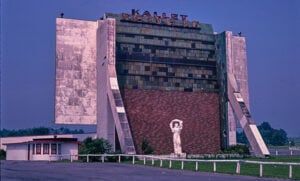
The former Kallet Drive-In, later known as the Marcy Drive-In, on Route 49 in Marcy, Oneida County, New York. Photographed by John Margolies in 1983. Courtesy of the Library of Congress.
During the middle of the 20th century, drive-in movie theaters became a familiar part of life across Upstate New York. From the suburbs of Rochester and Buffalo to the Mohawk Valley, Capital Region, Southern Tier, and North Country, huge outdoor screens lit up summer evenings. Families arrived in station wagons, teenagers met friends in parking rows, and concession stands stayed busy until the last feature ended.
Most of those theaters have now disappeared. Some lost customers to indoor multiplexes and home entertainment. Others occupied land that became far more valuable for shopping centers, office buildings, and highways. The 25 drive-ins below were real, documented theaters, and all have permanently closed. Their locations, opening years, and later histories show how thoroughly the landscape of Upstate New York has changed.
1. Starlite Drive-In (Henrietta)
Location: Henrietta, Monroe County
The Starlite Drive-In opened on June 17, 1949, at 2970 West Henrietta Road, with The Fabulous Texan and On an Island with You on the opening program. Its large parking field gave families south of Rochester a place to watch movies from their own cars during the postwar growth of the suburbs. The theater continued through the 1970s but closed after its final showing on October 16, 1983. The screen and ramps disappeared as commercial development took over the property. The site is associated today with a Delta Sonic car-care complex, a far cry from the summer-night movie crowds that once gathered there.
2. Lake Shore Drive-In (Greece)
Location: Greece, Monroe County
The Lake Shore Drive-In opened on July 1, 1950, on Ling Road near Greenleaf Road, not on East Ridge Road in Irondequoit. With space for more than 1,000 cars, it became a favorite of families from Rochester’s northwestern suburbs. The theater endured longer than the area’s other drive-ins, even as multiplexes, videocassette rentals, and suburban development changed moviegoing habits. Its final screenings took place on September 6, 1992, with Buffy the Vampire Slayer and Unlawful Entry. The former grounds are now occupied by the Lake Shore Hockey Arena. It was the last of Monroe County’s original group of drive-ins to close.
3. Sheridan Drive-In (Tonawanda)
Location: Town of Tonawanda, Erie County
The Sheridan Drive-In opened in 1951 as a single-screen operation built by the Cohen family, later associated with the still-familiar Transit Drive-In. Its first site was affected by highway construction, and the operation was moved about 1,000 feet to Ensminger Road in 1957. A second screen was added in 1970, allowing the theater to offer two programs to moviegoers from Tonawanda and northern Buffalo. It closed on October 4, 1981. Both the relocation and the later demolition show how the highways and industrial corridors that brought customers to a drive-in could also make its land valuable for other purposes.
4. Buffalo Drive-In (Cheektowaga)
Location: Cheektowaga, Erie County
The Buffalo Drive-In on Harlem Road opened on August 1, 1941, with Down Argentine Way, making it one of the area’s early outdoor theaters. It was later rebuilt and reopened in 1974 as a three-screen complex that could accommodate about 1,200 cars. Unlike many competitors, it survived the arrival of shopping plazas, indoor multiplexes, and home video. Its final night came on September 1, 2007, when moviegoers formed long lines for one more screening. Local accounts preserve the closing as the end of a familiar Erie County tradition. The former site was subsequently developed for medical offices.
5. Salina Drive-In (Nedrow)
Location: Nedrow, Onondaga County
The Salina Drive-In opened on April 20, 1954, along South Salina Street south of Syracuse. Initially built for approximately 600 cars, it later increased its capacity and operated under several theater companies, including Daytz Theatre Enterprises and National Amusements. The theater gave families on Syracuse’s south side an outdoor alternative to downtown cinemas, with a broad field of parked cars facing a single screen. The Salina closed on September 28, 1980. Although the screen was eventually removed, the documented history of its property is different from the retail redevelopments that overtook many other former drive-in sites.
6. Kallet Drive-In (Camillus)
Location: Camillus, Onondaga County
The Kallet Drive-In opened on April 20, 1946, on West Genesee Street, west of Syracuse. It was notable for its elaborate Streamline Moderne design, which included a waterfall descending the back of its screen tower, illuminated by colored lights. Theater-company records and period photographs document a far more ambitious complex than a plain movie screen in a field. The theater showed Cover Girl on opening night and ended its run in 1960. The property was later redeveloped as Camillus Plaza, then incorporated into subsequent shopping-center changes. The Kallet on this site was in Camillus, not Oneida, where the company operated other theaters.
7. Mohawk Drive-In (Colonie)
Location: Colonie, Albany County
The Mohawk Drive-In opened on June 1, 1946, on Central Avenue, an important route between Albany and Schenectady. Operated by Fabian Theatres, it became one of the Capital Region’s most recognizable roadside screens. Its large capacity and location amid growing suburbs made it a fixture of summer entertainment for decades. The theater remained in operation until 1986, when the spread of competing forms of entertainment and the value of Central Avenue property had changed its prospects. The drive-in was demolished, and the location was subsequently occupied by a Kohl’s department store. Its history reflects the wider transformation of the Albany-Schenectady commercial corridor.
8. Saratoga Drive-In (Latham)
Location: Latham, Albany County
Long before Latham’s extensive retail development, the Saratoga Drive-In welcomed cars along Route 9. It originally opened as the Auto Drive-In on May 9, 1941, and later operated under the Saratoga name. Historical listings describe room for about 465 vehicles, substantially less than the 800 cars claimed in some accounts. The theater’s final season appears to have been 1971, although traces of its layout remained visible afterward. Its site became commercial property. The Saratoga should not be confused with the separate Latham Drive-In, which opened nearby in 1970; both are genuine lost theaters with distinct histories.
9. New Hartford Drive-In
Location: New Hartford, Oneida County
The New Hartford Drive-In began on Commercial Drive as the WGAT Drive-In, named for the local radio station associated with its original ownership. It opened on October 4, 1949. Kallet Theatres purchased the property in 1955, and the cinema later became known as the New Hartford Drive-In. Drivers from Utica and its growing southern suburbs used the theater for decades as Commercial Drive became an increasingly busy shopping corridor. The venue closed in the 1980s, with historical theater sources differing about its last season. The former grounds were redeveloped for commercial use.
10. Marcy Drive-In
Location: Marcy, Oneida County
Before it was called the Marcy Drive-In, this theater opened as the Kallet Drive-In on June 27, 1947, near Routes 49 and 291. Its unusual entrance attraction was a large statue and illuminated waterfall, recalling the decorative flourishes at Kallet’s Camillus theater. It later operated under the Marcy name and continued showing movies for decades. The drive-in finally closed in 1993, much later than the 1980s date often attached to it. It was subsequently demolished as highway plans reshaped the area. The Marcy and New Hartford theaters were separate properties despite their shared connection to the Kallet chain.
11. Tri-Cities Drive-In (Endwell)
Location: Endwell, Broome County
Opened on August 21, 1946, the Tri-City Drive-In served the communities between Binghamton and Endicott along the George F. Highway. Later called the Tri-Cities and also associated with the George F. name, it was an early outdoor theater in the Triple Cities region. Advertisements document an opening program that included Cover Girl and Bells of Rosarita. The drive-in closed in 1958, and its remaining structures were gone before construction of the Southern Tier Expressway crossed the property during the 1960s. Its short life illustrates how thoroughly highway projects could erase a once-familiar entertainment site.
12. V Drive-In (Vestal)
Location: Vestal, Broome County
The V Drive-In opened on August 18, 1958, on Vestal Parkway East. One of its unusual features was an entrance road that passed beneath the screen itself. A playground near the screen was another attraction in the era when families often arrived well before dusk. The theater later came under CinemaNational and USA Cinemas management. Its final program was shown on September 7, 1987, and demolition followed in 1991 as the site was converted to a shopping plaza. The former screen location became part of one of the most developed retail strips in the Binghamton area.
13. Sunset Drive-In (Kingston)
Location: Kingston area, Ulster County
The Sunset Drive-In opened on April 26, 1949, on Route 28, the old Plank Road west of Kingston. Its original program paired The Prince of Thieves with an Abbott and Costello comedy. The theater’s screen was adapted for CinemaScope presentation in the 1950s, evidence that its operators invested in widescreen technology to compete for audiences. The drive-in eventually closed and its outdoor screen was demolished in the 1990s. A church later occupied the property, and local observers have identified the former concession building among the surviving features. This Kingston-area Sunset stood on Route 28, not Route 9W.
14. Latham Drive-In
Location: Latham, Albany County
The Latham Drive-In opened in 1970 on Route 9, close to the older Saratoga Drive-In. Its substantial single screen could be seen from nearby Interstate 87, and the theater formed part of a cluster of entertainment properties that included Hellman’s Towne Theatre. Latham’s drive-in operated through changes in management, including a period under United Artists. It closed around 1989 and remained standing, unused, for years before demolition. Its history is a useful reminder that some lost drive-ins were not immediately replaced after their last movie; empty screens could remain as neighborhood landmarks long after the concession stand stopped serving customers.
15. Northside Drive-In (Watertown)
Location: Watertown area, Jefferson County
The Northside Drive-In opened on July 20, 1950, on Route 12 north of Watertown. Opening-night promotions included flowers for women and balloons for children, a snapshot of the family-oriented marketing used by early outdoor theaters. Built by Dr. Phillip Lievig, the theater passed to another operator in 1975 and remained active through the 1988 season. Its screen was later removed, although historical accounts note remnants of the old concession and projection building. The Northside stood on Route 12, not Route 11, and should not be confused with Watertown’s separate Star-Lit Drive-In.
16. Star-Lit Drive-In (Watertown)
Location: Watertown, Jefferson County
The Star-Lit Drive-In was one of Watertown’s earliest outdoor movie theaters, opening on May 29, 1948, on Route 11. It was smaller than many postwar venues, with a reported capacity of approximately 250 cars. An opening program included Breakfast in Hollywood and Angel and the Badman. The Star-Lit continued for four decades before closing after the 1988 season. Its former grounds were later used for automobile sales. The distinction between the Star-Lit on Route 11 and the Northside on Route 12 is important because the two Watertown drive-ins are sometimes confused in recollections.
17. Plattsburgh Drive-In
Location: Plattsburgh, Clinton County
The Plattsburgh Drive-In opened on June 26, 1948, originally known as the Route 3 Drive-In. Benjamin Hobbs, who operated indoor theaters in the North Country, developed the property. It stood on Route 3 rather than Route 9 and could accommodate roughly 300 cars. The screen was adapted for CinemaScope in 1956, and the drive-in also hosted outdoor religious services. As Interstate 87 and nearby commercial development altered the district, the theater eventually ceased operating after the 1973 season. The site no longer functions as a drive-in, but the name survives in regional moviegoing history.
18. Super 87 Drive-In (Plattsburgh)
Location: Plattsburgh, Clinton County
Plattsburgh later gained another outdoor theater, the Super 87 Drive-In, which opened on June 24, 1964, near the Adirondack Northway. Its operators promoted films beyond the immediate Plattsburgh area, including advertisements in Montreal newspapers in both English and French. That connection reflected the cross-border appeal of drive-in moviegoing during a period when Quebec had restrictions on such theaters. The Super 87 operated into the 1980s before closing, and its site was subsequently redeveloped. It was a separate theater from the older Plattsburgh Drive-In, not a renamed continuation of the original Route 3 property.
19. Norwich Drive-In
Location: Norwich, Chenango County
The Norwich Drive-In opened on April 29, 1950, on Route 23,. It provided an outdoor movie option for Chenango County residents during the years when families and teenagers could spend an evening watching a double feature without leaving their cars. Historical theater records indicate that the drive-in had closed by the 1970s, although the precise final season is not securely established. The structures remained visible for some time afterward and were gone by the mid-1990s. The former property later became the site of an automobile dealership.
20. Del-Sego Drive-In (Oneonta)
Location: Oneonta area, Otsego County
The Del-Sego Drive-In opened on April 28, 1948, on Main Street outside Oneonta. Its name combined parts of Delaware and Otsego, the counties whose residents it hoped to attract. The property featured a large screen, a playground, and a miniature-golf course, giving families several reasons to arrive before the movie started. Its operators later expanded the recreational facilities, which were profiled in a 1963 theater trade publication. The Del-Sego closed in 1981. Commercial redevelopment followed, with a supermarket plaza occupying the former grounds. It was an entertainment destination for the Oneonta area long before that stretch of road became a retail corridor.
21. Allegany Drive-In
Location: Town of Allegany, Cattaraugus County
The Allegany Drive-In opened on July 8, 1949, along Route 417 near Olean, screening Arizona and a Blondie comedy. Though often remembered as an Olean-area theater, its documented name was Allegany Drive-In and its site was in the Town of Allegany. The business remained open until 1995, surviving longer than many rural outdoor theaters. The screen and main structures were later removed, but historical photographs and remains of the property still document its former use. This was not the Portville Drive-In, another Cattaraugus County operation that has continued showing films.
22. Aero Drive-In (Cheektowaga)
Location: Cheektowaga, Erie County
The Aero Drive-In opened on July 1, 1950, on Union Road near George Urban Boulevard. It provided a second outdoor choice for residents of Cheektowaga, in addition to the larger Buffalo Drive-In on Harlem Road. Its final season was 1971, before the property was incorporated into an expanding indoor-theater development known as the Holiday cinemas. The transition was unusually direct: one form of automobile-oriented moviegoing made way for a cluster of enclosed screens. A former concession building survived in later commercial use, even after the outdoor screen was gone.
23. Seneca Drive-In (Geneva–Waterloo)
Location: Geneva–Waterloo corridor, Seneca County
The Seneca Drive-In opened on June 15, 1950, along the road connecting Geneva and Waterloo, now associated with Routes 5 and 20. Its location put the screen within easy reach of Finger Lakes residents and travelers. Historical theater records show an opening bill that included Calamity Jane and Sam Bass and Blondie’s Big Deal. The closing date has been variously reported, with later research pointing to September 1987; it is safest to describe its final season as the 1980s pending an independent contemporary clipping. The former site is no longer an operating drive-in. The documented name was Seneca, not Geneva Drive-In.
24. Empire Drive-In (Webster)
Location: Webster, Monroe County
The Empire Drive-In opened on June 3, 1949, on Empire Boulevard, with the picture Mickey on its opening program. Drivers passing along the curved stretch of the boulevard could glimpse the screen, which helped make the theater a recognizable neighborhood landmark. The Empire lasted through the 1982 season, when it was sold for redevelopment as an indoor multi-screen cinema. The property later became the location of AMC Webster 12. Local historians have used its story to illustrate how outdoor movie theaters gave way not just to retail land uses but also to a different generation of movie exhibition.
25. Airport Drive-In (Cortland)
Location: Cortland area, Cortland County
The Airport Drive-In opened on July 3, 1949, on Route 222 in the Cortland area, offering a car-based alternative to downtown theaters. Film-industry directories listed it among Cortland’s outdoor cinemas, with space for about 500 vehicles. The theater operated through changing movie tastes and the growth of home entertainment before closing on August 31, 1986. Its old ramps and field outline have been noted in later historical aerial views. The Airport name recalls the location and distinguishes the theater from other roadside businesses in the Cortland area.
Drive-ins did not all disappear at once. Some closed while the outdoor-movie boom was still remembered as a recent phenomenon, while others stayed open into the 1990s or 2000s. The empty screens are gone from many commercial roads, but photographs, advertisements, and memories preserve the places where New Yorkers once watched movies under the stars.
For more New York movie history, read our articles about 10 lost Long Island drive-in theaters, 25 lost New York City movie theaters, and the Overlook Drive-In in Poughkeepsie, one of the surviving outdoor cinemas.