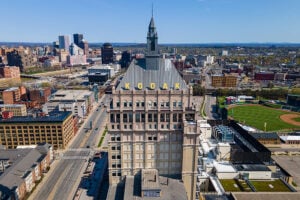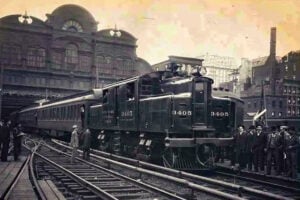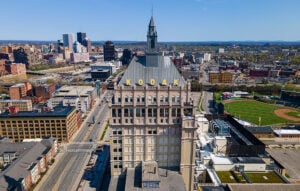
The historic Eastman Kodak headquarters overlooking Rochester, New York. Photo: Ted Shaffrey, Wikimedia Commons, licensed under CC BY-SA 4.0. Cropped from the original photograph.
Before technology companies began competing for space in California’s Silicon Valley, cities and small towns across Upstate New York produced goods that reached households and businesses across the United States. Rochester became a center of photography, optics, and later office equipment. Buffalo supplied industrial products and consumer goods. The Mohawk Valley and Southern Tier built businesses around manufacturing, agriculture, and the transportation corridors that linked inland communities with the Atlantic coast.
The Erie Canal helped make that transformation possible. Opened in 1825, it connected the Hudson River with the Great Lakes and gave manufacturers a means of moving raw materials and finished products more efficiently. Railroads later expanded those opportunities. In communities such as Canajoharie, Ilion, Troy, Endicott, and Le Roy, small businesses were able to develop customer bases far beyond the places where they started.
Many of the names associated with that industrial era are still familiar. Kodak brought photography into the family home. Xerox changed the office. Jell-O became a fixture in American kitchens. Fisher-Price helped define childhood play, and companies such as Wegmans and Stewart’s Shops turned regional businesses into institutions recognized well beyond their original communities. Other businesses on this list belong to an older manufacturing world, one in which a single factory could shape the identity and employment of an entire town.
Not every familiar corporation with a major Upstate factory actually started in the region. General Electric’s Schenectady works, Corning’s glassmaking operations, and Carrier’s Syracuse manufacturing history are enormously important, but their corporate origins are more complicated than a simple Upstate birthplace. This article concentrates instead on brands, businesses, or direct corporate predecessors that genuinely originated in Upstate New York. Where the current name arrived later, that distinction is part of the story.
The following 25 brands stretch from nineteenth-century workshops to twentieth-century supermarkets and a modern yogurt business established in a former dairy plant. Their products could hardly be more different, but each began with a company or commercial idea rooted in Upstate New York. Together, they reveal just how widely the region’s entrepreneurs influenced the ways Americans worked, shopped, ate, traveled, and lived.
1. Kodak
Origin: Rochester, Monroe County
George Eastman started commercially manufacturing photographic dry plates in Rochester in 1880. His business grew from a specialized photographic supplier into a company determined to put cameras in the hands of ordinary people. In 1888 he introduced the Kodak camera, a name designed to be short, memorable, and easy to recognize. Its factory-loaded film and return-for-processing service reduced the technical work that had discouraged many would-be photographers.
Eastman understood that the camera itself was only part of the business. Film, developing, photographic paper, and the machinery required to make them created demand for enormous manufacturing facilities in Rochester. Kodak Park became one of the great industrial sites of the twentieth century, employing generations of workers and supplying both amateur photographers and professional studios.
Kodak film was also fundamental to Hollywood and to scientific and commercial imaging. Rochester engineers later helped develop digital photography, although the shift away from film would severely disrupt the company’s traditional business. The familiar yellow Kodak packaging remains one of the clearest reminders of how a Rochester enterprise changed the way people recorded their lives.
2. Xerox
Origin: Rochester, Monroe County
Xerox began as the Haloid Company, founded in Rochester in 1906 to manufacture photographic paper. For decades its business was modest compared with the area’s dominant photographic manufacturers. Haloid’s leaders eventually recognized an opportunity in Chester Carlson’s process for making copies using electrical charges and powdered toner rather than conventional wet photographic methods.
The technology had not been invented in Rochester, but the difficult work of developing it into a reliable commercial system became central to Haloid’s future. The company adopted the name xerography for the process and introduced the Xerox 914 plain-paper copier in 1959. The machine transformed a time-consuming office chore into something workers could accomplish in moments.
The Haloid name gave way to Xerox as the copier became a business success. The company expanded research and manufacturing activity in the Rochester region, including Webster, while the word Xerox became familiar across offices, schools, and libraries. It is an unusual American brand story: a small Upstate paper supplier took a chance on a largely unproven invention and helped create an entirely new office technology market.
3. IBM
Origin: Endicott, Broome County
IBM’s origins involve several businesses rather than a single inventor setting up one shop. In 1911 financier Charles R. Flint combined companies making tabulating machines, scales, and time-recording equipment into the Computing-Tabulating-Recording Company. The new business established its headquarters in Endicott, a Southern Tier village with an existing time-recording industry.
One important predecessor was the International Time Recording Company, whose roots included the Bundy time-clock business in the Binghamton area. Under Thomas J. Watson Sr., C-T-R brought its different lines of mechanical business equipment under a more unified corporate identity. In 1924 the company formally adopted the name International Business Machines.
Endicott became associated with punched cards, tabulators, employee training, and the engineering culture that supported IBM’s expansion into computing. The corporation later developed important operations far beyond Broome County, but its early headquarters and industrial base make Endicott’s claim to the IBM story historically substantial. The village is still widely remembered as the birthplace of IBM.
4. Beech-Nut
Origin: Canajoharie, Montgomery County
Beech-Nut traces its beginnings to an 1891 food-packing business in Canajoharie, beside the Mohawk Valley transportation corridor. The original enterprise, known as Imperial Packing, was established to prepare and sell meat products, including ham and bacon. Raymond P. Lipe and other local business figures were involved in its earliest development, while Bartlett Arkell subsequently became an important force behind its expansion.
Under the Beech-Nut name, the company’s reputation expanded beyond cured meats. Its catalog eventually included candy, chewing gum, coffee, and other packaged foods. In the 1930s, baby food became an increasingly important line. For families throughout the country, Beech-Nut jars came to represent a recognizable category of manufactured food; for Canajoharie, the plant was a major employer and part of the community’s everyday life.
The company later moved its primary baby-food manufacturing activity to the nearby Amsterdam area. That change did not erase Canajoharie’s place in the brand’s beginnings. Beech-Nut remains one of the Mohawk Valley’s strongest examples of a small local enterprise becoming a national household name.
5. Remington
Origin: Ilion Gulch and Ilion, Herkimer County
The Remington name in firearms manufacturing began in 1816, when Eliphalet Remington Jr. made a rifle barrel in the Ilion Gulch area of Herkimer County. The Remington family’s forge soon began receiving requests for additional barrels and related metalwork. What started as a local workshop grew as the Erie Canal opened more convenient ways to ship products from the Mohawk Valley.
In 1828 Remington manufacturing moved closer to the canal in Ilion. Over the nineteenth century, the enterprise became E. Remington & Sons and developed into a major industrial employer. Its products included rifles and other firearms; in the 1870s, the Ilion operation also began manufacturing the Sholes and Glidden commercial typewriter, connecting the company’s machinery to an entirely different industry.
The Remington name passed through changing corporate structures and ownership over the following century. The historic Ilion factory’s closure in 2024 marked an especially significant local industrial loss. Whatever the future of products bearing the name, the manufacturing story began with a Mohawk Valley forge and remained closely identified with Ilion for more than two centuries.
6. Bausch & Lomb
Origin: Rochester, Monroe County
John Jacob Bausch opened an optical goods shop in Rochester in 1853. Its beginnings were modest: he made and sold spectacles at a time when optical instruments were expensive and manufacturing processes were often labor-intensive. A loan from his friend Henry Lomb helped keep the enterprise operating, and Lomb later became Bausch’s business partner.
An early success came from spectacle frames made with vulcanite, a durable form of hard rubber. That innovation opened the way for a larger optical manufacturing business producing microscopes, binoculars, photographic equipment, and precision lenses. In the twentieth century, Bausch & Lomb became known for technologies used in science, medicine, industry, and consumer products.
The company’s later history included Ray-Ban sunglasses and the introduction of soft contact lenses in 1971. Like Kodak and Xerox, Bausch & Lomb demonstrates how Rochester developed a concentration of expertise in optics and related manufacturing. Its international reputation grew out of a small Upstate storefront.
7. Champion
Origin: Rochester, Monroe County
Champion began in Rochester in 1919 as Knickerbocker Knitting Mills, founded by members of the Feinbloom family. The firm first produced sturdy knitwear, with growing interest in clothing suited to athletes and students. During the 1920s the family adopted the Champion name and began building relationships with schools and sporting organizations.
The brand’s strongest identity came from functional athletic clothes. Champion became known for sweatshirts and uniforms designed to withstand frequent washing and hard use. Its Reverse Weave process, introduced in the 1930s, helped limit the shrinkage associated with conventional fleece garments. What started as performance clothing would eventually become part of everyday American dress.
By the late twentieth century, Champion sweatshirts could be found well beyond locker rooms and school campuses. The brand’s influence on sportswear and casual fashion made it an international name, but its industrial ancestry belongs to Rochester’s textile manufacturers and the Feinbloom family’s original knitting business.
8. Chobani
Origin: South Edmeston, Town of Columbus, Chenango County
Chobani’s story began in 2005 when Hamdi Ulukaya bought a shuttered former Kraft yogurt factory in South Edmeston, a small community in Chenango County. Ulukaya, an immigrant from Turkey, saw an opportunity to introduce a thicker, strained yogurt to an American market then dominated by different styles of yogurt. He assembled a small team, including workers with experience at the former factory, to develop a product and restart production.
After extensive recipe development, the first Chobani Greek yogurt reached store shelves in 2007. The brand grew quickly through supermarkets, giving many American shoppers their first regular encounter with Greek-style yogurt. Rather than beginning in a large urban corporate office, the company emerged from a rural dairy-processing facility that might otherwise have remained empty.
Chobani’s expansion brought production and investment to locations beyond New York, but the South Edmeston plant remains central to its history. Its rise is a more recent example of Upstate entrepreneurship, built around food manufacturing and the skills of a regional workforce rather than the heavy industries usually associated with New York’s industrial past.
9. Fisher-Price
Origin: East Aurora, Erie County
Fisher-Price was established in East Aurora in 1930, during the Great Depression. Herman Fisher, Irving Price, and Helen Schelle brought business and retail experience to a company devoted to children’s toys. Illustrator Margaret Evans Price also contributed creative work to the early enterprise. Instead of treating toys as disposable novelties, the company emphasized play value, durability, and attractive design.
Its original wooden toys became popular with parents who wanted products that children could handle repeatedly. Bright colors, wheels, moving parts, and memorable animal characters helped the company develop a distinctive identity. Later generations associated the brand with the Corn Popper, Little People, play telephones, and many other familiar childhood objects.
Fisher-Price eventually became part of larger corporate organizations, including Mattel, and its product lines changed with developments in plastics and toy technology. Yet East Aurora remains a crucial place in the company’s history, where a small group of founders built one of America’s most familiar names in children’s products.
10. Arrow Shirts
Origin: Troy, Rensselaer County
Troy’s shirt and collar industry grew because clean, replaceable collars offered a practical answer to the laundry demands of nineteenth-century men’s clothing. Local manufacturers developed an industrial specialty in making detachable collars and cuffs. Among them was a business that evolved into Cluett, Peabody & Co., the firm associated with the Arrow name.
The Arrow brand emerged in Troy in the nineteenth century and eventually moved from collars into a broad range of men’s shirts. Its advertising became as influential as its products. Illustrator J. C. Leyendecker’s Arrow Collar Man, introduced in the early 1900s, helped make the brand a symbol of fashionable American menswear.
Factories connected with Cluett, Peabody employed large numbers of Troy residents, supporting the city’s identity as the Collar City. The industry’s later contraction changed the local economy, but Arrow’s beginnings remain inseparable from Troy’s nineteenth-century textile and garment-making tradition.
11. Oneida Tableware
Origin: Oneida and Sherrill, Madison County
The corporate origins of Oneida tableware lie in the Oneida Community, established in Madison County in 1848 under John Humphrey Noyes. The religious and social community operated several businesses, eventually turning toward the manufacture of cutlery. The first spoon production took place at its Wallingford, Connecticut, branch in 1877, an important distinction in the company’s early history.
When the original community reorganized into a joint-stock business in 1880, the enterprise became Oneida Community, Ltd. Over time, the company’s silver-plated tableware and Community Plate lines became widely recognized. Manufacturing eventually concentrated in New York, including the Sherrill area, where the company became a major source of industrial employment.
The Oneida name therefore came out of an Upstate New York community and corporation, even though its first spoonmaking occurred at a Connecticut branch. Its history also reveals how an unusual nineteenth-century social experiment gave rise to a business brand that appeared on dining tables across the United States.
12. Mott’s
Origin: Bouckville, Madison County
Samuel R. Mott began an apple-processing business in Bouckville in 1842. Situated in an agricultural region connected to wider markets by canals and roads, the operation made use of New York’s apple harvests and developed methods for preparing and preserving fruit products. The family enterprise preceded the packaged applesauce and juice products that later made the Mott’s name so familiar.
The business changed as generations of family members and subsequent owners expanded production. It eventually combined with other fruit-processing operations as the Duffy-Mott Company in 1914. Facilities in western New York, including the state’s Lake Ontario fruit-growing belt, became important to its later operations.
Today Mott’s is associated especially with applesauce, apple juice, and family lunchboxes. The brand’s long life illustrates how New York agriculture and preservation technology could build a lasting consumer-products business from a small nineteenth-century mill.
13. Utica Club
Origin: Utica, Oneida County
The company behind Utica Club has its origins in Utica’s West End Brewing Company, reorganized in 1888 by German-born brewer Francis Xavier Matt. The Mohawk Valley city had a substantial brewing culture, and the Matt enterprise became one of its best-known survivors. Like other American breweries, it faced extraordinary difficulties during Prohibition and relied on permitted alternative products to remain in business.
Utica Club beer emerged as a signature post-Prohibition brand and became deeply associated with Central New York. Later advertising featuring the talking beer steins Schultz and Dooley gave Utica Club a memorable personality, while the brewery’s regional distribution made it a familiar name in restaurants, bars, and homes.
The Matt family enterprise eventually developed additional product lines, including Saranac. Those are related brands from the same brewery, not separate company origins for the purposes of this list. Utica Club stands here as the best-known expression of a brewing business that began in Utica long before the brand gained its national recognition.
14. Endicott Johnson Shoes
Origin: Johnson City and Endicott, Broome County
The industrial enterprise eventually known as Endicott Johnson grew out of the Lestershire shoe-manufacturing business in Broome County. Henry B. Endicott and George F. Johnson played central roles in building it into a large regional concern. The company’s identity was closely connected to the communities of Lestershire, later Johnson City, and Endicott.
George F. Johnson developed what he called a program of industrial democracy. Workers and families benefited from community facilities and services that included parks, recreation, and forms of medical assistance. The approach was not free of paternalism, but it distinguished the enterprise from many of the harsher manufacturing systems of its time.
The business adopted the Endicott-Johnson Shoe Corporation name in 1919 and became one of the country’s major shoe manufacturers. Its factory towns, surviving buildings, and public carousels are reminders of an era when footwear manufacturing helped define much of the Southern Tier’s economy.
15. Genesee Beer
Origin: Rochester, Monroe County
The Genesee brewing name began in Rochester in 1878 when entrepreneur Mathius Kondolf purchased an existing brewery and renamed it the Genesee Brewery. The city’s immigrant communities, saloons, and industrial workforce helped sustain an active nineteenth-century brewing business. The Genesee River became both a geographic landmark and an enduring part of the brand’s identity.
The company passed through ownership changes and faced the disruptions of Prohibition. During the twentieth century, the Genesee name became increasingly associated with products such as Genesee Beer and Genesee Cream Ale. The Wehle family’s role in rebuilding and expanding the enterprise became an important chapter in its modern history.
Unlike many historic manufacturing names that disappeared from their home cities, Genesee remains strongly identified with Rochester. Its brewery and prominent signage continue to connect a contemporary beverage brand with the city’s nineteenth-century industrial landscape.
16. Jell-O
Origin: Le Roy, Genesee County
Jell-O was created in Le Roy in 1897 by Pearle Wait, who developed a flavored gelatin dessert. His wife May is traditionally credited with suggesting the name. Although the idea ultimately became one of America’s most famous packaged foods, the Waits initially struggled to establish a market for it.
In 1899 the couple sold the business and name to Orator Francis Woodward for $450. Woodward’s company developed national advertising campaigns and recipe booklets that helped teach families how to use a product that was new to many kitchens. Jell-O eventually became closely identified with desserts, celebrations, and the growth of packaged convenience foods.
The brand outgrew the village and its original manufacturing home, but Le Roy has continued to celebrate the connection through local historical interpretation. Jell-O is an especially striking example of a small-town Upstate invention becoming part of the national food vocabulary.
17. Wegmans
Origin: Rochester, Monroe County
Wegmans originated in Rochester in 1916, when John Wegman began a produce business that became the foundation of the later supermarket company. His brother Walter joined him as the operation expanded. The original enterprise was much closer to a local fruit and vegetable dealer than to the large stores for which Wegmans is now famous.
During the twentieth century the family developed larger markets that brought produce, meat, baked goods, and other departments together in one shopping trip. New ideas in store layout, refrigeration, food preparation, and customer service helped distinguish the business. The Rochester chain gradually developed a reputation that extended far beyond western New York.
Wegmans is now associated with expansive supermarkets and a strong store-brand identity, but it remains a family business with an especially visible connection to its Rochester beginnings. Its history is a reminder that Upstate New York’s famous brands did not all emerge from factory floors; some began in neighborhood food retailing.
18. French’s Mustard
Origin: Rochester, Monroe County
French’s yellow mustard grew from the R. T. French Company’s food and spice business, which became closely associated with Rochester. Brothers George and Francis French introduced the bright yellow prepared mustard that made the family name nationally recognizable at the 1904 St. Louis World’s Fair.
The mustard’s color, mild flavor, and convenient packaging helped it find a place alongside hot dogs and other familiar American foods. Rochester became identified with the brand’s industrial operations, and Mustard Street was a local reminder of the business that once operated there. Over time, ownership and production moved away from the city.
French’s survives as a national condiment name, now part of a larger food company. Although its first famous public presentation occurred at a world’s fair outside New York, the company and product development behind the brand were rooted in Rochester.
19. New Era Cap
Origin: Buffalo, Erie County
New Era Cap was established in Buffalo in 1920 by German immigrant Ehrhardt Koch. He began with fashion caps rather than the baseball headwear most people now associate with the company. Its earliest workshop operated in the city, and the business became a family enterprise as Koch’s son Harold joined him.
As American sporting culture expanded, New Era turned toward baseball caps. It supplied professional clubs and developed the fitted 59FIFTY style that became particularly important to the company’s identity. The cap moved from a practical item worn by players into a major part of streetwear and fan fashion.
The company later built manufacturing operations in the Buffalo region and expanded its relationships with professional sports leagues. The New Era name may be visible at ballparks across the country, but its first decades belonged to a Buffalo hatmaking business.
20. Ragú Pasta Sauce
Origin: Rochester, Monroe County
Ragú’s American story began with Assunta and Giovanni Cantisano, Italian immigrants who settled in Rochester. The family grew ingredients and prepared tomato sauce from its own recipes, selling the product locally during the Great Depression. In 1937 the sauce business took shape as a commercial enterprise.
Sales gradually expanded beyond the Cantisano household. The first Ragú factory opened in Rochester in the 1940s, giving the family the capacity to distribute jarred pasta sauce more widely. As supermarkets offered increasingly large selections of packaged foods, Ragú helped make ready-to-use Italian-style tomato sauce a common American pantry item.
The brand eventually became part of larger corporate portfolios, and its manufacturing geography changed. Its origin, however, is not in Italy or in a national corporate headquarters. It is in a Rochester family’s effort to share a sauce that had first been made for its own table.
21. TRICO Windshield Wipers
Origin: Buffalo, Erie County
TRICO’s roots reach back to Buffalo in 1917, when John R. Oishei established the Tri-Continental Corporation. The company’s early products addressed a growing problem for motorists: keeping the windshield clear in rain and snow. As automobile travel increased, reliable visibility became a practical safety concern rather than a luxury.
The firm developed and marketed windshield-cleaning products, including the Rain Rubber wiper, and over the following decades introduced improvements in motors, blade systems, and washers. Its work became part of the equipment drivers took for granted whenever the weather turned bad.
Buffalo was not simply a sales address for TRICO. Manufacturing and engineering there made the company an important local industrial employer for many years. It is a less glamorous consumer brand than a camera or a toy, but its influence on the everyday automobile was enormous.
22. Cutco
Origin: Olean, Cattaraugus County
Cutco knives began being manufactured in Olean in 1949. The name was derived from Cooking UTensil COmpany, and the early business was associated with the Wear-Ever and Alcoa organization. Its central product was a line of kitchen knives intended to combine durable construction with a recognizable handle design.
Over time Cutco developed distinctive features, including its wedge-lock handle and recessed cutting edge. Direct selling became a major part of the business’s distribution model, bringing the products into American homes through individual sales representatives. The company also promoted long-term service and sharpening as part of the customer relationship.
In 1982 a management buyout helped establish the privately owned business that continued operating in Olean. The company’s history shows how a branded product made in a relatively small Southern Tier city could build a national market through a combination of manufacturing, design, and unconventional sales methods.
23. Stewart’s Shops
Origin: Ballston Spa, Saratoga County
Stewart’s Shops traces its retail beginnings to 1945, when members of the Dake family purchased a dairy and ice cream business in Ballston Spa from Donald Stewart. The Dakes already had experience in dairy operations, and the storefront helped turn ice cream production into a direct relationship with customers.
The family expanded the concept into additional shops, emphasizing fresh dairy products, ice cream, coffee, and everyday convenience purchases. Stewart’s eventually became a familiar stop in communities throughout eastern and northern New York. Its identity was closely tied to smaller towns, local employees, and the idea that a convenience store could also be a neighborhood gathering place.
Later growth brought fuel pumps and a wider range of products, but Stewart’s retained the name of the little business acquired in Ballston Spa. The chain is an example of an Upstate company whose regional reputation became its chief strength rather than a limitation.
24. Price Chopper / Market 32
Origin: Capital Region, including Green Island and Schenectady
The supermarket business that became Price Chopper grew out of the Golub family’s grocery trade in the Capital Region. In 1932, William and Bernard Golub and business partner Joseph Grosberg began developing stores under names that soon became associated with Central Market. One early location was in Green Island, followed by additional stores in nearby communities.
The business introduced new supermarket practices and expanded through eastern New York and neighboring states. In the 1970s the company adopted the Price Chopper name as it emphasized value and competitive grocery pricing. The later Market 32 identity deliberately recalled the company’s founding year and its longstanding place in regional retailing.
The stores subsequently became part of a larger organization that also included Tops Friendly Markets. Even with those corporate changes, the chain’s commercial roots remain firmly in Upstate New York. Its development mirrors the transformation from neighborhood grocery shops into modern, full-service supermarkets.
25. Paychex
Origin: Rochester, Monroe County
Paychex began in Rochester in 1971 when B. Thomas Golisano launched a payroll-services business called Paymaster. Starting with limited capital and a relatively small client base, he concentrated on helping small and medium-sized employers handle payroll work that was often complicated and time-consuming.
The company expanded through franchises and partnerships and eventually consolidated its operations under the Paychex name. Technology and changes in workplace administration allowed it to offer employers a growing collection of services beyond processing paychecks, including human-resources and benefits-related support.
Unlike Rochester’s celebrated nineteenth-century factories, Paychex is a service-industry success from the late twentieth century. Its beginnings nevertheless fit the same regional pattern: a local company developed a specialized product for customers across the country and helped make Rochester a place associated with another nationally familiar business name.
These companies and brands followed very different paths. Some remained tied to their original communities, while others changed owners, closed factories, or expanded far beyond New York State. Their shared history is the way an idea, product, or enterprise developed in Upstate New York became familiar to people who might never have visited the place where it began.
For more background on the transportation and inventiveness that supported these businesses, read our history of the Erie Canal and 20 Inventions and Innovations From Upstate New York That Changed the World.