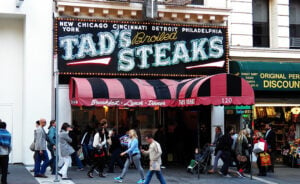
Tad’s Steaks at 120 Powell Street in San Francisco, photographed in 2012. Photo: Victor Solanoy / Wikimedia Commons, CC BY 2.0.
For more than six decades, the neon marquee and sizzling open-flame charbroilers of Tad’s Steaks were as essential to the visual and sensory vocabulary of Midtown Manhattan as yellow cabs and Broadway theater lights. Operating as a high-volume, cafeteria-style chophouse, Tad’s occupied a singular, populist niche in New York City’s culinary ecosystem: an unpretentious, cut-rate sanctuary where working-class laborers, theatergoers on a strict budget, and generations of frugal tourists could secure a steak dinner for a fraction of the cost charged by traditional establishments.
Whatever happened to Tad’s Steaks? Its final New York City restaurant, at 761 Seventh Avenue near Times Square, closed on January 5, 2020, after decades of mounting economic pressures and the gradual disappearance of its other Manhattan locations. The chain that once operated eight restaurants in New York had already dwindled to that one survivor. But the name did not disappear completely: a separately operated Tad’s Steakhouse continues to serve customers in San Francisco, the city where the concept originated.
The closing marked the end of a distinctive chapter in New York City dining. At Tad’s, customers did not have to dress for an expensive steakhouse, wait for a server to take an order, or spend an evening over dinner. They could watch steaks cooking over the flames through the front window, carry their meals on cafeteria trays, and take a seat amid dark red decorations and imitation Tiffany lamps. The appeal was partly economic and partly theatrical. The steak was the attraction, but so was the feeling that an ordinary customer could afford to eat in the middle of Manhattan.
Understanding why Tad’s disappeared from New York means looking at the unusual business model that made it successful, the changes in the neighborhoods where its restaurants operated, and the financial decisions that eventually ended an enterprise built around the promise of an inexpensive steak.
How Tad’s Steaks Began
The concept that ultimately changed urban budget dining was born thousands of miles from the East Coast. During the mid-1950s, brothers Donald and Neal Townsend developed Tad’s Steaks with their business associate Alan Tadeus Kay. The restaurant took its name from Kay’s middle name. The first location operated on Powell Street in San Francisco, where the affordable steak concept found a receptive audience. The surviving San Francisco restaurant traces its history to 1955, although accounts of the early chain sometimes use 1957, the year associated with its expansion and famous low-price dinner.
The Townsends recognized an opportunity between two established forms of dining. Traditional steakhouses catered to customers willing to pay for substantial meals, table service, and a leisurely evening. Cafeterias and lunch counters could feed people quickly and inexpensively, but steak was not usually the central attraction. Tad’s combined the two ideas. The meat would be cooked in front of the customer, the meal would include familiar side dishes, and almost everything associated with expensive restaurant service would be removed.
One of the earliest advertised steak dinners cost just $1.09, a remarkably low figure even in an era when restaurant meals were considerably cheaper than they are today. The familiar combination included steak, a baked potato, salad, and garlic bread. What Tad’s was selling was not a prime cut in a luxurious dining room. It was the opportunity to order something associated with a special night out at a price that ordinary people could manage.
The idea proved successful enough to move beyond California. Tad’s became a recognizable name in major American cities, including New York, Chicago, Philadelphia, Detroit, Cincinnati, and St. Louis. Eventually, the chain reached approximately 28 restaurants nationwide. New York City would become one of its most important markets.
When Tad’s Steaks Came to New York City
Tad’s expanded into New York in the late 1950s, establishing a presence around the busy commercial and entertainment streets of Midtown Manhattan. The restaurant at 761 Seventh Avenue, near West 50th Street, opened in 1960. It would eventually become the last surviving New York location, but for years it was one of several branches competing for customers in some of the most heavily traveled neighborhoods in the city.
During its most successful period, Tad’s had eight New York restaurants. Its signs could be found around Times Square, along West 34th Street near the department-store district, and in the Union Square area. Locations near theaters, offices, transit stations, and shopping streets gave the chain access to a broad and constantly changing clientele. A New Yorker looking for a quick dinner could stand in the same line as a visitor who had come into Manhattan for a Broadway show.
That location strategy helps explain why the chain became such a memorable part of the city. Tad’s was not a destination requiring an advance reservation. It was something people happened upon while moving through New York. The signs, the front-window grills, and the smell of cooking meat advertised the restaurant to thousands of pedestrians before they ever considered looking at a menu.
There was even a Tad’s presence at the 1964 New York World’s Fair in Flushing Meadows, part of the chain’s larger attempt to serve people who wanted a familiar, affordable meal while attending major public attractions. The company’s New York identity extended well beyond a single Times Square storefront.
The Steak Show and the Business of Selling Cheap Meals
The most visible element of the Tad’s strategy was what Donald Townsend called the “steak show.” Gas-fired charbroilers were positioned prominently near the front windows, turning the preparation of food into a sidewalk attraction. Customers could watch cooks handling multiple steaks at once while flames rose from the grill. The cooking process itself functioned as advertising.
Inside, the operational workflow was designed for speed. Customers entered a cafeteria-style line, made their selections, and carried their food to a table on a tray. A typical meal included a steak, a baked potato or another starch, salad, and garlic bread. There was no need for the large dining-room staff associated with a conventional steakhouse. The company could turn over seats quickly while keeping its menu and preparation process relatively simple.
The surroundings were intentionally more elaborate than the service. Red flocked wallpaper, ornate lettering, imitation Tiffany lamps, and richly colored decorations offered a deliberately theatrical version of old-fashioned luxury. A customer was not paying for a fine-dining experience, yet Tad’s made a point of giving the restaurant a distinct visual identity. Its garishness became part of its personality.
Keeping a steak dinner cheap required the business to watch its food and labor costs closely. The chain used economical cuts and methods intended to make them acceptable to customers, rather than presenting the aged prime beef associated with the city’s celebrated chophouses. Reviews over the years were often less than flattering about the tenderness of the meat, but the value and experience continued to attract a loyal audience.
There was a larger influence as well. The success of inexpensive, standardized steak dinners helped demonstrate that a restaurant could build a business around a narrow menu and simplified operations. Other budget steakhouse concepts, including the early Sizzler model, developed during the same period. Tad’s belonged to a broader transformation of American restaurant dining in which speed, consistency, and price mattered at least as much as formal service.
An Unusual Tad’s Experiment on East 42nd Street
The Townsends were not interested only in selling steak. In 1963, The New Yorker reported on another Tad’s venture at 18 East 42nd Street, where the company experimented with self-service meals that customers heated in microwave ovens located at their tables. It was an ambitious attempt to push the labor-saving idea behind cafeteria dining even further.
The proposed system relied on meals prepared and frozen in advance, then brought back to serving temperature by the diner. Neal Townsend described a kitchen operation in the basement that could prepare food for additional restaurants if the experiment succeeded. He believed that rising labor and food costs would transform the entire restaurant industry.
That microwave concept did not replace the familiar grill-front steakhouse, but it reveals how aggressively the company was searching for ways to reduce costs and serve large numbers of people. Decades before modern fast-casual chains popularized streamlined service and assembly-line ordering, Tad’s was testing how far a restaurant could go in minimizing the traditional dining-room experience.
The 1988 Sale to the Riese Organization
By the late 1980s, Tad’s entered a different corporate era. In 1988, Donald and Neal Townsend sold the restaurant business to the Riese Organization, an established New York restaurant operator with extensive holdings in the city. The sale was not simply an informal transfer of a few surviving restaurants. It was a substantial corporate transaction documented in later litigation involving Tad’s shareholders.
A 1996 Delaware Court of Chancery decision records that the sale was completed on May 4, 1988. Riese paid $9.75 million for the restaurant business, after the proposed price was renegotiated following the 1987 stock market crash. The court also described separate consulting and noncompetition agreements involving the Townsend brothers. At the time of the transaction, Tad’s owned six low-cost steakhouses in the New York metropolitan area.
Riese was experienced at operating restaurant businesses in valuable urban locations. Under its ownership, Tad’s continued to serve a loyal customer base, but the economic circumstances surrounding Manhattan dining were changing. The neighborhoods where the chain had prospered were becoming increasingly expensive, while restaurant customers had a widening selection of fast-food, casual-dining, and takeout alternatives.
The sale did not cause every restaurant to close at once. Tad’s survived for more than three decades afterward in New York. Nevertheless, the Riese years became the period in which the once-large network gradually contracted toward a single remaining location.
Why Tad’s Steaks Began Disappearing From Manhattan
The very mechanics that fueled Tad’s mid-century ascent became harder to sustain in a changing city. The chain’s model depended on selling large numbers of inexpensive meals. A traditional steakhouse could charge premium prices for its food, service, and atmosphere, but Tad’s had made low prices the defining element of its appeal. Raising them too far risked changing the identity that made the restaurants successful in the first place.
Manhattan’s commercial transformation placed additional pressure on that formula. Times Square, once filled with inexpensive entertainment businesses and modest dining options, experienced substantial redevelopment and rising commercial expectations. The same highly visible corners that drew customers to Tad’s also became valuable sites for businesses capable of generating much greater revenue. Such changes made a low-margin operation increasingly difficult to justify.
Food and labor costs were another challenge for a business selling steak at a discount. By the late 1980s, entrees were commonly priced several dollars rather than the famous original $1.09. The chain kept its bargain identity into the 21st century, but menu pricing gradually increased. In 2014, restaurant critic Robert Sietsema found a steak special advertised at $8.69 at the remaining Seventh Avenue restaurant. By the time the closing was announced in 2019, the least expensive steak offering was still around $9, although meals with additional items could cost considerably more.
Meanwhile, changing tastes altered how people judged the restaurant. What earlier generations appreciated as inexpensive and amusingly extravagant could seem worn or outdated to later customers. The heavy red decor and thin steaks, once central to the identity of Tad’s, increasingly belonged to a style of dining that was disappearing from Midtown. Yet that same old-fashioned character remained the reason nostalgic customers returned.
There was no single documented cause behind the disappearance of every branch. Individual leases, real estate conditions, competition, and operating decisions could differ from location to location. What is clear is that Tad’s became progressively less common as the city’s economy and restaurant industry changed.
The Last Tad’s Steaks Restaurant in New York City
As locations closed across Manhattan, the Seventh Avenue restaurant became an increasingly rare survivor. The old 42nd Street branch was gone by 2004, and the remaining city restaurants also disappeared over time. By the middle of the 2010s, the location at 761 Seventh Avenue, near West 50th Street, was the last place in New York where customers could still experience Tad’s familiar cafeteria line and front-window grill.
For its final years, that branch operated as a living time capsule of mid-century Manhattan dining. Broadway workers, nostalgic New Yorkers, and visitors on a budget could still watch steaks broiling in the window before carrying their meals through the dining room. The restaurant had undergone changes, but its unmistakable identity survived: the bright sign, red interior, affordable meat, and rapid service.
In October 2019, news emerged that the restaurant would close early the following year. Reporting on the announcement cited a government filing referring to economic difficulties. Although rising costs and changes in Midtown help explain the larger decline, it would be misleading to treat any single unverified lease explanation as the definitive cause of the final closure.
On Sunday, January 5, 2020, Tad’s Steaks served its final customers in Manhattan. Some longtime patrons came specifically to have one last meal, recalling family visits and decades of inexpensive dinners in the Theater District. The loss was not simply another change in the restaurant lineup. For people who had known Tad’s since the 1960s, 1970s, or 1980s, it was the disappearance of a recognizable piece of the city itself.
Does Tad’s Steaks Still Exist Anywhere?
Yes. The New York City chain is gone, but Tad’s Steakhouse continues to operate in San Francisco under separate ownership. The surviving restaurant moved from its longtime Powell Street location to nearby Ellis Street and retains its connection to the original California business. Its current location is listed at 38 Ellis Street, San Francisco.
The continued operation of that restaurant is an important distinction. The closing of the last New York location ended Tad’s as a Manhattan institution; it did not mean the name or the steakhouse concept disappeared from the United States. The San Francisco business also has its own contemporary menu and prices, so customers should not expect to find the original $1.09 dinner.
For New Yorkers, however, Tad’s belongs to the history of a city in which an inexpensive steak dinner could once be found near some of Manhattan’s busiest theater and shopping streets. Its disappearance illustrates what happens when the commercial conditions that support a familiar type of restaurant gradually vanish. The original chain’s final Manhattan grill may have gone dark in January 2020, but the image of steak cooking behind the window and customers moving through the cafeteria line remains a memorable part of New York’s restaurant history.
Readers interested in the changing world of affordable American restaurant chains can also explore our histories of Ponderosa Steakhouse and Howard Johnson’s restaurants, two other familiar names whose stories reflect major changes in New York dining.