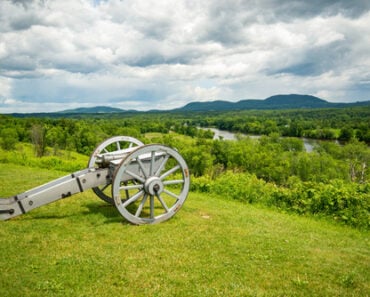
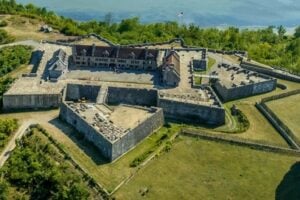
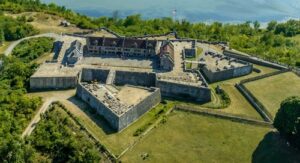
 Aerial view of historic Fort Ticonderoga overlooking Lake Champlain in Essex County, New York. Photo: tokar / Shutterstock.com.
At the southern end of Lake Champlain, near the place where the waters of Lake George begin their journey north through the La Chute River, stands one of the most important military landmarks in New York State. Fort Ticonderoga has been associated with French soldiers, British armies, American revolutionaries, and the difficult geography that made this corner of the Adirondacks strategically valuable long before the United States existed.
For centuries, the lakes and rivers running between the Hudson Valley and the St. Lawrence River offered a practical route through a region where mountains and forests made overland travel difficult. Anyone moving between the two river systems had to negotiate several stretches of land, including the portage around the falls between Lake George and Lake Champlain. The route was important to Indigenous peoples long before Europeans built forts along it. Later, rival colonial powers recognized how the same geography could help armies and supplies move between Canada and the English colonies.
The French began building the stronghold they called Fort Carillon in 1755. Four years later, the British occupied it and gave it the name Fort Ticonderoga. In May 1775, Ethan Allen, Benedict Arnold, and American forces captured the fort from a small British garrison, seizing artillery that helped George Washington force the British to evacuate Boston. The British regained the position in 1777, when the Americans discovered that nearby high ground made their defenses vulnerable.
That sequence of victories and reversals is one reason Fort Ticonderoga deserves an article of its own. Its history was never simply a story about a fortress that could not be taken. Control depended on supplies, the surrounding hills, the movement of ships, and decisions made far beyond the stone walls. Today, the restored fort and its surviving historic landscape allow visitors to explore the events that made the Lake Champlain corridor so important to the history of New York and North America.
Why the Lake Champlain Corridor Was So Important
Lake Champlain runs north toward the Richelieu River and the St. Lawrence, while Lake George reaches south toward the Hudson River watershed. The two lakes are connected by the La Chute River, but its falls and rapids historically made it unsuitable for continuous boat travel. Canoes, boats, and cargo had to be carried over land between navigable stretches of water. Another portage was needed between the southern end of Lake George and the Hudson near Fort Edward.
This combination of waterways and portages created one of the most useful north–south travel corridors in the Northeast. Indigenous communities knew and used it for generations, and the region’s history cannot be reduced to the later struggle between France and Britain. The place name Ticonderoga is commonly connected to an Indigenous expression referring to the meeting or junction of waterways.
By the eighteenth century, European colonial powers saw the same route as a means of moving soldiers and equipment between French Canada and the English colonies. A fort near the northern end of the Lake George portage could guard a vital passage and serve as a base for campaigns in either direction. That made the site valuable, but it did not mean that anyone holding it automatically controlled the whole continent. Fortifications depended on the wider military situation and on who commanded the surrounding terrain.
Building Fort Carillon During the French and Indian War
French construction at Ticonderoga began in 1755, during the conflict Americans remember as the French and Indian War, part of a much wider struggle between European empires. The fort was called Carillon. Its position on a peninsula above Lake Champlain was chosen to protect the route toward Canada and challenge British advances north from the Lake George region.
The fort’s bastioned design reflected eighteenth-century military engineering. Angled walls and artillery positions were intended to protect approaches to the structure and allow defenders to fire across open ground. The French also relied on earthworks, soldiers in the surrounding landscape, and allied forces. Stone walls alone did not make the position impregnable, particularly if an attacker could reach nearby heights or interrupt supplies.
In 1757, French commander Louis-Joseph de Montcalm led a major expedition south from the Carillon region against British-held Fort William Henry at the southern end of Lake George. French regulars, Canadian troops, and Indigenous allies participated in the campaign. The British surrender and the violence that followed the capitulation became one of the most remembered and contested episodes of the war. The events demonstrated how closely the fortunes of the forts at opposite ends of Lake George were connected.
The Battle of Carillon in 1758: A Devastating British Defeat
On July 8, 1758, Fort Carillon became the center of one of the bloodiest battles fought in North America during the eighteenth century. British commander James Abercromby advanced with an army of nearly 16,000 British regulars and colonial troops against a much smaller French force commanded by Montcalm. The attackers had a substantial numerical advantage, but that advantage did not decide the outcome.
Montcalm’s troops had constructed strong field defenses west of the fort, including a breastwork protected by an abatis: an entanglement of felled trees and sharpened branches. This was where the main fighting took place. The battle was not a series of successful assaults upon the fort’s stone walls. Abercromby ordered repeated infantry attacks against the defended line without first using his heavy artillery to reduce the position.
The attackers struggled through the tangled obstacles and came under sustained French fire. Wave after wave failed to break the defenses. British and colonial casualties approached 2,000 killed and wounded, while the French suffered far fewer losses. Abercromby withdrew down Lake George. The result was an extraordinary French tactical victory, although it did not reverse the wider shift in the war that was increasingly favoring Britain.
The battlefield helps explain a larger lesson in Ticonderoga’s history. The strength of the position lay partly in the landscape and the defenses erected beyond the main fort. Decisions made by commanders—and the refusal to adapt when an attack was failing—could matter more than the apparent size of an army.
Why the French Abandoned Fort Carillon in 1759
The following year, the situation had changed dramatically. British commander Jeffery Amherst brought another army north in 1759, but French resources were stretched by threats elsewhere, including major British offensives against Canada. Rather than repeat the costly defense of 1758, the French withdrew from Carillon.
Before leaving, the remaining French forces ignited the powder magazine, damaging the fort and some of its structures. The explosion did not destroy the entire masonry fortress. Amherst’s men occupied the position in late July 1759, and the British renamed it Fort Ticonderoga. This was a British victory, but it was not the successful storming of a fully defended fort after a prolonged siege.
Britain’s conquest of Canada eventually changed the strategic value of the position. After the war, Ticonderoga was no longer a heavily contested frontier between rival colonial empires. The garrison and its defenses received less attention. That made the fort vulnerable when a new conflict began in the British colonies in 1775.
Ethan Allen, Benedict Arnold, and the Capture of Fort Ticonderoga in 1775
The American Revolution had only just begun when Patriot leaders recognized the opportunity presented by Fort Ticonderoga. News of the fighting at Lexington and Concord in April 1775 encouraged efforts to seize British military supplies. The fort, though strategically situated, was guarded by a small and poorly prepared British garrison.
In the early hours of May 10, 1775, a force associated with Ethan Allen’s Green Mountain Boys and Benedict Arnold crossed from the Vermont side of Lake Champlain. Allen and Arnold both claimed authority, and their competing roles later became part of the story. The attackers surprised the garrison and seized the fort with little resistance and no combat deaths. It was a dramatic early success, but it should not be presented as a major pitched battle.
The capture mattered for two reasons. It removed a British outpost from a vital northern route, and it placed an extraordinary collection of artillery in American hands. At that moment, the military value of the guns would prove more immediately important than the walls themselves.
Arnold’s later betrayal of the American cause sometimes overshadows his earlier service. At Ticonderoga in 1775, however, he was operating on the Patriot side, and his participation belongs to the history of the fort alongside Allen and the Green Mountain Boys.
Henry Knox and the Artillery That Helped Liberate Boston
George Washington’s army surrounding British-held Boston had a serious shortage of heavy cannon. The captured weapons at Ticonderoga offered a possible solution, but transporting them across hundreds of miles during winter seemed nearly impossible. Washington approved the plan of Henry Knox, a young Boston bookseller who had taught himself much about military artillery.
Knox reached Ticonderoga in December 1775 and organized the removal of 59 pieces of artillery, including cannon, mortars, and howitzers, weighing nearly 60 tons in total. With the help of soldiers, teamsters, oxen, horses, sledges, and boats, the guns traveled along Lake George and over the difficult roads of New York and Massachusetts. The expedition became known as the Noble Train of Artillery.
By late January 1776, the weapons had reached Washington’s forces near Boston. In early March, American troops fortified Dorchester Heights with artillery capable of threatening the city and the British fleet. British commander William Howe decided that remaining in Boston was no longer tenable. On March 17, 1776, British troops evacuated the city.
Fort Ticonderoga therefore contributed to a major American victory far from Lake Champlain. Its captured artillery helped resolve the siege of Boston, an achievement that made the otherwise lightly defended fort’s seizure one of the most consequential operations in the opening year of the Revolution.
Fort Ticonderoga and the Defense of Lake Champlain in 1776
The war in the north did not end with the departure of Knox’s artillery. After the American attempt to invade Canada failed, troops withdrew south and prepared defenses around Ticonderoga and Mount Independence on the opposite, Vermont side of Lake Champlain. These positions worked together to obstruct a British advance toward the Hudson Valley.
Benedict Arnold commanded an improvised American fleet that fought a stronger British force at Valcour Island in October 1776. The Americans lost the naval engagement and many of their vessels, but their resistance and the time required to prepare and conduct the campaign slowed the British advance. British commander Guy Carleton ultimately returned to Canada rather than attempt a major attack on the Ticonderoga defenses so late in the season.
The delay helped give the Americans more time to prepare for the following year. It also reinforced how the fort was tied to events across the entire lake. Ships, ports, roads, and the ability to supply troops all mattered to the defense of the corridor.
The British Return in 1777: Mount Defiance Changes Everything
In the summer of 1777, British General John Burgoyne led an army south from Canada as part of a campaign intended to gain control of the Hudson Valley. Fort Ticonderoga and the adjacent defenses at Mount Independence stood directly in his path. American Major General Arthur St. Clair commanded a garrison too small to defend every possible approach.
The British identified a decisive weakness: the high ground known as Sugarloaf, later Mount Defiance, overlooked the fortifications. British troops and engineers hauled artillery up the heights, where guns could threaten the American positions below. On July 5, St. Clair and his officers concluded that remaining at Ticonderoga risked trapping and destroying the defending force.
During the night of July 5–6, the Americans withdrew from Fort Ticonderoga and Mount Independence. The British occupied the positions. News of the evacuation caused anger and disbelief among Americans who remembered the prestige of the fort, but preserving the army was a military consideration that could not be ignored.
Burgoyne’s capture of the fort did not bring victory in the wider campaign. His advancing army encountered increasing resistance, supply difficulties, and delays before surrendering at Saratoga in October 1777. Ticonderoga’s apparent invulnerability had been disproved, and the struggle for control of New York’s northern approaches was far from settled.
What Happened to Fort Ticonderoga After 1777?
After Burgoyne’s surrender, British forces withdrew from Ticonderoga and damaged or removed military materials before leaving. The fort did not return to its former central position in the war. British forces revisited the area in 1781 and undertook some work on the ruined buildings, but the site’s role as a major permanent garrison was ending.
George Washington visited the abandoned fort in 1783, near the close of the Revolutionary War. In the following decades, the buildings deteriorated. Without a continuing military mission or systematic protection, stone and other materials were taken from the ruins, while weather and vegetation contributed to their decline.
The landscape still held the history of several generations of warfare, but there was no guarantee that the physical remains would survive. Preservation would depend on people who recognized its importance long before historic sites were routinely managed as public institutions.
The Pell Family and the Restoration of Fort Ticonderoga
In 1820, New York merchant William Ferris Pell acquired the property containing the fort’s ruins. His efforts to protect the site from further removal of stone are now recognized as an early example of historic preservation in the United States. At a time when many old military structures were abandoned or reused for building materials, the decision to protect Ticonderoga was unusual.
In the early twentieth century, Pell descendants Stephen H. P. Pell and Sarah Gibbs Thompson Pell began an ambitious restoration. Work started in 1908, and the Fort Ticonderoga Museum opened to the public on July 6, 1909. The project reconstructed substantial portions of the fortress and helped establish a museum dedicated to its eighteenth-century military history.
It is important to distinguish a reconstructed historic fortress from a structure that has survived unchanged since the 1750s. Fort Ticonderoga contains restored buildings and fortifications informed by historical research, along with surviving archaeological remains and landscapes. The museum’s collections, research, and continuing preservation work help visitors understand both the history of the fort and the twentieth-century effort to save it.
Fort Ticonderoga Today and Its Place in New York History
Today, Fort Ticonderoga is a museum and historic landmark in Essex County, New York. Its exhibitions, demonstrations, collections, and surrounding grounds interpret the experiences of soldiers and the larger military campaigns that passed through the Champlain Valley. The site also includes historical landscapes that help explain battles fought outside the walls, particularly the events of 1758 and 1777.
The fort’s meaning extends well beyond its stone walls. It reminds us how much New York’s early history was shaped by its geography: the Hudson River, Lake George, Lake Champlain, the portages between them, and the high ground above the water. Those features influenced military planning during the French and Indian War and again during the American Revolution.
Fort Ticonderoga never guaranteed victory to whichever army occupied it. In 1758, French field defenses helped defeat a much larger force. In 1759, the French withdrew rather than defend it. In 1775, Americans took it by surprise, and in 1777 British artillery on Mount Defiance forced them to retreat. Its history shows both the power and the limitations of a fortification in a changing war.
For more history of the region, see our articles on the history of Lake George, famous military heroes from Upstate New York, and the Battle of Plattsburgh, another conflict shaped by control of Lake Champlain.