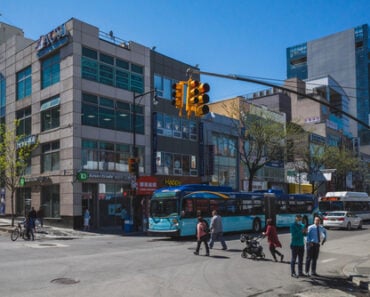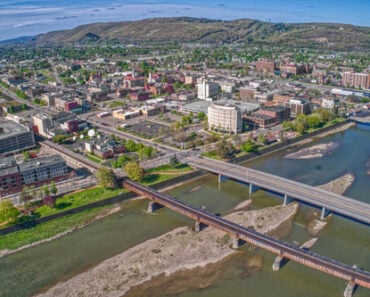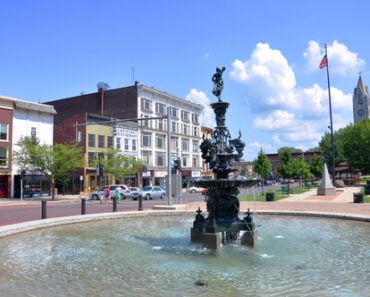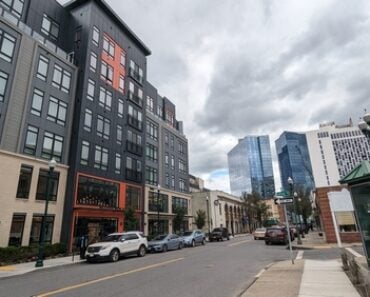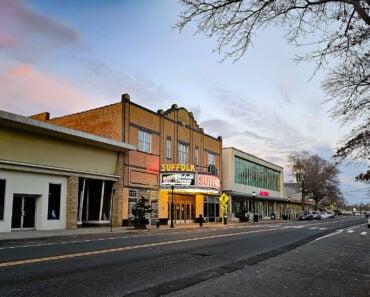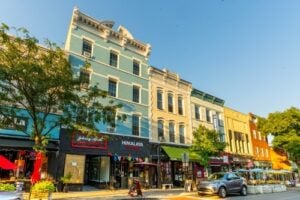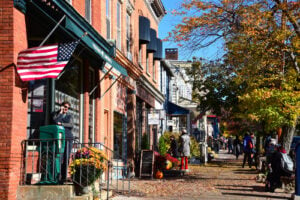
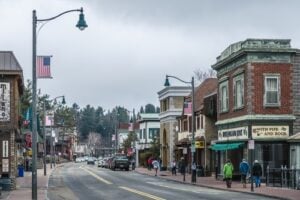
A view of Main Street in Lake Placid, New York, in April 2013. Photo: Conny Pokorny / Shutterstock.com.
A visitor walking along Main Street in Lake Placid sees reminders of the Olympics almost everywhere. There are displays recalling the 1932 and 1980 Winter Games, buildings associated with the athletes who competed here, and the speed skating oval beside the high school. With Mirror Lake just below the shops and the Adirondack High Peaks rising beyond the village, it is easy to understand why generations of competitors have been drawn to this part of Essex County.
But Lake Placid has produced more than winter athletes. A singer who became an international recording star grew up here. So did a future American ambassador. A fashion editor who later appeared in Old Navy commercials was born in the village, as was a woman who went on to edit one of the country’s most influential political magazines. The careers of these people took them to New York City, Washington, Europe, and Olympic venues around the world, but their Lake Placid connections are part of their stories.
That distinction is especially important in a resort community. Many celebrated Americans have vacationed in Lake Placid, maintained summer homes, or moved here after becoming famous. Those relationships are part of local history, but they are not the same as being born or raised here. This article focuses on people with documented early-life ties to the village. It also recognizes that Lake Placid’s sporting history stretches beyond the familiar 1980 American hockey victory. Some of the most interesting stories belong to residents whose achievements came decades earlier.
1. Lana Del Rey
Lana Del Rey, born Elizabeth Woolridge Grant in New York City in 1985, spent her childhood in Lake Placid after her family moved to the Adirondacks when she was very young. She attended St. Agnes School and sang in church. In interviews, she has recalled the village as a small, quiet place where much of her extended family lived nearby. Those are much more specific connections than the familiar shorthand that describes her simply as a New York singer.
As a teenager she left Lake Placid for boarding school in Connecticut. She later attended Fordham University and began performing around New York City, developing the musical and visual identity that eventually made her internationally famous. Her breakthrough album, Born to Die, arrived in 2012, followed by recordings including Ultraviolence, Norman F***ing Rockwell!, and Did You Know That There’s a Tunnel Under Ocean Blvd.
Her songs often examine memory, longing, American places, and the uneasy distance between dreams and everyday life. It would be too simple to claim that the Adirondacks explain her entire artistic outlook. Still, the Lake Placid years were formative. In a 2012 interview with GQ, Del Rey identified the village as her hometown and explained that she had not spent much time there since leaving for school at about fourteen.
2. Jack Shea
Jack Shea was a Lake Placid native who learned to skate on Mirror Lake and became one of the central figures of the village’s first Winter Olympics. He grew up at a time when the community was developing a reputation for winter sports, and he had the advantage of ice and local competition close to home. In 1929, he won a national all-distance speed skating championship on Mirror Lake itself.
At the 1932 Winter Games, held in his hometown, Shea won the men’s 500-meter and 1,500-meter speed skating races. He became the first American to win two gold medals at a single Winter Olympics. Winning on familiar ice, with local spectators watching, made him a hometown hero in a very literal sense. His victories gave Lake Placid an enduring place in the history of American speed skating.
Shea’s contribution did not end when his racing career did. He remained active in the community, worked in public service, and supported the effort that brought the Winter Games back to Lake Placid in 1980. His family extended the Olympic story across three generations: his son Jim competed in cross-country skiing in 1964, and his grandson Jim Shea Jr. won Olympic skeleton gold in 2002. Few families are as closely woven into the history of one American Olympic town.
3. Craig Wood
Golf champion Craig Wood was born in Lake Placid and grew up in an Adirondack environment better known today for its skiing and skating than for producing major golf winners. Wood was the son of a timber-company foreman, and accounts of his early life describe an outdoors-oriented upbringing. His powerful build and driving distance later earned him the nickname the Blond Bomber, but strength was only part of a career that also required extraordinary persistence.
For years, Wood was known as a golfer who came agonizingly close to winning major championships. He lost important playoff contests and appeared destined to be remembered for narrow defeats. In 1941, that reputation changed dramatically. He won the Masters and then the U.S. Open, becoming the first man to capture both championships in the same year. He also represented the United States in Ryder Cup competition.
Wood spent significant parts of his professional life as a club professional, including at Winged Foot in Westchester County. His achievements brought him induction into the World Golf Hall of Fame in 2008. For a village often associated almost exclusively with the Winter Olympics, his story is a reminder that Lake Placid also produced one of the notable American golfers of the twentieth century.
4. Art Devlin
Art Devlin was born in Lake Placid in 1922 and grew up around the ski jumps and winter-sports culture that helped establish the village’s international reputation. He became a talented ski jumper while still young, but World War II interrupted the years when he might have expected to compete. Devlin served in the military as a bomber crewman, flew combat missions, and received decorations including the Distinguished Flying Cross and the Purple Heart.
After the war he returned to jumping. He represented the United States at the 1952 Winter Olympics in Oslo and the 1956 Games in Cortina d’Ampezzo, finishing fifteenth and twenty-first respectively. He also placed fifth at the 1950 world championships held in Lake Placid. Those results established his sporting reputation, even though he never won an Olympic medal.
Devlin became nationally familiar in a second career, working as a television sports commentator for CBS and ABC. Back home, he operated Art Devlin’s Olympic Motor Inn and played an important role in the campaign to bring the 1980 Games to Lake Placid. His life connected three different versions of the village: the early ski-jumping community, the postwar television era, and the Olympic host town that millions of Americans watched in 1980.
5. Andrew Weibrecht
Andrew Weibrecht was born and raised in Lake Placid, where alpine skiing was not merely something to watch on television. He developed his skills in a community with access to major training facilities and a strong competitive culture. As a young skier, he came through the regional racing system before moving onto the international circuit. His hometown connection is documented by the New York State Olympic Regional Development Authority, which celebrated his Olympic achievements.
At the 2010 Winter Olympics in Vancouver, Weibrecht won the bronze medal in the men’s super-G, a high-speed event combining the demands of downhill racing with technically precise turns. Four years later, in Sochi, he exceeded many expectations by winning silver in the same event. The two medals made him one of Lake Placid’s most accomplished modern alpine racers.
Weibrecht’s career also reflected the physical and psychological pressures of international competition: injuries, demanding travel schedules, and the difficulty of sustaining peak performance across Olympic cycles. His success meant that Lake Placid could claim not only the famous skaters and bobsledders of its early history, but also an alpine medalist whose achievements belonged to a new century.
6. Hubert Stevens
John Hubert Stevens was born in Lake Placid in 1890, part of a family that became synonymous with the village’s early bobsled history. As a young man he played hockey and golf, studied engineering at Rensselaer Polytechnic Institute, and served during World War I. He later helped run the family hotel, a reminder that the local winter-sports scene grew alongside the businesses accommodating visitors.
At the 1932 Winter Olympics, Hubert drove a two-man bobsled with his brother Curtis. They won gold on their home track. Their victory became part of the lore surrounding Lake Placid’s first Games, including accounts of their unconventional preparation of sled runners. Hubert subsequently competed in the four-man event at the 1936 Olympics, and he accumulated national and North American bobsled championships.
He also took on work connected to the Whiteface Mountain Highway and the development of winter-sports facilities. That combination of athlete, hotel operator, and local development advocate reveals how intertwined the Olympics were with the economy of Lake Placid. Hubert Stevens did not arrive as an established star for a few days of competition; he helped build the local culture from which the sport drew its strength.
7. Curtis Stevens
Curtis Palmer Stevens, born in Lake Placid in 1898, was Hubert Stevens’s older brother and partner in the gold-medal two-man bobsled at the 1932 Winter Olympics. The brothers’ shared achievement deserves to be remembered, but they also had separate careers and interests. Curtis attended Rensselaer Polytechnic Institute and worked in the family’s hotel business, while also operating a local fuel and oil dealership.
His sporting interests were unusually broad. In addition to bobsledding, Curtis competed successfully in motorboat racing, including an international regatta in Cuba in 1929. Olympedia credits him with national and North American titles in bobsled competition. Those accomplishments show why he was more than a passenger on his brother’s sled: he was an established competitor with experience in several demanding sports.
In the 1932 Olympic two-man event, Curtis and Hubert defeated the other teams on the Lake Placid course and gave their hometown one of its defining gold-medal stories. Curtis remained tied to the region for decades. Viewed together, the Stevens brothers represent an era when local families could operate hotels, help promote outdoor recreation, and compete at the highest level of the sports their community hosted.
8. Frank Tyler
Francis William Tyler, generally known as Frank Tyler, was born in Lake Placid in 1904. He joined the Lake Placid Sno-Birds bobsled club, one of the organizations that made the Adirondack village a center of the sport. His life was also rooted in ordinary local work: he served as a police officer before later working as an insurance adjuster.
Tyler competed in the four-man bobsled at the 1936 Olympics, but his greatest success came after the war. At St. Moritz in 1948 he drove the American four-man crew to gold, joined by Bill D’Amico, Patrick Martin, and Ed Rimkus. The achievement gave Lake Placid another Olympic champion at a Winter Games held far from the Adirondacks, and it placed him among the country’s leading bobsled drivers of the period.
His later Olympic involvement took a different form. After losing amateur eligibility because of a commercial endorsement, he served as a bobsled coach rather than a competitor at the 1952 Games and was associated with the American team again in 1956. Tyler died later that year. His story captures an older sporting era, when the line between amateur competition, commercial work, and Olympic eligibility could profoundly affect an athlete’s career.
9. Carrie Donovan
Fashion editor Carrie Donovan was born in Lake Placid in 1928. Her name may be less familiar than that of a pop singer or Olympic champion, but millions of Americans eventually recognized her distinctive oversized glasses, black clothing, and exuberant personality. Long before those television appearances, Donovan had developed an early fascination with fashion. A widely published obituary recounts that, at age ten, she sent actress Jane Wyman her own clothing sketches and received a reply.
Donovan studied at Parsons School of Design and worked in fashion before moving into journalism. She became a writer and editor at The New York Times, Vogue, and Harper’s Bazaar, working in a field where personal style, access, and a strong editorial eye were vital professional tools. Her work brought her into contact with major designers and helped translate the world of fashion to newspaper and magazine readers.
In the 1990s she found a surprising second audience through Old Navy advertising, appearing in a series of memorable commercials with a dog named Magic. The campaigns made her an unlikely television personality late in life, but the fame rested on decades of experience in fashion publishing. Donovan is one of the clearest examples of someone born in this Adirondack village whose career developed in a world seemingly far removed from ski jumps and frozen lakes.
10. Freda Kirchwey
Freda Kirchwey was born in Lake Placid in 1893. Her father, George Washington Kirchwey, was a legal scholar and reformer, and she grew up in a family where public affairs were taken seriously. She later attended Horace Mann School and Barnard College in New York City. Her Lake Placid connection is documented as her birthplace; the historical record does not justify inventing years of political or journalistic training in the village itself.
After working in journalism, Kirchwey joined The Nation in 1918 and steadily assumed greater editorial responsibility. She became a leading voice at the magazine and eventually its editor and publisher. During the turbulent decades of the 1930s and 1940s, she used that position to argue about fascism, the New Deal, civil liberties, war, and American foreign policy. Her magazine could be controversial precisely because it took positions on matters of national importance.
Kirchwey’s long career illustrates another side of Upstate New York’s contributions to American public life. She did not become widely known because of the resort where she was born. She became known for shaping an influential editorial institution, defending positions she considered important, and participating in debates that reached far beyond her birthplace.
11. Bill Beaney
Bill Beaney is a Lake Placid native whose career made him one of the most successful coaches in American college hockey. Growing up in a village with a deeply established winter-sports culture helped connect him to the game early. He later played college hockey at the University of New Hampshire, serving as team captain, before moving into coaching.
Beaney began behind the bench at Bellows Free Academy in Vermont, where his teams won three consecutive state titles. After coaching at New England College, he took over Middlebury College’s men’s hockey program and built an extraordinary Division III dynasty. Under his leadership, Middlebury won eight NCAA national championships, including five in succession from 1995 through 1999. He completed his men’s hockey coaching career in 2015 with 602 victories overall.
His influence extended beyond the record book. USA Hockey has recognized Beaney for his work in player development, including the use of small-area games and teaching methods that encourage quick decisions under pressure. He also coached golf at Middlebury and received a USA Hockey Distinguished Achievement Award in 2024. His Lake Placid roots connect the village’s athletic reputation to decades of education and mentoring well beyond the Adirondacks.
12. Pete Sears
Gordon Peter “Pete” Sears was born and raised in Lake Placid in 1947. He played youth and high school hockey there, and later recalled watching the American men’s team win Olympic gold in 1960. That televised victory helped convince him that he wanted to wear the United States uniform himself. In a town with its own Olympic history, it was an especially powerful ambition.
Sears played goaltender at SUNY Oswego and earned All-American recognition. His path to the Olympics was not straightforward: he spent time in the Army, including service in Vietnam, before continuing his hockey career. He joined the United States roster for the 1972 Winter Olympics in Sapporo, when the team won silver. A detail often lost in brief sports biographies is that Olympedia lists him as a non-starter in the tournament. He was part of the medal-winning squad, but the record does not show him playing in an Olympic game.
After his playing career, Sears returned to the Oswego area, teaching history and coaching hockey for many years. His honors include induction into the New York State High School Hockey Hall of Fame. He represents a different kind of Lake Placid success story: not a single famous winning run, but a lifetime that joined military service, national-team hockey, classroom teaching, and coaching younger athletes.
13. John P. Desrocher
John Desrocher grew up in Lake Placid and graduated as valedictorian of Lake Placid High School in 1982. He has described the 1980 Winter Olympics, which took place when he was a teenager, as an experience that broadened his understanding of the world. Suddenly, the small village he knew was filled with visitors from other countries and people whose lives were very different from his own.
That encounter helped steer him toward international affairs. Desrocher pursued a career in the United States Foreign Service, taking diplomatic assignments around the world. In 2017, he became the U.S. ambassador to Algeria, serving until 2020. Unlike some people associated with Lake Placid through a vacation home or later career, Desrocher’s local connection is unambiguous: he grew up and went to school there.
North Country Public Radio interviewed him about the relationship between his hometown and his chosen profession. His story broadens the range of this list in a meaningful way. The same international gathering that made Lake Placid famous as a sporting destination also gave a local student an early glimpse of the work that would eventually define his diplomatic career.
14. Shirley W. Seney
Shirley Seney’s connection to Lake Placid began at an extraordinary moment. She was born on February 4, 1932, the opening day of the village’s first Winter Olympics. That coincidence became a fitting introduction to a life closely connected to local government, community organizations, and the effort to bring the Games back to the Adirondacks.
Seney was the only woman among the original 59 signers of Lake Placid’s agreement with the International Olympic Committee for the 1980 Winter Games. She also served on the local school board and village board. In 1993, she became Lake Placid’s first woman mayor and later served as supervisor of the Town of North Elba from 1996 to 2007. The offices were local rather than national, but they placed her in positions directly affecting the community’s daily life.
In 2014, the New York State Senate recognized Seney as a Woman of Distinction for her service. Her presence on this list recognizes an aspect of Lake Placid’s history often overshadowed by medal winners and international celebrities: the work of residents who organized events, served in elected office, and helped the village function in the years between Olympic celebrations.
15. James “Jim” Bickford Jr.
James John Bickford Jr. was born in Lake Placid in 1912 and attended school there. He later became one of the durable figures in American bobsledding, representing the United States at four Winter Olympic Games: 1936, 1948, 1952, and 1956. Few competitors from the early history of the sport remained active across so many Olympic cycles.
His most successful Olympic result came at St. Moritz in 1948, where he won bronze in the four-man bobsled event. Yet another honor distinguished him even beyond the medal: he carried the American flag at the opening ceremonies of both the 1952 and 1956 Winter Olympics. Olympic histories note how unusual it was for a competitor to be chosen twice for that ceremonial role.
Bickford’s life outside sport was equally grounded in the North Country. He served in the Marine Corps during World War II and worked for many years as a New York State forest ranger. His local schooling, long residence in the region, Olympic career, and work in the Adirondacks make him a particularly strong example of someone whose national achievements remained connected to his home community.
Why Lake Placid Has Produced So Many Notable People
There is no single explanation for the people who came out of Lake Placid. Some were born here and made their names elsewhere; others trained in a community where competition was part of ordinary life. The 1932 and 1980 Winter Olympics created opportunities for local athletes, coaches, officials, and young people who suddenly found their hometown at the center of an international event.
The village’s history is also broader than sports. Lana Del Rey spent her childhood here before pursuing music in New York City. Carrie Donovan and Freda Kirchwey entered influential forms of journalism. John Desrocher found an interest in international affairs, and Shirley Seney devoted much of her life to local public service. They are different people with different kinds of achievements, united by a place that played a real part in their earliest years.
For more about the region and its history, see our 25 Famous People From the Adirondacks and North Country and 25 Olympic Gold Medalists From Upstate New York.