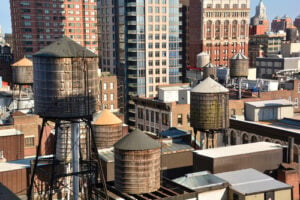
Traditional wooden water towers stand above New York City buildings, using gravity to help supply water to upper floors. Photo: Contributor365 Focus Photography / Shutterstock.com.
New York City buildings have wooden water towers on their roofs because the city’s street-level water pressure is not always strong enough to reach the upper floors. In a traditional system, a pump lifts water to a tank above the apartments. When someone turns on a faucet or takes a shower, gravity sends that stored water back down through the building’s pipes. The rooftop tank is there to provide a dependable source of water and pressure, not to decorate the skyline.
That simple answer explains one of New York’s most recognizable sights. Above the streets of Manhattan, Brooklyn, the Bronx, Queens, and Staten Island, round wooden tanks sit on steel frames, often with small conical roofs. They look old-fashioned beside modern glass towers, yet many are functioning pieces of infrastructure. The wood is deliberate, too: it is an economical, insulating material that can be assembled and maintained high above a busy street.
So why did New York adopt this arrangement, how do the tanks actually work, and why have they survived when other buildings use modern pumps? The answers connect everyday plumbing to the rise of the city’s tall buildings, the craftsmanship of barrel makers, and the practical advantages of letting gravity do part of the job.
Why Do NYC Buildings Need Water Towers on the Roof?
Most New Yorkers never have to think about the journey water makes before reaching a kitchen faucet. The city’s reservoirs, tunnels, and distribution mains provide an extraordinary amount of water, with gravity doing much of the work across the wider municipal system. Yet there is a difference between bringing water to a building and lifting it all the way to the highest occupied floor.
As a general rule, pressure in the street system can supply the lower floors of many buildings, commonly described as roughly the first five or six stories. That is an approximation, not a universal cutoff. Actual performance depends on local pressure, elevation, building height, piping, and the amount of water being used. Above the reach of adequate street pressure, a building requires additional equipment.
In the traditional rooftop-tank system, electric pumps move water upward through a dedicated pipe to the tank. A level-control mechanism tells the pumping system when the stored water has fallen and needs replenishing. The pumps do the difficult lifting in intervals; they do not have to start from scratch every time somebody opens a faucet. Once water is stored above the apartments, its elevation provides the pressure needed for downward distribution.
Gravity is the crucial part of the design. The greater the vertical distance between the tank’s water level and a fixture below, the greater the available pressure, although friction and the building’s plumbing arrangement affect what actually reaches the tap. Taller buildings may have separate pressure zones or pressure-regulating equipment to keep water delivery appropriate on different floors. A tank does not magically produce identical pressure everywhere in a building; it supplies the elevated water source from which the distribution system works.
How Do NYC Rooftop Water Towers Work?
Think about an apartment resident on an upper floor filling a glass of water. In a building served by a rooftop gravity tank, that water may already be sitting above the resident’s ceiling, several stories higher up. Opening the faucet allows it to travel downward through the building’s piping. When enough water has left the tank, the control system calls for the pumps to refill it.
The arrangement can reduce the need for pumps to run continuously at fluctuating demand. It also leaves some water physically stored in the building. That reserve can be valuable during a short interruption of pumping power, although the tank will not continue to refill without an operating supply system and its usable reserve is finite.
Some rooftop tanks also form part of a building’s fire-protection arrangement. Depending on the design, a tank may serve domestic drinking water, fire suppression, or a combination with water reserved for emergencies. It is important not to assume that every wooden tank has the same plumbing connections or that every gallon in it is available for both purposes. The building’s approved system determines how the water is used.
Why Are NYC Rooftop Water Towers Made of Wood?
From the street, a wooden tank can seem less advanced than a metal one. But choosing a construction material is not the same as choosing an architectural fashion. For many traditional rooftop installations, cedar and redwood have offered a workable combination of cost, durability, insulation, and ease of assembly. The wood’s natural insulating properties help moderate changes in water temperature during cold winters and hot summers. They do not eliminate the need to design and maintain the system for local weather conditions.
Wooden tanks can be fabricated as individual parts, transported to a roof, and assembled relatively quickly. Tank builders and building-maintenance specialists have also described wood as relatively economical to maintain or replace in this setting. Steel and other materials remain legitimate choices, especially where a particular building’s needs favor a different shape, location, capacity, or mechanical arrangement. Modern buildings may dispense with a conventional rooftop tank entirely and rely on booster pumps instead.
There is one popular explanation that needs correcting: a wooden tank does not make the weight of thousands of gallons of water disappear. Ten thousand U.S. gallons of water weigh more than 80,000 pounds before accounting for the tank, platform, and associated equipment. Changing the container material changes part of the structure’s weight, but the stored water remains the dominant load. Engineers must account for the filled tank and its supports regardless of whether the vessel is made from wood or metal.
For the buildings that already have the traditional support platforms and piping, the practical appeal of replacing an aging wooden tank with another wooden tank can be substantial. The result is a technology that survives not because New Yorkers refuse to modernize, but because replacing it with something more elaborate is not always necessary.
How Do Wooden Water Towers Stay Watertight?
A wooden rooftop tank is essentially a very large coopered barrel. Its curved walls are assembled from vertical wooden boards called staves. The pieces are shaped to fit closely against their neighbors, set around a circular base, and secured with strong metal hoops or bands. A covered roof keeps out rain, debris, and animals, while pipes and fittings allow water to enter, leave, and overflow safely when necessary.
The most interesting part happens after assembly. When a newly built wooden tank is first filled, a little water may seep between the dry boards. As the staves absorb moisture, they swell against one another and the surrounding hoops. That expansion closes the joints and helps make the barrel watertight. The principle is the same one traditional coopers used in much smaller barrels.
Accounts of tank construction often point out that the main water-holding joints can seal without chemical adhesive or nails driven through the walls. That does not mean an entire rooftop installation contains no metal fasteners. The bands, structural supports, pipe fittings, covers, access hardware, and safety equipment are all essential parts of a finished system. The elegance lies in using the movement of the wood itself as part of the seal.
Because these tanks are often assembled on the roof, logistics matter almost as much as carpentry. Precut staves and other components can travel in a freight elevator when they fit, while larger pieces may be lifted from outside the building. Crews must work around existing equipment, building access, and the need to restore the water supply promptly. There is no single rule that workers always climb the stairs carrying every plank or that cranes can never be used.
When Did New York City Start Using Rooftop Water Towers?
Before New York had its modern reservoir system, residents depended heavily on local wells and other sources that became increasingly unreliable as the city grew. Contaminated drinking water and the threat of destructive fires made a more dependable supply essential. The great change arrived in 1842, when the Old Croton Aqueduct began delivering water from the Croton River in Westchester County to Manhattan. Built largely around the principle of gravity, the system was one of the major public works achievements of nineteenth-century New York.
The new supply made a larger city possible, but another problem emerged as buildings grew taller. During the late nineteenth century, elevators, improved construction methods, and eventually steel-frame buildings allowed New Yorkers to occupy floors that ordinary water-main pressure could not adequately serve. The spread of indoor plumbing also meant that occupants expected water at sinks, baths, and toilets rather than at a pump or a common fixture downstairs.
Putting a storage tank high above the occupied floors offered a practical answer. Water could be pumped up when necessary and allowed to flow down when residents needed it. The solution was well suited to an existing trade: the city’s barrel makers already knew how to build large wooden containers capable of holding liquids. By the end of the nineteenth century, rooftop tanks had become closely associated with New York’s increasingly vertical buildings, and historic regulations reinforced their use. Today’s plumbing code permits other properly designed pressure-boosting systems, but the original arrangement has proved unusually durable.
Who Builds New York City’s Wooden Water Towers?
One reason the wooden water tower has remained so recognizable is that the trade has long been associated with a small group of specialist businesses. Rosenwach Tank Company, Isseks Brothers, and American Pipe & Tank are the names most frequently linked to New York’s traditional rooftop water tanks. Their work combines shop fabrication, carpentry, plumbing knowledge, and the unusual demands of construction high above a crowded city street.
Rosenwach’s story begins with barrel maker William Dalton, whose business expanded into water tanks as tall buildings multiplied. According to the Rosenwach Group’s own history, Dalton hired Harris Rosenwach in 1894. After Dalton’s death, Rosenwach acquired the business’s lumber, tools, and goodwill from his widow for $55. What began as a practical trade grew into a family enterprise identified with New York’s rooftops.
Isseks Brothers traces its beginnings to 1890, while American Pipe & Tank joined the industry in the early twentieth century. The firms have adapted to changing building practices, and their work is not limited to one unaltered nineteenth-century model. Still, the survival of specialist fabrication knowledge is significant. A skyline feature that appears anonymous from the sidewalk is the product of individual craftspeople and generations of practical experience.
How Much Water Can a Rooftop Water Tower Hold?
Many familiar rooftop tanks hold several thousand gallons, and capacities in the neighborhood of 5,000 to 10,000 gallons are commonly cited for traditional installations. Larger tanks also exist. Their size depends on the building’s water demand, required reserves, available rooftop space, and the engineering of the supporting structure. The visual similarity of two wooden tanks from street level does not mean they have the same capacity or serve the same number of residents.
The support structure is more than an architectural afterthought. Steel framing and other engineered supports transfer the weight of the filled tank into the building below. The tank must also be accessible for maintenance, with suitable covers, ladders, and safeguards. On a densely built New York block, installing or replacing it is a carefully organized construction job rather than an afternoon of ordinary barrel making.
A properly maintained wooden tank can remain in service for decades. Industry accounts give typical lifespans that vary from roughly twenty to thirty-five years, depending on its material, exposure, and upkeep. There is no automatic date on which every tank rots away. Wear, leakage, structural condition, and sanitary performance determine when repairs or replacement are needed.
Is Water From a NYC Rooftop Tank Safe to Drink?
It is easy to appreciate the silhouette of a rooftop tank without thinking about the drinking water inside. But a water tank is part of a public-health system, not simply a piece of outdoor equipment. Tanks that store drinking water must be protected against contamination from birds, insects, debris, and other environmental hazards. Their lids, screens, access points, and interior condition all matter.
New York City’s Department of Health and Mental Hygiene requires owners of covered drinking-water tanks to arrange an inspection at least once each calendar year. The inspection includes the tank’s physical and sanitary condition, and water samples must be tested for total coliform and E. coli bacteria. Reports are submitted under the city’s inspection program. The requirements apply to tanks used for drinking water, including qualifying dual-purpose tanks; a separate tank used only for fire suppression falls under different rules.
These requirements answer an understandable question: does storing drinking water in wood make the water unsafe? The tank material alone does not settle that issue. Proper construction, regular inspection, cleaning when needed, secure access, and water-quality testing are all necessary. An attractive old water tower should never be mistaken for a system that can simply be left unattended.
Why Doesn’t Every NYC Building Use Modern Pumps Instead?
Some modern buildings use pressure-boosting pumps to send water directly to upper floors, avoiding the need for a conventional rooftop storage barrel. New York City’s plumbing code allows approved alternatives when the public water main cannot provide the required pressure. This means rooftop wooden tanks are not a universal requirement for every new tall building.
Yet rooftop storage has an advantage that a pump-only arrangement may not share: water is already elevated and available to flow downward for a limited period if pumping stops. A city building-resilience study noted this feature when comparing gravity tanks with newer systems that depend more continuously on mechanical pressure. That does not make the old approach suitable for every high-rise, but it helps explain why engineers continue to consider stored water valuable.
The wooden tanks also remain part of New York’s architectural vocabulary. Their cylindrical forms and little roof caps soften otherwise hard-edged buildings, appearing in rooftop photographs, films, and street-level views between tall facades. They have become familiar enough that designers sometimes choose to keep them visible rather than hide them behind mechanical enclosures.
Why the Wooden Water Tower Remains Part of New York’s Skyline
New York City has replaced much of the machinery and infrastructure that shaped its nineteenth-century growth. Its streets, elevators, plumbing, and skyline have changed dramatically. The wooden rooftop water tank is a rare case in which a recognizable old design continues to perform much the same basic function: get water above the people who need it, then let gravity bring it back down.
There is a pleasing contrast in that arrangement. The city’s water may have traveled from a distant reservoir through an enormous system of engineered tunnels and mains, only to complete the last part of its journey through a wooden barrel high above a neighborhood street. The structure may look humble next to a glass tower, but it represents an enduring and remarkably practical chapter in New York’s engineering history.
For more on the city’s water supply, read our history of New York City tap water and the Croton Aqueduct. Another related landmark is the Highbridge Water Tower, featured in our guide to hidden gems in Manhattan; unlike the small rooftop tanks, that historic stone tower was part of the city’s larger water-distribution infrastructure.