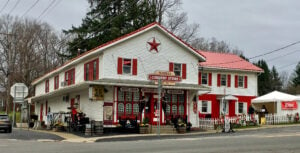
The historic Marilla Country Store in Erie County, New York, established in 1851. Photo by Andre Carrotflower / Wikimedia Commons, CC BY-SA 4.0. Cropped from original.
There was a time when the general store could tell you almost everything you needed to know about a small New York town. The shelves held flour and coffee, work clothes and nails, fishing supplies and candy. Customers stopped for what they needed, but they also came for news. In places where farms, mills, mountain camps, and villages were separated by miles of country road, the general store often became the closest thing a community had to a common meeting room.
Many of those stores disappeared as supermarkets, chain retailers, and shopping centers changed the way New Yorkers bought everyday necessities. Others survived by adapting. Some still sell groceries and hardware; some have added cafés, handmade gifts, books, or locally produced food. A few operate in buildings that have held stores since the nineteenth century, although the businesses inside them have changed hands or even closed for a period before reopening.
The fifteen places below are genuine businesses with documented histories and evidence of recent operation, rather than attractive old storefronts that no longer function as stores. They range from the Adirondacks and the Finger Lakes to Western New York, the Catskills, and the Hudson Valley. Two are traditional five-and-dime variety stores, included because their broad mix of household goods, toys, candy, and everyday merchandise carries on much of the same shopping tradition. Where a store is seasonal, has reopened after a closure, or faces an ownership change, that distinction matters and is noted. These are not all uninterrupted businesses dating back to their buildings’ construction.
1. Marilla Country Store — Marilla, Erie County
Marilla Country Store has the kind of history that most modern retailers can only imagine. Established in 1851, it has survived the arrival of railroads, automobiles, shopping malls, and online retail while continuing to serve its corner of rural Erie County. Its location at Bullis and Two Rod roads still recalls the period when country crossroads were natural places for a merchant to sell necessities to nearby farming families.
In 2026, the store celebrated its 175th anniversary. Local reporting introduced co-owner Sandy Grunzweig and described a business still selling groceries, deli food, and the bulk spices for which it has become known. The store has remained in the hands of only a small number of families over its long life. Its shelves may have changed, but its importance as a place where neighbors stop and talk helps explain how a nineteenth-century country business can remain relevant in the twenty-first. The anniversary received recognition in the Congressional Record and coverage by Buffalo-area public media.
2. Adirondack General Store — Adirondack, Essex County
Despite its association with Schroon Lake, the Adirondack General Store is in the hamlet of Adirondack on East Shore Drive, not in the village of Schroon Lake. It traces its beginnings to 1855, when a mercantile business served the people living and working around the eastern shore of the lake. For generations, establishments like this supplied remote Adirondack communities whose residents could not simply drive to a large shopping center.
The present store combines groceries and supplies with a deli, café, local crafts, and Adirondack souvenirs. It remains an especially useful stop for seasonal residents and travelers. There is an important current detail: the store announced that it had finished its 2026 season and expected to reopen on May 1, 2027. Its owners also advertised the historic business and property for sale in 2026. Those developments should not be confused with a permanent closing; the store’s own website describes a seasonal shutdown and a planned return.
3. Russell’s General Store — Bovina Center, Delaware County
Russell’s General Store is part of the identity of Bovina Center, a Catskills hamlet where farming and small-town commerce have been intertwined for generations. The Russell family became associated with the store on January 1, 1919, when Cecil Russell purchased it. He operated it for decades, and his daughter Marjorie later carried on the family connection. The store’s old-fashioned appearance, including its long-familiar gasoline pump, became a recognizable part of the community.
Today the Bovina Historical Society owns the property, and changing leaseholders have continued to operate the business. Rather than being preserved as an empty historic room, Russell’s offers food and everyday goods, including sandwiches and grocery items. Delaware County tourism materials and the Bovina Library’s summer 2026 newsletter both document its continued place in village life. This is an example of a store surviving through a change in ownership arrangements while retaining its original importance as a place for people to meet.
4. Old Chatham Country Store — Old Chatham, Columbia County
The Old Chatham Country Store stands in a rural Columbia County community where the general store has long been a gathering place. Its operators trace the business’s local history to 1786. Historical property records supplied to the Town of Chatham document successive owners of the store property from the nineteenth century onward, showing how many families have been connected with the location. Those records are especially valuable because an old building and an uninterrupted business are not automatically the same thing.
The current store has become a combination of country market, café, and restaurant, with an emphasis on regional farms, baked goods, and meals. Its website lists regular daytime service and evening meals on selected days. The dining operation represents a modern adaptation of the village-store tradition, not proof that the merchandise or management has remained unchanged for more than two centuries. What persists is the location’s role as a place to buy food, encounter neighbors, and participate in the life of Old Chatham.
5. Canal Towne Emporium — Wurtsboro, Sullivan County
The story of Canal Towne Emporium begins long before the business acquired its present name. According to the store’s own history, H. R. Morris built the property in 1839 and operated a general store there. Its location in Wurtsboro placed it near the Delaware and Hudson Canal, a transportation route that helped carry coal and other freight through the region. Later owners, including members of the Holmes family, expanded the operation and sold groceries, household merchandise, and goods associated with canal traffic.
The old business ceased operating in 1958, and the building remained vacant for years. Doris Holmes revived it in 1976 as Canal Towne Emporium, restoring period details and developing a new retail identity built around gifts, crafts, country furniture, and specialty foods. Today the business advertises regular operating hours at 107 Sullivan Street. Its nineteenth-century building and preserved fixtures are important parts of its appeal, but the present-day business dates from 1976 rather than representing continuous operation since 1839.
6. Old Forge Hardware — Old Forge, Herkimer County
Old Forge Hardware calls itself the Adirondacks’ most general store, and the description makes sense once you look beyond its name. Moses Cohen began selling hardware in Old Forge around 1900 and returned the following year with the intention of opening a permanent business. He purchased a prominent corner lot in 1902, helping establish a store that supplied residents, summer camps, and hotels with goods they otherwise might have needed to order from Utica.
The original store building was destroyed by fire in 1922. The business reopened in a new building in 1923 and grew through generations of owners and managers. Today its inventory extends far beyond tools: household supplies, outdoor gear, art materials, clothing, local foods, and Adirondack gifts appear alongside ordinary hardware. The store’s own historical account documents both the interruption caused by the fire and the enterprise’s revival. Its active retail website and published hours confirm that the name remains part of Old Forge’s commercial life.
7. Schroon Lake Department Store — Schroon Lake, Essex County
On Main Street in Schroon Lake, the Schroon Lake Department Store occupies a building with a retail history stretching back more than 140 years. Previously known as the Towne Store, it represents a different part of the Adirondacks’ general-store tradition from the Adirondack General Store on the lake’s eastern shore. The town’s Main Street businesses historically served both year-round households and people arriving for summer holidays.
The current owners, Ryan and Amanda, took over in 2023 and have spoken about preserving aspects of the building while adapting the business for contemporary customers. The Schroon Lake Chamber of Commerce still lists it as a family-owned shop at 1089 Main Street. The specific business name and ownership have changed over time, so the building’s age should not be confused with a claim of continuous operation under the present name. Its continued use as a general-merchandise store is what makes the historic property worth including.
8. Northville 5 & 10 — Northville, Fulton County
The Northville 5 & 10 belongs to a nearly vanished class of American retailer: the old-fashioned variety store where a shopper might find sewing supplies, toys, dishes, hardware, candy, and souvenirs in one visit. The business was founded in 1907 and moved to its long-standing South Main Street location in 1914. Its survival is particularly striking because the five-and-dime category once included powerful chains whose names have largely disappeared from shopping districts.
Later owners invested in renovating the store while keeping many of its historic details, including old wood floors and decorative ceilings. The merchandise now includes Adirondack gifts and homemade fudge as well as the practical goods that bring local shoppers through the door. The Fulton Montgomery Regional Chamber of Commerce continues to list the business at 122 South Main Street and identifies it as a historic retail attraction. It is a variety store rather than a nineteenth-century rural general store, but its commercial role and century-long history belong in this conversation.
9. Raquette Lake Supply Company — Raquette Lake, Hamilton County
A general store in an isolated Adirondack lake community had to be more than a place to buy souvenirs. It supplied groceries, fuel, hardware, and the things needed by residents and visitors whose travel might depend on boats and difficult roads. Raquette Lake Supply Company developed in exactly that setting. A historic marker researched by the William G. Pomeroy Foundation places its beginnings at Long Point around 1891, followed by a move to its present area around 1900. Modern store materials describe the establishment as dating to 1908, so the precise founding year depends on which stage of its history is being counted.
Fire damaged the business in 1908, and a far more destructive fire in 1927 led to a rebuilding in 1928. The store remains an active source of groceries and supplies, with seasonal merchandise, fishing necessities, propane, and other practical items. The Raquette Lake community website publishes current store information and seasonal hours, while North Country Public Radio has documented its daily role in the village. The store is one of the strongest examples of a true Adirondack general store in this article.
10. Circle W Market — Palenville, Greene County
Circle W opened in Palenville in 1908, serving a Catskills hamlet whose economy included quarry workers, summer visitors, artists, and people attracted to nearby mountain scenery. At one time, a customer could buy everything from work clothing and paint to groceries and fishing equipment. That broad inventory made the store useful to very different kinds of customers living in or passing through the Kaaterskill Clove area.
The store did not operate continuously for its entire history. It closed during the 1990s, and the property deteriorated before Patti and Gary Harvey purchased and restored it in 2009. Family members later continued the business, which now combines groceries, coffee, sandwiches, and locally made goods. The market’s own website provides its 1908 history and current Palenville hours. Circle W is a worthwhile survivor precisely because its revival prevented an old general-store location from disappearing, not because its doors were open without interruption.
11. Vidler’s 5 & 10 — East Aurora, Erie County
Walking into Vidler’s on East Aurora’s Main Street recalls an era when the five-and-dime variety store was a standard feature of American shopping districts. Founded by Robert Vidler in 1930, the family business expanded through neighboring storefronts and developed an enormous assortment of candy, toys, kitchen equipment, cards, seasonal decorations, and unusual household items. Customers can still spend considerable time exploring the connected buildings and their many departments.
Vidler’s has continued operating under family ownership, although its current owners have publicly discussed retirement and their hope of finding someone to carry on the business. The store’s website explicitly says it is not closing and publishes regular hours. The distinction is important: a business offered for sale is not necessarily a business that has closed. Vidler’s also shows why old five-and-dime stores deserve a place alongside country general stores. Both traditions were built on having a little of almost everything available in one familiar local shop.
12. Kelly’s Country Store — Grand Island, Erie County
Kelly’s Country Store began in 1962, when Walter and Grace Kelly turned their experience selling candy and small goods at festivals into a permanent Grand Island business. Its original space was modest, but the family gradually expanded the store and its reputation. The Kelly name became associated with chocolates, candy, gifts, and the kind of shopping trip that appealed to families looking for something more personal than a chain-store visit.
Kelly’s remains family-owned across multiple generations and operates at 3121 Grand Island Boulevard. Its current website posts daily hours and describes both the merchandise and the company’s history. By the standards of an eighteenth- or nineteenth-century country store, Kelly’s is a younger business, but more than six decades of family retailing is a meaningful record. Its evolution into a candy-and-gift destination also demonstrates how long-established independent shops sometimes find a specialty that keeps people returning.
13. Hoss’s Country Corner — Long Lake, Hamilton County
Hoss’s Country Corner is familiar to generations of Adirondack travelers. The business under its present identity dates to 1972, when the Hosley family purchased an existing general store in Long Lake. That makes its modern family history more than half a century old, while the location’s store tradition extends further back. The building’s many rooms and rambling arrangement became part of its appeal, along with the unusual sight of a living tree incorporated into the structure.
Hoss’s has preserved the broad inventory that makes a general store indispensable in a mountain town. Books, maps, tackle, groceries, camping equipment, outdoor clothing, local cheese, and gifts all appear in its present offerings. North Country Public Radio has documented both the store’s long community connections and stories from employees who worked there decades ago. The store’s current website advertises year-round service, making it a functioning retailer rather than simply a nostalgic tourist attraction.
14. Fly Creek General Store — Fly Creek, Otsego County
Fly Creek General Store serves a small community outside Cooperstown where one shop can still become a place for neighbors to gather over breakfast and coffee. Its history reaches back through different owners and names. An obituary in the local press records the Foster family’s operation of the Fly Creek General Store during the early twentieth century, while later accounts refer to the business under the Aufmuth name before Tom Bouton took it over. That history establishes a longstanding local store tradition without requiring an unsupported exact founding date.
More recent descriptions emphasize the store’s deli, breakfast food, groceries, and informal social life. Local reporting in 2021 described people stopping in for sandwiches and morning meals, and community publications continued listing the store in 2025. Its New York grocery license has also been renewed through 2027. A store like this is easy to overlook if the only thing one notices is the gas pump or roadside convenience, but the social routines around its counter are precisely the traditions that made general stores important to rural New York.
15. The Olde Country Store and More — North Cohocton, Steuben County
At the North Cohocton crossroads, a store has occupied the site since 1849, although the present building dates to 1873. The Olde Country Store and More has become particularly well known for its old-fashioned sweets, glass candy jars, woodwork, and merchandise that recalls the shopping experience of earlier generations. Its history has also included interruptions. The location stood closed for years before sisters Jenny and Denise Wells reopened it in 2015 and turned it into a destination for visitors to the Finger Lakes region.
The store entered a period of uncertainty in 2026. Its owners announced that they hoped to sell the business before returning to Germany and had considered a going-out-of-business sale if no buyer emerged. On September 1, they announced that they had signed a purchase agreement, and reporting published October 29 described the operation as preparing for a transition to new owners. The sale had not yet been confirmed as complete at that report’s publication. For that reason, this is the one entry whose current ownership and visiting arrangements especially warrant a direct check before making a trip. Its inclusion recognizes the documented effort to keep the historic store operating, not a guarantee that the ownership transition has finished.
What Keeps an Old General Store Alive?
These stores have not all survived in the same way. Marilla Country Store and Vidler’s retain unusually long family and retail traditions. The Adirondack and Raquette Lake stores still supply communities where distance and seasonal travel matter. Circle W Market and Canal Towne Emporium returned after periods of closure, while the Old Chatham Country Store found new life through food and a local gathering space. Old Forge Hardware and Hoss’s Country Corner have kept a broad assortment of goods that makes the word “general” seem especially appropriate.
The differences matter because an old building alone does not make a historic business, and the word “continuous” should never be applied to a store that closed for years before reopening. What these places share is a tangible link to a form of commerce that shaped small towns across Upstate New York. They may no longer be the only places to buy groceries, tools, or candy, but they remain places where the act of shopping still carries a sense of local history.
For more New York retail history, explore 25 classic Long Island hardware and home improvement stores and our article on the historic St. James General Store on Long Island. The latter is outside the Upstate region covered in this list, but it provides another fascinating example of the general-store tradition.